
An awning solves one problem and creates three others. It throws shade over your camp, and then it leaves you sitting in that shade with wind driving rain sideways under the fabric, dust blowing through from the side, and mosquitoes finding every gap between the leg and the ground.
That is the entire argument for awning walls for overland camping. A wall panel is the cheapest way to take the shelter you already own and make it usable in weather the awning alone cannot handle. You do not buy a second awning, and you do not give up the open shade you love on dry desert nights. You zip or Velcro fabric onto the awning legs, stake the bottom hem, and close the last seam.
We compared 10 wall kits, side walls and full awning rooms for this roundup, and the pattern that surprised us most was how much of the buying decision happens before the price ever matters. Fit is the first blocker. A wall that does not match your awning rail, your awning width and your vehicle geometry is a tarp, not a product. So every review below opens with a compatibility verdict: which awning it fits, which it does not, and what kind of terrain it suits.
The second thing worth knowing before you read on is the format. Side wall kits give you one or two panels. Enclosures give you three or four. Annex rooms give you a full tented box with a floor and a door. Those are three very different purchases at three very different weights, and a lot of people buy a two-panel kit expecting a room.
Table of Contents
Top 3 Awning Wall Picks for Overland Camping in 2026

ARB Awning Room 2500×2500
- Fits ARB 2500x2500 awning
- 300D Oxford polyester
- Mesh roof and midge-proof side panels

ALL-TOP Multi-Side Awning Wall
- Universal front or side panel
- 280gsm ripstop polycotton
- Sail track and hook-and-loop attachment

ALL-TOP Awning Room with Floor
- Fits 6.6 x 8.2ft awnings
- 210D Oxford with PU 3000mm
- Five-minute single-person setup
Our overall pick is the ARB Awning Room, and the margin is not close. It carries 851 ratings, far more owner history than anything else we reviewed, which means its weaknesses are known and its strengths are proven rather than advertised. The ALL-TOP Multi-Side Wall takes the highest star rating we found and fits far more awnings than anything else here. The ALL-TOP Awning Room encloses the most volume in the set if you want a full box rather than panels.
Best Awning Walls at a Glance in 2026
| Product | Specifications | Action |
|---|---|---|
| ARB Awning Room 2500×2500 |
|
Check Latest Price |
| ALL-TOP Awning Room with Floor |
|
Check Latest Price |
| ALL-TOP Multi-Side Awning Wall |
|
Check Latest Price |
 OVS Nomadic 270 Wall 3 Driver Side OVS Nomadic 270 Wall 3 Driver Side |
|
Check Latest Price |
 Rough Country 270 Wall Enclosure Rough Country 270 Wall Enclosure |
|
Check Latest Price |
 OVS Nomadic 270 LTE Walls 1 and 2 OVS Nomadic 270 LTE Walls 1 and 2 |
|
Check Latest Price |
 OVS Nomadic 180 Awning Wall OVS Nomadic 180 Awning Wall |
|
Check Latest Price |
 Tuff Stuff Shade Wall 4.5 x 6ft Tuff Stuff Shade Wall 4.5 x 6ft |
|
Check Latest Price |
 Smittybilt 270 Walls Driver Side Smittybilt 270 Walls Driver Side |
|
Check Latest Price |
 OVS Nomadic 270 Side Wall 2 OVS Nomadic 270 Side Wall 2 |
|
Check Latest Price |
Most of these ten are built for one named awning system, and the two that are not depend entirely on a size match rather than a rail profile. That is why every review below opens with a compatibility verdict, and why we cover the fitting process in detail further down.
What Are Awning Walls?
Awning walls are zip-on or hook-and-loop fabric panels that attach to the legs of a vehicle-mounted 180-degree or 270-degree awning, turning open shade into an enclosed shelter that blocks wind, rain, sun and insects. Each panel has a reinforced hem that runs the full length of an awning leg, so it slides on in a couple of minutes, gets tensioned at the bottom with stake loops or ground anchors, and then has its seam rolled or snapped shut.
That last detail is the difference between a wall and a tarp. A tarp needs its own frame. A wall borrows the awning legs it already has, which is why the attachment method matters so much. Zipper rails make a tighter, faster seal. Hook-and-loop strips are quicker to roll back and forth but never fully airtight. Poles give you a free-standing panel with no ground anchor at all, at the cost of weight and pack bulk.
Walls also change the thermal picture. Shade under fabric cuts solar gain, but a fully enclosed box loses airflow and generates condensation on the inside of the fabric overnight. Run one wall rolled up and one closed if you are sleeping in it, and you keep the airflow without giving up the wind break.
1. ARB Awning Room for the 2500x2500mm Awning – Full Tent Room with Mesh Roof
- Most reviewed awning room in the set with 851 ratings
- Stands a 6 foot 2 inch adult upright inside
- Cross-flow mesh roof and midge-proof mesh sides
- One-person pitch
- Kept interior dry through strong gusts and rain
- Square shape leaves side panels slack on wider vehicles
- Does not seal against non-metal vehicle bodies
- Repacking into the stuff sack is fiddly
Compatibility verdict: this room only works with the ARB 2500x2500mm awning, part numbers 814410, 814411, 814412A and 814108. The awning is not included. If your rack carries any other brand of awning, skip this section entirely and read on.
The owner feedback on this room is deeper than anything else we reviewed, and the recurring description is a shelter that goes up faster than the awning it hangs from, because it attaches to the awning poles with heavy-duty nylon hooks rather than needing its own structure.
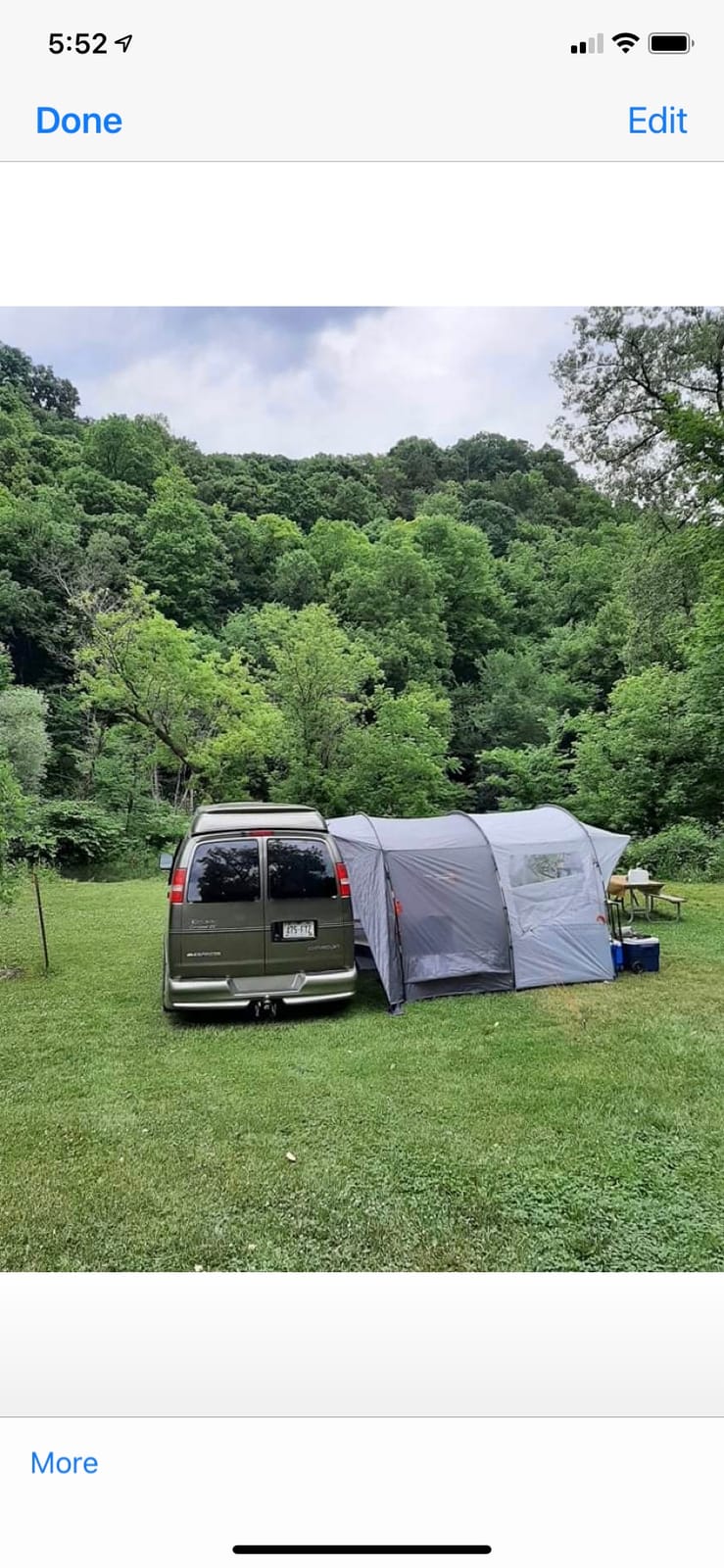
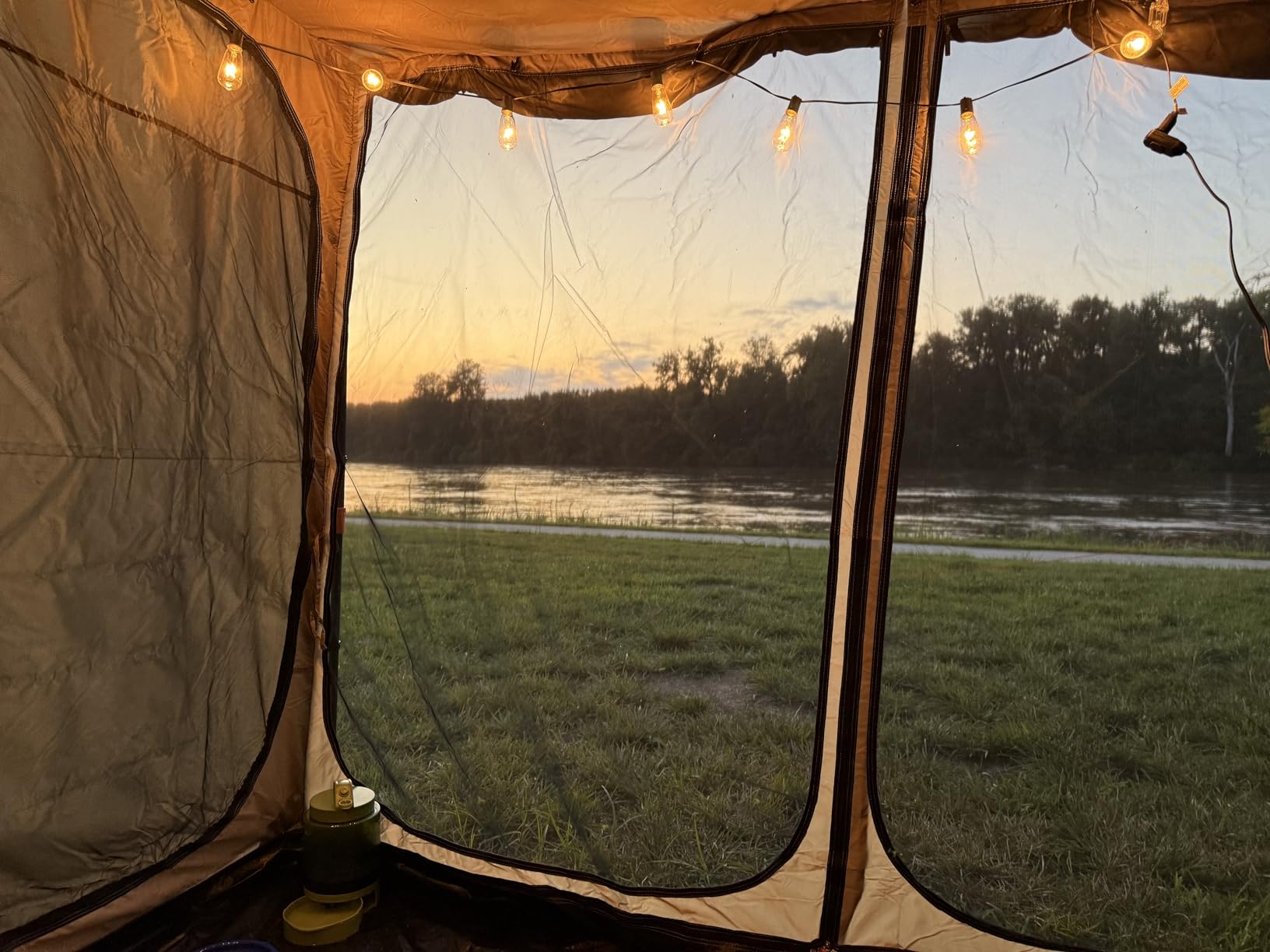
Headroom is the number that surprises people. Owners report standing a 6 foot 2 inch adult upright inside and sleeping three on a mattress across the 67.24 square foot polyethylene floor. The cross-flow mesh roof has a clear panel in the middle, which means awning-mounted LED lighting still throws light onto the ceiling rather than being blocked by solid fabric.
The mesh side panels are the reason this room works in places with midges and mosquitoes. They zip closed for full bug protection, or roll open for airflow, which makes the room usable as a changing area or a shower stall without turning into a sauna. The 300D Oxford polyester exterior is UV treated, and seams have held through strong wind gusts and rain according to owners.
What you need to know before buying
The square footprint is the catch. ARB makes one room size, and on a long or narrow vehicle the side panels do not pull fully taut, which means flapping in wind. It is not a failure, but it is audible on a windy night and it is the most common complaint we found.
The second catch is the vehicle-side seal. Fiberglass and composite body panels do not bond to fabric the way metal does, so insects can find a gap along the body. The included pegs are basic wire types with modest holding power, and we would upgrade those before anything else. Attaching it also takes two people, because one end slides into the awning mount rather than clipping on.
Who should skip it
Skip this if you do not own an ARB 2500x2500mm awning, because there is no adapter. Skip it if you need a very low packed weight for a rack that is already carrying recovery gear, and consider a panel instead.
Buy it if you want a genuine standing-height sleeping and changing room with bug protection and rain sealing, and if you camp in places where being dry at 2am is worth a larger packed bag.
2. ALL-TOP Awning Room with Floor – 357 cu ft Double-Layer Shelter
- Roughly five-minute single-person setup
- Double-layer build held up in strong wind
- Stitching and zippers clean for the tier
- Removable PVC floor
- Skylight panel in the roof
- Rear access needs the awning mounted far forward
- Tall rigid box pools water at the centre
- Needs extra support for snow load
Compatibility verdict: this room fits 6.6 by 8.2 foot vehicle awnings, and the awning and poles are not included. The brand recommends its own 6.6 by 8.2 foot awning. It will not fit a 270 batwing.
When you want an enclosure rather than panels, this is the volume you get. The room encloses 357 cubic feet at 8.2 feet long by 6.6 feet wide by 6.6 feet high, and the whole thing goes up in about five minutes with one person using slide-in ends and hooks. Owners running teardrop and trailer campers report the double-wall construction holding up in genuinely strong wind.
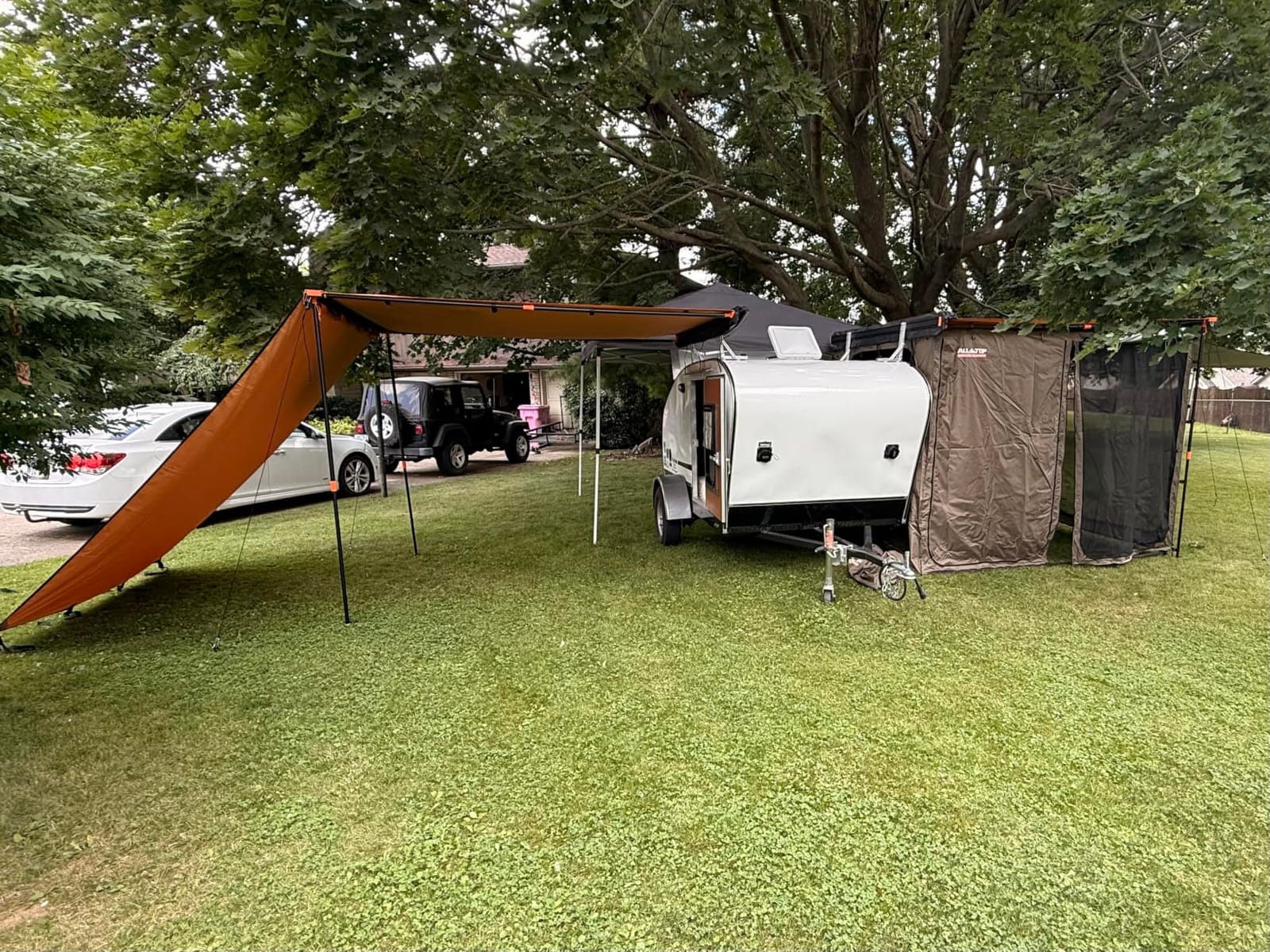
The fabric stack is the reason it punches above its tier: a 210D Oxford outer with PU 3000mm waterproofing and UV 50+ resistance, a black coating for privacy from the outside, and a full inner layer of nylon mesh. There are four roll-up side doors plus front and rear doors, and the PVC floor unzips completely for removal, which cuts pack weight and cleanup time when the ground is dry.
The large end panel is a genuinely useful trick. Owners prop it out with poles and use it as an extra awning, which turns the rear of the enclosure into a shaded working or cooking area rather than a wall you stare at.
Geometry and drainage are the two things to plan for
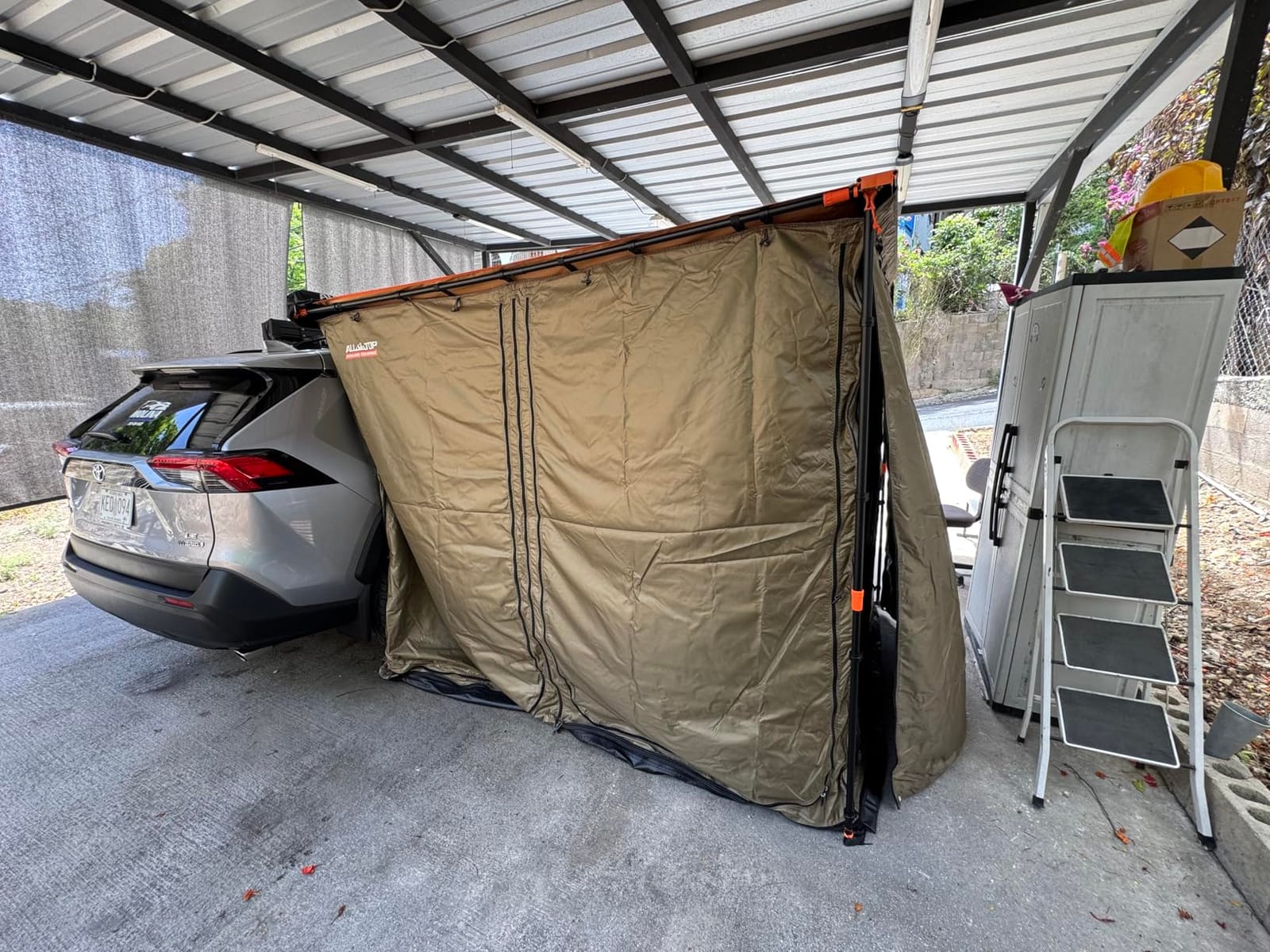
Rear vehicle access on this room means the awning has to be mounted fairly far forward on the vehicle. If your awning mount sits close to the rear, the opening will not line up with your tailgate or rear door, and that is the single most common mismatch reported by owners.
The second planning point is drainage. This is a tall, rigid box, which means it cannot be tilted to shed heavy rain the way a lean-to can. Water collects toward the centre, so you need to push the fabric up from underneath to drain it. The same geometry means snow load can pull on the centre zipper unless you add support poles or a crossbar. One owner also reported a small hole in the removable floor after pitching on grass over a rock.
Who should skip it
Skip it if you camp in heavy monsoon rain, because the drainage behaviour will drive you mad, and skip it if you plan to run a rear access door from a rear-mounted awning. All-or-nothing tarp panels also mean less partial ventilation than a Velcro-based shelter, where you can peel back one strip.
Buy it if you want a full blacked-out, bug-proof, rain-rated room with a door on both ends, and you camp on ground soft enough to spare the floor.
3. ALL-TOP Multi-Side Awning Wall – Universal Panel for Front or Side
- Highest star rating in the set at 4.9
- Works as a front wall side wall or extension
- Sail track plus hook-and-loop fits a very wide range of awnings
- Sewn-in straps for angling
- Includes four heavy-duty stakes
- A support pole is required to use it as an extension
- Only a partial enclosure on its own
- Color match is best against ALL-TOP awnings
Compatibility verdict: this is the only genuinely universal panel in the roundup. It fits awnings of 4.6, 6.6, 8.2 and 10 foot lengths because it attaches two ways at once, through a sail track slider and a hook-and-loop fastener. A pre-installed awning is required. Awning and support poles are not included.
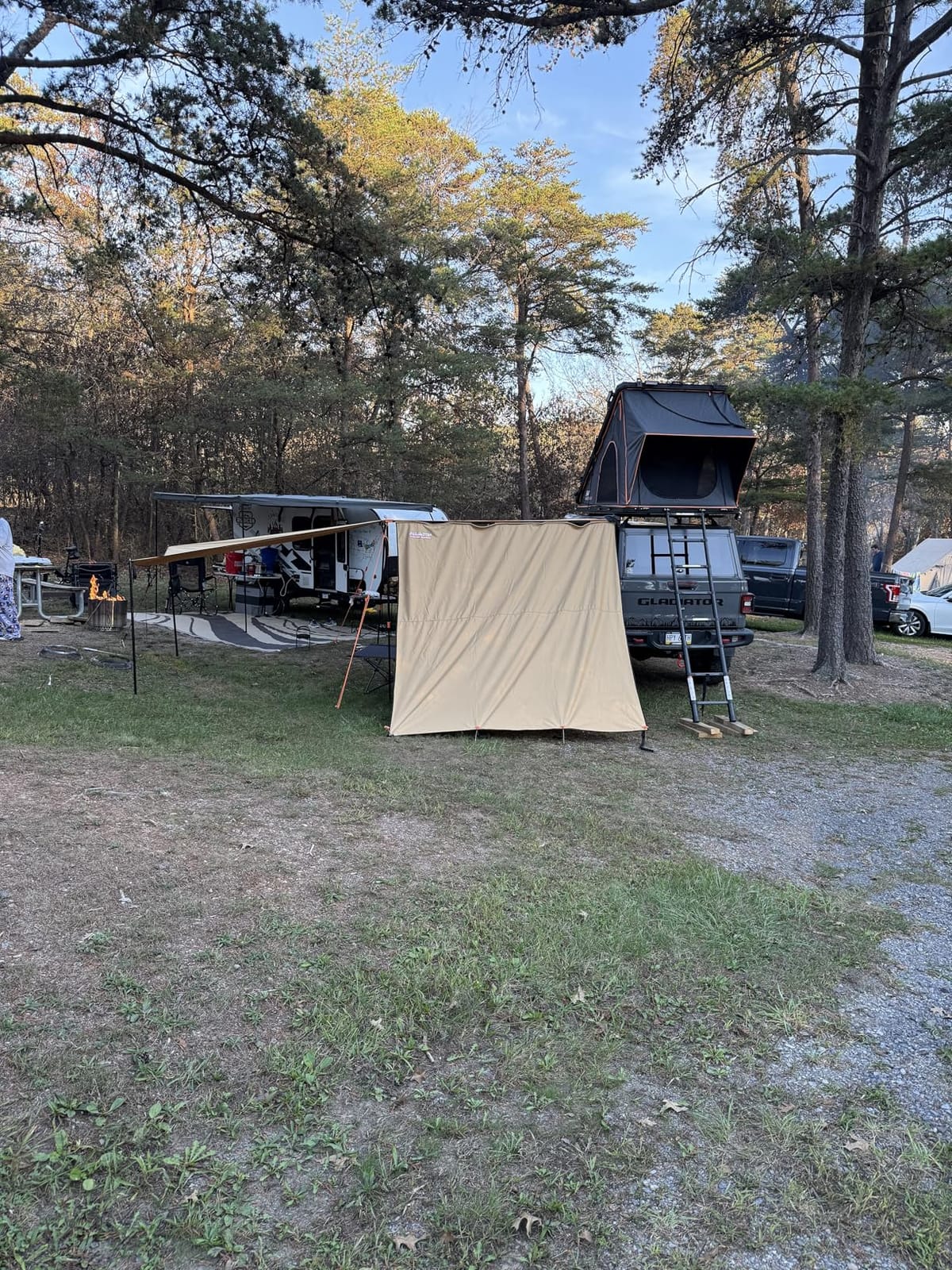
It carries the highest star rating in the set at 4.9 across 38 ratings, and the design explains why. A panel that can be a front wall closes the open end of a 180 awning. The same panel angled along a 270 blocks the sun on the low western side. Owners with two of them report buying a third to close all sides, which is the intended pattern here.
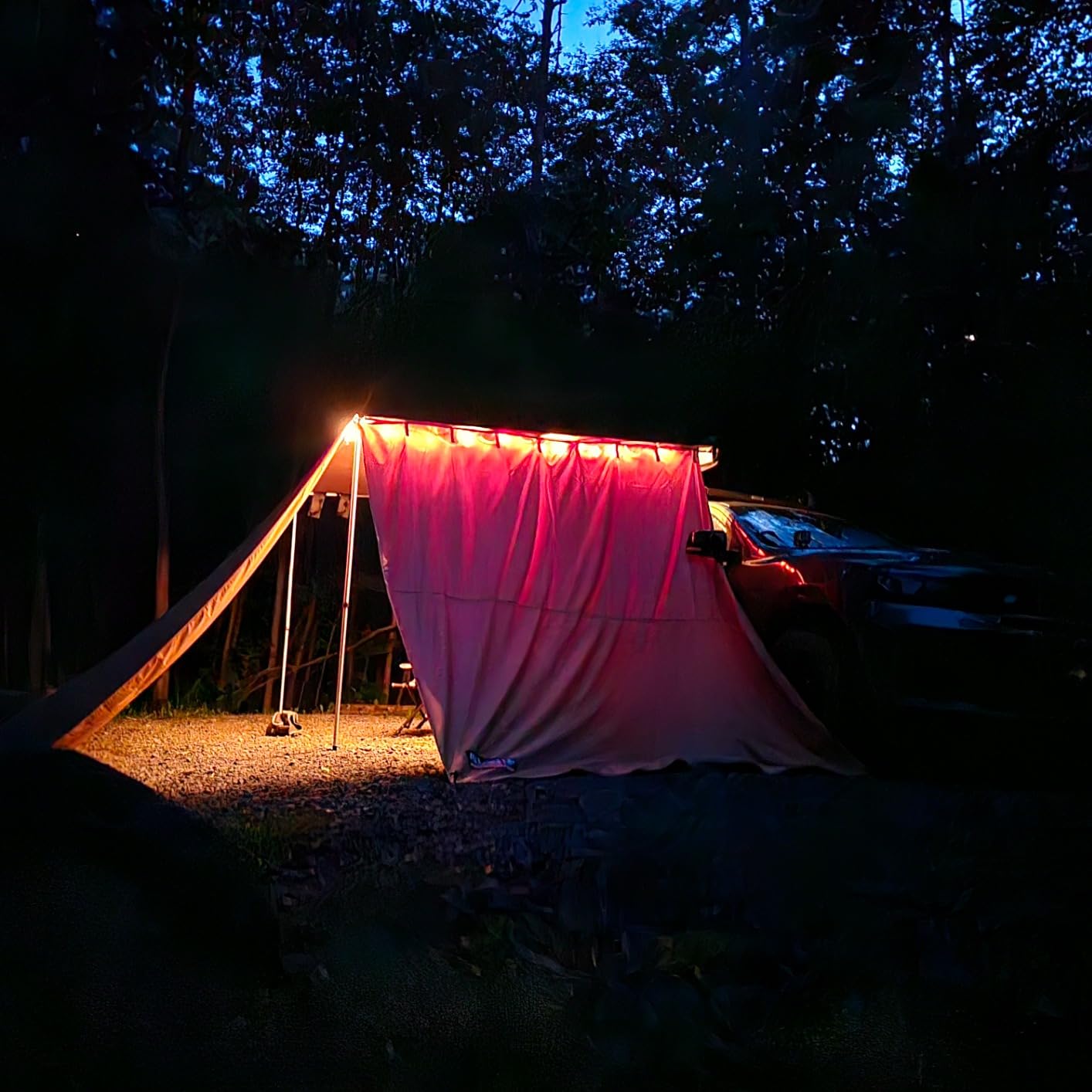
The fabric is 280gsm ripstop polycotton with a waterproof PU coating and UV resistance. At 280gsm with a PU coating, this is a different material family from the Oxford panels in this roundup, and in trade the poly-cotton blocks wind better while breathing slightly more than a coated polyester. Sewn-in adjustable straps let you angle the panel with the supplied stakes instead of pulling it flat, and that angle is what keeps wind pressure from turning the whole wall into a sail.
Packed size is the quiet winner. It goes into a 16 by 12 by 2.5 inch canvas bag, which is thin enough to live permanently in a gear tote rather than being a thing you leave at home.
What it takes to close a shelter
One panel is not an enclosure. Two give you a wind break and a privacy screen on the two sides that matter for the sun. A third and fourth let you close the front and rear of a 180 and turn the awning into something closer to a room. Plan your count around which directions you actually camp in rather than buying two to start.
If you want to use it as an awning extension, you need a support pole, and that pole is not in the box. The dual attachment is also the reason this panel fits things no other wall here will, including awnings whose rails run in a different profile than a Nomadic.
Who should skip it
Skip it if you need bug mesh, because this is a solid fabric panel and you will be rolling it up for airflow rather than screening it. Skip it if you need a walk-in room, a floor or a door, and pick an enclosure instead. Colors match ALL-TOP awning fabric closely, so on another brand expect a visible tone difference at the seam.
Buy it if you own an awning nobody else makes walls for, or if you want one panel that can change jobs depending on the season.
4. OVS HD Nomadic 270 Driver Side Wall 3 – Heat-Sealed 280G Panel
Overland Vehicle Systems HD Nomadic 270 Drivers Side Awning Wall 3 | Dark Grey | Awning Sold Separately | 18119909
- Heat-sealed seams stopped leaks in owner reports
- Blocks low sun on east-facing camps
- Lighter and smaller packed than expected
- Carry bag plus extra pegs and guy lines
- Four-year limited warranty
- Sold as a single wall so full coverage needs separate panels
- Velcro will not work with awnings that zip in the same channel
- Fit is specific to the HD Nomadic 270 driver side
Compatibility verdict: this is wall 3, the driver side panel for the HD Nomadic 270 awning, and it fits nothing else. The Nomadic 270 range also has a 270 LT variant with a different rail, so check your model before ordering.
This is the panel that shows what the OVS three-wall system is built around, and the material is the story. 280G poly cotton rip stop with heat-sealed seams is a heavier fabric than most side walls use, and owners specifically credit the sealed seams for stopping leaks during overnight rain. Heat sealing is the difference between stitching and a welded join, and welds do not wick water through the thread.
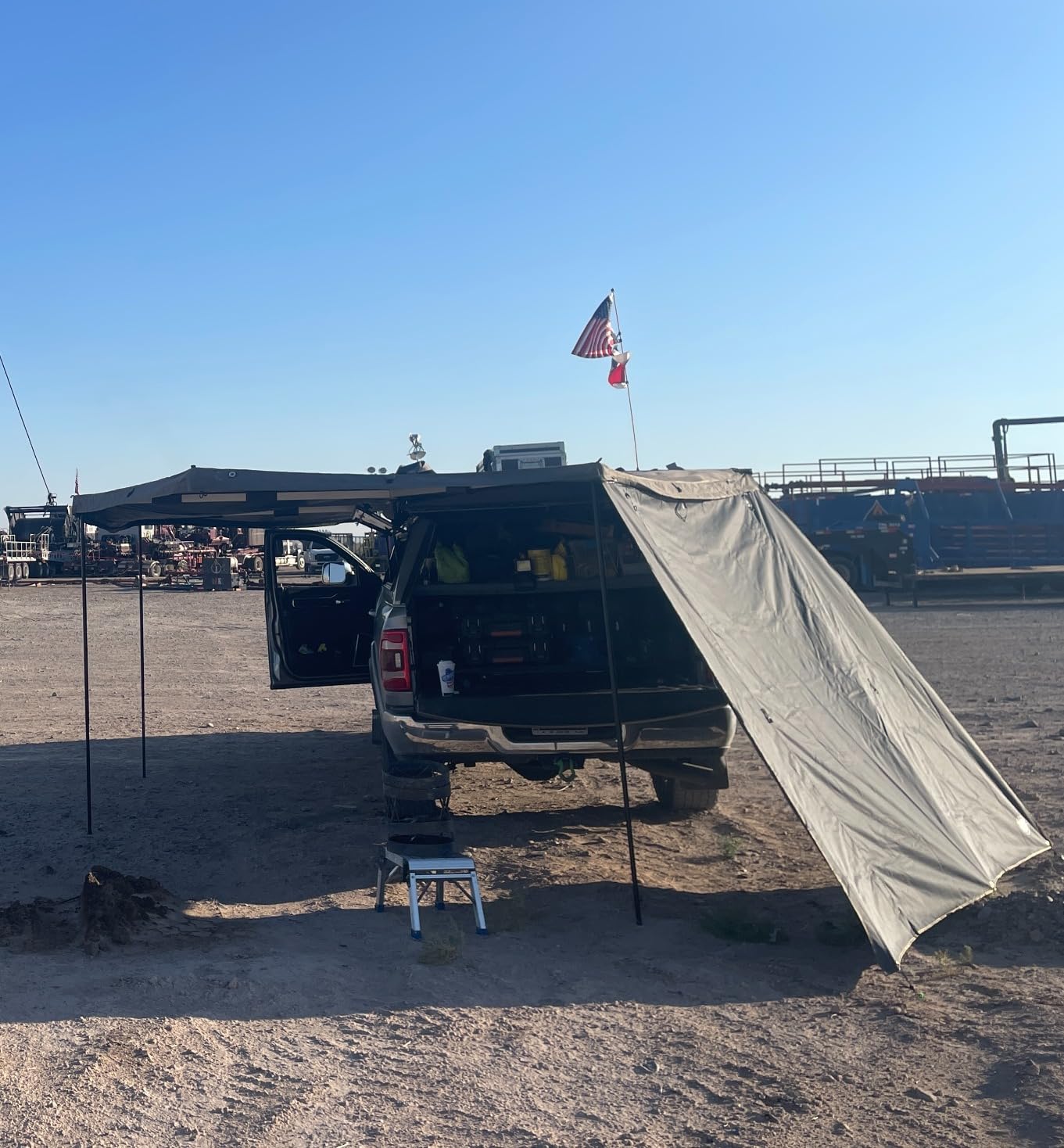
At 2.3 pounds it is among the lightest serious walls here, and owners note it packs smaller than they expected. The kit comes with a carry bag, extra pegs and guy lines, which sounds ordinary until you compare it with kits that ship the panel and nothing else. Guy lines are what turn a wall from a wind block into a wall that stays put when the front of the truck is doing the work of a sail.
The functional use case owners report most is low sun. A driver side wall on an east-facing campsite blocks the early light that otherwise hits you straight in the eyes at coffee time, and it turns the awning into usable shade for a cooking setup rather than a place you sit in the dark.
Before you add it to a build
Buy wall 3 on its own only if you already have walls 1 and 2 or deliberately want one side closed. Several owners in the reviews state their plan to add the matching panels, which is the intended build, but a single panel leaves the rest of the Nomadic open to weather.
Attachment is the detail to verify against your awning. This wall uses hook-and-loop to the frame, and that will not work on an awning that zips into the same channel. If you are building new and can choose, the zipper-rail wall listed below is a faster and tighter connection. The four-year limited warranty matches the longest cover in the roundup apart from Rough Country’s lifetime warranty.
Who should skip it
Skip it if your awning is not an HD Nomadic 270, and skip it if you need a door or mesh. There is no mesh in this panel and no walk-in access, so it is a wind and sun wall rather than a living space.
Buy it if you run a Nomadic 270 and want the driver side shut before the sun comes up, and you like knowing your seams are heat sealed rather than stitched.
5. Rough Country 270 Degree Awning Wall Enclosure – Three Walls with Telescopic Poles
- Three telescopic aluminium poles included in the box
- Owners rate material and finish above the price point
- Quick to install and remove
- Performs well in mixed weather
- Limited lifetime replacement warranty
- Wall height is not published so you must measure yourself
- Tailgate opening too narrow for a full-size Silverado
- Refolding into the bag after fitting poles takes trial and error
Compatibility verdict: this is a three-wall enclosure for the Rough Country 270 degree awning. It is not a universal panel and it does not fit other brands. If your awning is not a Rough Country 270, this section does not apply to you.
The reason this one is worth a place is the completeness. You get three walls and three telescopic aluminium poles that run from 52 inches collapsed to 94 inches extended, so the panels stand on their own frame rather than relying on the awning legs alone. That is the difference between an enclosure that holds shape in wind and one that billows.
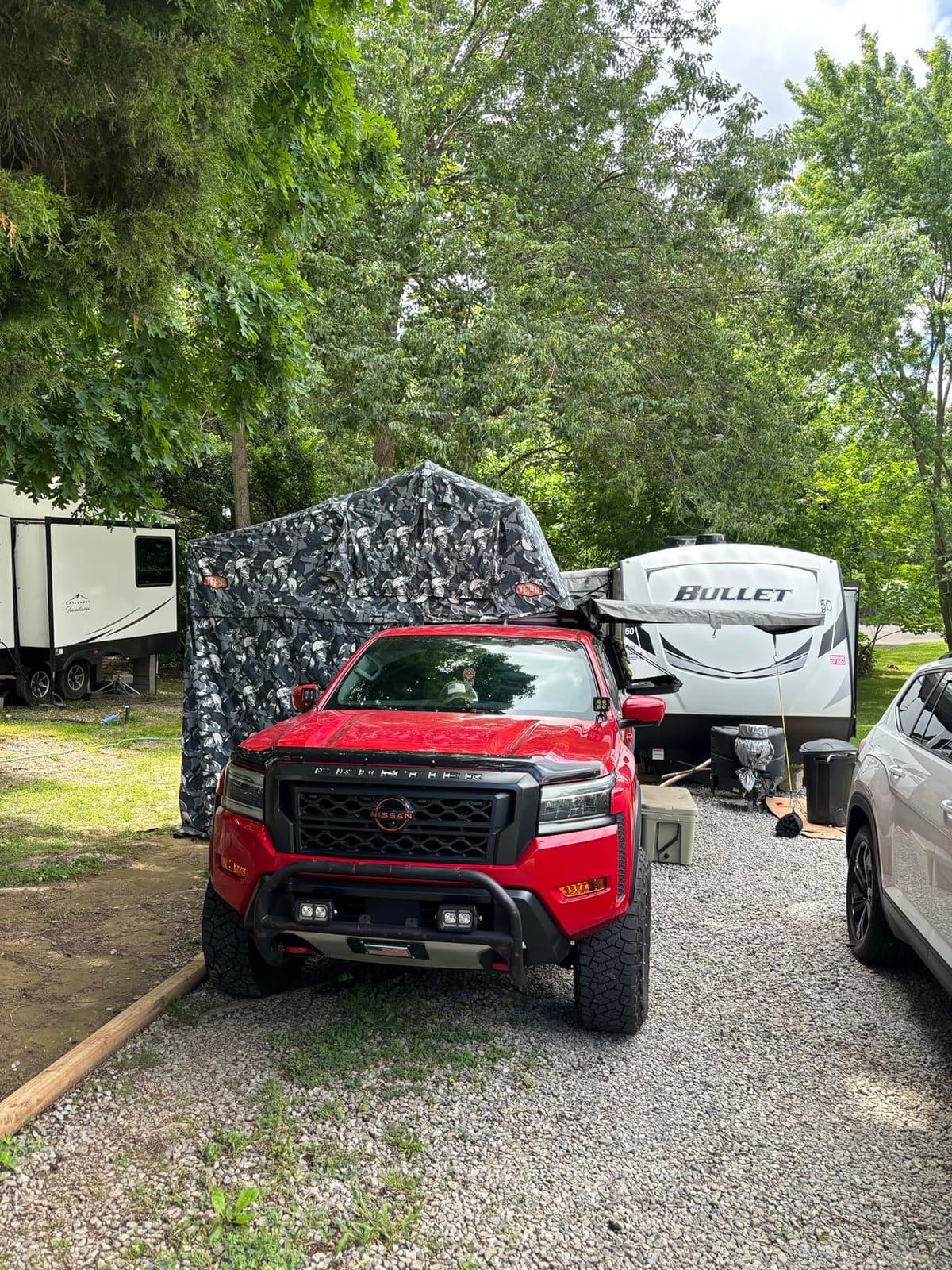
Fabric is 420D Oxford with a PU 2000mm waterproof coating and anti-UV 50+ treatment. That is among the heaviest weaves in this roundup, and PU 2000mm is a real rain rating rather than a marketing word. Owners consistently rate the material and finish as well above what they expected to get, and report good performance in mixed weather.
This carries the longest warranty in the set, a limited lifetime replacement warranty, meaning a seam failure or a torn panel in year three is a replacement rather than a purchase. For a fabric product that lives in sun and rain year round, that matters more than any spec line.
Measure before you order
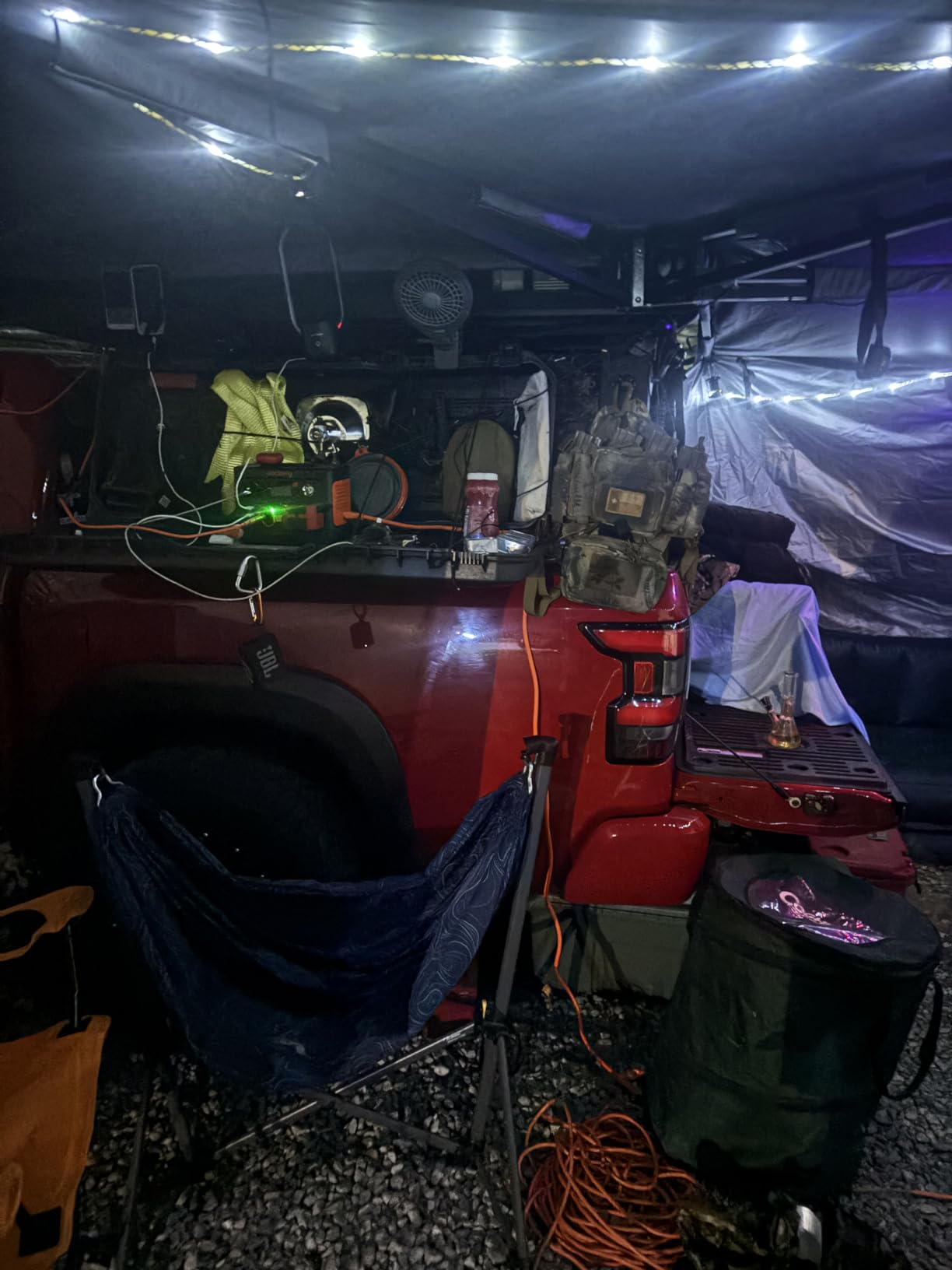
Wall height is not published on this enclosure, and that is the reason it collects complaints. Owners who measured report roughly 75 inches of wall with a further 7 inch skirt. If your awning is mounted higher than that, you are looking at a gap you will have to solve with the skirt or a custom filler.
The other geometry issue is the vehicle opening. Owners report the rear and tailgate opening is not wide enough for a full-size Chevy Silverado and needs modification. This is a measurement you can take in two minutes with a tape against your closed tailgate, and doing it first will save you a return.
Who should skip it
Skip it if you want a fast single-panel setup, because refolding the enclosure back into its 35.5 by 11.8 by 9.8 inch bag after the poles are fitted takes trial and error the first few times. Skip it if you run a full-size truck and need rear access without modification.
Buy it if you want a three-sided 270 with a real support frame and a warranty that outlives most of your gear list.
6. OVS Nomadic 270 LTE Walls 1 and 2 Set – Passenger Side Two-Panel Kit
- Two walls in one purchase for broader coverage per kit
- Heat-sealed seams in 280G poly-cotton ripstop
- Velcro attachment plus ground anchor points
- Travel storage bag included
- Four-year limited warranty
- Only six ratings so long-term field performance is unproven
- Fits the Nomadic 270 LTE passenger side only
- Listed under the TrendsAuto name rather than OVS
Compatibility verdict: this is a two-panel set covering walls 1 and 2 on the passenger side of the HD Nomadic 270 LTE. Minimum clearance is listed at 1.83 meters. It does not fit the standard HD Nomadic 270, and it does not cover the driver side.
Two panels is a meaningfully better starting point than one. A single wall blocks one direction and leaves the other two open, so you still get crosswind and still get sun on half the area. Buying walls 1 and 2 together closes the passenger side of the 270, which is the orientation that matters most on a west-facing campsite in the afternoon.
Construction matches the OVS panels rated above: 280G poly-cotton ripstop with heat-sealed seams, Velcro attachment and ground anchor points. Ground anchor points are worth calling out separately from pegs, because they distribute load across a wider patch and behave better in hard desert soil where a narrow stake just cuts a hole and goes nowhere.
The honest limits on this one
Six ratings is a very small sample, and 90 percent five-star on six ratings is not the same as proven field performance. We are including it because the specification is solid and the four-year warranty is real, not because owners have put it through two seasons of weather. Treat the build quality as likely rather than confirmed.
There is also a naming wrinkle. The listing appears under the TrendsAuto brand rather than the Overland Vehicle Systems name used on the sibling walls, and it includes a TrendsAuto decal. Functionally it is the same Nomadic 270 LTE wall system, but if you are matching panels with a different OVS product, check the model number 18349909 rather than the brand name.
Who should skip it
Skip it if you run a standard HD Nomadic 270 rather than the LTE, or if you need the driver side. Skip it if you want mesh or a door, since these are solid fabric panels. And if you are the kind of buyer who needs a hundred owner reviews before committing, this is not that product.
Buy it if you are closing out the passenger side of an LTE build in one transaction and want the same fabric and warranty language as the rest of the OVS wall range.
7. OVS Nomadic 180 Awning Wall – Windowed Panel with Large Door
- Only side wall panel here with a walk-in door
- Windows add light and ventilation to a closed wall
- Zipper rail attachment is faster and tighter than hook-and-loop
- Storage bag included
- Thinnest review base here at 10 ratings with a fifth of them two-star
- Sold as one wall so a full enclosure needs more panels
- Rail fit is specific to the Nomadic 180
Compatibility verdict: this is a side wall for the Overland Vehicle Systems Nomadic 180 awning, secured with a zipper into the awning rail. It will not fit the 270 models and it will not fit a 180 from another brand.
It is the only side wall panel here with a walk-in door large enough to move a person and their gear through a closed wall, which changes what you can do under a 180. A 180 is a tailgate awning, so without a door you are crawling over the tailgate in whatever the weather is doing. With one, you have a normal entrance.
The windows carry protective insect mesh, so you can have light and airflow with bugs kept out. On a desert setup where you are cooking before sunrise that matters, because a solid wall either blocks the view or blocks the light.
Why the zipper attachment is the better system
This wall zips into the rail rather than using hook-and-loop, and that difference shows up every time you set up in the dark or in wind. A zipper is a single continuous path you can run with one hand, and it makes a tighter seal once closed. Hook-and-loop is faster to roll back and open, but it never fully closes the gap and it catches grit.
Fabric is 280G poly cotton rip stop, described as durable, breathable and weather resistant, and a storage bag is included. The model number is 18159909.
Who should skip it
Skip it if you run a 270 rather than a 180, and skip it if you want a full room, because this is one panel and full coverage means buying the matching walls. The review base is the other warning: ten ratings, and 20 percent of them are two-star, so there is not much owner history on either side of the average.
Buy it if your 180 is your primary shelter and you want to walk in and out of it without climbing over the tailgate.
8. Tuff Stuff Overland Awning Shade Wall 4.5 x 6 Foot – Basic Budget Panel
- Simple low-cost way to add a sun and wind break
- Lightweight and easy to carry
- Neutral beige color suits a wide range of awnings
- Quick to pitch
- Smallest stated panel size at 4.5 x 6 feet
- No waterproof rating no mesh and no windows
- Lowest average rating here at 4.0 with 13 percent one-star
- Thin listing detail with a single descriptive bullet
Compatibility verdict: this is a generic 4.5 by 6 foot shade wall panel. It is not tied to a named awning model, so fit depends on your awning width and rail rather than a brand match. Measure before you assume.
What this does well is one specific job: stopping low sun and wind on the exposed side of a small awning. Polyester and vinyl construction is a shade and wind material, not a rain material. There is no waterproof rating, no mesh and no window, and the beige color is chosen to sit quietly against most awning fabrics.
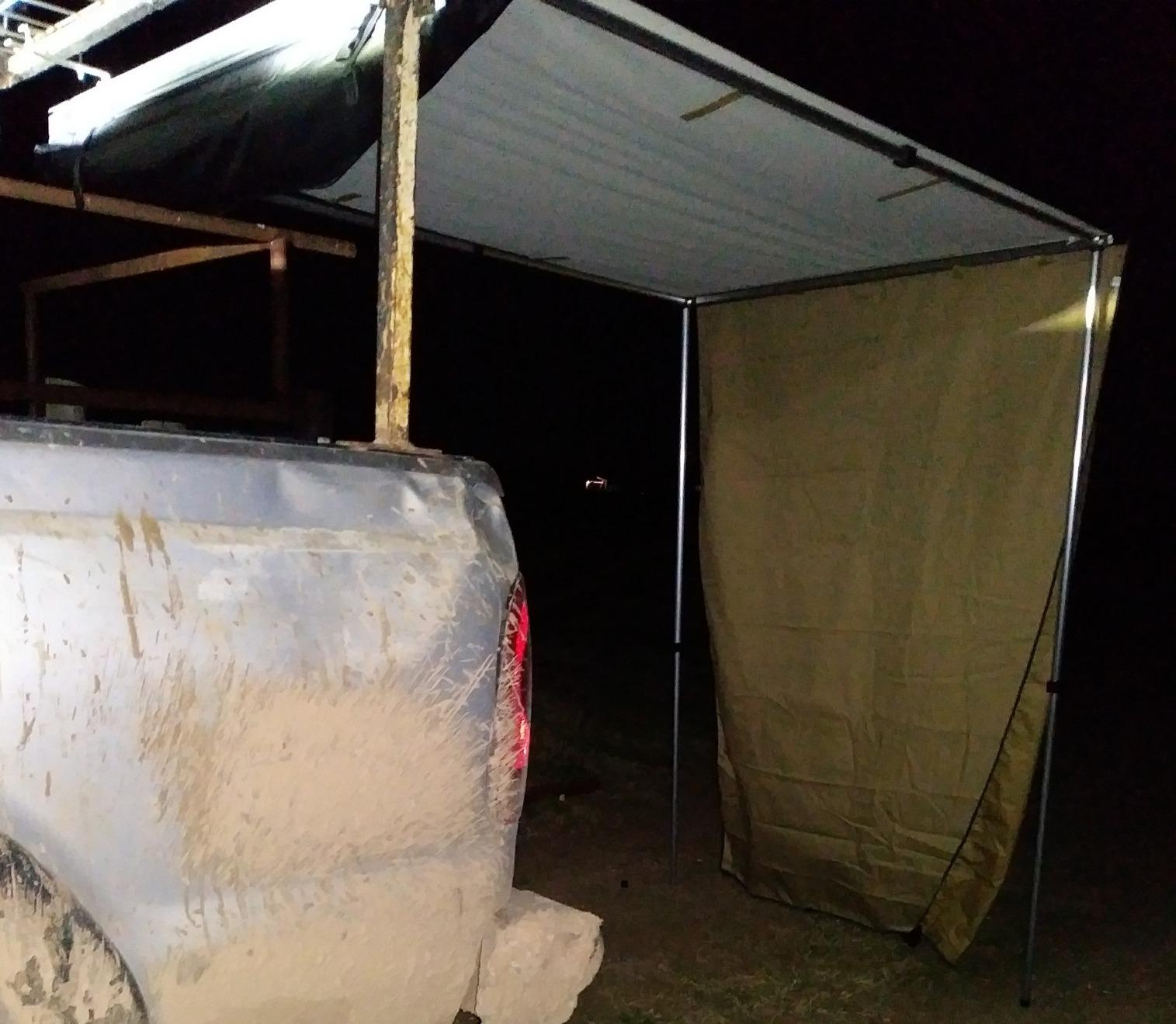
It is also the cheapest way to test the concept. If you are trying awning walls for the first time and you camp somewhere dry and mild, this is a low-risk way to find out whether you actually use one before committing to a three-wall system.
The 4.0 average across nine ratings is the lowest in this roundup, with 13 percent of ratings at one star. The listing detail is also thin, a single descriptive bullet, so there is less information about rail compatibility, stake points and packed size than you would want when buying something you have to size yourself.
When a small panel is the right answer
There is a legitimate case. On a compact awning over a pickup bed or a rear rack, a 4.5 by 6 foot panel is often a better match than a full-width wall, because a wall wider than the awning has nothing to attach to. If your awning is small, an oversized enclosure is wasted fabric, weight and wind surface.
It is also the right answer for anyone who camps in dry, low-wind conditions and simply wants the low western sun taken off a cooking station.
Who should skip it
Skip it if you camp where it rains, mosquitoes are present, or you plan to sleep under the awning. There is no bug protection and no rain sealing, so it will not keep water off you. It is a wind and shade accessory, and it should be sold to you as one.
Buy it if you want one inexpensive panel to knock down glare and crosswind on a small awning, and nothing more.
9. Smittybilt 270 Degree Awning Walls Driver Side – 123 sq ft 600D Oxford Set
- 123 square feet of coverage from a single panel
- Owners rate material quality above expectations
- Heavy-duty 600D Oxford with a 10-gauge expandable zipper
- All tie-down points supplied with stakes and guy ropes
- 1000G PVC travel cover is unusually heavy duty
- Only two ratings and both from the UK
- Fits only the Smittybilt 270 degree awning
- 12.25 kg is a heavy addition to a loaded rack
Compatibility verdict: this is the driver side wall set for the Smittybilt 270 degree awning. One buyer reported being unable to fit it to a non-Smittybilt awning, so treat the fit as brand-specific and verify your rail profile before ordering.
On paper this is the most generously specified panel in the roundup. The 123 square feet of shade coverage is the only coverage figure any of these products publishes, and the fabric is 600D Oxford polyester, a heavier weave than anything else here. Heavy weave means better wind resistance and slower abrasion on the leading edge, at the cost of weight: the listed item weight is 12.25 kg, which lands directly on a roof rack that is already loaded.
Attachment uses a 10-gauge expandable zipper, which is a wide coil zipper that spreads load across the whole rail instead of concentrating it at a point. That is a sensible choice for a panel this large, and it is the reason the coverage figure is believable rather than theoretical.
The kit is unusually complete
Stakes and guy ropes are included for all tie-down points, and the travel cover is 1000G heavy-duty PVC rather than the light stuff sacks that come with smaller walls. On a panel this size, the tie-down hardware is not an accessory, it is part of the structure, and having it supplied removes the most common reason walls end up flapping.
Guy ropes across a wall this broad are not optional. A large fabric surface catches pressure, and the difference between a wall that sits still and one that becomes a sail is whether the bottom corners are pulled out to ground anchors with lines rather than simply pegged straight down.
Who should skip it
Skip it if rack weight is the constraint, since at 12.25 kg this competes directly with recovery gear for space. Skip it if your awning is not a Smittybilt 270. And treat the two available ratings, both from the UK, as limited evidence for field use in desert or alpine conditions.
Buy it if you run a Smittybilt 270 and you want the largest coverage area any of these panels publishes, and you have rack capacity to carry the weight.
10. OVS Nomadic 270 Side Wall 2 – Zip-In Driver Side Shelter Panel
OVS 18109909 Nomadic Awning 270 – Side Wall 2 – Dark Gray with Storage Bag – Driver
- Zips fully into the awning for a complete shelter
- Roll-up straps let you adjust coverage as weather changes
- Door included in the matching wall 1
- Waterproof enough for overnight rain use
- Travel bag included and well made
- Water can pool at the seams if the pitch is not perfect
- Sold as a single wall with fit specific to the Nomadic 270
- Only 12 ratings with 13 percent at one star
Compatibility verdict: this is side wall 2, driver side, for the Overland Vehicle Systems Nomadic 270. It is sold as a single panel with a travel bag and fits only that awning.
The Nomadic 270 three-wall set is the most common layout in overlanding, and wall 2 is the middle piece of it. It zips fully into the awning frame rather than attaching with hook-and-loop, and the zipper is what allows the panel to pull genuinely taut across its whole length. A taut wall does not flap, and flapping is the noise that ruins a night of sleep under an awning.
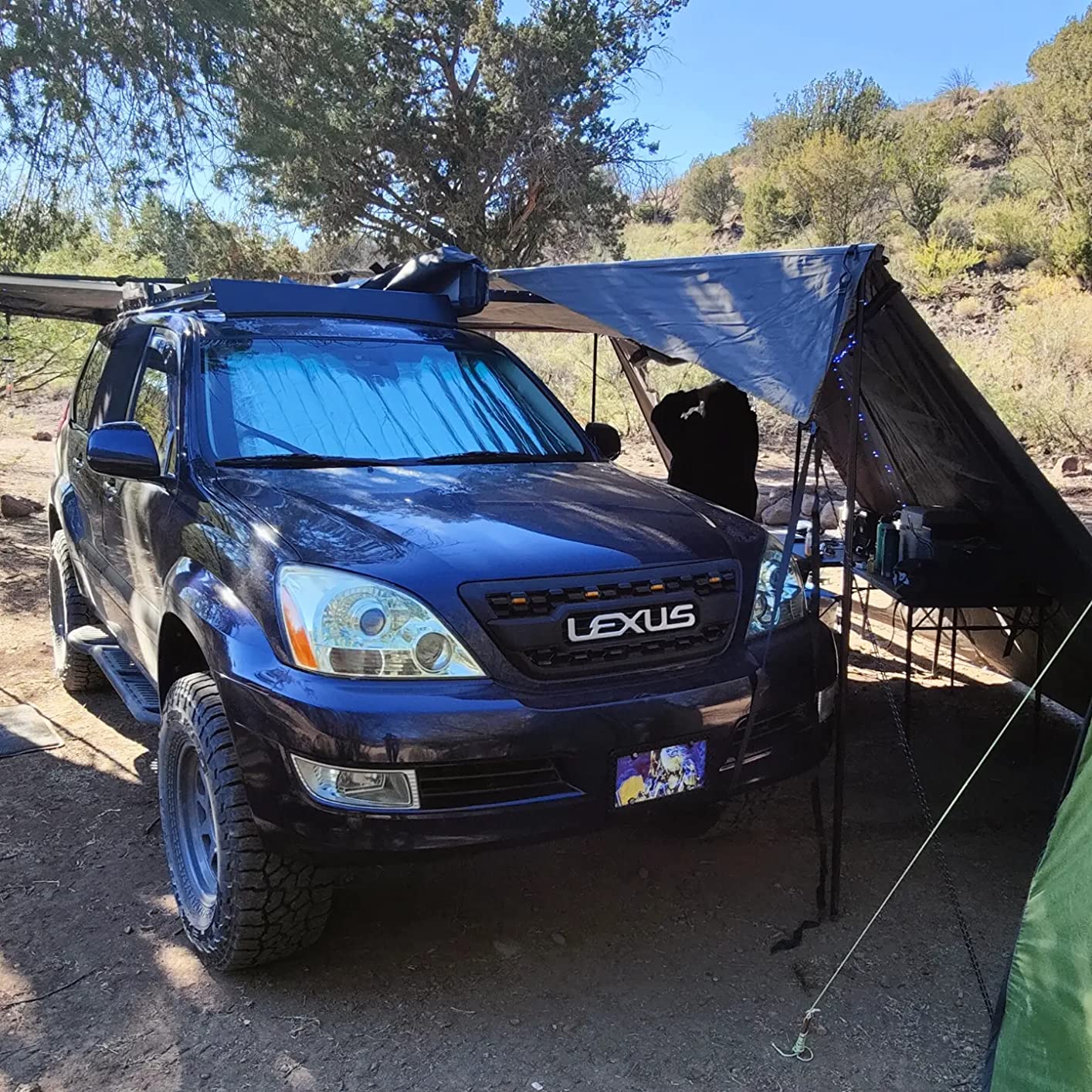
The roll-up straps are the feature owners mention most, because weather under an awning changes faster than the forecast. Roll a wall partway up and you keep airflow and a view while still blocking the wind. Leave it fully down and you have a solid shelter. That adjustability is the practical advantage over a fixed panel, and it is the reason people running Nomadic 270 builds tend to end up with all three walls rather than one.
Owners report sleeping under the assembled set in rain without water coming through, and describe the construction as durable on a long-term overland build. Wall 1 in the same system includes a door, so the three-panel set gives you a walk-in enclosure on the driver’s side of the awning.
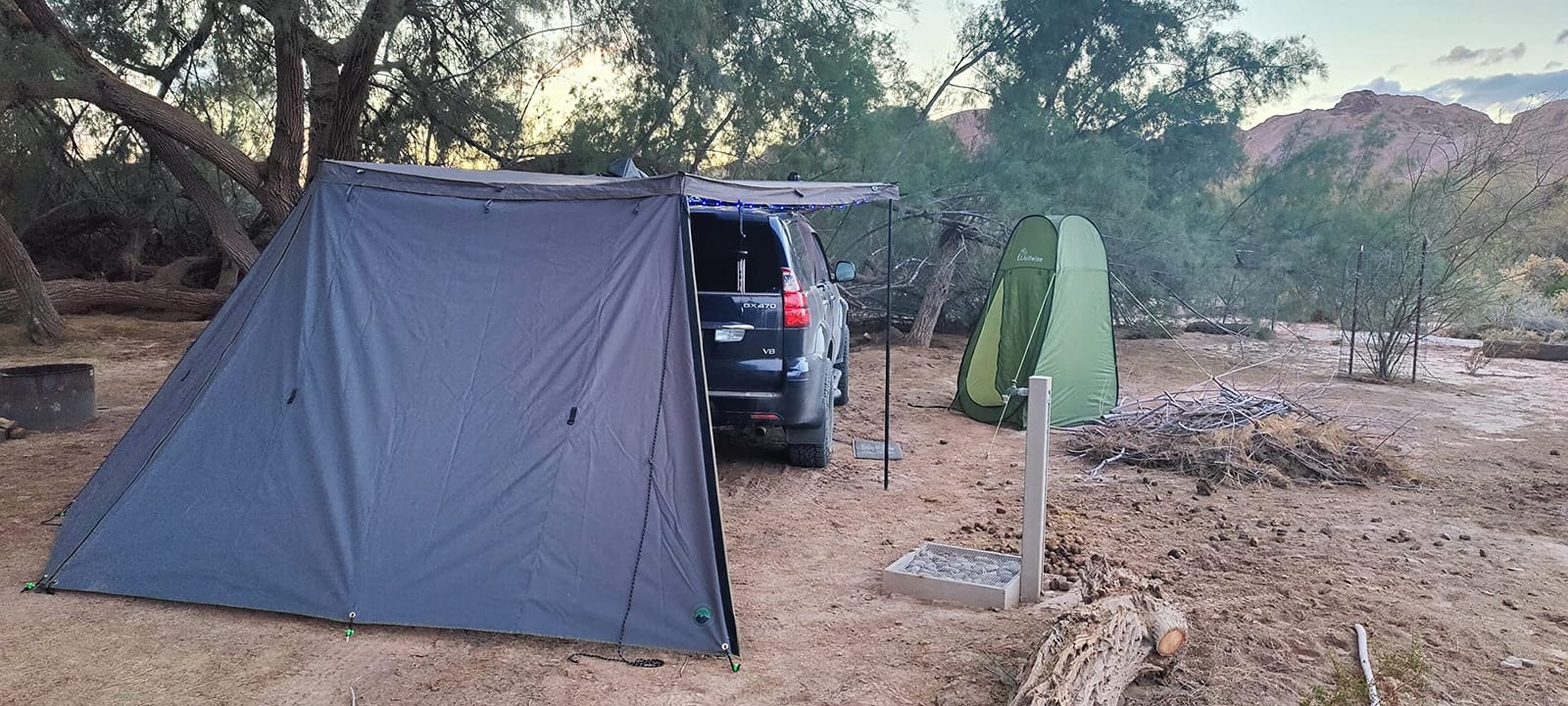
Pitch quality decides whether it leaks
The one substantive complaint in the reviews is water pooling at the seams when the pitch is not right. This is a geometry problem rather than a fabric problem. The awning frame needs to be level and the wall needs tension along the entire hem, otherwise the lowest point becomes a collection point that eventually finds the seam.
The practical sequence is simple and worth doing every time: check the awning legs are at equal height, run the zipper the full length, then tension the bottom corners to ground anchors before the middle. Owners who sleep under it in rain report the dry result, and those are the same people who are careful with that sequence.
Who should skip it
Skip it if your awning is not a Nomadic 270, and skip it if you want a single panel to do the work of a room, since you need walls 1 and 3 as well. The rating spread is worth noting: 12 ratings with 13 percent at one star, so expect a range of experiences.
Buy it if you are partway through a Nomadic 270 wall build, you prefer a zipper seal over hook-and-loop, and you want the option to roll the wall up as conditions change.
Awning Wall Compatibility Guide – Which Wall Fits Which Awning
Compatibility, not quality, is the number one source of returns in this category. It comes down to rail profile, awning length and where the awning is mounted on your vehicle. Work through these four checks before you order anything.
First, identify the exact awning model and variant, not just the brand. The ARB room in this roundup fits only the 2500x2500mm ARB awning. The OVS panels are split across the Nomadic 180, the HD Nomadic 270 and the HD Nomadic 270 LTE, and those three use different rails. Buying the wrong variant means the zipper or the hook-and-loop strip simply has nothing to grab.
Second, match the width. A panel wider than your awning has slack at the edges, and slack is what flaps. The universal multi-side panel is sold at 8.2 by 8.5 feet and works across 4.6, 6.6, 8.2 and 10 foot awnings because the extra width is absorbed by angling rather than by leaving the hem loose. That trick does not exist in a fitted single-width wall.
Third, check the attachment system against your awning rail. Zipper rails accept zip-on walls and nothing else. Hook-and-loop strips need a flat, clean frame surface to bite into, and they will not hold if your awning already zips into the same channel. A few products here are hook-and-loop only, and that single fact rules them out for some builds.
Fourth, measure the vehicle side. Enclosures need the rear opening to line up with your tailgate or rear door, and the wall height to reach from the awning rail down to the ground or close to it. One enclosure here is roughly 75 inches of wall plus a 7 inch skirt, and one room in this roundup only gives rear access if the awning is mounted far forward. A tape measure solves both in two minutes.
As a general rule, if you own one of the named awning systems in this roundup, buy that brand’s own wall. If you own something else, or plan to change awnings, the dual-attachment universal panel is the only product here that is built to move with you.
How to Choose an Awning Wall – Fabric, Kit Format and Weather
Choosing between the formats is simpler than most buyers make it. A side wall kit gives you one or two panels and solves wind, sun and bugs on the sides that matter. An enclosure gives you three or four panels and turns the awning into a room you can sleep in. An annex room gives you a sealed box with a floor, a door and mesh, and it is the heaviest option by a wide margin. Buy the level that matches the weather you actually camp in, not the level that looks best in a photograph.
On fabric, you will see two kinds of numbers. Fabric weight in gsm tells you how much material is in the panel and is the better predictor of wind resistance and durability. Denier, written as 300D or 600D, describes the thread thickness and is the better predictor of abrasion resistance on the leading edge and in salt air. In this roundup the range runs from 210D Oxford with a PU 3000mm coating, through 280gsm poly-cotton, to 420D and 600D Oxford for the heaviest panels. A PU coating figure, where it is published, tells you the waterproof rating directly.
Anchor method is the next decision. Stake loops and ground anchors are the standard, and they are the only reliable option on soil. On rock, hardpan or sand where stakes will not hold, you need a wall that stands on poles instead, which is what the telescopic pole kit in this roundup provides. Rock camps are the situation that forces this choice, and buying a staked-only wall for a canyon trip means carrying something you cannot use.
Wind is where awning walls fail, and owners report the same three mechanisms. The first is pooling: water collects in the low corner of a fabric panel and has to be pushed up by hand to drain, which means standing directly under it when it goes. The second is vehicle-side whip, where wind gets under the body-side edge of a wall on a high-racked truck; some owners cut skirts from old tents to close that gap. The third is billowing, which happens when a wall is not tensioned along the bottom hem and the whole panel turns into a sail. Guy lines and proper hem tension address the third, guy lines address the second, and only slope and drainage address the first.
That leads to the fourth wall. Front and rear add-ons are actively sought by owners, and they are the difference between a shelter and an enclosure. On a 180 tailgate awning a front wall with a door turns the space into something you can walk into. On a 270, closing the front and rear turns three sides into a room. Check that the add-on shares the same attachment method as the side walls before you commit, because mixing systems is where compatibility breaks.
One last practical note on living with walls day to day. Owners consistently describe walls as more cumbersome to fit than the awning itself, and pack-down time matters more than people expect on a long trip. A wall that folds into a flat bag and lives in a gear tote gets used every trip. A wall that is a wrestling match to repack gets left in the garage. If you are outfitting for a specific season, our camping lantern picks are the other piece of gear that ends up living in the awning at night.
Frequently Asked Questions
What are awning walls for overland camping?
Awning walls are zip-on or hook-and-loop fabric panels that attach to the legs of a vehicle-mounted 180-degree or 270-degree awning. They turn open shade into an enclosed shelter that blocks wind, rain, sun and insects, and they stake or anchor at the bottom hem to hold tension. You use the awning legs as the frame rather than building a separate structure, which is why they are so much lighter than a standalone tent.
Which 270 awning with walls is the best?
The best 270 awning with walls depends on your awning brand first. For a Rough Country 270 the three-wall enclosure with telescopic poles gives the most complete coverage. For a Nomadic 270 build the three-wall OVS set is the standard layout, and the universal multi-side panel is the only option here that fits awnings no other wall will fit. Always confirm the exact awning variant before buying, because rails differ even within one brand.
What is the best material for awning walls?
Polyester and poly-cotton are the two common materials. Poly-cotton at around 280gsm blocks wind well and breathes, while Oxford polyester at 300D to 600D resists abrasion and holds up longer in salt air and sun. A PU coating rating, where published, is the direct measure of rain performance. Choose a heavier weave for exposed camps and a coated lighter weave if packed weight is the constraint.
Do awning walls keep out bugs?
Only the enclosures with mesh do. Solid fabric side walls block wind, rain and sun but not insects, so they are rolled up for airflow rather than screened. If mosquitoes are the deciding factor, look for a room with mesh side panels or a full inner mesh layer, such as the ARB awning room with midge-proof mesh sides or the ALL-TOP room with a full nylon mesh inner layer.
Can you use awning walls in wind?
Yes, but only if the bottom hem is tensioned and the corners are pulled out to ground anchors or guy lines. Owners report three recurring problems: billowing when a wall is not tensioned, water pooling in the low corner, and wind getting under the vehicle-side edge on a high-racked truck. Guy lines, ground anchors and a fabric skirt address these. Panels that stand on their own poles are the better choice on rock or hardpan where stakes will not hold.
Are awning walls worth it compared with a bigger awning?
Walls are usually the better value, because they turn shelter you already own into weather-capable shelter without adding a second awning frame or another set of legs to your roof rack. Reviewers commonly describe walls as transformative in rain, where an open awning is close to useless. A bigger awning still gives you more shade, but it does not block wind on the sides, which is usually the problem you are actually trying to solve.
Final Verdict – Which Awning Wall Should You Buy?
The best awning walls for overland camping in 2026 come down to one question: which awning do you already have. If it is an ARB 2500x2500mm, the ARB Awning Room is the only sensible answer, and with 851 ratings behind it it is also the most proven shelter in this roundup. If you own anything else and want one panel that adapts, the ALL-TOP Multi-Side Wall earns its place with the highest star rating in the set and dual attachment across four awning lengths.
Beyond that, match the format to the weather. Nomadic 270 owners should build the three-wall set and pay attention to hem tension. Nomadic 180 owners should start with the windowed wall with the door. A Rough Country 270 owner gets the most complete coverage from the telescopic three-wall enclosure. If you want a room rather than panels, the two room products here are the shortlist, with the ARB proven on owner history and the ALL-TOP room offering far more enclosed volume, at a heavier pack weight.
And do the measuring before the ordering. A tape measure and your awning model number will save more returns than any amount of reading, and the compatibility notes above tell you exactly which panel belongs to which awning.