
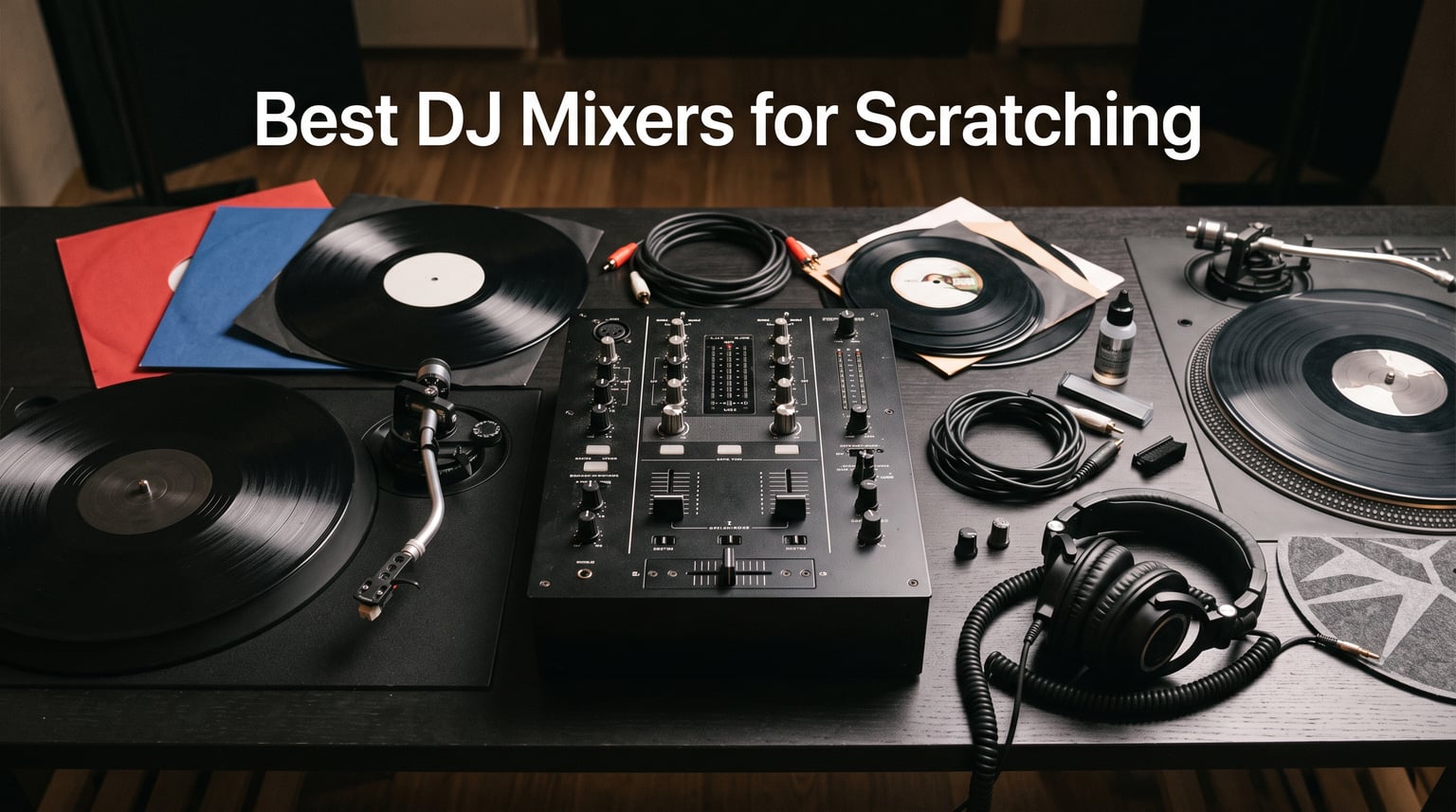
I have spent the better part of a decade behind a pair of turntables, and if there is one thing I have learned, it is that the crossfader makes or breaks your scratch game. Finding the best DJ mixers for scratching means looking past the flashy effects and focusing on fader feel, cut-time sharpness, and how well the mixer handles the abuse of daily crab scratches, chirps, and transforms.
Whether you are a bedroom turntablist working on your first babies or a battle DJ prepping for DMC competitions, the right scratch mixer changes everything. A dedicated battle mixer gives you a short-throw crossfader with adjustable curve control, phono inputs for your turntables, and the clean signal path you need for sharp cuts. A club mixer, on the other hand, prioritizes effects and channel count over fader precision.
In this guide, our team tested 10 scratch mixers across every budget tier. We compared crossfader feel, software compatibility with Serato DJ Pro and Rekordbox, DVS support, build quality, and real-world fader durability. We also pulled insights from scratch DJs on Reddit and gear forums to highlight what actual users value. If you are also building out a broader setup, check our guides on DJ mixers for home studios and the best turntables for home DJing to complete your rig.
Table of Contents
Top 3 Picks for Best DJ Mixers for Scratching
Before we get into the full breakdown, here are the three mixers that stood out across our testing. These picks cover the premium, value, and budget tiers so you can find the right fit regardless of your setup budget.

Pioneer DJ DJM-S11
- Pro scratch mixer
- Serato + Rekordbox
- Magvel fader
- 4 pad modes
- OLED display
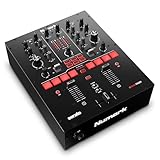
Numark Scratch
- InnoFader crossfader
- Serato DJ Pro included
- DVS license
- 6 FX selectors
- Performance pads

Numark M2
- 2-channel scratch mixer
- Replaceable crossfader
- 3-band EQ
- Rack mountable
- Reverse and slope controls
Best DJ Mixers for Scratching in 2026
Here is the full comparison table covering all 10 mixers we reviewed. Use this to compare specs side by side, then scroll down for detailed hands-on impressions of each unit.
| Product | Specifications | Action |
|---|---|---|
| Pioneer DJ DJM-S11 |
|
Check Latest Price |
| Numark Scratch |
|
Check Latest Price |
 Pioneer DJ DJM-250MK2 Pioneer DJ DJM-250MK2 |
|
Check Latest Price |
 Pioneer DJ DJM-450 Pioneer DJ DJM-450 |
|
Check Latest Price |
| Numark M2 |
|
Check Latest Price |
 Numark M6 USB Numark M6 USB |
|
Check Latest Price |
 Behringer NOX101 Behringer NOX101 |
|
Check Latest Price |
 Behringer DX626 Behringer DX626 |
|
Check Latest Price |
 Behringer DJX900USB Behringer DJX900USB |
|
Check Latest Price |
 Gemini MM1 Gemini MM1 |
|
Check Latest Price |
1. Pioneer DJ DJM-S11 – The Professional Scratch Standard
Pioneer DJ DJM-S11 Professional Scratch Style 2-Channel DJ Mixer for Serato DJ Pro or Rekordbox
- Best-in-class crossfader feel
- Dual software compatibility (Serato + Rekordbox)
- Built-in beat FX and Scratch Bank access
- High refresh OLED screen
- Premium build at 7.5 kg
- Premium price point
- Steep learning curve for beginners
- Limited user reviews available
The moment I put my hands on the DJM-S11, I understood why it carries a perfect 5.0 rating from every DJ who has reviewed it. The Magvel crossfader on this thing is, without exaggeration, the smoothest I have ever felt on a production mixer. The cut-in time is razor sharp, and the tension feels dialed in for rapid-fire crab scratches right out of the box.
What sets the DJM-S11 apart from every other mixer in this lineup is its dual software compatibility. It works natively with both Serato DJ Pro and Rekordbox, which means you are not locked into one ecosystem. The built-in Scratch Bank feature in Serato gives you instant access to your sample library, and the onboard beat FX rival what you would find on a full-size club mixer like the DJM-900NXS2.
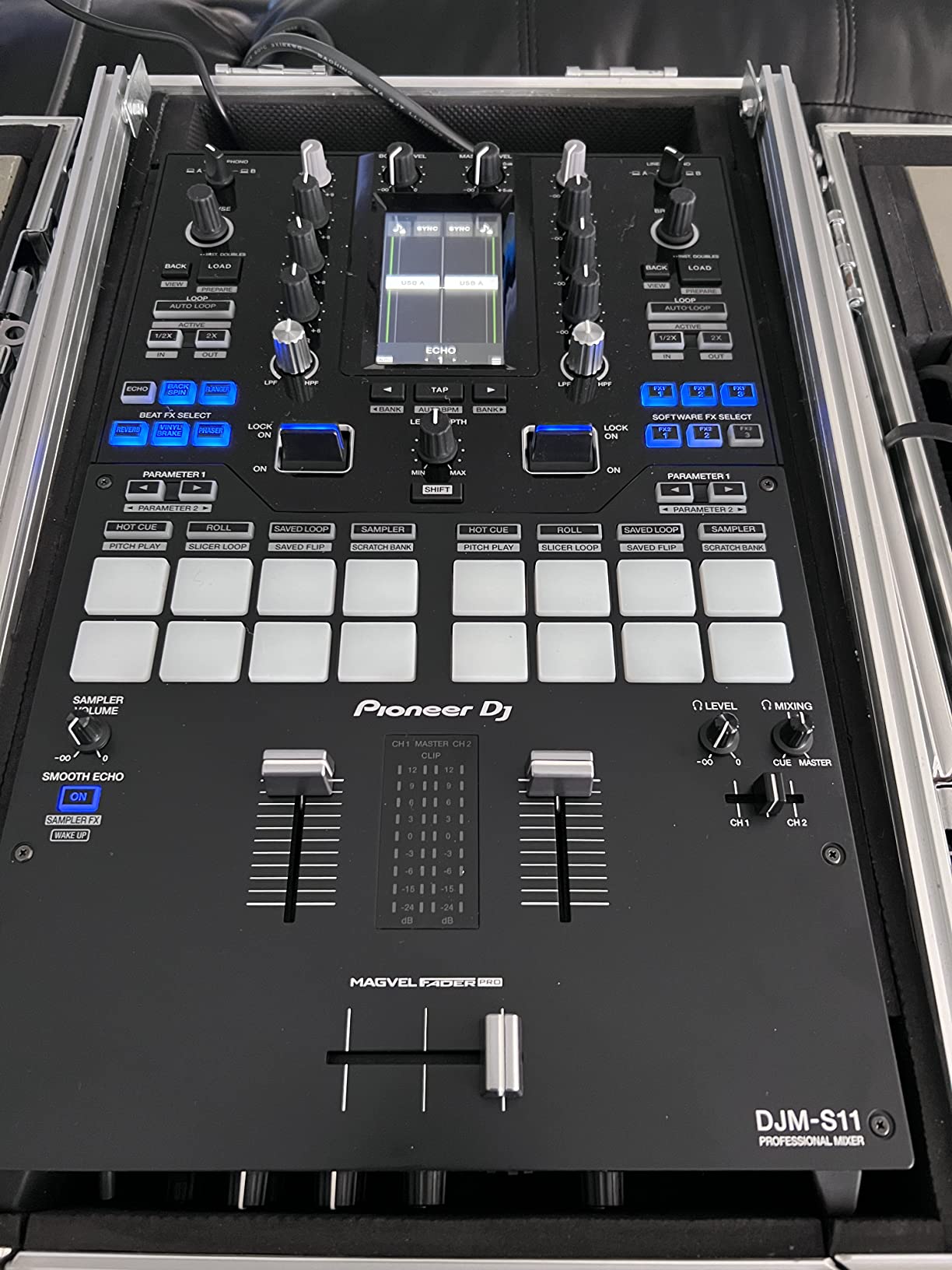
The OLED screen in the center of the mixer is a genuine productivity boost. It has a high refresh rate that makes navigating settings and FX parameters feel instantaneous. I was able to tweak crossfader curve, adjust FX routing, and monitor input levels without ever touching my laptop. For a battle DJ, keeping your eyes off the screen and on your hands is everything.
On the connectivity front, you get XLR and RCA outputs, USB for DVS, and phono inputs for analog vinyl. The mixer weighs in at 7.5 kilograms, which tells you the internal components are substantial. This is a mixer built to sit in a professional rig and handle nightly gig abuse.
Who Should Buy the DJM-S11
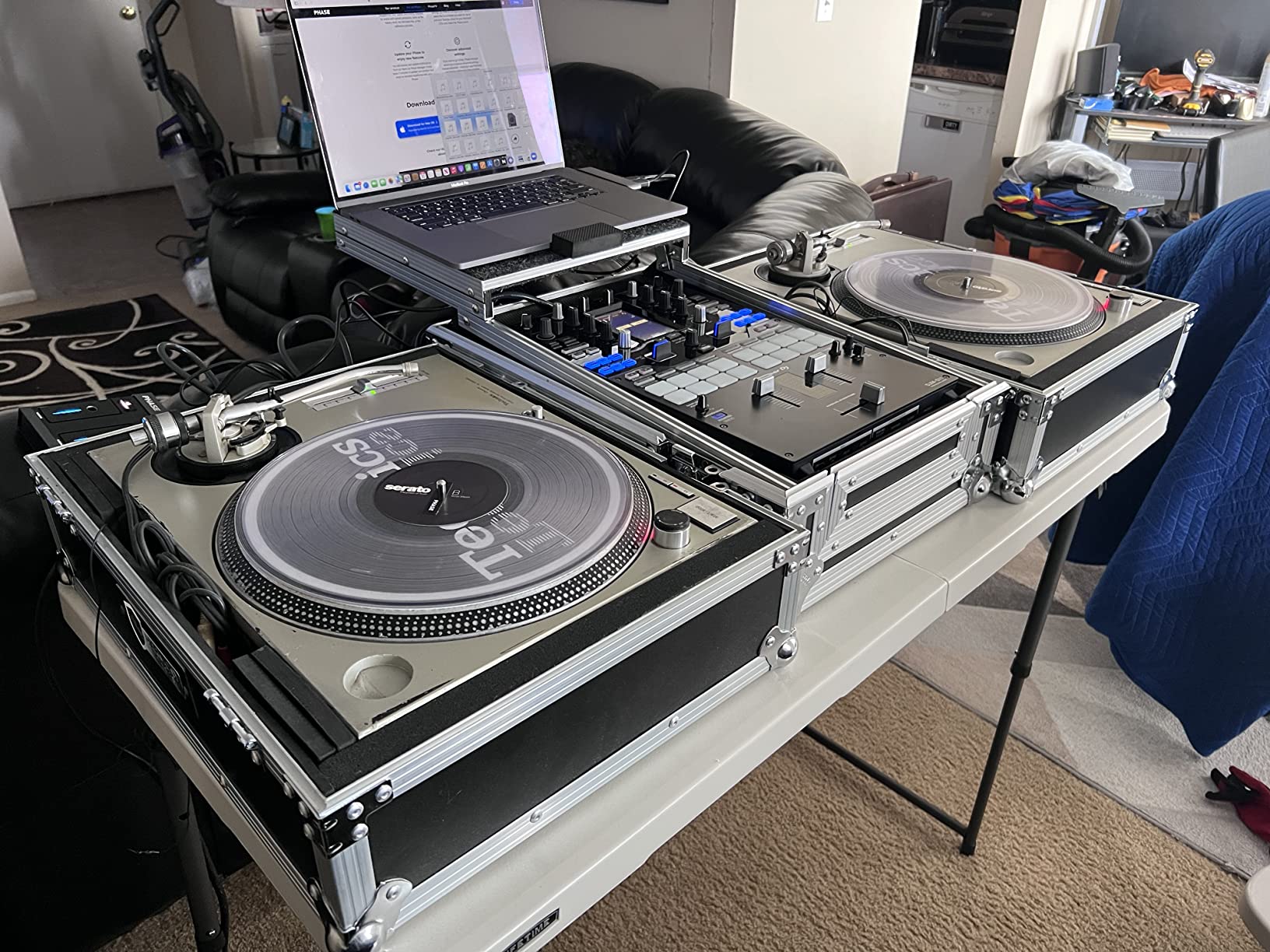
This mixer is for serious turntablists and working scratch DJs who need professional-grade fader performance and FX in one unit. If you compete in battles, stream regularly, or gig at clubs where you need both analog vinyl and DVS capability, the DJM-S11 is the gold standard. It is also the right pick if you switch between Serato and Rekordbox and want one mixer that handles both flawlessly.
What to Watch Out For
The price is the obvious barrier here. At over $2,000, this is an investment that only makes sense if scratching is central to your DJ identity. Beginners will also find the feature set overwhelming, with a learning curve that could slow down your progress. If you are just starting out, the Numark Scratch below covers 80 percent of what this mixer offers at a fraction of the cost.
2. Numark Scratch – Best Value Serato Battle Mixer
- InnoFader is buttery smooth
- Serato DJ Pro and DVS license included
- Plug-and-play setup
- Performance pads and FX toggles
- Balanced XLR output
- No auxiliary input
- All-red LED lighting with no color coding
- DVS vinyl not included
If there is one mixer that scratch DJs on Reddit agree on, it is the Numark Scratch. I have seen it recommended in r/DJs and r/Turntablists more times than I can count, and after testing it, the consensus makes sense. The InnoFader crossfader ships pre-installed, and it delivers a cut feel that rivals faders costing more than this entire mixer.
The included Serato DJ Pro license and DVS expansion are where the value really hits. You are getting a full turntablism software package bundled in, which means you can plug in control vinyl and start scratching digitally without buying anything else. The plug-and-play setup had me running within five minutes of unboxing.
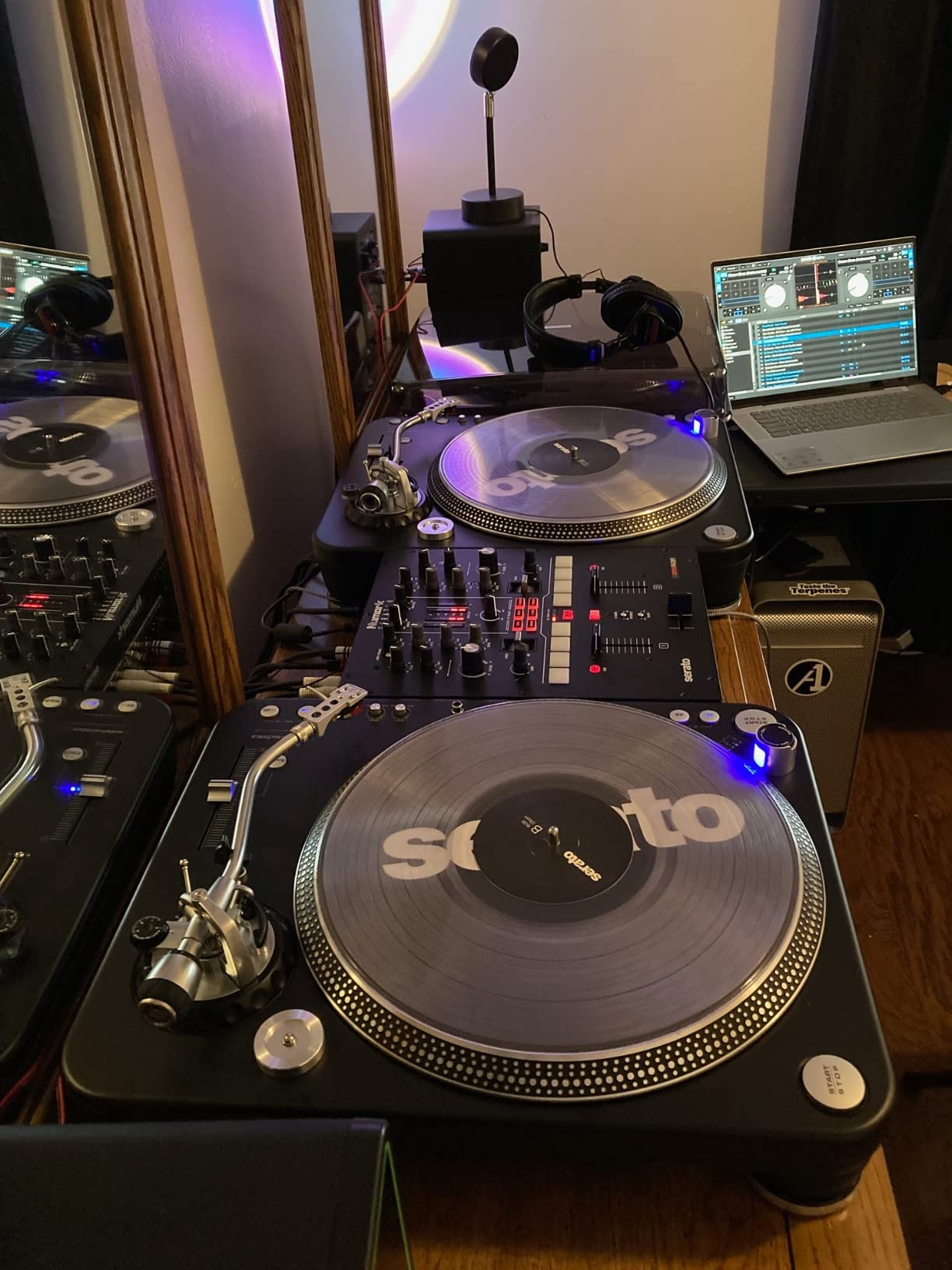
The six direct-access effect selectors with dual paddle triggers let you fire off FX without digging through menus. Combined with the performance pads for cue points and looping, this mixer gives you a surprising amount of creative control for the price. The filter knobs are great for sweeps and transitions between scratch routines.
Build quality is solid for the price tier. The mixer feels dense at 2.6 kilograms, and the knobs have good resistance. You get balanced XLR output, a separate booth output, and dual headphone jacks in both 1/4-inch and 1/8-inch. For a mixer in this range, that connectivity is generous.
Who Should Buy the Numark Scratch
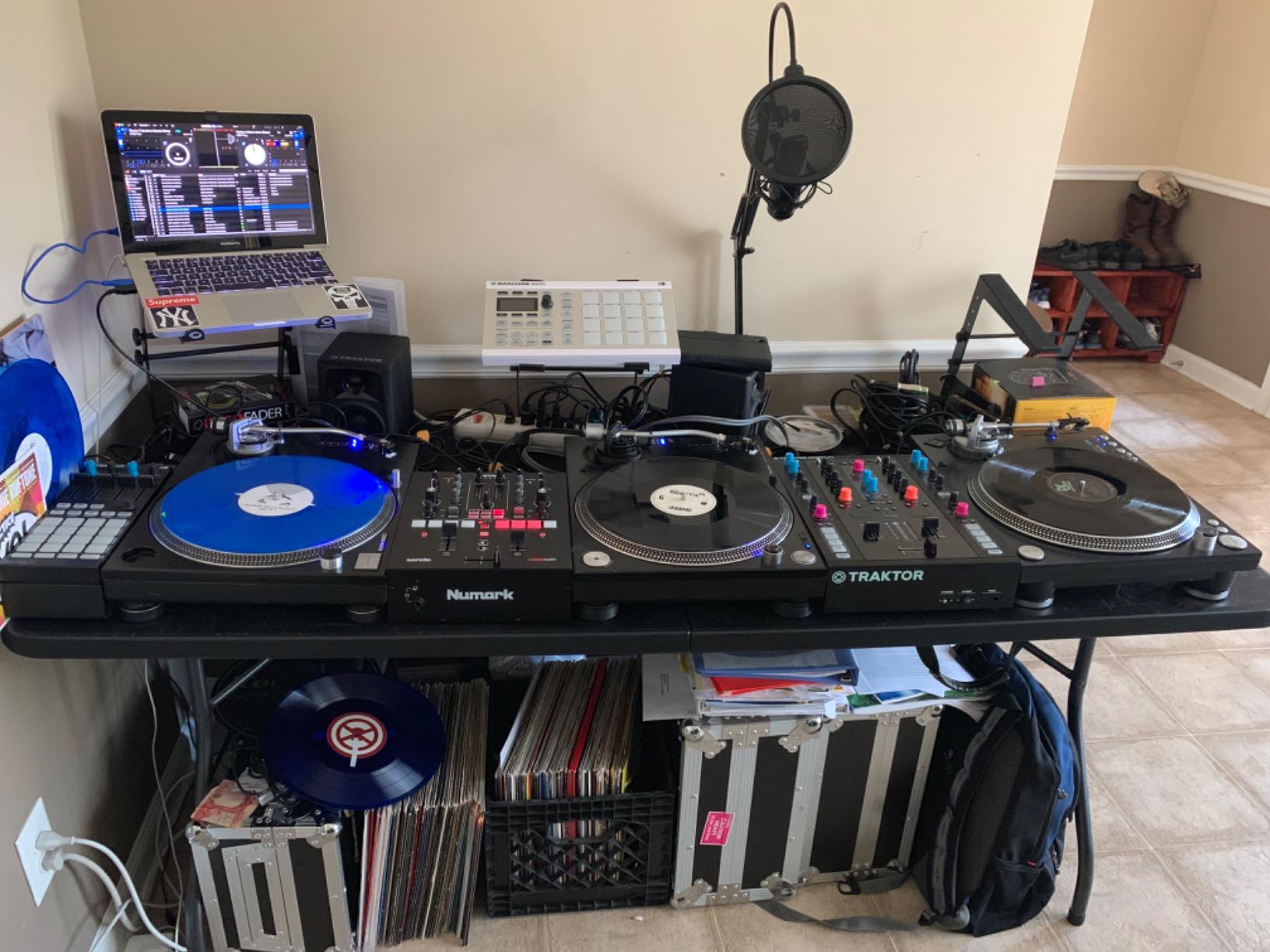
This is the sweet-spot mixer for intermediate scratch DJs who want professional fader performance without spending $2,000-plus. If you are already in the Serato ecosystem or planning to commit to it, the bundled software license makes this one of the best value purchases in all of DJ gear. It is also ideal for bedroom DJs who want a proper battle mixer layout without the battle mixer price.
What to Watch Out For
The all-red LED lighting is a real limitation. Every pad, button, and indicator is red, which means you cannot color-code your cue points or visually distinguish between active states. The lack of an auxiliary input also means you cannot easily route a third device. These are not dealbreakers, but they are reminders that Numark cut costs somewhere to hit this price.
3. Pioneer DJ DJM-250MK2 – Best Entry Scratch Mixer with DVS
- Magvel crossfader smooth for scratching
- Rekordbox DJ license included
- Built-in sound card
- Pioneer sound quality
- Dual headphone outputs
- No booth monitor outputs
- DVS only works with Rekordbox not Serato
- No USB recording
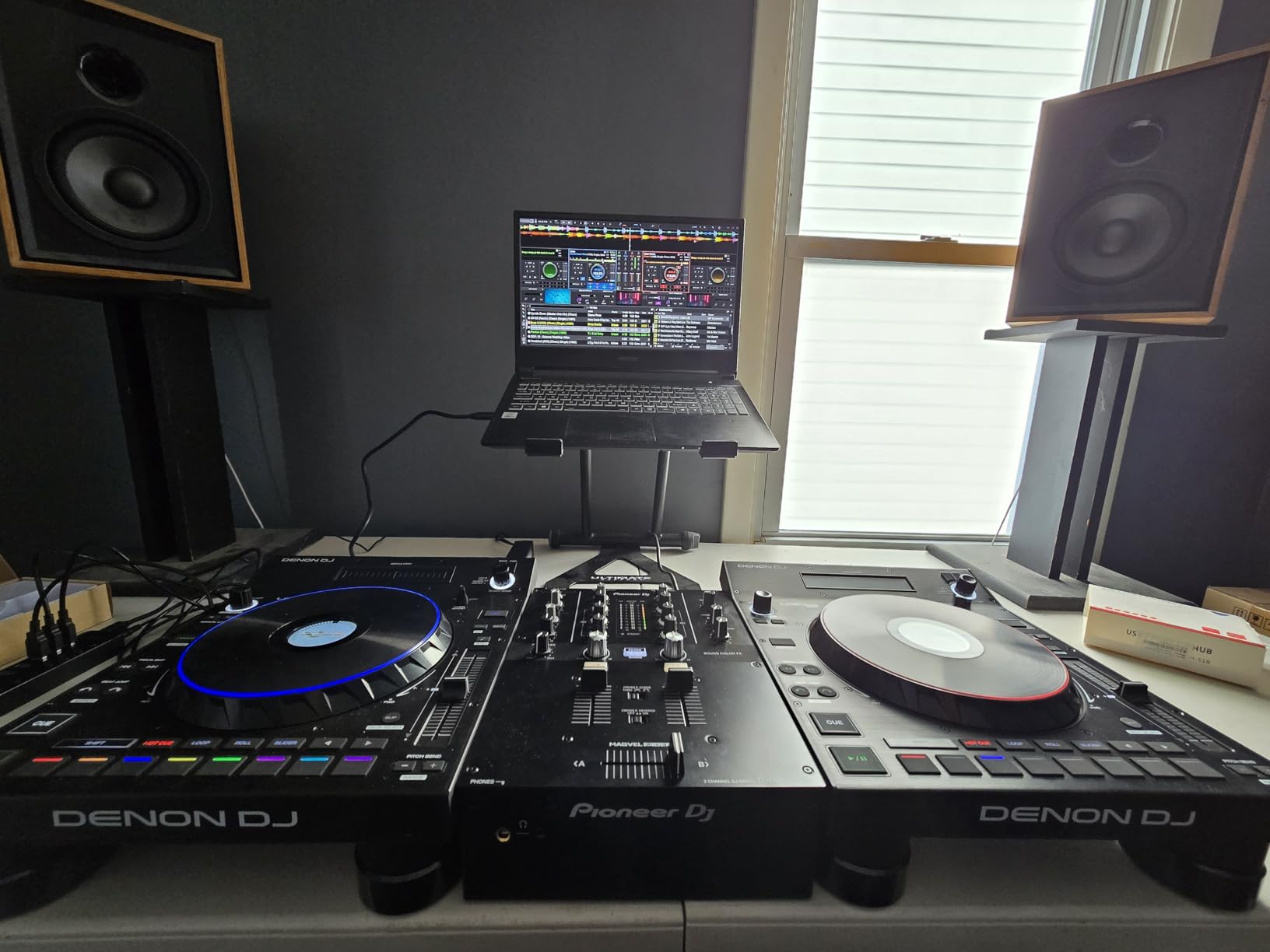
The DJM-250MK2 is Pioneer DJ’s answer to the entry-level scratch mixer question, and it brings the Magvel crossfader to a price point that surprised me. With a 4.6-star average across 174 reviews, this mixer has earned a loyal following among bedroom DJs who want the Pioneer sound without jumping to the DJM-450 or DJM-S11.
The Magvel crossfader on the 250MK2 is not the same unit as the one on the S11, but it still delivers that signature Pioneer smoothness. I found the cut-in time sharp enough for basic transforms and chirps, and the fader held up well during extended practice sessions. The built-in sound card means you can connect directly to your laptop for DVS without buying an external interface.
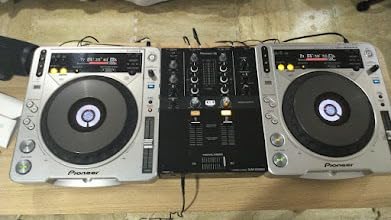
Pioneer includes a Rekordbox DJ license and DVS expansion with this mixer, which adds significant value. If you are in the Rekordbox ecosystem, this is one of the most affordable ways to get a proper DVS scratch setup running. The dual headphone outputs in both 1/4-inch and 3.5mm are a nice touch for back-to-back sessions.
The sound quality is what you expect from Pioneer. Warm, clean, and articulate across the frequency range. The 3-band EQ per channel gives you enough control for basic mixing and EQ-based transitions, though it lacks the full-kill isolation you would find on more expensive units.
Who Should Buy the DJM-250MK2
This is the best DJ mixer for scratching beginners who want to start with Rekordbox DVS and a quality crossfader without spending over $500. It is also a strong pick if you already own Pioneer gear and want consistency in your signal chain. The Magvel fader and bundled software make it a genuine value at this tier.
What to Watch Out For
The DVS only works with Rekordbox, not Serato. If you are committed to Serato DJ Pro, you will want the Numark Scratch instead. The lack of booth outputs also limits this mixer for anyone thinking about playing out at venues. This is firmly a bedroom and home studio mixer.
4. Pioneer DJ DJM-450 – Compact Mixer with Sound Color FX
- Sound Color FX from DJM-900 Nexus lineage
- Compact and well-built
- Great sound quality
- TRAKTOR SCRATCH compatible
- Mobile app FX expansion
- No booth monitor outputs
- Limited professional connectivity
- Some users find it overpriced
- Sparse feature set for the tier
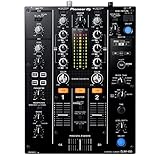
The DJM-450 sits in an interesting middle ground in the Pioneer lineup. It brings the Sound Color FX architecture from the flagship DJM-900NXS into a compact 2-channel format. During testing, I found the FX quality genuinely impressive for the size, with the filter and noise effects adding character to scratch routines.
The crossfader is functional but not a dedicated battle fader. It handles scratches adequately, but if you are coming from an InnoFader or Magvel pro, you will notice the difference in cut sharpness. Where this mixer shines is in its versatility as a hybrid mixing and scratching tool.
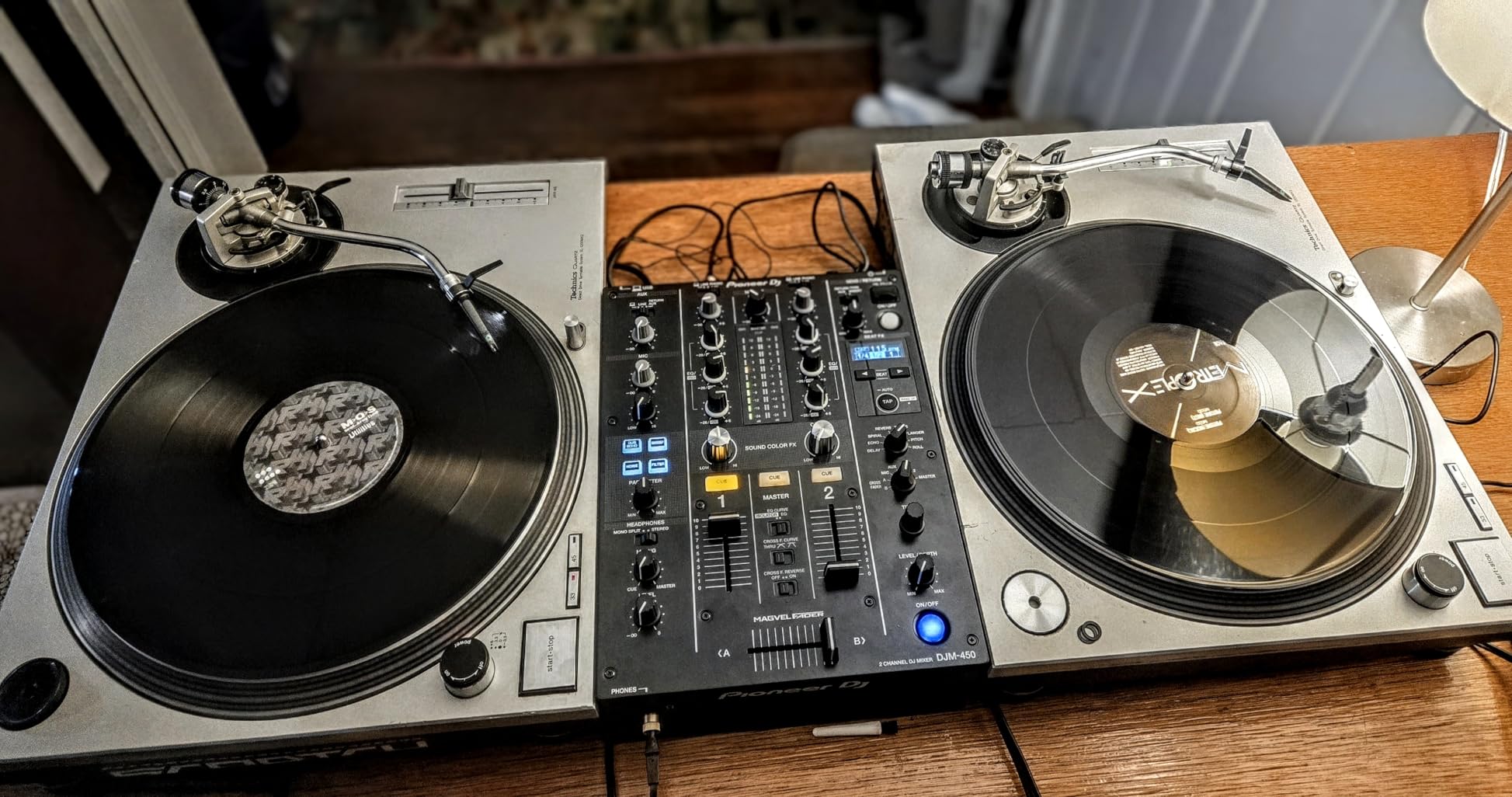
The USB connectivity supports Pioneer’s mobile app, which lets you expand the FX options via your phone or tablet. I tested this with an iPad and found it opened up creative routing possibilities that you simply do not get from other mixers in this range. The built-in sound card handles DVS duty for TRAKTOR SCRATCH.
Sound quality is consistent with Pioneer’s reputation. The preamps are clean, and the overall tonal character is warm without being colored. With 76 percent of reviews giving it 5 stars, users clearly appreciate what this mixer does well, even if the spec sheet looks thin on paper.
Who Should Buy the DJM-450
This mixer suits hobbyist DJs who split their time between mixing and light scratching. If you want Pioneer’s Sound Color FX in a compact format and value the Pioneer ecosystem, the DJM-450 delivers. It is also a good pick for DJs who use TRAKTOR SCRATCH and want a Pioneer-branded interface.
What to Watch Out For
The lack of booth outputs limits gig viability. The crossfader is not designed for heavy battle scratching, so hardcore turntablists will want something with a pro-grade fader. At this price point, some users feel the feature set does not match the cost, especially when the Numark Scratch offers an InnoFader and Serato license for less.
5. Numark M2 – Best Budget Scratch Mixer Under $150
- Replaceable crossfader with slope and reverse
- 3-band EQ on each channel
- Rack mountable design
- All-metal construction
- Great value for beginners
- Knobs and sliders feel loose
- EQ has large dead zones
- Unbalanced mic input
- Toggle switches easy to bump
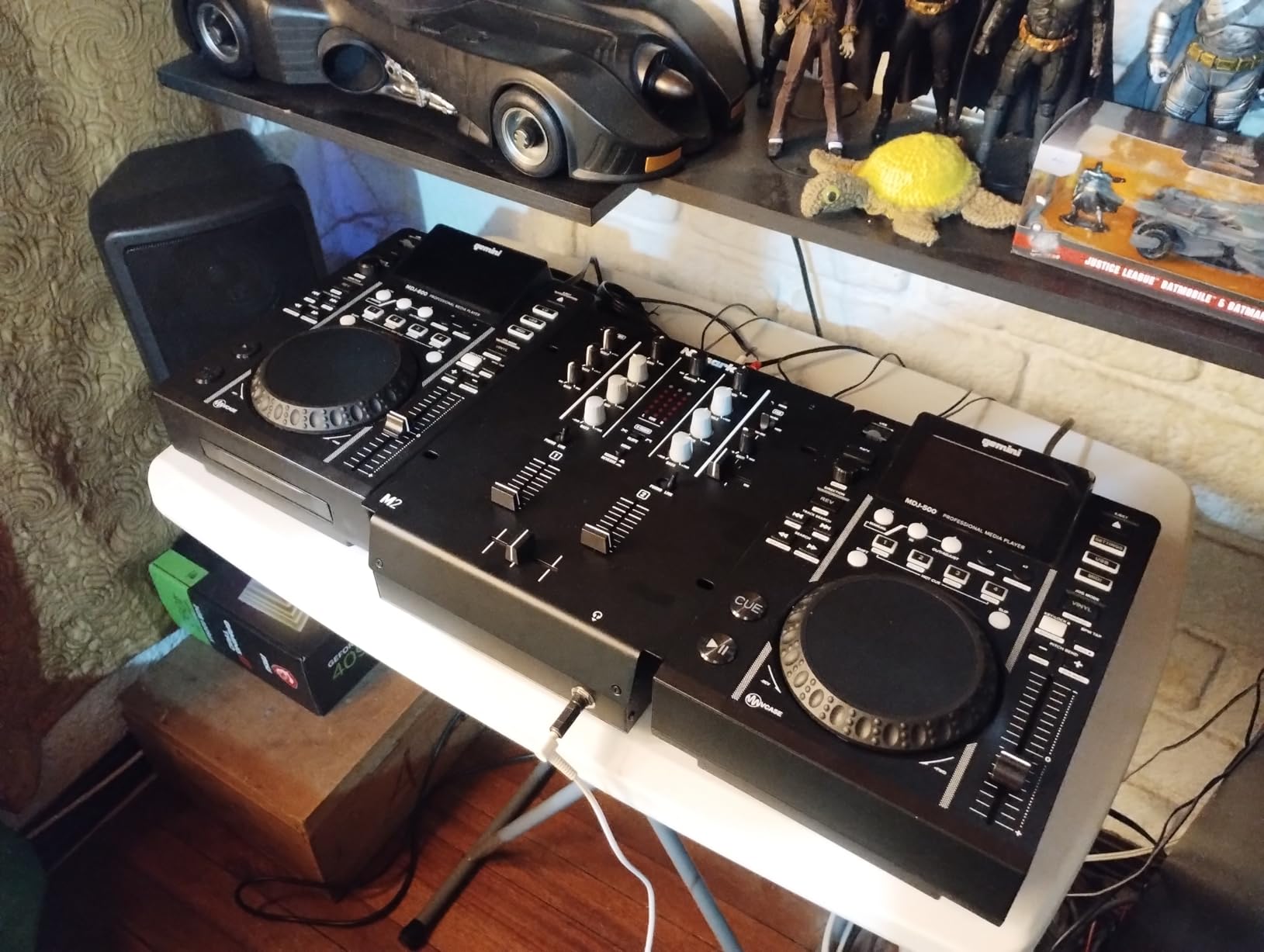
The Numark M2 is the mixer I recommend to anyone who asks about getting into scratching without spending serious money. At its price point, getting a replaceable crossfader with reverse and slope controls is remarkable. I tested this mixer with a pair of entry-level turntables and was genuinely surprised by how usable it is for learning scratch fundamentals.
The 3-band EQ on each channel gives you frequency control that most budget mixers skip. You can isolate frequencies for EQ-based cuts and transitions, which adds creative options beyond basic crossfader work. The crossfader itself is replaceable, meaning when it wears out, you swap it rather than replacing the whole mixer.
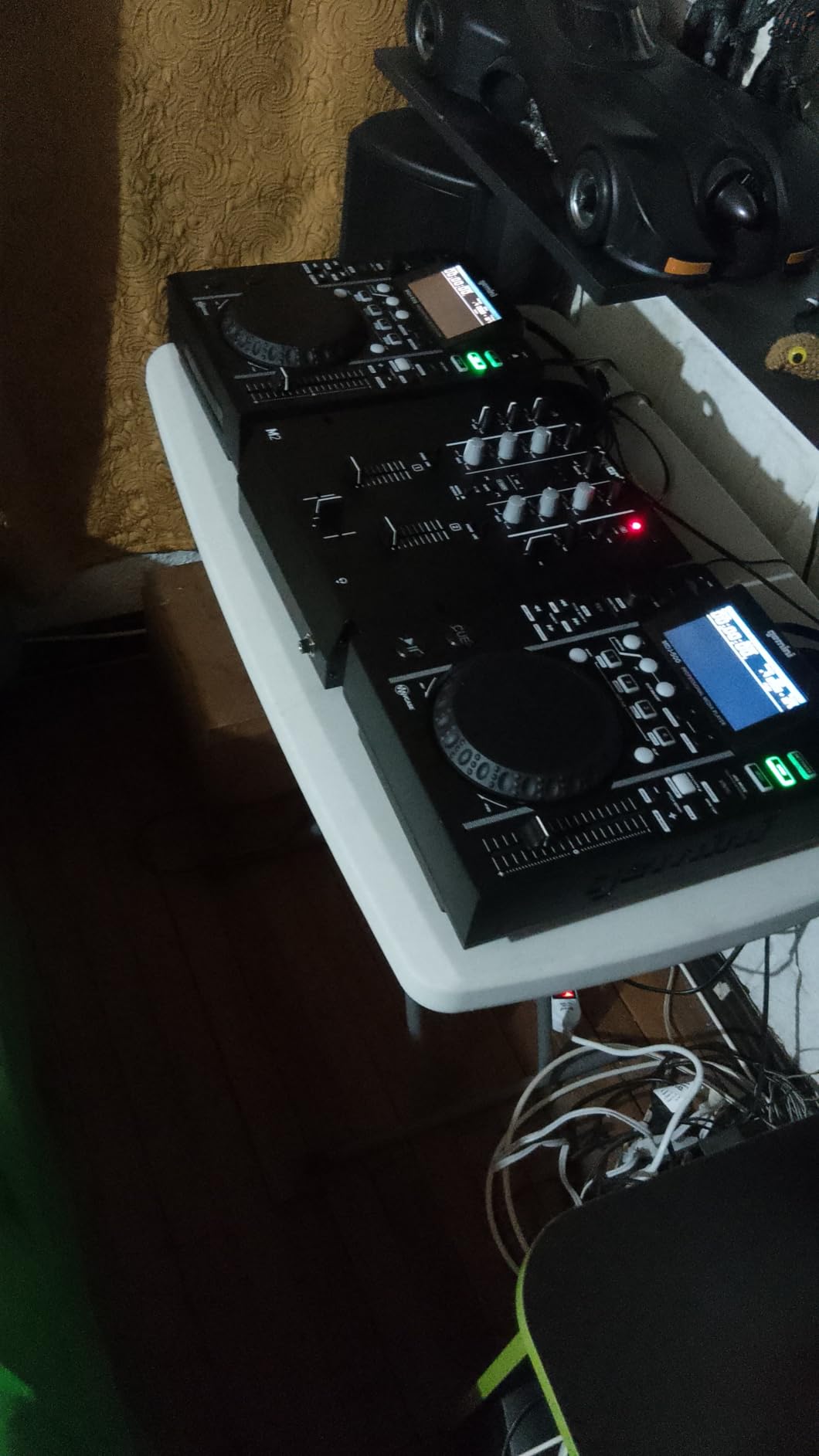
Build quality is where the budget nature shows through. The all-metal chassis is solid, but the knobs and sliders have a loose, plasticky feel. During aggressive scratching, I noticed the fader could feel mushy compared to a Magvel or InnoFader. The EQ knobs have noticeable dead zones that make precise adjustments tricky.
The rack-mountable design is a bonus for DJs who want to integrate this into a fixed setup. With phono inputs for two turntables and line inputs for additional sources, the M2 covers the connectivity basics that a beginner needs to get scratching.
Who Should Buy the Numark M2
This is the best DJ mixer for scratching under $150, full stop. If you are a complete beginner buying your first setup, or if you need a backup mixer for practice sessions, the M2 delivers everything you need to learn crossfader technique. It is also a solid choice for DJs building a rack-mounted home setup on a budget.
What to Watch Out For
The fader feel is the main limitation. If you develop your technique on this mixer and then try a pro battle mixer, the upgrade will be dramatic. The unbalanced mic input and loose knobs are reminders that costs were cut to hit this price. This is a learning tool, not a performance instrument.
6. Numark M6 USB – Best Budget 4-Channel Mixer
- 4 channels at an accessible price
- Built-in USB audio interface
- Balanced XLR plus multiple RCA outputs
- Replaceable crossfader
- All-metal construction
- Internal sound card is basic single stereo pair
- Headphone cue limitations
- Faders can get stiff over time
- No built-in effects
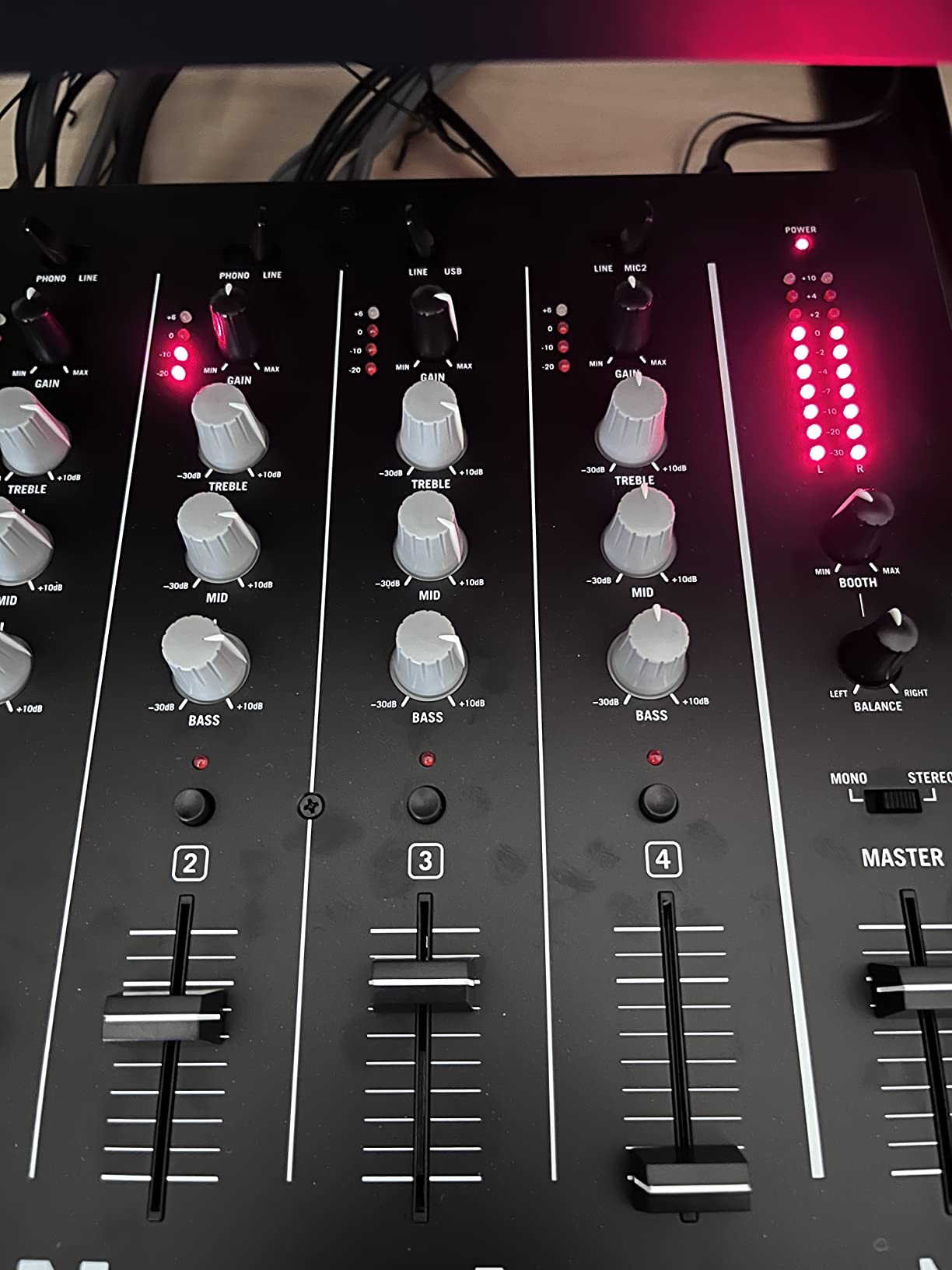
The Numark M6 USB is not a dedicated battle mixer, but it earns a spot on this list because it offers four channels at a price where most competitors give you two. For scratch DJs who also mix, having the extra channels means you can run turntables alongside CDJs, a phone, or a laptop without swapping cables.
The replaceable crossfader has slope control, which is the minimum requirement for usable scratching. It is not an InnoFader or Magvel, but it handles basic scratch techniques respectably. I found the cut sharpness adequate for learning and casual practice, though serious turntablists will want an upgrade eventually.
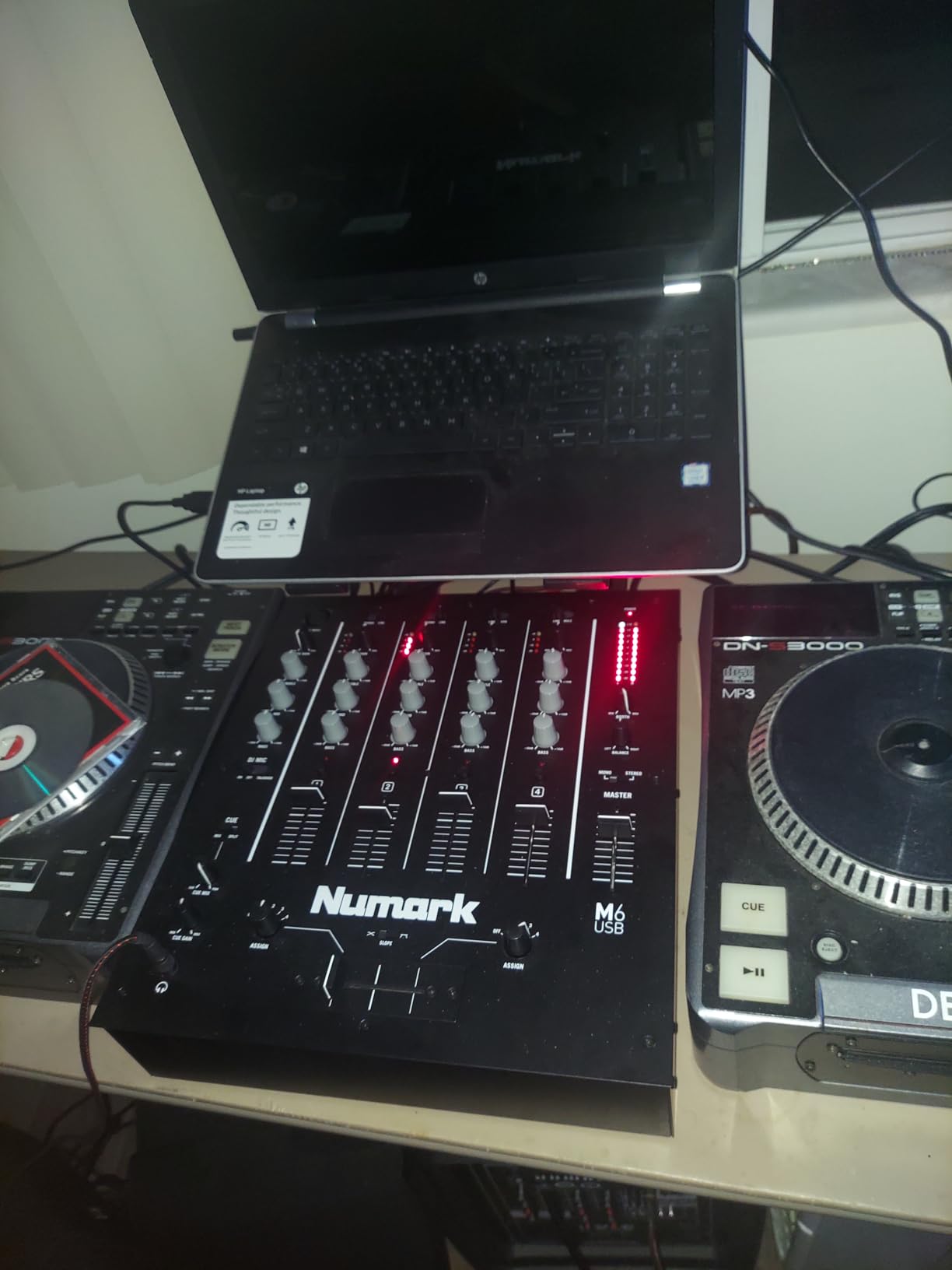
The built-in USB audio interface is the headline feature. It lets you connect directly to your computer for recording or software playback. However, the interface only handles a single stereo pair, which means you will need an external interface for proper DVS use with Serato or Traktor. This is a notable limitation to be aware of.
The output section is generous for the price. You get master RCA, booth RCA, record RCA, and balanced XLR. That kind of connectivity usually costs significantly more. The 3-band EQ per channel with dedicated cue controls rounds out a feature set that makes this mixer surprisingly capable.
Who Should Buy the Numark M6 USB
This is the right choice for DJs who need four channels on a budget and want to incorporate scratching into a broader mixing workflow. If you run multiple sources, record your sets via USB, and want XLR outputs for a PA system, the M6 USB covers all of it. It is also a strong option for home studios that need a versatile mixer.
What to Watch Out For
The crossfader is not built for aggressive battle scratching. The internal audio interface is basic, so do not expect to run full DVS without additional hardware. The headphone cue system has known limitations where the cue signal overpowers the mix, which can frustrate precise monitoring during complex routines.
7. Behringer NOX101 – VCA Crossfader with Full-Kill EQ
Behringer PRO MIXER NOX101 Premium 2 Channel DJ Mixer with Full VCA-Control and Ultraglide Crossfader
- VCA crossfader with adjustable curve
- Full-kill EQ filters
- Superior preamp quality
- XLR output at budget price
- Sturdy metal construction
- No master cue function
- No built-in effects
- Faders lack resistance for heavy scratching
- Occasional QC issues
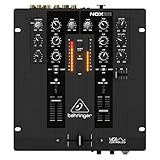
The Behringer NOX101 is a sleeper pick in the budget scratch mixer category. Its VCA-controlled Ultraglide crossfader is a step above what you typically find at this price, and the full-kill EQ on each channel gives you the kind of frequency isolation that scratch DJs use for creative transitions and beat juggling.
I compared the NOX101 side by side with the Numark M2, and the preamp quality on the Behringer was noticeably cleaner. The VCA crossfader has curve adjustment on both the crossfader and individual channel faders, which lets you dial in the cut feel for your scratching style. The rubber grips on the EQ dials provide better tactile control during fast adjustments.
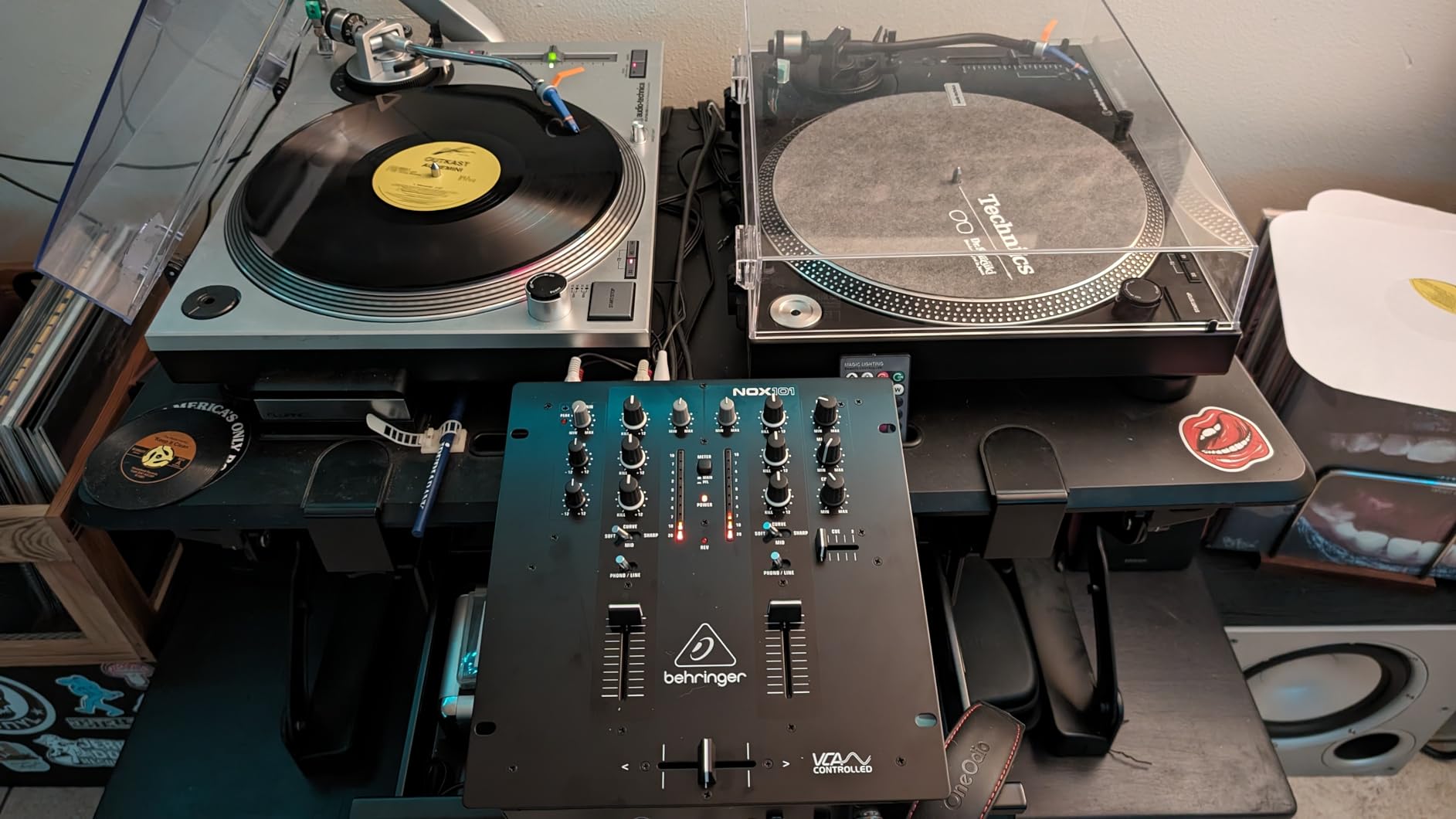
XLR output is a standout feature at this price. Most budget mixers only offer RCA, but the NOX101 gives you balanced XLR, TRS, and RCA connectivity. This makes it viable for small gigs and PA systems where balanced connections matter for noise rejection over longer cable runs.
The build is solid metal throughout, and the mixer feels denser than its weight suggests. However, the faders lack the resistance and snap that serious scratch DJs prefer. The Ultraglide is smooth, but it does not have the magnetic return feel of a Magvel or InnoFader.
Who Should Buy the NOX101
This mixer is ideal for beginner to intermediate DJs who want VCA crossfader technology and full-kill EQ without spending more than $150. The XLR output also makes it viable for small gigs and events. If you value sound quality and connectivity over fader precision, the NOX101 delivers strong value.
What to Watch Out For
The faders lack the resistance needed for advanced scratch techniques. Some users have reported QC issues with internal components, so buying from a retailer with a good return policy is wise. The absence of a master cue function is a workflow limitation compared to the Numark M2.
8. Behringer DX626 – 3-Channel Mixer with BPM Counter
Behringer Pro Mixer Dx626 Professional 3-Channel Dj Mixer With Bpm Counter, Black
- 3 channels at budget price
- Ultraglide fader rated 500k cycles
- 3-band kill EQ at -32 dB
- Studio-grade mic input
- Low noise design at 15 dB
- BPM counter often unreliable
- Crossfader slope not adjustable
- No real USB connectivity
- Volume dip at fader center
The Behringer DX626 offers something different from the standard 2-channel battle mixer: a third channel. For DJs who want to scratch on two turntables while running a backup track or sampler on a third input, this layout adds flexibility. The Ultraglide crossfader is rated for 500,000 life cycles, which is impressive for the price tier.
The 3-band kill EQ on each channel goes to -32 dB, giving you near-full isolation for creative frequency manipulation. During testing, I found the kill depth useful for EQ-based scratches and transitions that go beyond simple crossfader cuts. The low noise floor at 15 dB means your signal stays clean even with the gains pushed.
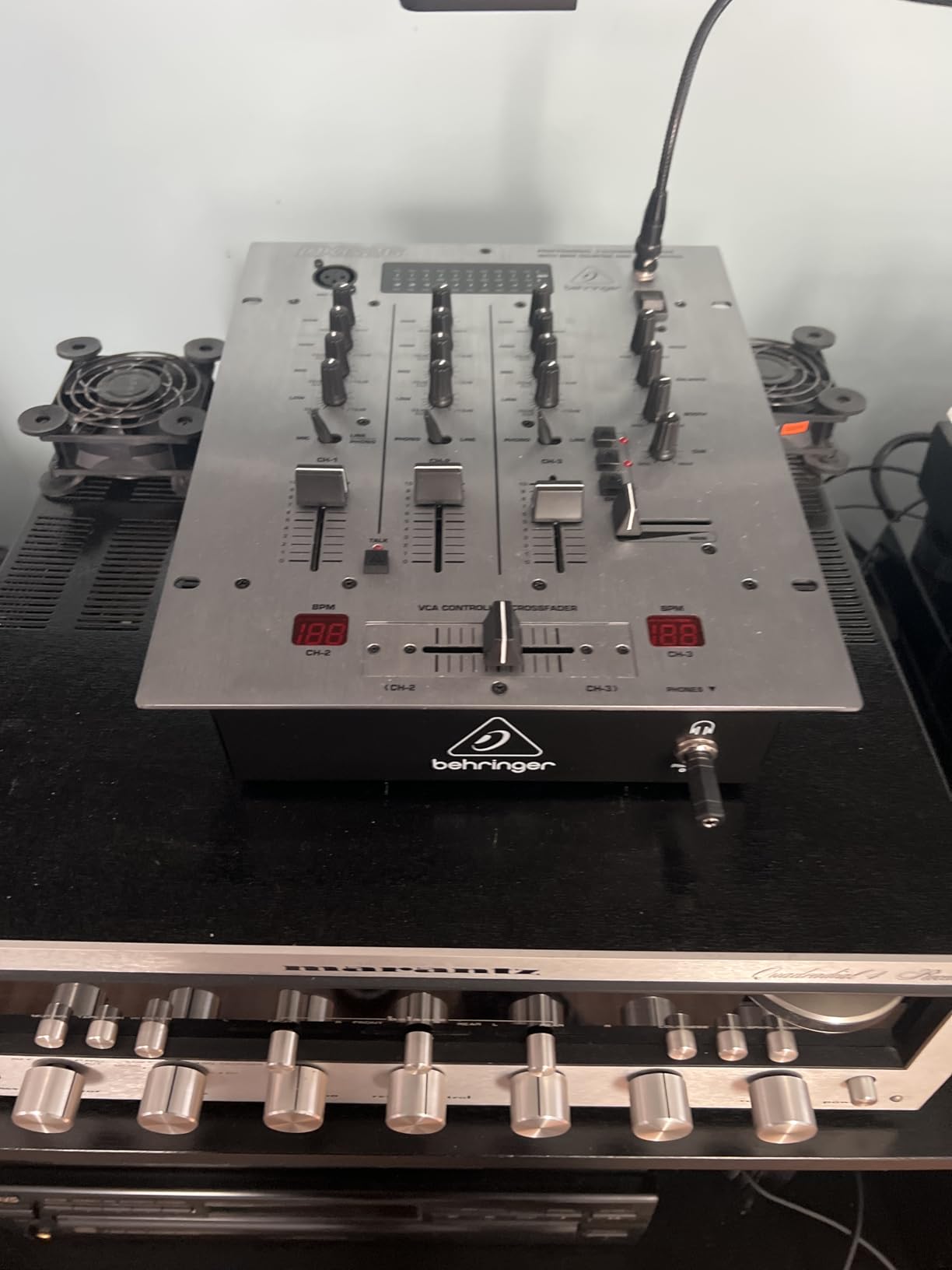
The dual BPM counter is the headline feature that Behringer promotes, but in practice, it is the weakest part of this mixer. Multiple users report that the BPM counter is unreliable or fails to activate. I would treat it as a bonus rather than a deciding factor when evaluating this mixer.
The switchable ULN microphone input on one channel is a nice touch for DJs who MC or need to make announcements during sets. The PFL function with master mix option gives you flexible monitoring for cueing up tracks during complex routines.
Who Should Buy the DX626
This mixer suits DJs who need three channels on a budget and want a durable crossfader for moderate scratching. If you mix more than you scratch but still want crossfader capability for transitions, the DX626 straddles both worlds. The low noise design also makes it viable for recording setups.
What to Watch Out For
The crossfader slope is not adjustable, which limits your ability to fine-tune the cut feel for scratching. The volume dip at the center point of the crossfader is noticeable and can disrupt smooth transitions. Despite the listing mentioning USB, the connectivity is limited and not what most DJs would expect from a USB mixer.
9. Behringer DJX900USB – 5-Channel Mixer with Optical Fader
- 5 channels with phono inputs
- Contact-free optical crossfader with adjustable tension
- 24-bit built-in effects
- USB recording and playback
- Good tactile feedback
- BPM counter inaccurate
- Effects unit not intuitive
- Lower output gain
- Build feels less premium
- LEDs only light at high volume
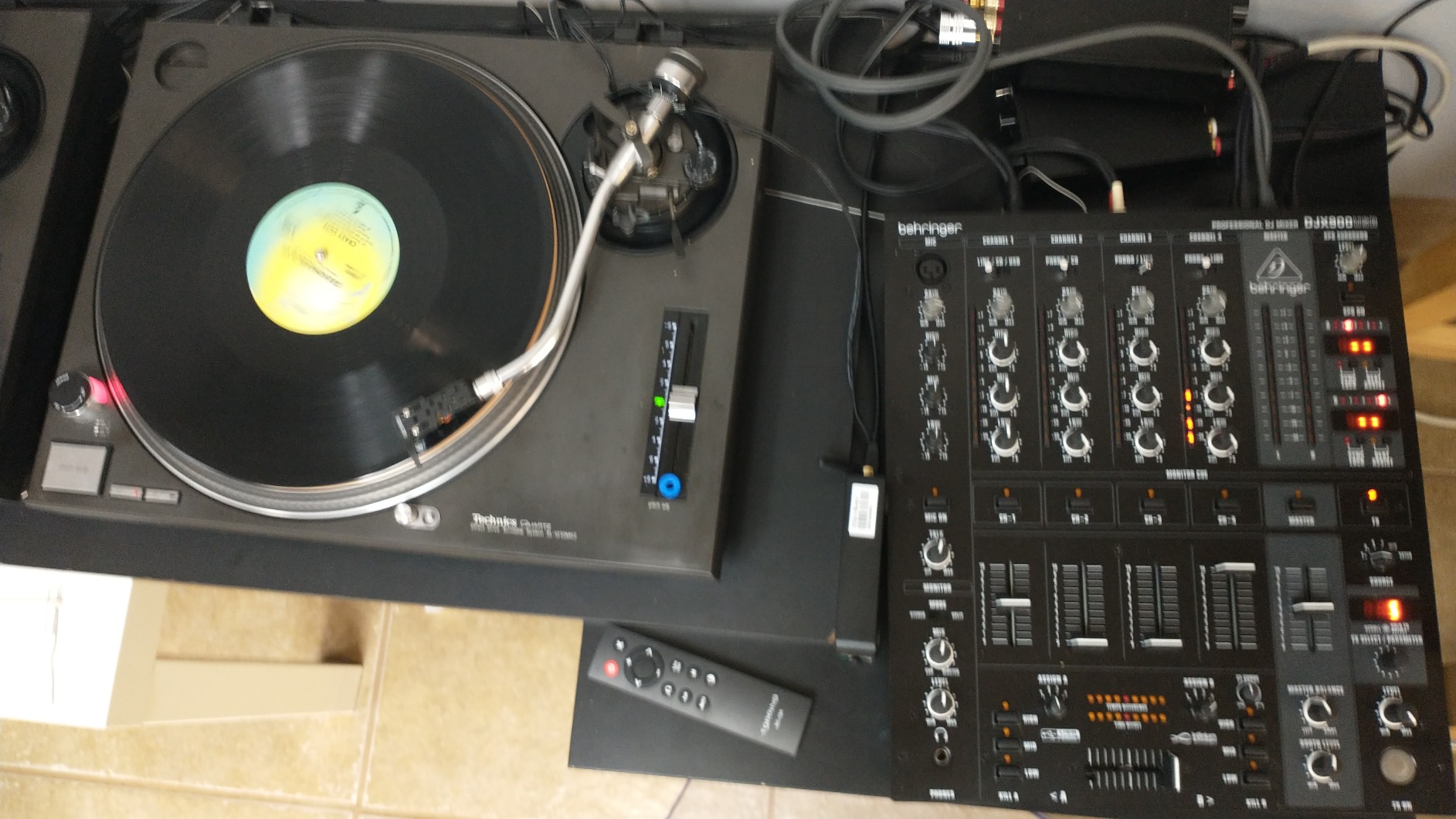
The Behringer DJX900USB is the most feature-dense mixer in this lineup, offering five channels, a contact-free optical crossfader, 24-bit digital effects, and a USB interface all in one unit. For DJs who want maximum channel count and features per dollar, this mixer packs a lot into its frame.
The Infinium optical crossfader is the key feature for scratch DJs. Because it is contact-free, there are no physical contacts to wear out, which theoretically means longer fader life. I found the adjustable tension useful for dialing in the right feel, and the optical tracking provides consistent performance across the full travel of the fader.
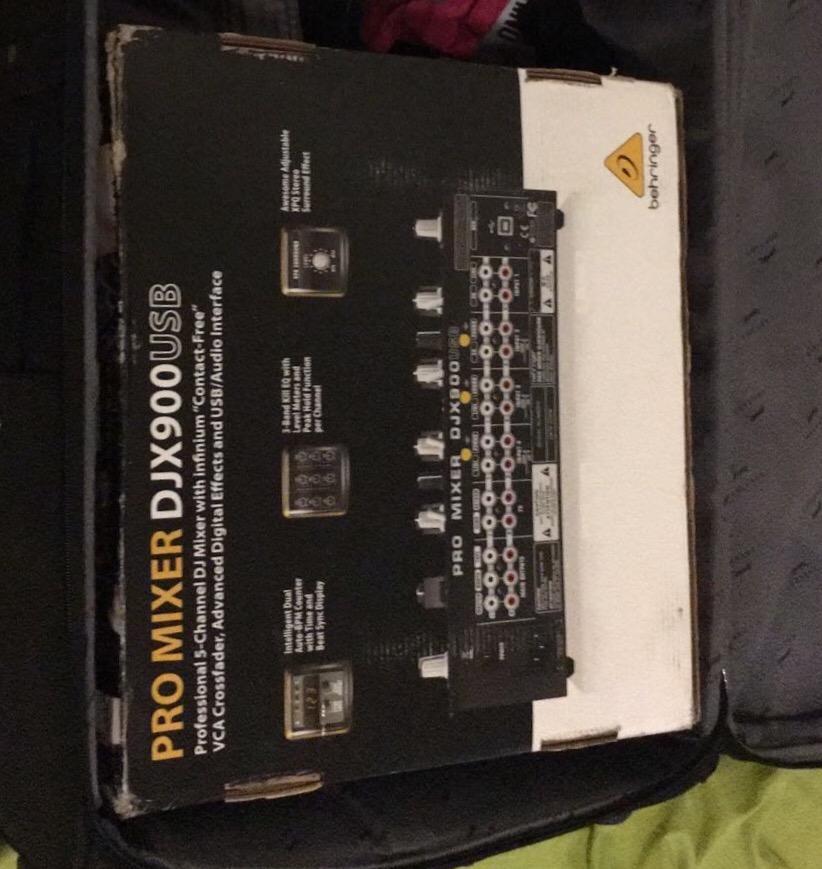
The 24-bit digital effects add creative options that most mixers at this price lack. You get parameter control over the effects, allowing for everything from subtle reverb to dramatic filter sweeps. However, the effects routing is not intuitive, and I had to spend time with the manual to understand the signal flow.
The built-in USB interface handles recording and playback without drivers on Mac and PC. This makes the DJX900USB viable as a recording mixer for capturing practice sessions or producing mixes. The 62 percent 5-star rating reflects that most users appreciate the value, even if the build feels less premium than Pioneer or Rane gear.
Who Should Buy the DJX900USB
This mixer is for DJs who want maximum channel count and features without spending premium money. If you run a complex setup with multiple turntables, CDJs, and a laptop, the five channels give you room to grow. The optical crossfader also makes it viable for DJs who scratch regularly and want fader longevity.
What to Watch Out For
The build quality feels cheaper than the price suggests, with plastic components that do not inspire long-term confidence. The BPM counter is consistently inaccurate across user reports. The lower output gain means you may need to push your speakers or amplifier harder than with other mixers. The effects unit requires patience to learn.
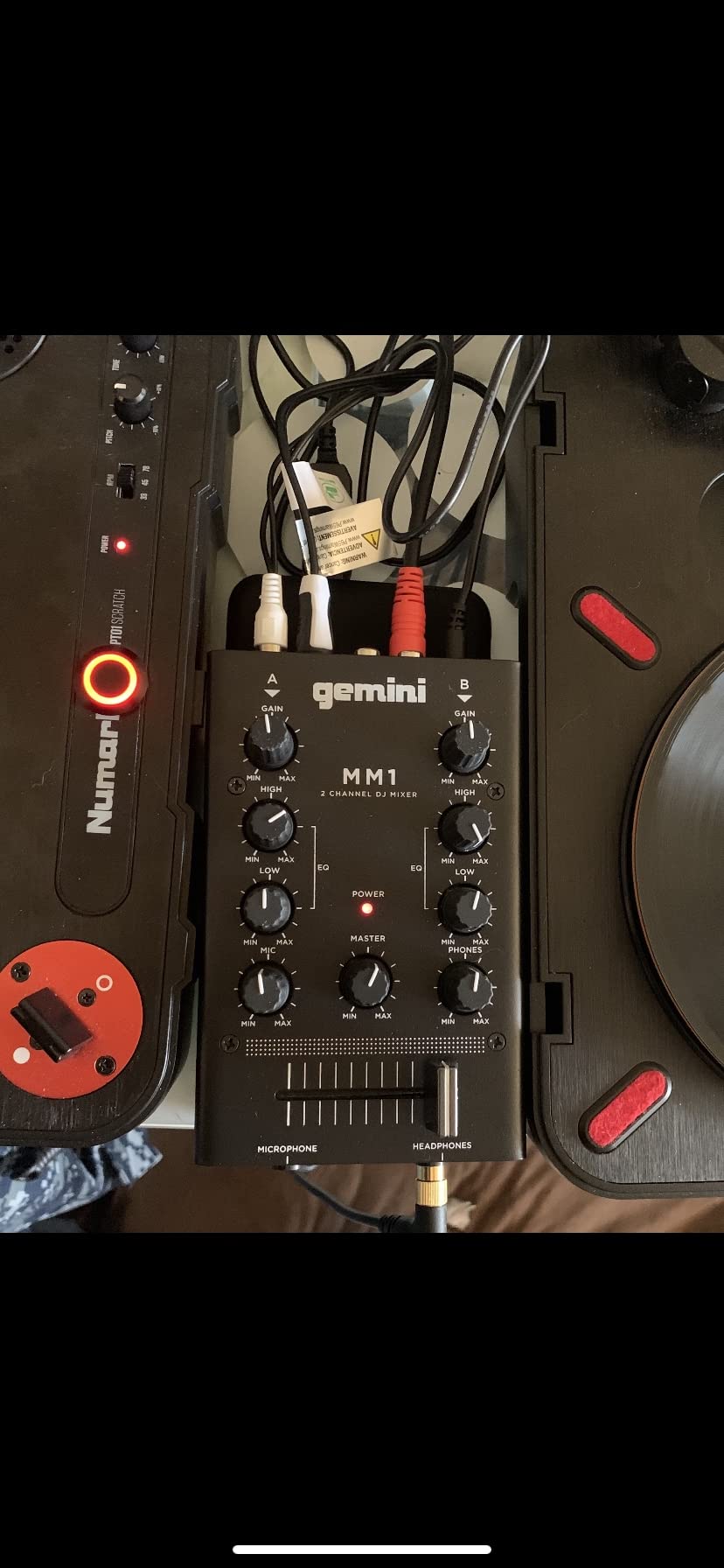
10. Gemini MM1 – Ultra-Portable Scratch Mixer
- Fits in the palm of your hand
- All-metal rugged construction
- Full-size crossfader with smooth action
- Adjustable gain per channel
- Extremely affordable
- No built-in phono preamp
- Low output level requires amplification
- 12KHz whine reported by some users
- Threaded case screws can strip
The Gemini MM1 is the most compact mixer in this lineup, and arguably the most portable scratch mixer on the market. At 1.2 pounds and small enough to fit in a backpack, it is designed for DJs who need a mixer they can take anywhere. I was skeptical about scratching on something this small, but the full-size crossfader surprised me with its smooth action.
The all-metal body construction gives the MM1 a durability that belies its price. This is not a toy. The full-size crossfader has a smooth sliding action that handles basic scratch techniques, and the adjustable gain per channel lets you balance levels between your turntable and line sources.
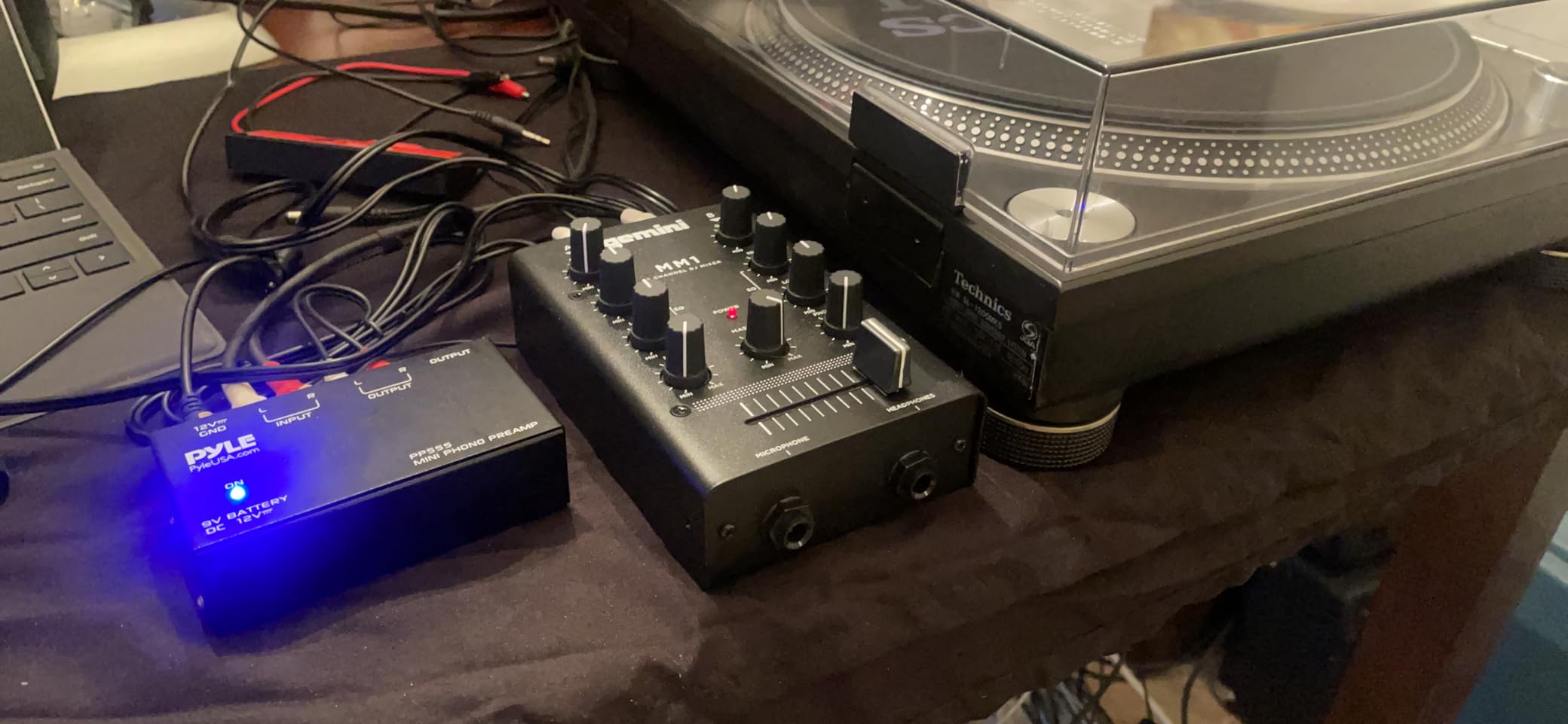
The 2-band EQ is basic but functional. You get high and low frequency control with adjustable gain, which is enough for simple mixing and tonal shaping. The lack of a built-in phono preamp means you will need an external preamp if you are connecting turntables directly, which adds to the total cost.
Some users report a faint 12KHz whine in the output and low output levels that require additional amplification. These are real limitations for a mixer at this price point. The Bluetooth variant (MM1BT) has additional connectivity issues due to the metal case acting as a Faraday cage, so stick with the wired version.
Who Should Buy the Gemini MM1
This mixer is for DJs who need maximum portability at minimum cost. If you do mobile gigs, livestream from different locations, or want an ultra-compact backup mixer, the MM1 fits the bill. It is also a viable option for absolute beginners who want to try DJing before committing to a larger investment.
What to Watch Out For
The lack of a phono preamp means you need additional hardware to connect turntables. The reported whine and low output levels indicate the audio circuitry is basic. This mixer is best understood as an emergency or practice tool rather than a primary performance instrument.
How to Choose the Best DJ Mixer for Scratching
Choosing a scratch mixer comes down to understanding which features actually matter for turntablism versus which are marketing noise. I have broken down the key factors based on what scratch DJs on forums and in our testing consistently prioritize.
Crossfader Quality Is Everything
The crossfader is the heart of any scratch mixer. A good scratch crossfader has a short cut-in time (the distance the fader travels before audio cuts), adjustable curve control, and a smooth feel that does not wear out quickly. The Magvel fader on Pioneer DJ mixers and the InnoFader on Numark mixers are the two gold standards. VCA faders like the Behringer Ultraglide are acceptable for beginners but lack the precision of magnetic faders. If you are serious about scratching, do not compromise on crossfader quality.
Fader durability is a topic that no competitor covers in depth, so I will address it here. Contact-based faders wear out through physical friction, typically lasting 100,000 to 500,000 cycles depending on quality. Optical faders like the Behringer Infinium eliminate physical contact entirely, theoretically extending lifespan indefinitely. Magnetic faders like the Magvel and InnoFader use magnetic sensing, which also avoids physical wear. For daily practice, expect to replace a contact-based fader within 1-2 years, while magnetic and optical faders should last significantly longer.
Channel Count: 2 vs 4
Battle mixers are almost always 2-channel. This is intentional, because fewer channels mean a narrower footprint that puts the crossfader closer to your turntables. If your primary goal is scratching, 2 channels is the right choice. Four-channel mixers like the Numark M6 USB are better if you split time between scratching and mixing with multiple sources. Three and five-channel options like the Behringer DX626 and DJX900USB make sense for DJs who run complex rigs.
Software Compatibility: Serato vs Rekordbox
Software compatibility is the second most important factor after crossfader quality. Serato DJ Pro is the dominant platform for turntablism, with features like Scratch Bank, Serato Stems, and deep DVS integration. Rekordbox is Pioneer’s ecosystem, and it has been gaining ground with DVS improvements. The Pioneer DJM-S11 supports both, which is rare. The Numark Scratch is Serato-only with a bundled license. The DJM-250MK2 is Rekordbox-only. Before buying, confirm which platform you plan to use and ensure the mixer supports it.
Forum users consistently report that software compatibility issues between Serato and Rekordbox are a major pain point. Buying a mixer with a bundled license for your preferred platform avoids the hassle of purchasing and activating software separately.
DVS Compatibility
DVS (Digital Vinyl System) lets you control digital audio files using control vinyl on real turntables. This is essential for modern turntablism, as it gives you access to your entire digital library while maintaining the tactile feel of vinyl. Look for mixers with built-in sound cards that support DVS natively. The Numark Scratch, DJM-250MK2, and DJM-S11 all include DVS licenses. Mixers without built-in sound cards require an external interface for DVS use, which adds cost and complexity.
Build Quality and Connectivity
A scratch mixer takes physical abuse. Look for all-metal construction, replaceable crossfaders, and knobs with good resistance. Connectivity should include phono inputs for turntables, balanced XLR outputs for PA systems, and headphone jacks. Booth output is important if you plan to play out. Budget mixers often skip XLR and booth outputs to save cost, so check the spec sheet carefully.
Budget Tiers Explained
Under $150, you are looking at entry-level mixers like the Numark M2 and Behringer NOX101. These are learning tools with functional but not pro-grade crossfaders. From $200 to $500, mixers like the Numark Scratch and Pioneer DJM-250MK2 offer genuine battle mixer capability with quality faders and bundled software. Over $800, you enter professional territory with the DJM-450 and DJM-S11, where build quality, FX, and fader precision reach performance standards.
If you are exploring audio gear beyond DJing, our guide to podcast mixers for home studios covers options for recording and streaming setups.
Frequently Asked Questions
What is the best DJ controller for scratching?
The best DJ controller for scratching depends on your budget and software preference. For a dedicated scratch mixer experience, the Pioneer DJ DJM-S11 is the top choice with its Magvel crossfader and dual Serato/Rekordbox support. For value, the Numark Scratch with its InnoFader and included Serato DJ Pro license is the most recommended option among scratch DJs.
What do DJs use to scratch records?
DJs use a crossfader on a DJ mixer to scratch records. The crossfader allows rapid cutting of audio between channels, which creates the characteristic scratch sound. Turntablists also use the platter to manipulate vinyl forward and backward. A dedicated scratch or battle mixer has a crossfader with adjustable curve and short cut-in time specifically designed for this technique.
Can you scratch on any DJ controller?
You can technically scratch on any DJ controller with a crossfader, but the experience varies dramatically. Controllers with jog wheels and cheap faders feel frustrating for scratching, which is why forum users consistently recommend dedicated battle mixers. A proper scratch mixer like the Numark Scratch or Pioneer DJM-S11 has a magnetic crossfader with the sharp cut-in time and adjustable curve that scratching requires.
Do I need a battle mixer for scratching?
You do not strictly need a battle mixer for scratching, but it makes a significant difference. A battle mixer is designed with a short-throw crossfader, adjustable curve control, and a layout that positions the fader close to the turntables. Standard club mixers and controllers have crossfaders optimized for smooth mixing rather than rapid cutting. If scratching is your primary focus, a battle mixer is worth the investment.
What is the difference between a club mixer and a scratch mixer?
A scratch mixer (also called a battle mixer) prioritizes crossfader quality with short cut-in times, adjustable curves, and magnetic faders. It typically has 2 channels and minimal effects. A club mixer prioritizes channel count, effects processing, and sound quality for long mixing sets. Club mixers like the Pioneer DJM-900 series have more channels, extensive FX sections, and booth outputs, but their crossfaders are not optimized for rapid scratching.
Final Verdict: Best DJ Mixers for Scratching in 2026
After testing all 10 mixers, three stand out as the best DJ mixers for scratching in 2026. The Pioneer DJ DJM-S11 is the uncompromising choice for professional turntablists who need the best crossfader, dual software support, and built-in FX. The Numark Scratch is the value champion, delivering an InnoFader and bundled Serato DJ Pro license at a price that makes it accessible to most DJs. The Numark M2 remains the top budget pick for beginners learning their first scratches.
Your choice comes down to where you are in your turntablism journey. Start with the M2 or NOX101 if you are learning, step up to the Numark Scratch or DJM-250MK2 when you are ready for a real battle fader, and invest in the DJM-S11 when scratching is your career. Whichever you choose, prioritize the crossfader above all else, because that single component defines your scratch experience.