
If you want one device that handles a heavy squat day and still tells you something useful about recovery the next morning, the Samsung Galaxy Watch 7 40mm is the watch we would put on your wrist in 2026. Its AI heart rate filtering is the only wrist-based optical system in this test that explicitly tries to separate body movement from real heart rate change, which is exactly the failure mode that ruins lifting data. Behind it, the Garmin Forerunner 165 is the value pick with the deepest strength profile library, and the Amazfit Bip 6 pairs a 1.97 inch AMOLED screen with 14 days of battery for the least demanding budget.
This roundup covers 12 fitness watches for weightlifting, from a 42mm health smartwatch to a 49mm titanium flagship and a screenless band. We judged them on six things that actually change in a gym: heart rate behaviour under wrist flexion, strength workout profiles and rep counting, battery measured in training weeks rather than smartwatch mode, scratch and sweat durability, wrist bulk, and whether a subscription is required to see the data. If you also need a belt, our [best weightlifting belts guide](https://www.requiemforadream.com/best-weightlifting-belts/) covers the lifting side of the setup.
One warning before the picks. No watch on this list logs your sets accurately by itself. Lifters consistently pair a wearable for strain and recovery with a phone app such as Strong or Hevy for the actual set, rep and weight log, and on r/FitnessTrackers that two-device workflow is the most repeated piece of advice in lifting threads. Treat the watch as the training-load instrument and the app as the notebook.
Table of Contents
Top 3 Best Fitness Watches for Weightlifting in 2026

All 12 Picks at a Glance in 2026
| Product | Specifications | Action |
|---|---|---|
| Samsung Galaxy Watch 7 40mm |
|
Check Latest Price |
 Garmin Forerunner 165 Garmin Forerunner 165 |
|
Check Latest Price |
 Amazfit Bip 6 Amazfit Bip 6 |
|
Check Latest Price |
 Samsung Galaxy Fit 3 Samsung Galaxy Fit 3 |
|
Check Latest Price |
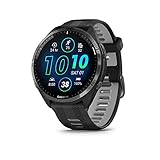 Garmin Forerunner 965 Garmin Forerunner 965 |
|
Check Latest Price |
 Garmin vivoactive 6 Garmin vivoactive 6 |
|
Check Latest Price |
 Amazfit T-Rex 3 Amazfit T-Rex 3 |
|
Check Latest Price |
 Fitbit Charge 6 Fitbit Charge 6 |
|
Check Latest Price |
 Apple Watch Ultra 2 Apple Watch Ultra 2 |
|
Check Latest Price |
 Apple Watch Series 10 Renewed 46mm Apple Watch Series 10 Renewed 46mm |
|
Check Latest Price |
 WHOOP 5.0 WHOOP 5.0 |
|
Check Latest Price |
 COROS APEX 2 COROS APEX 2 |
|
Check Latest Price |
Why Wrist Heart Rate Fails When You Lift
Every fitness watch in this roundup reads heart rate optically, with a small green and infrared light array pressed against the underside of your wrist. The sensor works by watching how blood absorbs that light, and it assumes your wrist is quiet. Heavy compound lifts break that assumption in three separate ways.
First, wrist flexion. When you brace for a heavy triple, your wrist bends and the extensor tendons on the underside of the forearm tighten and shift. The sensor slides a few millimetres and the contact light path changes, which typically reads as an artificial heart rate spike. Second, grip contraction. Wrapping your fingers around a barbell thickens and moves the tissue under the sensor, and the more you pull, the more the reading drifts. Third, tendon movement and sweat. Tendons glide under the sensor as your wrist changes angle through a rep, and a sweaty wrist loses the stable optical contact the algorithm depends on.
The result is the pattern powerlifters describe: a believable warm-up number, then a spike during the working sets that sits far above your actual heart rate, then a recovery reading that takes far longer than the real cardiovascular recovery. That is why the AI movement filtering on the Galaxy Watch 7 matters more for this sport than any other single specification in this list.
There are three practical fixes, and only the first is a purchase decision. A chest strap gives an electrical reading from the chest that does not care what your wrist is doing, and it is the only option that stays accurate under a maximal deadlift. An armband monitor worn on the upper arm sits on steadier tissue. Moving the watch or band to the bicep, where there is less wrist flexion, helps on lighter work but the accelerometer-based rep detection usually suffers. Tightening the strap a notch and warming up for five minutes before you wear it fixes most of the low-end drift.
How We Picked and Tested
We scored every device on six criteria, weighted toward the ones that break first in a strength training week.
1. Heart rate behaviour under load. How the watch responds to wrist flexion and grip contraction, and whether the brand documents any movement filtering.
2. Strength features that exist. Dedicated strength profiles, animated form workouts, muscle group targeting, rep and set detection, and whether a rest timer actually exists on the device.
3. Battery in real training weeks. Advertised smartwatch figures assume notifications trimmed. We care how many weeks you get between charges when you train four days and sleep in it.
4. Durability at the gym. Sapphire versus glass versus no screen, water rating, and how a case behaves when it strikes a rack or a racked plate.
5. Wrist bulk and comfort. Case diameter and weight matter most to lifters with developed forearms, where a large case sits directly under the bar on a press.
6. Cost of ownership. Whether the headline data is gated behind a membership, counted over five years rather than one purchase.
We are transparent about a limit here: our accuracy judgements come from the published sensor design, the movement filtering each brand documents, and owner reports on lifting-specific reads, not from our own lab against a chest strap. Where a claim is contested, we say so.
1. Samsung Galaxy Watch 7 40mm – Best Lifting Heart Rate Accuracy in This Test
- AI heart rate tracking filters out body movement for more accurate lifting readings
- Energy Score gives a daily readiness number built from the previous day
- 40mm case suits smaller wrists and does not interfere with pressing grip
- Sleep tracking detects moderate to severe sleep apnea
- Battery is short and many owners charge daily
- Only reaches 11 to 14 hours with heavy use
- US version is Android only
I put this on first because the 40mm case is the detail that decides it for most lifters. Bulky smartwatch cases are the hidden tax on pressing movements, where the bar sits over the forearm and any extra millimetres of case become leverage you did not ask for. The Galaxy Watch 7 in 40mm reads like a normal watch in the locker room and disappears under a barbell sleeve.
The real reason it leads is the heart rate work. Samsung’s Galaxy AI heart rate tracking is described as filtering out body movement to produce more accurate readings, and that is precisely the failure mode of a heavy pull. Combined with the Energy Score, which is calculated from the previous day’s activity, it gives you a readiness signal the morning after a brutal session without needing a separate recovery subscription.
![Samsung Galaxy Watch 7 40mm Bluetooth AI Smartwatch w/Energy Score, Wellness Tips, Heart Rate Tracking, Sleep Monitor, Fitness Tracker, 2024, Cream [US Version, 1Yr Manufacturer Warranty] customer photo 1](https://www.requiemforadream.com/wp-content/uploads/2026/08/B0D1YNVD88_customer_1.jpg)
The 2000 nit Super AMOLED is easy to read mid-set in a bright commercial gym, and the TPU band stays put through sweaty sessions better than a soft silicone. Automatic workout detection also catches the odd session you forget to start, which happens to everyone who sets a phone on a bench to film a lift.
The weakness is battery, and it is a real one. Owners consistently report 11 to 14 hours under heavy use and daily charging, so this is a device you top up overnight rather than a device you forget about for two weeks. The Bluetooth-only version also leans on the paired phone for GPS, which is irrelevant in a gym but matters if you run outdoors.
![Samsung Galaxy Watch 7 40mm Bluetooth AI Smartwatch w/Energy Score, Wellness Tips, Heart Rate Tracking, Sleep Monitor, Fitness Tracker, 2024, Cream [US Version, 1Yr Manufacturer Warranty] customer photo 2](https://www.requiemforadream.com/wp-content/uploads/2026/08/B0D1YNVD88_customer_2.jpg)
What it gets right that other picks miss
The movement filtering is the whole argument. Every other watch in this list can produce a plausible heart rate number during a heavy triple, and most will spike. This one is built by a phone maker whose entire sensor stack is aimed at separating movement artefact from signal, and the improvement shows up specifically on compound lifts.
It is also one of only two watches here with a readiness score built from the previous day’s training, so you can decide before you warm up whether today is a push day.
Where it will disappoint you
If your training week is five or six sessions, charging every night is friction you will notice. If you are an iPhone user, the US version of this watch is Android only, so the Apple comparison in this roundup points at a different device entirely.
And for anyone chasing tonnage rather than recovery, the Galaxy Watch 7 will not log a single set for you. That job still belongs to Strong or Hevy on your phone.
2. Garmin Forerunner 165 – Best Value for Strength Training
- Strength profile among 25 plus built-in activity profiles
- Exceptionional battery life that often exceeds the advertised figure
- Wrist heart rate
- HRV and VO2 max readings praised for accuracy
- Lightweight and comfortable for smaller wrists
- Cannot reply to messages from the watch
- Bluetooth occasionally disconnects and reconnects
- Recovery time suggestions can be overly aggressive
The Forerunner 165 is the pick most people should actually buy. It has 25 or more built-in activity profiles including a dedicated strength profile, and the training metrics behind that mode are the deepest strength set in this roundup.
What sold us is the combination of a training effect rating, training effect labels and a recovery time estimate. Those three numbers together are the closest thing any watch gets to telling you whether a session was productive or a waste, and the recovery time figure is the one you will argue with most often because owners report it being overly aggressive.
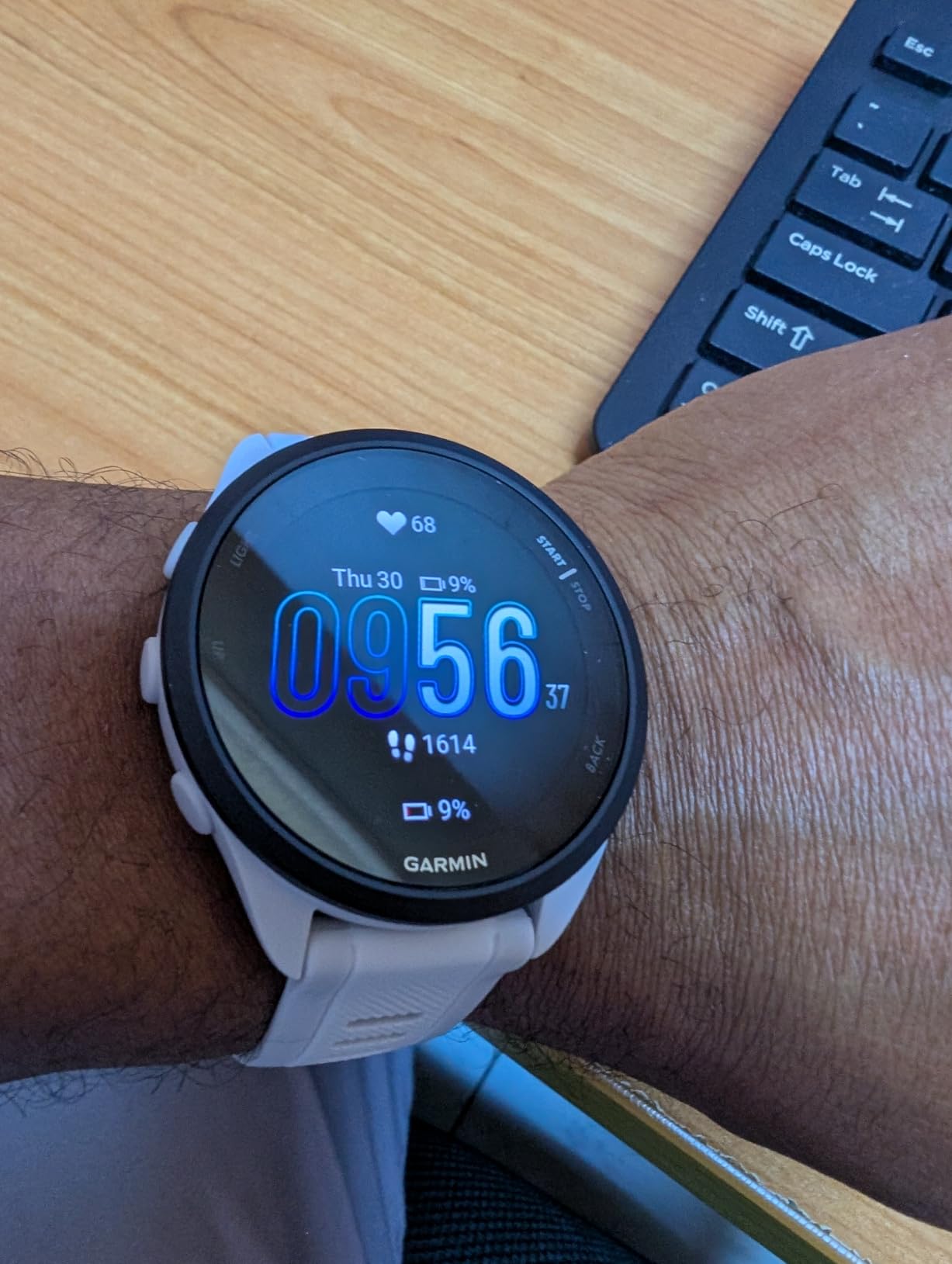
Owners migrating from other brands repeatedly describe this as the best value Garmin, and a week or more of battery is realistic once you trim notifications. The 43mm case and 1.2 inch AMOLED screen are large enough to read mid-set and small enough for a smaller wrist.
The AMOLED is genuinely bright in direct sunlight, the quick-release 20mm bands are easy to swap and clean, and the incident detection with Assistance sharing means a heavy session that goes wrong still has a safety net behind it.
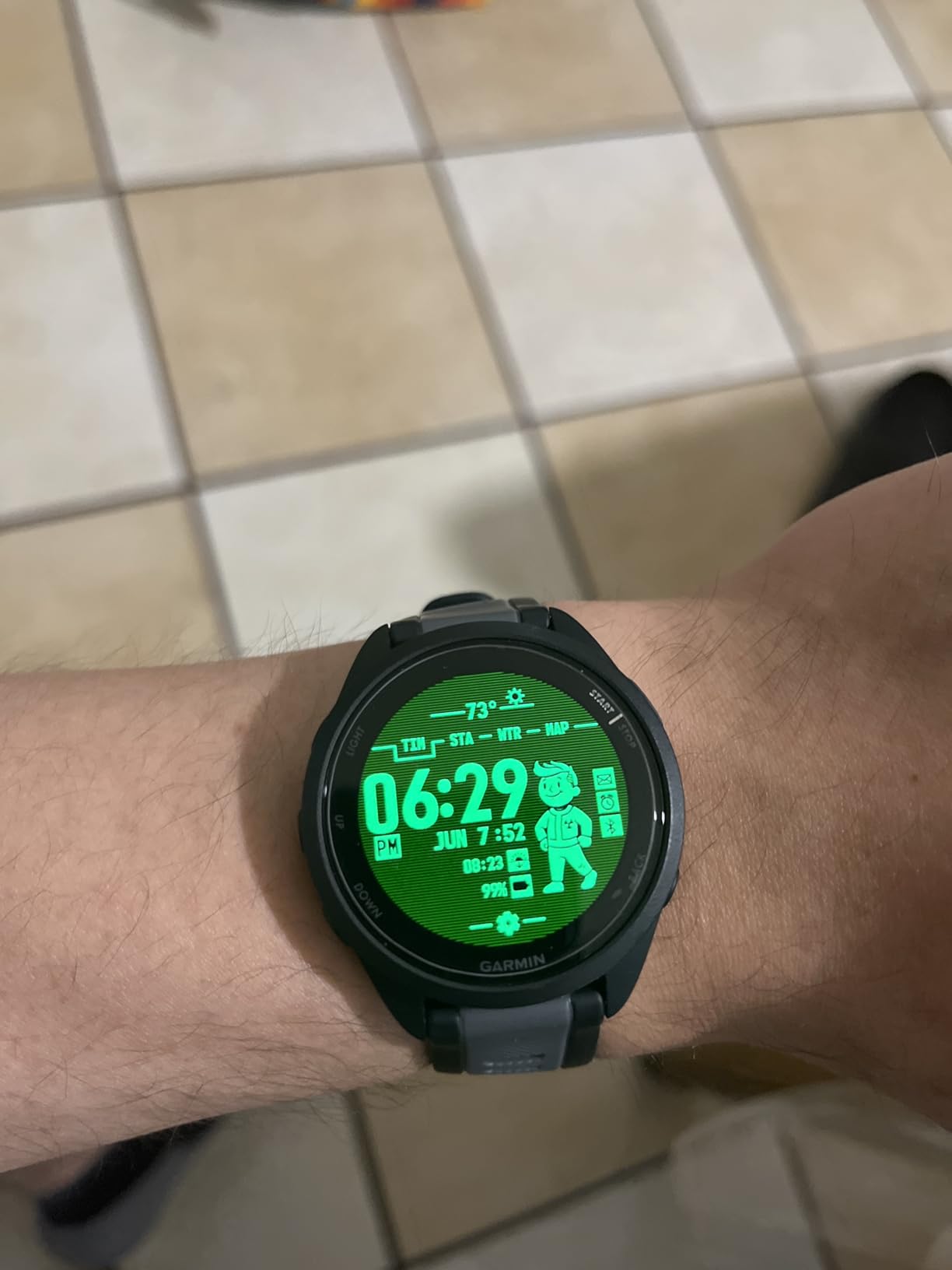
Why it beats the premium Garmin options for lifting
The Forerunner 965 gives you more maps, titanium and 23 days of battery, and none of that changes your strength training data. Above the 165 you are paying for map data and a titanium bezel rather than better lift metrics.
The 20mm quick-release strap is also a quiet gym advantage. Swapping to a tighter band between sets, or moving the watch to the bicep for an isolation movement, takes seconds rather than tools.
Where Garmin’s rep data will frustrate you
Automatic rep and set detection on Garmin watches is reliable enough to give you a rough count and not reliable enough to trust. Lifters on r/FitnessTrackers describe routinely opening the app afterwards to correct the record, which is the same manual step you would have done anyway.
The other friction is software. Some Garmin Connect watch faces are paid, Bluetooth can drop and reconnect repeatedly, and you cannot reply to a message from the watch even though it displays one.
3. Amazfit Bip 6 – Best Big-Screen Pick With Two-Week Battery
Amazfit Bip 6 Smart Watch, 1.97″ AMOLED Display, GPS, iOS/Android
- 1.97 inch AMOLED at 2000 nit is the largest screen in this roundup
- 14 day battery removes nightly charging
- Dedicated Strength Training and HYROX workout modes with AI coaching
- Works with both iOS 14 and Android 7
- Entry level sensors are less accurate than premium multisport watches
- 512 MB storage and 64 MB RAM limit app capability
- Some features need a paid Zepp membership
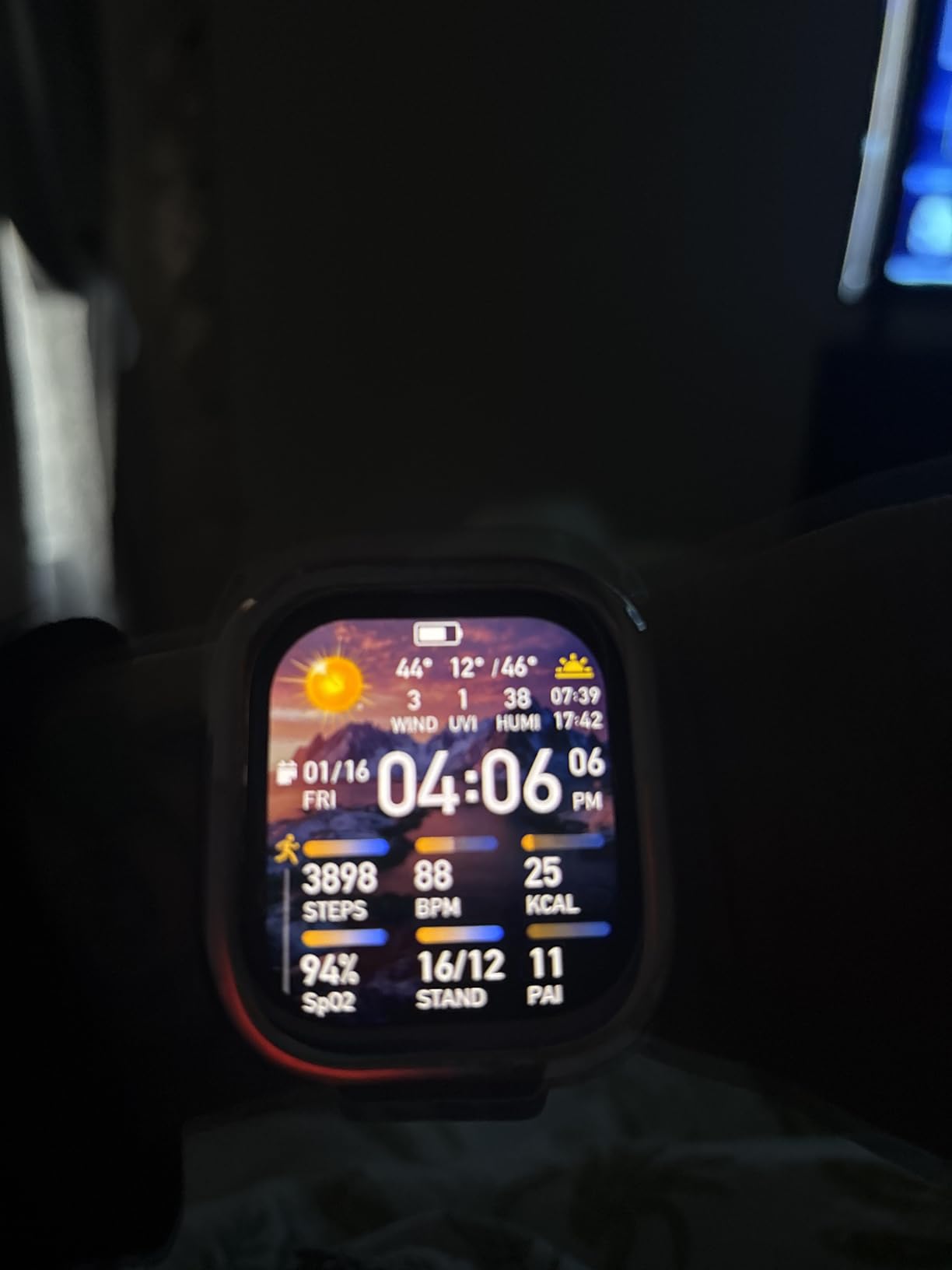
The Bip 6 exists because most lifters spend more time checking the screen than looking at their wrist fitness tracker usually allows. A 1.97 inch AMOLED at 2000 nits is the biggest display in this roundup, and during a long set of a superset it means you can actually read a rest timer without tapping five times.
Amazfit has also done the unglamorous work of shipping a real Strength Training mode alongside a HYROX Race mode, with AI-generated training plans on top. Neither will replace a real programming template, but having a strength profile that exists beats a watch that labels your squat session as generic cardio.
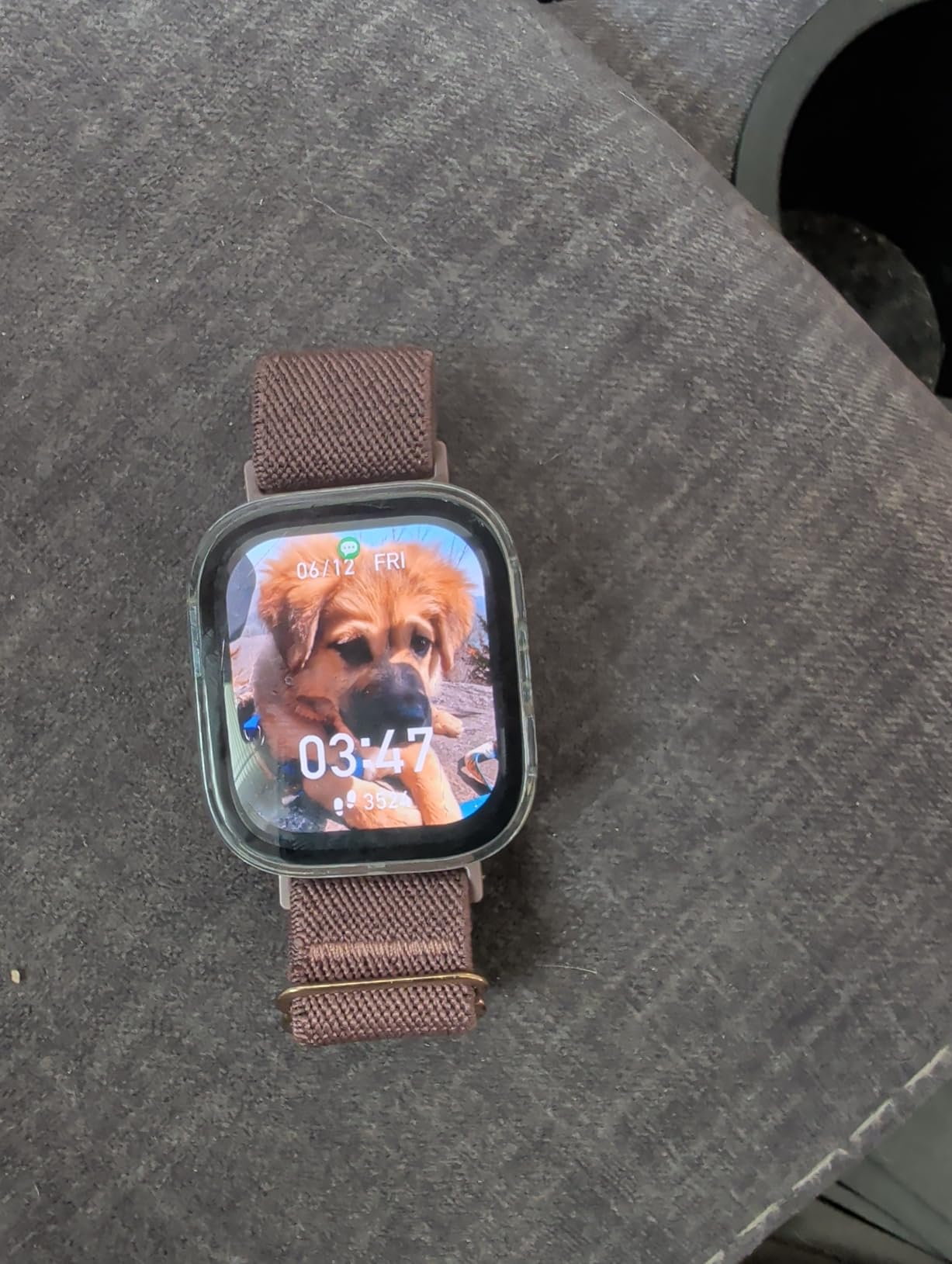
The 1.44 ounce aluminium build is genuinely light, and with 14 days of battery and 50 metre water resistance it is the easiest device here to wear continuously through a hypertrophy block. Free downloadable maps with turn-by-turn directions across five satellite systems mean it doubles as a basic running watch if your program includes conditioning work.
Owners consistently frame it as the value route into a large-screen fitness watch, and it is compatible with both iOS 14 and Android 7, so the phone you own does not narrow the choice.
Where the value is real
Screen size and battery are the two things you cannot upgrade later, and the Bip 6 gives you a large panel and a long interval between charges in a single device. For a lifter who does not need advanced recovery analytics and simply wants to start sets on time, that is the right trade.
It is also a genuinely practical gift-level purchase for a training partner, because the hardware is forgiving and the app is straightforward to pair.
Where the savings show up later
The optical sensor is entry level, and owners report heart rate readings that run high. For a strength-focused watch where wrist flexion already degrades the signal, that compounds the problem.
With 512 MB of storage and 64 MB of RAM there is no headroom for serious third-party apps, and some Zepp features sit behind a paid membership. This is a fitness watch, not a data platform.
4. Samsung Galaxy Fit 3 – Best on a Shoestring for Android Lifters
- 13 day battery far exceeds similarly priced trackers
- 1.6 inch AMOLED display with over 100 workout modes
- Sleep coaching and 5ATM with IP68 water resistance
- Lightweight and comfortable for continuous wear
- International model with no US warranty
- Not compatible with iPhone or iOS devices
- No built-in GPS so outdoor pace relies on the phone
The Galaxy Fit 3 is a realistic way to stop being the person who has no idea how hard they trained last week. A 1.6 inch AMOLED at 302 PPI, more than 100 workout modes and 13 days of battery is a genuinely complete package for anyone training on a tight budget.
Sleep coaching is the quiet strength of this device. A 13 day battery means you can actually wear it overnight four nights a week, which is the only way any recovery metric is worth reading, and 5ATM with IP68 makes it shower and pool safe.
![SAMSUNG Galaxy FIT 3 [2024] 1.6](https://www.requiemforadream.com/wp-content/uploads/2026/09/B0CW3VJFPN_customer_1.jpg)
Buyers treat it as a low-cost entry into the Samsung ecosystem, and with over 100 watch faces you can dial the screen down to something that does not announce your fitness interest to the whole gym floor.
For anyone whose training is entirely barbell and dumbbell based, the missing GPS costs you nothing. The optical heart rate sensor and accelerometer handle a strength profile perfectly well without a satellite lock.
![SAMSUNG Galaxy FIT 3 [2024] 1.6](https://www.requiemforadream.com/wp-content/uploads/2026/09/B0CW3VJFPN_customer_2.jpg)
What you get for very little
Thirteen days of battery with a 1.6 inch AMOLED is the combination that makes continuous wear possible, and continuous wear is what makes sleep and recovery data useful. Most people who buy a cheap tracker abandon it after three weeks of charging. This one removes the reason people quit.
It is also the least distracting device in the roundup, because a budget tracker that does less generates fewer reasons to check it between sets.
What you need to check before buying
This is the international model. It carries no US warranty, and buyers should confirm that before ordering outside a market it was built for.
It is Android only, Samsung Pay is not supported, and there is no built-in GPS. If you own an iPhone this device simply will not pair.
5. Garmin Forerunner 965 – Best for Serious Training Data
Garmin Forerunner® 965, Running Smartwatch, 47mm, Black/Powder Gray
- Up to 23 days in smartwatch mode and 31 hours in GPS
- Training readiness
- training status and HRV status metrics
- Lightweight 53 g case with titanium bezel
- AMOLED touchscreen with physical button controls
- Fitness features lean toward endurance sports rather than strength profiles
- Costs more than entry level Garmin running watches
- Touchscreen is less precise than buttons during intense activity
The Forerunner 965 is the watch you buy when your training is a project rather than a hobby. Training readiness, training status and HRV status are the three numbers that tell you whether to push, and Garmin computes all three from sleep quality, recent training load and your heart rate variability status.
For a lifter, HRV status is the most useful of the three. Overnight HRV is the closest thing you get to a cheap, objective read on whether the nervous system has absorbed last week’s work, and a watch that measures it every night while you sleep changes how you plan a session.
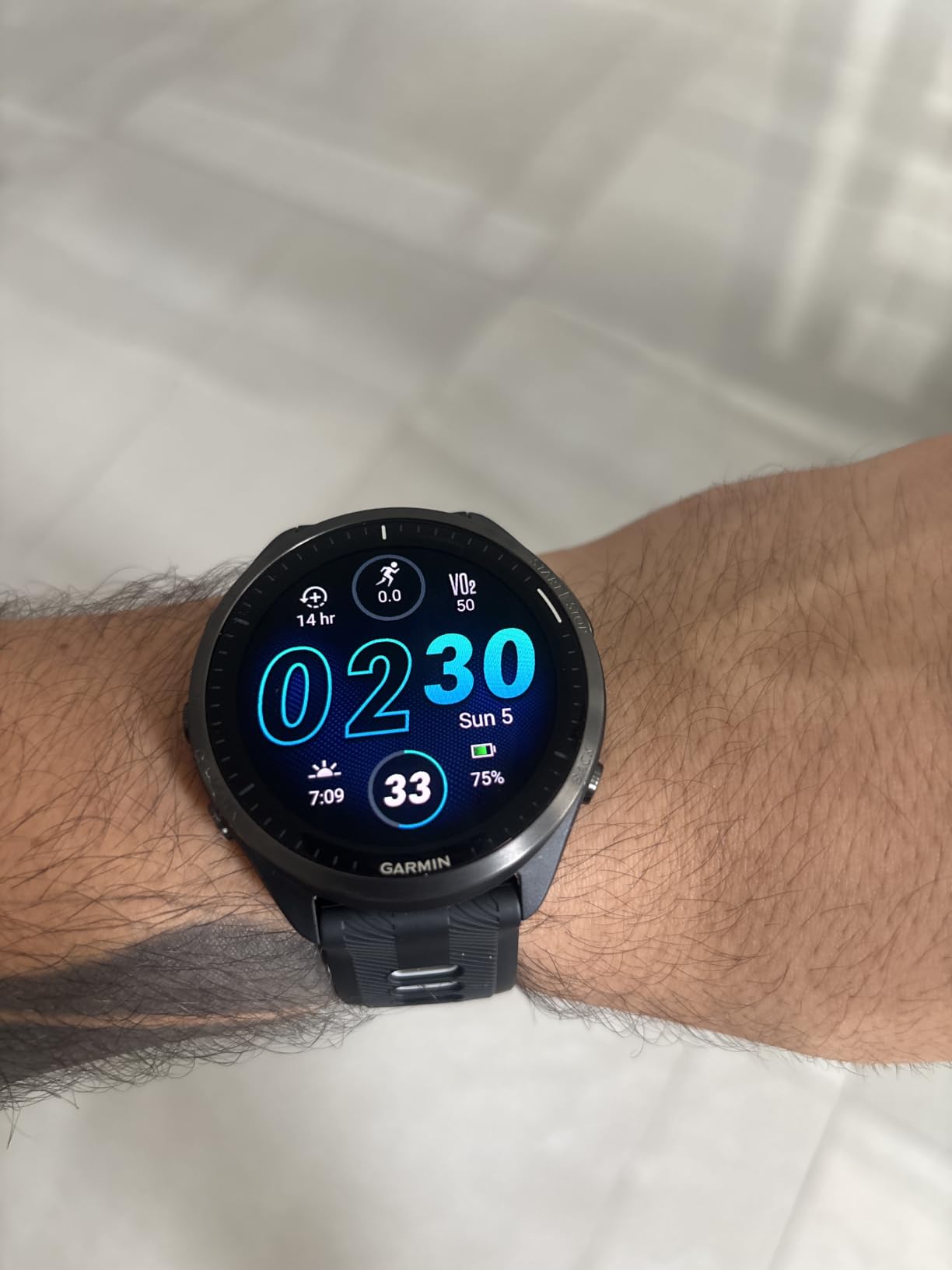
The physical quality is the other story. A titanium bezel on a 53 g case is unusually light for a multisport watch with full-colour maps built in, and the AMOLED touchscreen stays readable in a bright gym. Button controls remain for when your hands are chalked beyond usability.
Twenty-three days of battery in smartwatch mode means you charge roughly monthly. For anyone who resents plugging in a watch every second night, that changes the relationship with the device.
Why the deeper metrics are worth it here
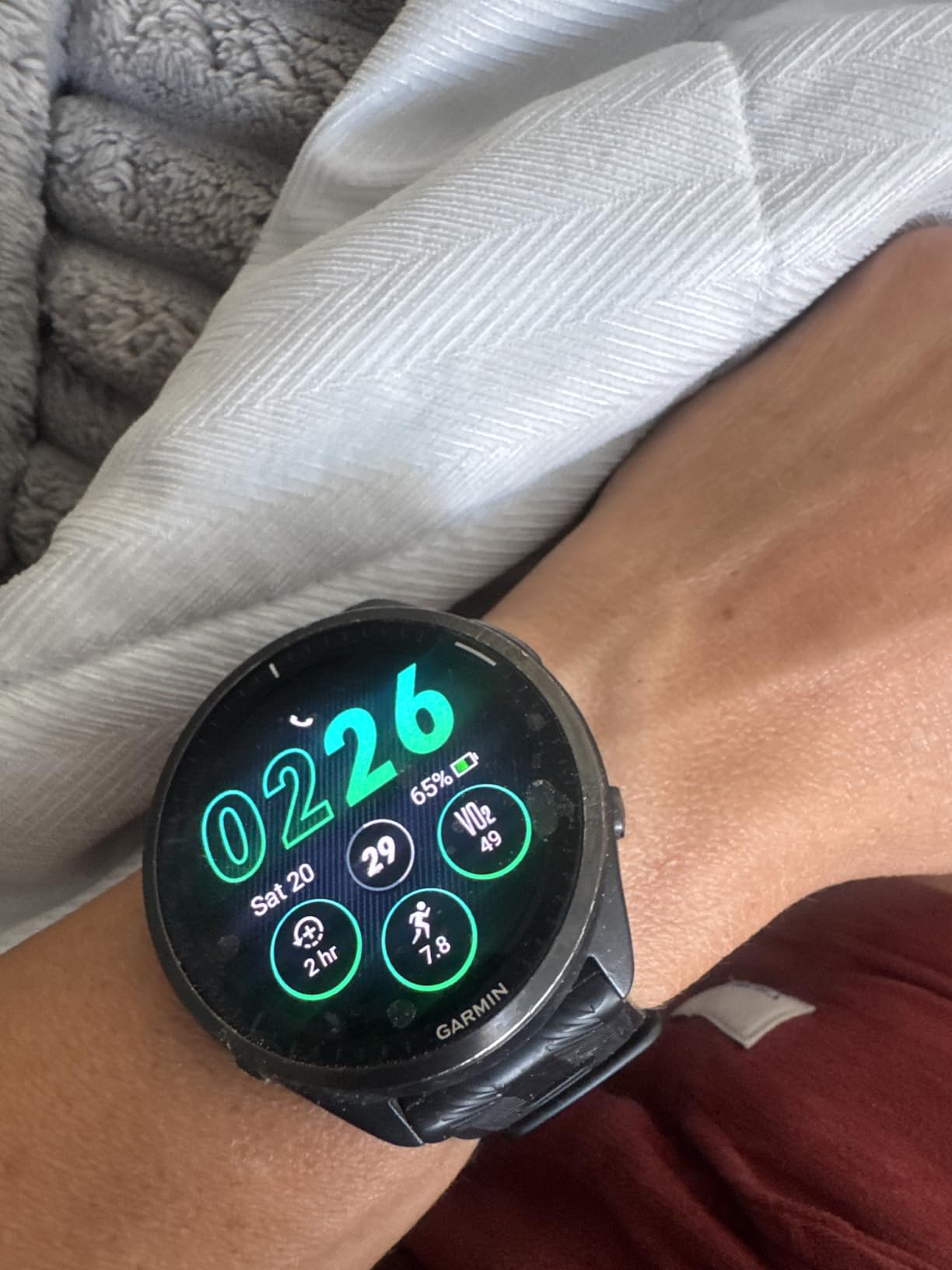
Training readiness pulls sleep, recovery, training load and HRV into one number you can act on before you unrack. The morning report delivers the same information with weather and a training outlook, which is a reasonable way to decide whether a planned heavy session is sensible today.
The trade is that this is a running-first device. Full-colour maps, multi-band GPS with SatIQ and wrist-based running dynamics exist because Garmin designed it for endurance athletes, and none of it helps you bench.
Where the premium is hard to justify
If your programming is three days a week of barbell lifts, the Forerunner 165 delivers the same strength profile, training effect and recovery time data for a fraction of the outlay. You are buying map data and a titanium bezel.
The touchscreen is also the less precise input method during intense activity, and Garmin mixes buttons in partly for that reason. The 47mm case sits wider than the 42 to 43mm models if you have a smaller wrist.
6. Garmin vivoactive 6 – Best for Small Wrists and Form Coaching
Garmin vívoactive® 6, Health & Fitness GPS Smartwatch, 42mm, Jasper Green
- Animated strength HIIT yoga and Pilates workouts coach form on the wrist
- 42mm case and 1.3 ounce weight suit smaller wrists
- Body Battery and sleep coaching without a subscription
- Over 80 indoor and GPS sports apps
- Small display with wide dark bezels limits on-wrist screen area
- Included silicone band can irritate skin
- Some heart rate readings lag during short sessions
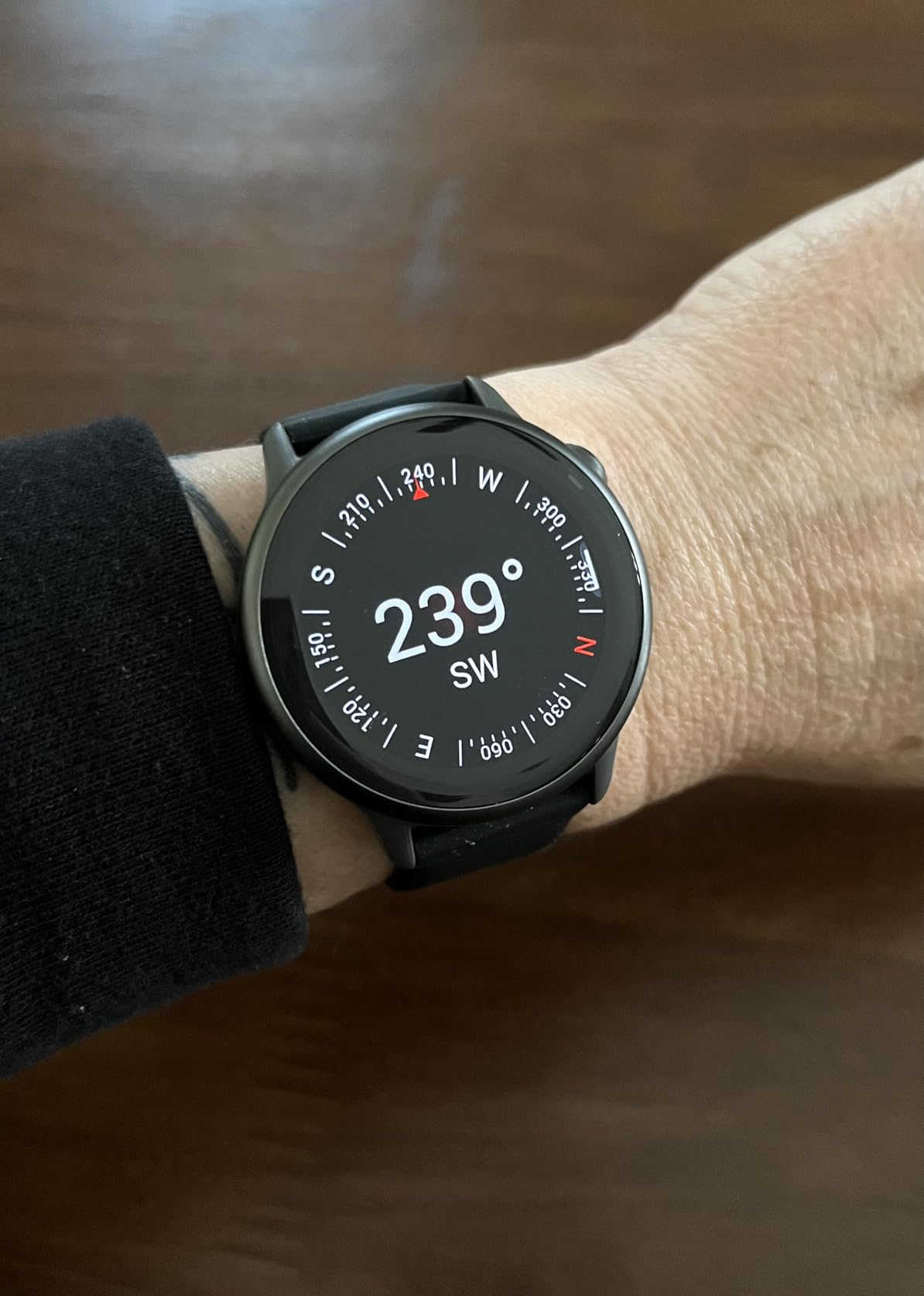
The vivoactive 6 is the only watch here with animated strength workouts that show the movement. That sounds like a gimmick until you consider how many lifters train with no video and no spotter and get their depth wrong for months, having nobody to correct them.
It is also the right size. At 42mm and 1.3 ounces it disappears on a smaller wrist, and Garmin’s 20mm quick-release bands mean you can move it up the forearm or onto the bicep for an isolation movement when wrist flexion starts corrupting the heart rate.
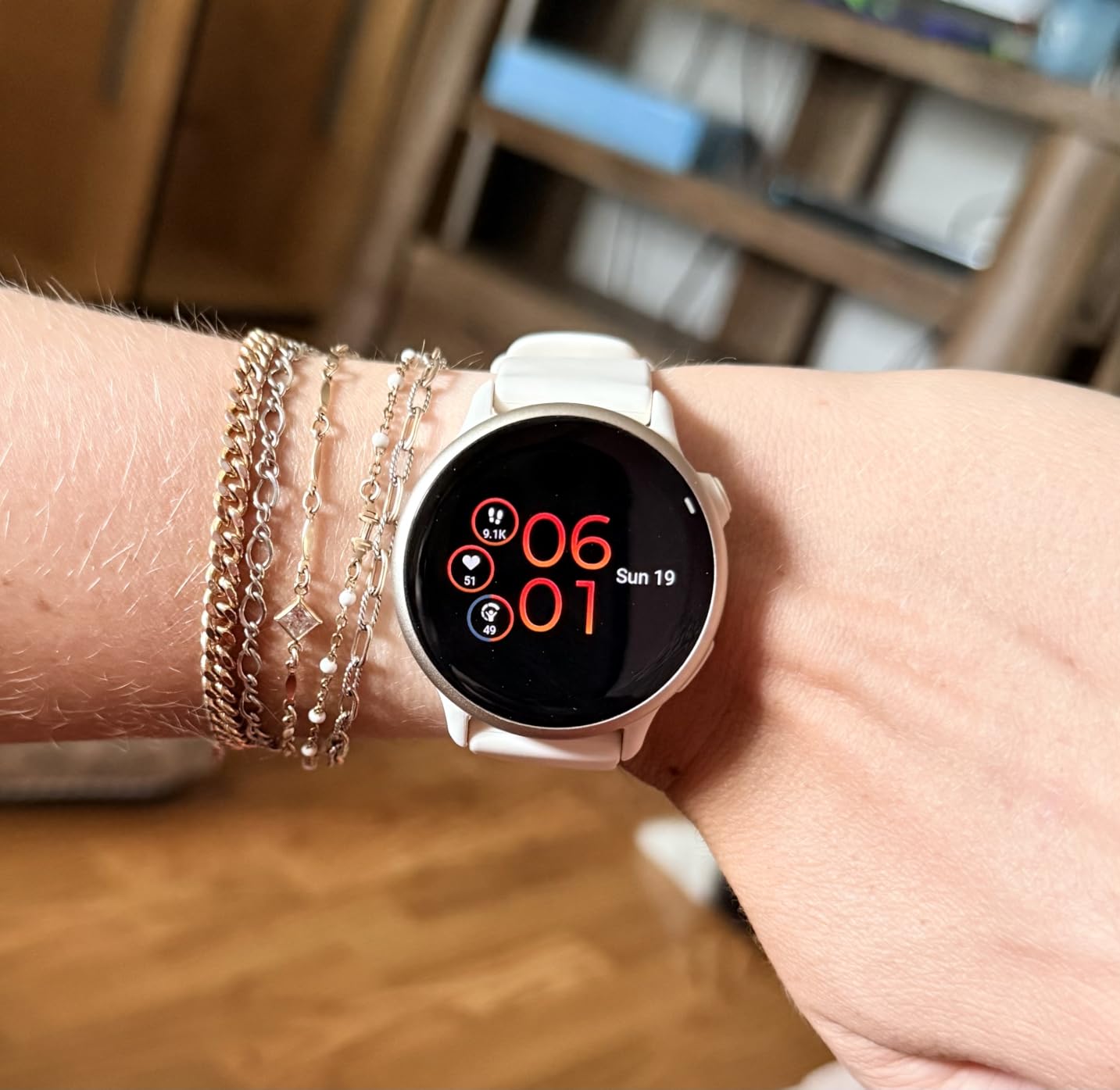
Workout benefit and recovery time metrics give clear guidance on whether a session actually did something for you, and over 80 built-in indoor and GPS sports apps cover everything from HIIT to mobility work. Reviewers moving from Fitbit highlight the multi-day battery alongside accurate sleep and heart rate data.
Body Battery energy monitoring with automatic nap detection is a nice touch for lifters who train through lunch, because it treats the short sleep as recovery rather than ignoring it.
What the animated workouts actually fix
They do not check your bar path or your depth against a real camera. What they do is put a moving model of a squat or a deadlift on your wrist so you have a reference while your hands are occupied, which for a solo lifter is worth more than it sounds.
Garmin Coach and custom workouts in Garmin Connect extend the same idea into a real programme, and the sleep coaching with HRV status covers the morning after.
Where the small case bites
A 1.2 inch display with wide dark bezels leaves the least usable screen area of the Garmin watches here, and it makes the animated form guides smaller than they should be. If you want a big screen, the Amazfit Bip 6 solves the same problem differently.
The included silicone band is also the most complained-about part, because soft silicone plus sweat plus a fiddly clasp irritates skin. Swap it early. Some heart rate readings also lag or overestimate on short sessions.
7. Amazfit T-Rex 3 – Best Rugged Pick With Three-Week Battery
Amazfit T-Rex 3, Smart Watch, 1.5″ AMOLED Display, GPS, iOS/Android
- Over 3 weeks of typical battery life and up to 180 hours in GPS mode
- 316L stainless steel bezel rated from minus 22F to 158F with 100 m water resistance
- 2000 nit AMOLED with night and glove mode
- 170 plus workout modes with AI training plans
- Health and fitness metrics can read high for some users
- Bulky case with a basic plastic feel band
- No eSIM despite some listings suggesting it
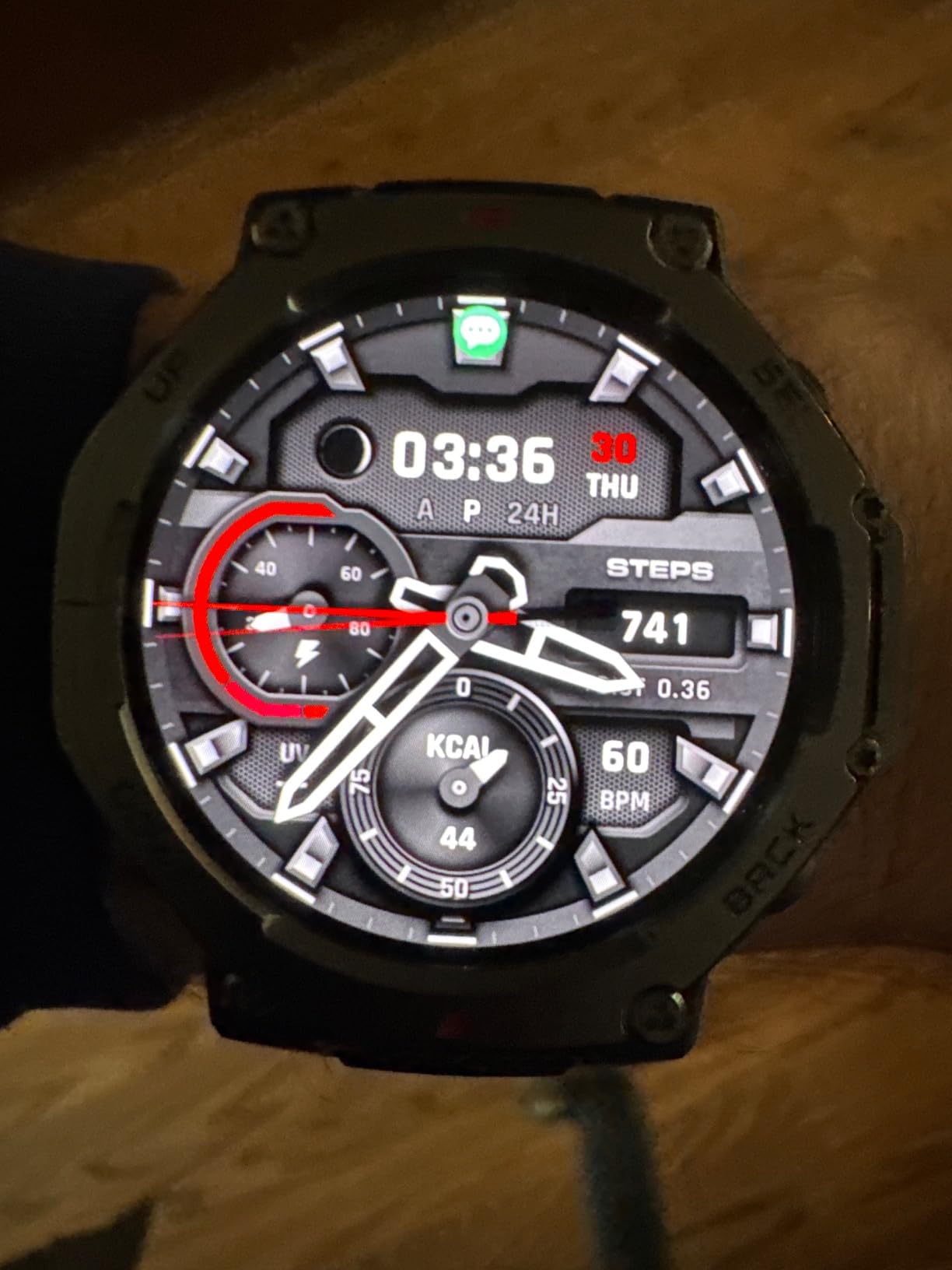
The T-Rex 3 makes an unfashionable argument that is correct for a lot of lifters: the watch that survives contact with a barbell beats the watch with the better analytics. A 316L stainless steel bezel rated from minus 22F to 158F and 100 metre water resistance is closer to a tool than a gadget.
It also solves the charging problem properly. Over three weeks of typical use and up to 180 hours in GPS mode means you can start a training block, travel for a week, and come back without thinking about a charger.
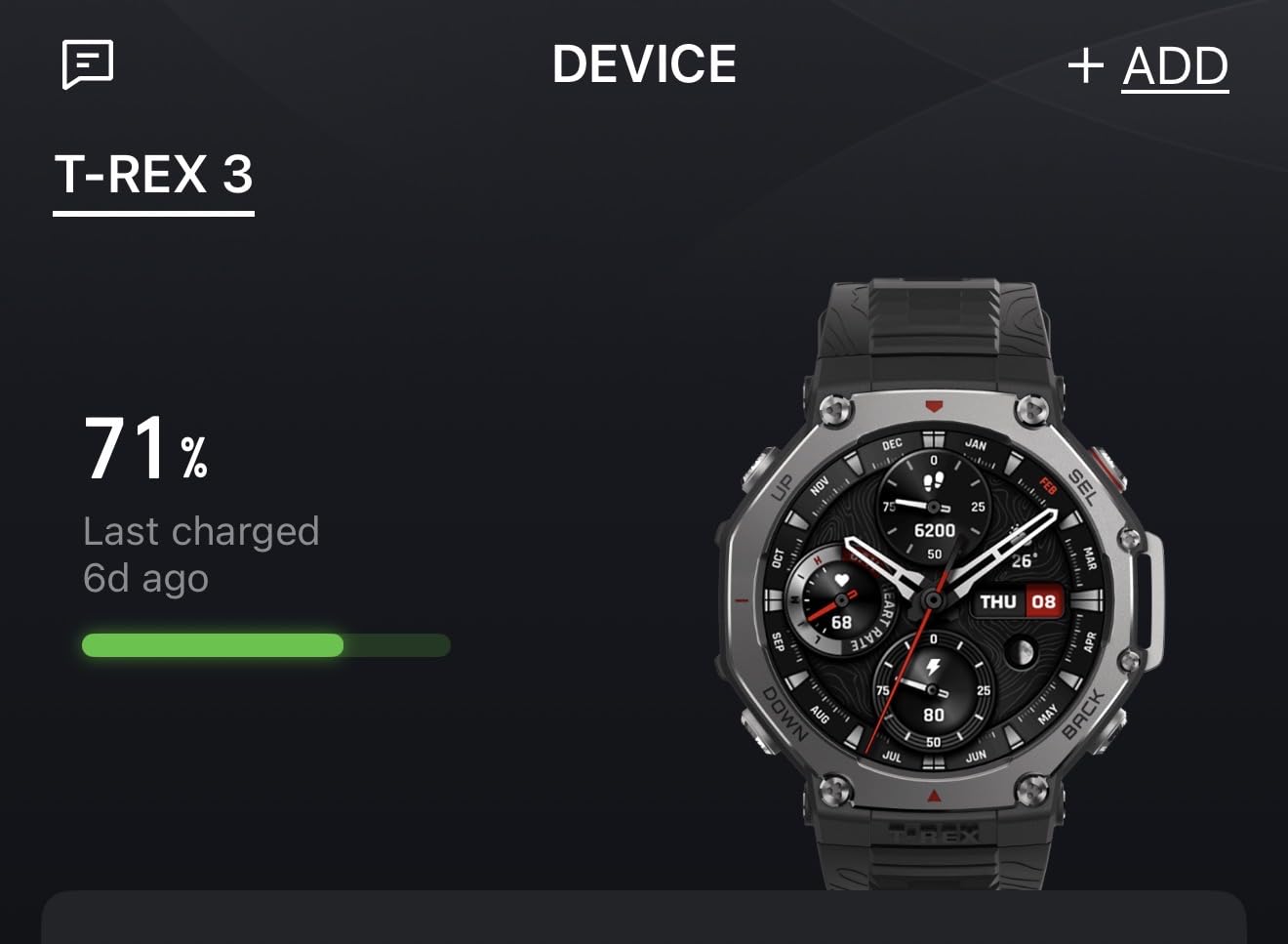
Many owners who previously owned Apple and Garmin watches call the T-Rex 3 better value with far superior battery life and comparable ruggedness. The 2000 nit peak brightness with a glove mode is a gym-specific feature rather than a spec-sheet trick, because chalked hands and gym gloves both reduce screen control.
Free global maps with dual-band positioning across six satellite systems and turn-by-turn directions mean it is a real multisport watch, and 170 plus workout modes cover strength alongside extreme sports.
Why durability is the deciding feature
Scratches and knocks are the most common gym complaint about any watch with a screen, and a steel bezel takes that hit instead of the display. Lifters who train functional fitness or anything with a loaded bar travelling around their body will value that more than any sleep score.
The water rating also means a hot, poorly ventilated commercial gym with heavy sweating is not a concern, and the 22mm quick-release bands let you change the look fast.
Where the accuracy complaints bite
Opinion on the health metrics is genuinely divided. Some owners report readings that run high, and the consensus recommendation is to treat it as a fitness tracker rather than a clinical device.
That said, for a wrist under heavy wrist flexion, a high-reading optical sensor is the same problem every watch in this list has, amplified. The case is bulky and the band feels basic, and there is no eSIM despite some listings implying one.
8. Fitbit Charge 6 – Best for Sleep Tracking Without a Big Case
- Seven day battery survives a full training week plus weekend sleep tracking
- Sleep stage analysis and sleep quality scoring are consistently praised
- Light unobtrusive design that does not chafe or shift
- Built-in GPS and contactless payments
- Fitbit and Google app sync failures are repeatedly reported
- 1.04 inch display is an activity tracker not a smartwatch
- Included band can pinch skin and the large strap has too few holes
The Charge 6 is the anti-gadget answer. At 1.04 inches and 3 grams it barely registers on the wrist, and for anyone whose wrist gets in the way of a press or who simply stopped wearing their smartwatch weeks after buying it, that is the feature that matters.
Its real strength is sleep. Owners consistently praise the sleep stage analysis and sleep quality scoring, and with seven days of battery the habit of wearing it overnight actually survives the first month, which is where most trackers die.
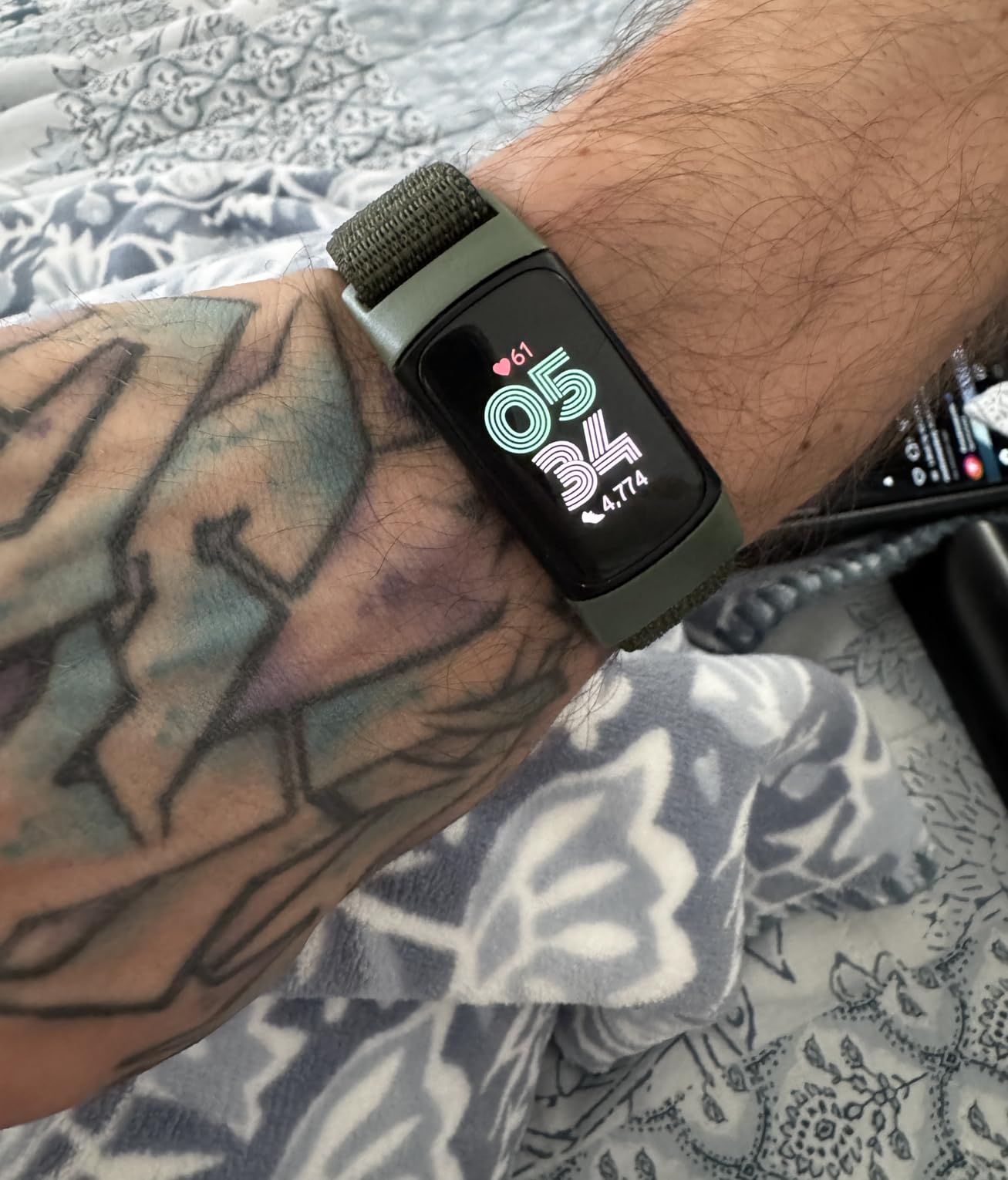
Automatic detection of walking, running and sleep means you do not have to remember to start anything, and the optical heart rate sensor with ECG capability covers the basics of a training week. Built-in GPS and a wallet add more than most bands at this level.
Both small and large bands are in the box, which is a genuine advantage for a device you will wear overnight and want tight.
Why the small case is a lifting feature
Every millimetre of case under the bar on an overhead press changes how the load feels, which is why the smallest device in the roundup is a legitimate recommendation. A 1.04 inch screen and 3 gram body is one of the least intrusive options here, and lifters with developed forearms consistently prefer slim trackers over flagship slabs.
Because it also tracks sleep well, you get the recovery half of the job done in a package you will still be wearing in month three.
Where the Charge 6 falls short for lifting
There is no strength workout profile of substance here, and the screen is far too small for a meaningful rest timer or rep display. Rep counting is essentially a step-counting problem here, and the hand movements in a kettlebell swing can register as activity.
The most serious issue is software. Fitbit and Google app sync failures are reported repeatedly, sometimes requiring a full reinstall and re-pairing, and some premium insights such as the Daily Readiness Score require a Fitbit Premium membership. Owners report the widest rating spread of any pick here, with a meaningful share of 1 star reviews.
9. Apple Watch Ultra 2 – Best for iPhone Users Who Lift Outside
- 49mm corrosion resistant titanium case with sapphire crystal tested to MIL-STD 810H
- Training load and Heart Rate Zones show how hard each session stresses the body
- Cellular support for calls texts and music without an iPhone
- Customizable Action button gives one-touch control during sets
- Very large 49mm case is bulky for smaller wrists
- Premium cost against fitness focused multisport watches
- Requires an iPhone for many features
The Ultra 2 is the only device here with a training load metric that explicitly answers the question a lifter asks, which is how hard did this session actually work. Combined with Heart Rate Zones in the Workout app, it gives you a per-set stress estimate that most competitors leave to a whole-session summary.
Build quality is the other argument. A corrosion-resistant titanium case with a sapphire front crystal, tested to MIL-STD 810H, is rated for harsh environments, and the 100 metre water resistance handles anything a pool or a very hot gym can throw at it.
![Apple Watch Ultra 2 [GPS + Cellular 49mm] Smartwatch with Rugged Titanium Case & Blue/Black Trail Loop S/M. Fitness Tracker, Precision GPS, Action Button, Extra-Long Battery Life customer photo 1](https://www.requiemforadream.com/wp-content/uploads/2026/08/B0CSTGJVKF_customer_1.jpg)
The Action button is more useful in a gym than it looks on paper. One press starts a workout or toggles a metric mid-set, which is exactly the kind of thing you want when your hands are chalked and your phone is on the bench. Cellular support means calls, texts and music without your iPhone nearby.
Battery life of up to 36 hours in normal use, or 72 hours in Low Power Mode, is the longest run among the screen-equipped smartwatches here, and dual-frequency GPS with automatic track detection is genuinely precise.
![Apple Watch Ultra 2 [GPS + Cellular 49mm] Smartwatch with Rugged Titanium Case & Blue/Black Trail Loop S/M. Fitness Tracker, Precision GPS, Action Button, Extra-Long Battery Life customer photo 2](https://www.requiemforadream.com/wp-content/uploads/2026/08/B0CSTGJVKF_customer_2.jpg)
What the Ultra 2 does that fitness watches do not
It is a complete safety and health device, with an ECG app, blood oxygen readings, irregular rhythm notifications, sleep apnea notifications, hard fall and crash detection, and emergency SOS. For anyone training alone at night or in a garage, that is a real category of value that a fitness tracker simply does not offer.
Third-party strength apps are also the strongest here. The Apple watch pairs with the wider third-party lifting app ecosystem, which is the answer to Apple not counting reps natively.
Where the size becomes the problem
Nothing in that roundup is a pure fitness watch, so a 49mm case is the bulkiest thing in the list, and it sits directly under the bar on a press. Lifters with smaller wrists consistently report the case getting in the way, and if you are one of them, the 46mm Series 10 is the more sensible Apple option.
Powerlifters also report heart rate spikes on big compound moves that need a chest strap to correct, and the training load metric still under-credits muscular work relative to cardiovascular load.
10. Apple Watch Series 10 Renewed 46mm – Best Value Route Into the Apple Ecosystem
Apple Watch Series 10 [GPS, 46mm] – Silver Aluminum Case with Denim Sport Band, S/M (Renewed)
- Thin lightweight aluminum case sits comfortably during lifting
- Full Apple health app ecosystem with ECG certification
- Large 46mm display is easy to read mid-workout
- Double tap gesture and voice control work hands free
- Renewed battery holds at least 80 percent of original capacity
- Accessories are compatible third-party items rather than original
- Only 90 days of warranty coverage
This is the practical entry point for an iPhone owner who wants the Apple training load, Heart Rate Zones and third-party app support without the flagship outlay. The renewed unit is professionally inspected, tested and cleaned, with no visible cosmetic imperfections at arm’s length, and the battery is guaranteed above 80 percent of new capacity.
Thin and light is the underrated spec for a lifter. An aluminum case in this size class sits flatter against the wrist than the Ultra 2, which matters during a press where the bar passes right over the forearm.
![Apple Watch Series 10 [GPS, 46mm] - Silver Aluminum Case with Denim Sport Band, S/M (Renewed) customer photo 1](https://www.requiemforadream.com/wp-content/uploads/2026/09/B0DHYF71VJ_customer_1.jpg)
The double tap gesture and voice control genuinely help mid-set, because you can start or stop something without fumbling a crown with chalked fingers. The 46mm display is easy to read while the bar is loaded.
Compatibility covers Wi-Fi, Bluetooth, 4G cellular and NFC, and the ECG certification means you get the health features that make the Apple ecosystem worth staying in for a long-term lifter.
![Apple Watch Series 10 [GPS, 46mm] - Silver Aluminum Case with Denim Sport Band, S/M (Renewed) customer photo 2](https://www.requiemforadream.com/wp-content/uploads/2026/09/B0DHYF71VJ_customer_2.jpg)
Why renewed makes sense for this use case
A watch you will bang against a rack and wear in sweat does not need flagship resale value, and the battery is the part most likely to degrade over years of continuous wear. Buying a unit that already has some cycle count on it trades a spec you will never notice for money you will.
The 90 day replacement window is the honest caveat. It is shorter than a new-device warranty, so keep the packaging and document the condition on arrival.
Where you give something up
GPS relies on the paired iPhone rather than a built-in dual-frequency receiver, so outdoor pace and distance tracking is a phone-assisted approximation. Battery life is also shorter than the Ultra 2, and the accessories are compatible third-party items rather than original.
None of this affects strength training, where you are indoors and the display is what matters. All of it matters if your program includes serious outdoor work.
11. WHOOP 5.0 – Best Screenless Recovery Tracking
WHOOP Peak – 12 Month Membership -24/7 Activity and Sleep Tracker, Personalized Coaching, Menstrual Cycle Insights – 14+ Days Battery Life
- Screenless design eliminates every distraction and nothing to scratch
- 14 plus day battery
- 24/7 heart rate with continuous Strain and Recovery tracking suited to heavy lifting
- Sleep coaching and real-time Stress Monitor with a 12 month membership included
- Requires a 12 month membership beyond the included year for full insights
- No display means no wrist workout prompts or timers
- Less versatile than screen equipped watches
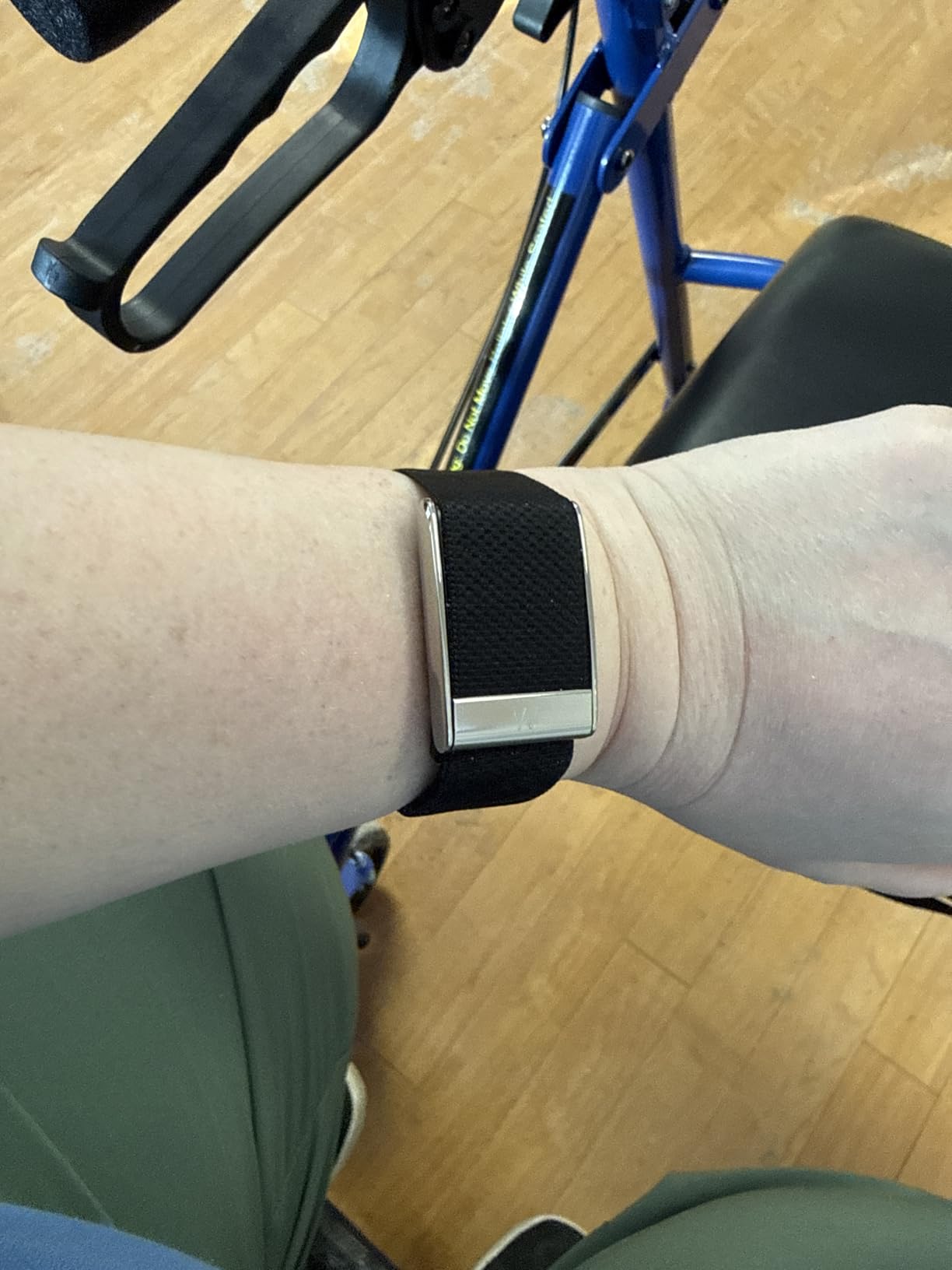
WHOOP is the odd one out and that is the point. There is no screen, so there is no screen to scratch against a rack, no screen to check between sets, and nothing that pulls your attention away from the lift. Lifters who keep knocking watches off their wrist tend to end up here.
Its Strain and Recovery model is the scoring system in this roundup built for training that is not primarily cardiovascular. Strain runs on a 0 to 21 scale and blends heart rate with accelerometer and gyroscope data, so the score reflects muscular output as well as cardiovascular effort rather than treating every deadlift as a light cardio session.
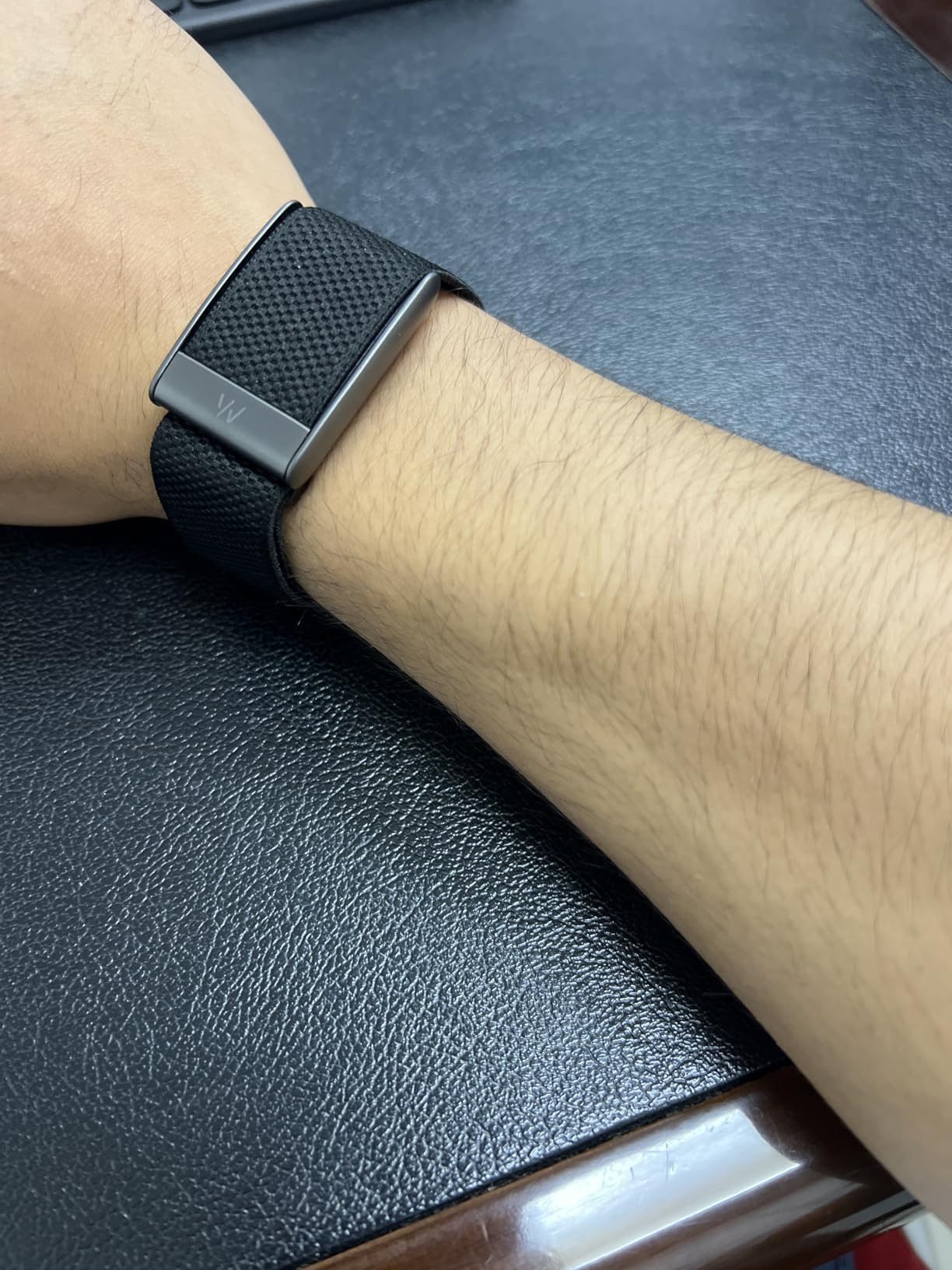
Heart rate is monitored every second of every day, which means the Recovery score each morning is built on genuine continuous data rather than a workout that happened yesterday. The real-time Stress Monitor and WHOOP AI coaching that analyses more than 140 metrics turn that into actionable sleep and strain targets.
At 14 plus days of battery on a 4 ounce nylon band, it is one of the easiest devices here to keep on your wrist permanently, and a waterproof power pack is included for travel.
Why screenless wins for serious training
There is a real physiological argument here beyond scratch risk. A screen-equipped watch becomes a prompt engine, and the prompts compete with the focus state you spent months building. Removing the display removes the entire category of distraction, which is why screenless bands get recommended so often in lifting threads.
Integrations with Apple Health, Google Health Connect and Strava mean the data still lands in the places you already look.
Where the subscription bites
This is the only pick in the roundup where the headline data sits behind an ongoing membership. The first 12 months are included, and reviews show the clearest split in the roundup over what happens after that, with 11 percent of owners giving one star. The Recovery, Sleep and Strain insight you bought it for is the part that goes behind the fee.
There is also no rest timer and no on-wrist workout prompt, so if your sets are unsupervised the timing has to come from somewhere else.
12. COROS APEX 2 – Best for Coach-Programmed Workouts
- Sapphire glass display with a Grade 5 titanium alloy PVD coated bezel
- 75 hours GPS and up to 30 days in daily use
- Coach programmable structured workouts through the COROS Training Hub
- 42 g case with physical buttons that work with sweaty hands
- LCD display is dimmer and less vivid than AMOLED competitors
- Smaller third-party app ecosystem than Garmin or Samsung
- Learning curve for the COROS app and training hub
The APEX 2 is the one to buy if your programming comes from a coach rather than from your own head. The COROS Training Hub lets a coach build structured workouts and training plans that push to your watch, which is a genuinely different relationship with a fitness watch than picking a strength profile yourself.
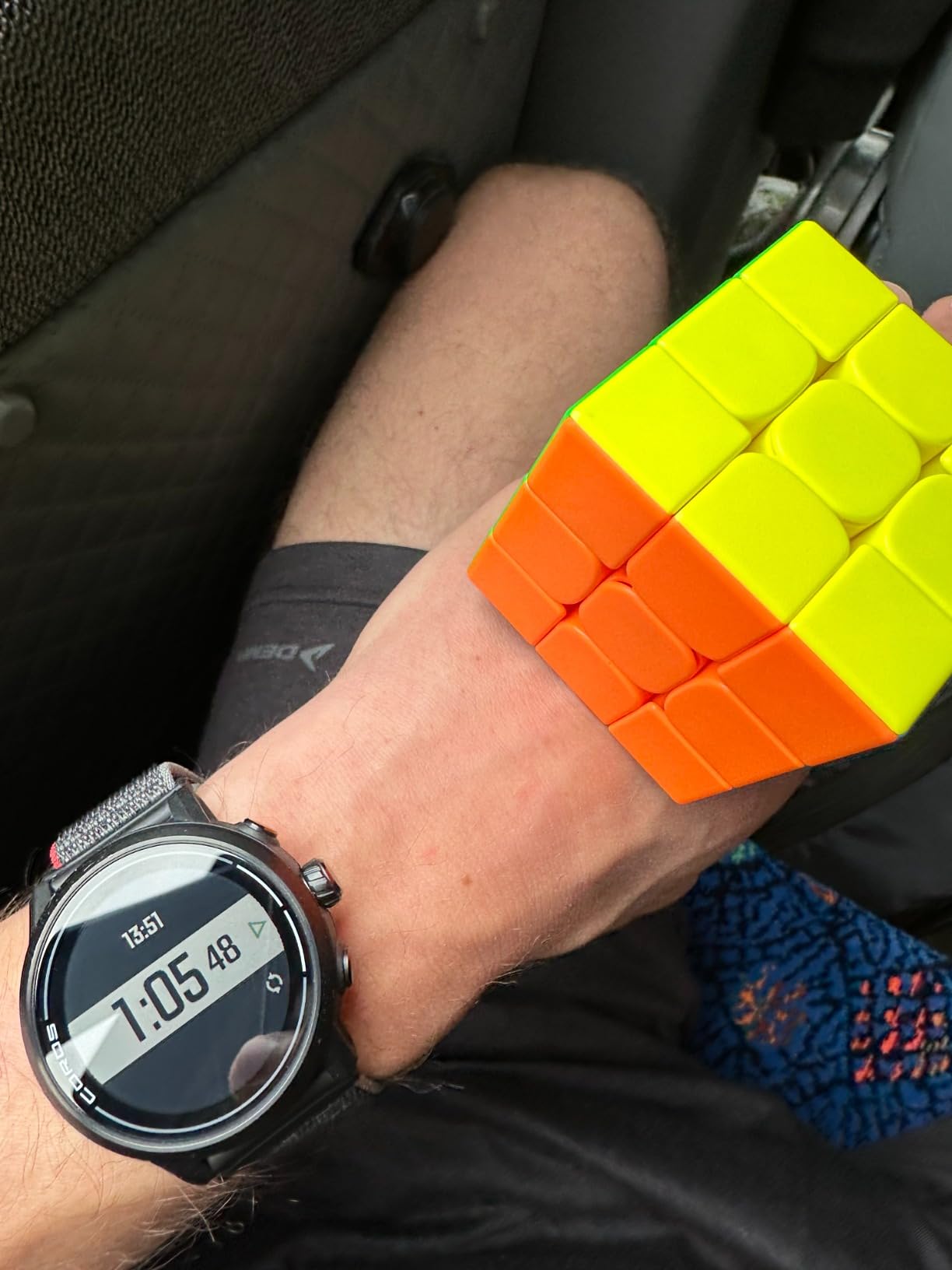
Structurally it is built for years of contact with barbells, plates and rack uprights. A sapphire glass display paired with a Grade 5 titanium alloy PVD-coated bezel is a combination you normally only see on flagship outdoor watches.
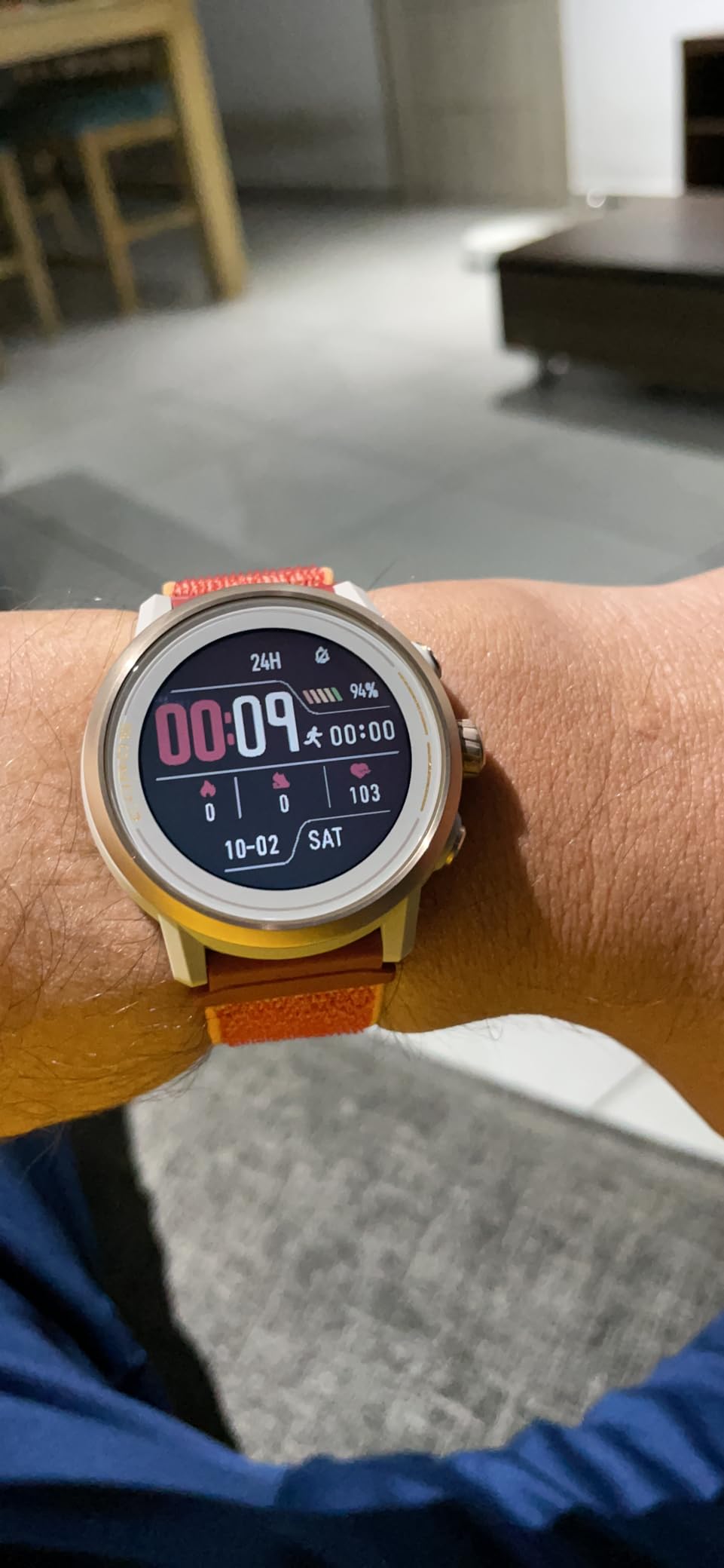
Multi-band satellite support across BeiDou, GLONASS, GPS and Galileo, plus on-wrist maps, makes it a real outdoor watch as well. Recovery monitoring with deep, light and REM sleep tracking feeds the same readiness question the Garmin flags answer.
The 42 g case with physical buttons and dials works when your hands are chalked, and a two year warranty is the longest in this roundup.
Why coach programming changes the recommendation
Most lifters plan their own sessions, so a structured workout builder is a nice-to-have. If a coach is writing your blocks, a device that receives the plan changes what the watch is for, and COROS makes coach-built programming a headline feature rather than a side export.
The integrations list is also unusually good for a lifting athlete, with TrainingPeaks, Strava and Apple Health support alongside Komoot and Stryd.
Where it is not the right choice
The LCD is dimmer and less vivid than the AMOLED panels on every other watch here, and it is the first thing you notice in a bright gym. In a facility with overhead lighting and no natural light, that is a real cost.
The ecosystem is also among the smallest in this roundup, and the app plus training hub carry a learning curve that Garmin does not. If you want the deepest strength-specific community and app support, this is not the device.
Garmin vs Apple Watch for Weightlifting
This is the highest-intent comparison on the topic, so here is the direct answer. Garmin is better for weightlifting. Apple is better at being a phone on your wrist, and for a lifter whose training is the priority rather than a side effect, that ranking holds.
Strength features. Garmin treats strength as a named sport mode across its whole range, with animated strength workouts on the vivoactive 6, 25 or more activity profiles on the Forerunner 165, and training effect, training effect labels and recovery time as first-class metrics. Apple has no native rep counting and no native set detection. Its answer is training load and Heart Rate Zones, which measure intensity well but leave the logging to a third-party app.
Heart rate under load. Both rely on optical wrist sensors, so both degrade under wrist flexion and grip contraction. The Galaxy Watch 7, an Android device, filters movement with AI, and the Ultra 2’s more advanced sensor hardware reads well but still spikes on heavy compound lifts according to owner reports. For the deepest continuous heart rate data, Garmin is the better all-rounder, and either brand improves sharply with a chest strap.
Battery and durability. Garmin wins battery decisively, with 11 days on the Forerunner 165 and 23 days on the Forerunner 965 against 36 hours normal use for the Ultra 2, which reaches 72 hours only in Low Power Mode. Apple wins case materials, since the Ultra 2 pairs titanium with a sapphire crystal where Garmin’s premium model uses a titanium bezel around a glass display.
Ecosystem. Apple wins outright if you own an iPhone, and the 46mm Series 10 is a cheaper way in. The 49mm Ultra 2 is bulky under a barbell, and the Galaxy Watch 7 US version is Android only, so an iPhone owner is choosing between two Apple sizes. Android owners get more choice and better value from Garmin.
If you want more depth on the Garmin side specifically, the buying guide below covers how the Forerunner 165, Forerunner 965 and vivoactive 6 differ for lifting, and which case size fits your wrist.
What to Look for in a Gym Wearable
1. Heart rate accuracy under flexion. This is the single most important specification for this sport and the one most product pages bury. Look for documented movement filtering, and accept that no wrist device will match a chest strap during a maximal pull. If accurate heart rate during heavy compounds matters to your programming, budget for a strap.
2. Strength features that actually exist. Check for a named strength profile with muscle group targeting rather than a generic workout mode. Count how many lifting-specific features the brand lists, and remember that rep counting is still an estimate you will correct by hand.
3. Battery measured in weeks. Advertised figures assume notifications trimmed. A 7 day battery that you actually reach is worth more in the gym than a 3 week claim that collapses the moment you turn on always-on display and continuous GPS. Budget trackers here range from a 1.04 inch band to a 1.97 inch screen, so pick the size you will tolerate on your wrist rather than the biggest one available.
4. Durability and screen survival. This is where screenless and rugged designs separate from fashion-led watches. If you drop weights near your wrist, a titanium or steel case with a raised edge, or a sapphire screen, or no screen at all, will outlast a resin body with a glass face. Wearable scratch damage from contact with barbells and racked plates is one of the most common complaints in lifting communities. If you care about the watch surviving a Hyrox or a CrossFit class, our notes on [fitness trackers for swimming](https://www.requiemforadream.com/best-fitness-trackers-for-swimming/) cover water resistance ratings in more depth.
5. Cost of ownership over five years. Subscription devices look different when you count five years rather than one purchase. A membership-based band adds a recurring annual cost every year on top of the hardware, while a one-time purchase device has no ongoing fee. Decide early whether you want to pay a subscription for recovery analytics, because that choice eliminates most of the field.
6. App ecosystem and workout mode support. Look for whether the watch can receive and log structured training plans, and whether the brand’s community and third-party app support is active. This is also where you should accept the two-device workflow: a watch for strain and recovery, a phone app such as Strong, Hevy or Gymaholic for sets, reps and weight. On powerlifting forums, that combination is the default recommendation from experienced lifters. If you also lift outside a gym, a structured belt matters too, and we cover the [best belts for powerlifting](https://www.requiemforadream.com/best-weightlifting-belts-for-powerlifting/) separately.
A note on water resistance while you are choosing. A 5 ATM rating covers sweat, showers and surface swimming. A 10 ATM or 100 metre rating covers serious pool and open-water work. For dry lifting, 5 ATM is entirely sufficient, and the difference matters more if you also swim, which is where the ratings in this roundup diverge most sharply.
Frequently Asked Questions
What is the best watch for weightlifting?
The Samsung Galaxy Watch 7 40mm is our top pick because its AI heart rate tracking filters out body movement, which is the main failure mode of wrist sensors during heavy compound lifts. The Garmin Forerunner 165 is the value option with a dedicated strength profile and training effect metrics, and the Amazfit Bip 6 is the budget pick with a large screen and two-week battery. All three need a phone app to log actual sets.
Is Garmin or Apple Watch better for weightlifting?
Garmin is better for weightlifting. Strength is a named sport mode across the Garmin range, with training effect, training effect labels and recovery time built in, while Apple Watch has no native rep or set counting and depends on third-party apps. Apple wins on ecosystem, safety features and case materials, and its training load metric is genuinely useful. Garmin wins decisively on battery life, with 11 to 23 days against 36 hours.
Which Garmin is better for weightlifting?
For most lifters the Forerunner 165 is the best Garmin for weightlifting, with a dedicated strength profile, training effect and recovery time at a modest outlay. The Forerunner 965 adds training readiness, HRV status and a titanium bezel if you want deeper recovery data. The vivoactive 6 wins on fit for smaller wrists and animated strength workouts, and the Instinct line wins on ruggedness rather than analytics.
Can Garmin detect weight lifting?
Yes, Garmin watches have a built-in strength activity profile that you start before a session, and they record sets, reps, rest time and heart rate into your training history. What Garmin cannot do is count every rep automatically with enough accuracy to skip checking. Lifters still open the app afterwards to correct set and rep counts, which is why pairing a watch with a dedicated logging app remains the common workflow.
Do fitness trackers work for weightlifting?
They work for measuring intensity and recovery, but not for logging your training accurately on their own. Wrist optical heart rate degrades under wrist flexion and grip contraction, and automatic rep counting needs manual correction after most sessions. The realistic setup is a watch for strain, sleep and recovery data plus a phone app such as Strong or Hevy for the actual set, rep and weight record.
Are Fitbits good for weightlifting?
The Fitbit Charge 6 is a reasonable low-commitment option if sleep tracking is your main interest. Its seven day battery and light 3 gram design make it one of the least intrusive watches in this roundup, and sleep stage scoring is consistently praised. It has no real strength workout mode, its display is too small for a useful rest timer, and Fitbit app sync problems are a recurring complaint among owners.
Why are people ditching smart watches?
Three reasons come up repeatedly. Screenless bands remove distraction and scratch risk entirely, subscription fatigue makes people tired of paying monthly for basic data, and bulky cases get in the way during heavy presses and pull on smaller wrists. Some lifters also report that large smartwatch cases interfere with grip and wrist mobility on big compound lifts, which pushes them toward slimmer trackers or bands.
Do I need a chest strap for accurate lifting heart rate?
If accurate heart rate during heavy compound lifts drives your programming, yes. A chest strap reads electrically from the chest, so it stays accurate when wrist flexion, grip contraction and tendon movement corrupt an optical wrist sensor. That matters most on maximal pulls where wrist-based devices commonly spike. If you only need intensity trends, a watch plus a tighter strap and a five minute warm-up while wearing it will cover most of the error.
What is the best watch for small wrists while lifting?
The Garmin vivoactive 6 at 42mm and the Galaxy Watch 7 at 40mm are the safest picks for smaller wrists. Both sit flat enough to stay clear of the barbell during a press, unlike 47mm and 49mm cases. If you want an even smaller profile, the Fitbit Charge 6 at 1.04 inches is the least intrusive option, with the trade-off of no real strength workout mode.
Final Verdict for Weightlifters in 2026
The best fitness watches for weightlifting in 2026 are not the ones with the biggest screens, they are the ones that handle wrist flexion honestly. The Samsung Galaxy Watch 7 40mm takes the top spot because AI movement filtering gives the most trustworthy wrist-based heart rate in a heavy compound lift, and its 40mm case will not interfere with your press grip.
Buy the Garmin Forerunner 165 if you want the deepest strength feature set and the best value, the Amazfit Bip 6 if a large screen and two-week battery matter more than sensor precision, and the WHOOP 5.0 if you would rather have no screen and a Strain score that credits muscular work. For an iPhone user, the renewed Apple Watch Series 10 is the sensible route into the Apple training load metrics.
Whichever you choose, pair it with a chest strap for heavy compound days and a phone app for set logging. That combination, not any single device, is what makes the data worth trusting. We keep the reasoning behind our picks updated here, alongside our [best weightlifting belts guide](https://www.requiemforadream.com/best-weightlifting-belts/) if you are putting together a full setup.