
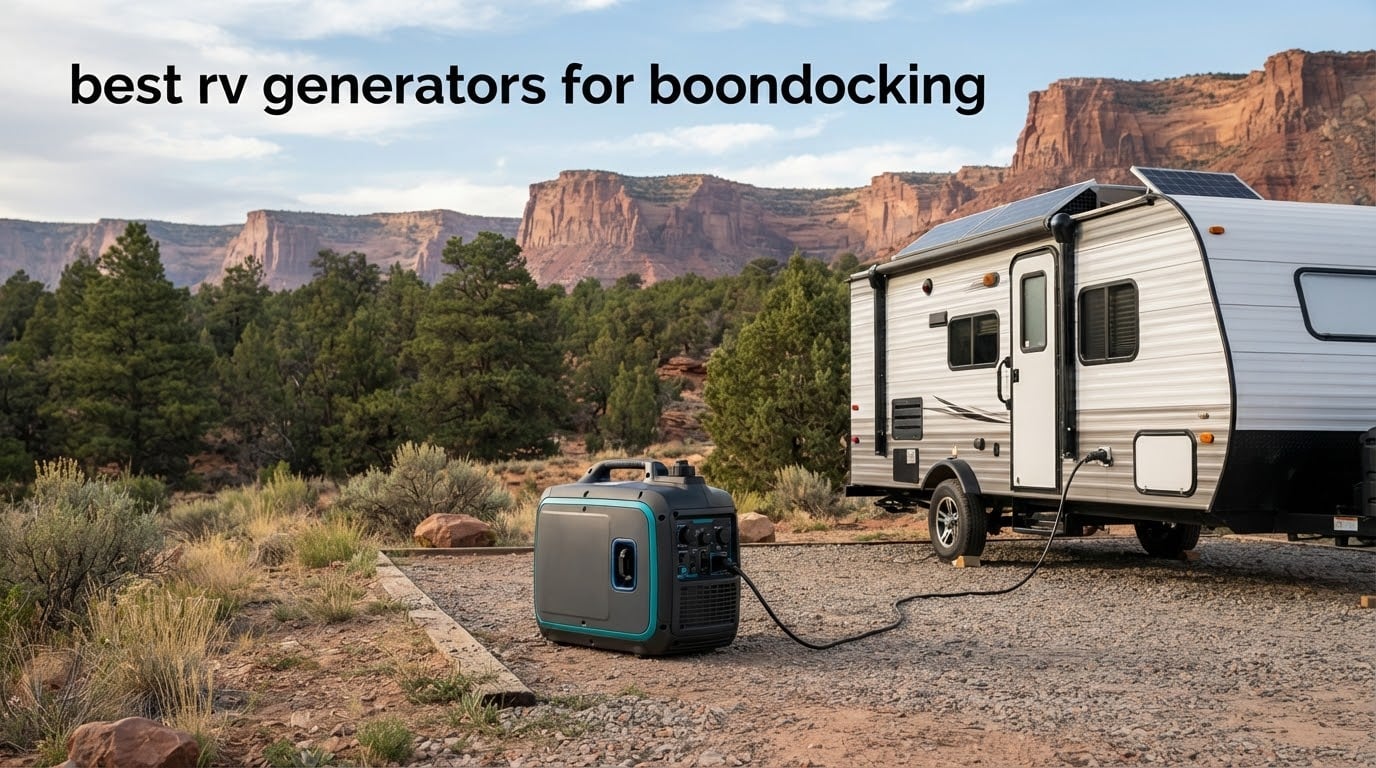
Boondocking means parking your RV far from a hookup and making your own power for a few nights. Yes, you can absolutely run a generator while boondocking, and in most states and national parks it is the expected way to do it. You start the unit, run a 30-amp shore power cord from its twist-lock outlet into your RV inlet, and your rig runs on its own for as long as the fuel lasts.
The question that actually matters is which one. A boondocking generator has to fit somewhere in or beside your trailer, weigh no more than one person can still lift, make less noise than your neighbours can stand at midnight, and deliver enough surge to start a rooftop air conditioner if your rig has one. Those four constraints rule out most of what sits on hardware store shelves.
We compared eight of the most-reviewed portable units in this class, pulled the manufacturer-rated figures for each, and matched them against what owners report after real nights off-grid. This guide covers the best rv generators for boondocking in 2026, including the sizing math, the installed-versus-portable decision, and the park noise rules that catch people out.
If your rig already has a big lithium bank, start with our dual battery system picks first, then come back. A generator and a battery build are complements, not substitutes.
Table of Contents
Top 3 Picks for Boondocking in 2026

All 8 Picks at a Glance in 2026
| Product | Specifications | Action |
|---|---|---|
 Honda EU2200i 2200W Inverter Honda EU2200i 2200W Inverter |
|
Check Latest Price |
| Champion 4000W Dual Fuel RV Ready |
|
Check Latest Price |
 WEN 56380i 3800W RV Ready WEN 56380i 3800W RV Ready |
|
Check Latest Price |
 PowerSmart 3800W Dual Fuel PowerSmart 3800W Dual Fuel |
|
Check Latest Price |
 AIVOLT 4300W Inverter AIVOLT 4300W Inverter |
|
Check Latest Price |
 Pulsar PGD40ISCO 4000W Pulsar PGD40ISCO 4000W |
|
Check Latest Price |
 WEN 56235i 2350W Inverter WEN 56235i 2350W Inverter |
|
Check Latest Price |
 Oxseryn 4400W Open Frame Oxseryn 4400W Open Frame |
|
Check Latest Price |
Two products here deserve an immediate warning. The WEN 56235i and the Honda EU2200i are both genuinely excellent units, but at 1900 and 1800 running watts they sit below what a rooftop air conditioner draws. A Class B owner on classbforum.com asked the exact question in 2026: can a small 2,000-watt generator handle air conditioning? The honest answer is that 1,800 running watts alone will not start a 13,500 BTU compressor surge without help.
How to Size a Generator for Boondocking
Running watts are what the unit sustains. Starting watts, also called surge, are the short burst a motor-driven appliance needs to get moving. A refrigerator compressor, a water pump, a microwave and a rooftop air conditioner all draw far more at startup than while running, and that gap is where undersized generators fail.
Start with an inventory of what actually runs at once on a boondocking night. For most RVs that is the refrigerator, a battery charger, a CPAP machine, a television with laptop, and the roof air conditioner. Add those running watts together, then check that the total stays under the unit’s sustained rating rather than its surge rating.
Then size the surge. A 13,500 BTU rooftop air conditioner is the single most demanding load on most rigs, and it needs more starting power than its running draw suggests. Generators in the 2,000-watt class generally cannot start one on their own. Adding a soft-start capacitor device to the air conditioner circuit is the workaround owners on these forums report using, and it is why a smaller unit can end up running a big air conditioner anyway.
Finally, confirm the outlet type. Your RV wants a 30-amp twist-lock or NEMA TT-30R receptacle, not a household 20-amp plug. We cover the outlet differences in more detail in our 30-amp inverter generator guide.
1. Honda EU2200i – Editor’s Choice All-Rounder for Boondocking
- Exceptionally quiet at 48-57 dB(A)
- Clean inverter output for electronics
- Light enough for one person to load
- CO-MINDER carbon monoxide auto shutdown
- Bluetooth app with remote stop
- 3-year residential warranty
- 1800 running watts will not start a 13500 BTU rooftop A/C unassisted
- Gasoline only with no propane option
- 0.95 gallon tank means frequent refuelling
- Not sold in California
The Honda EU2200i is the unit we kept coming back to. It carries a 4.7 average across more than 3,200 reviews, the deepest review history in this group by a wide margin. The 121cc four-stroke produces 1800 running watts and 2200 starting watts on a 0.95-gallon tank that carries it about nine hours.
Noise is the headline. Owners measure 48 to 57 dB(A) depending on load, which is quieter than a normal conversation held at arm’s length. That matters more than the raw wattage for anyone who plans to run the unit after dark in a dispersed campground site rather than in the next site over.
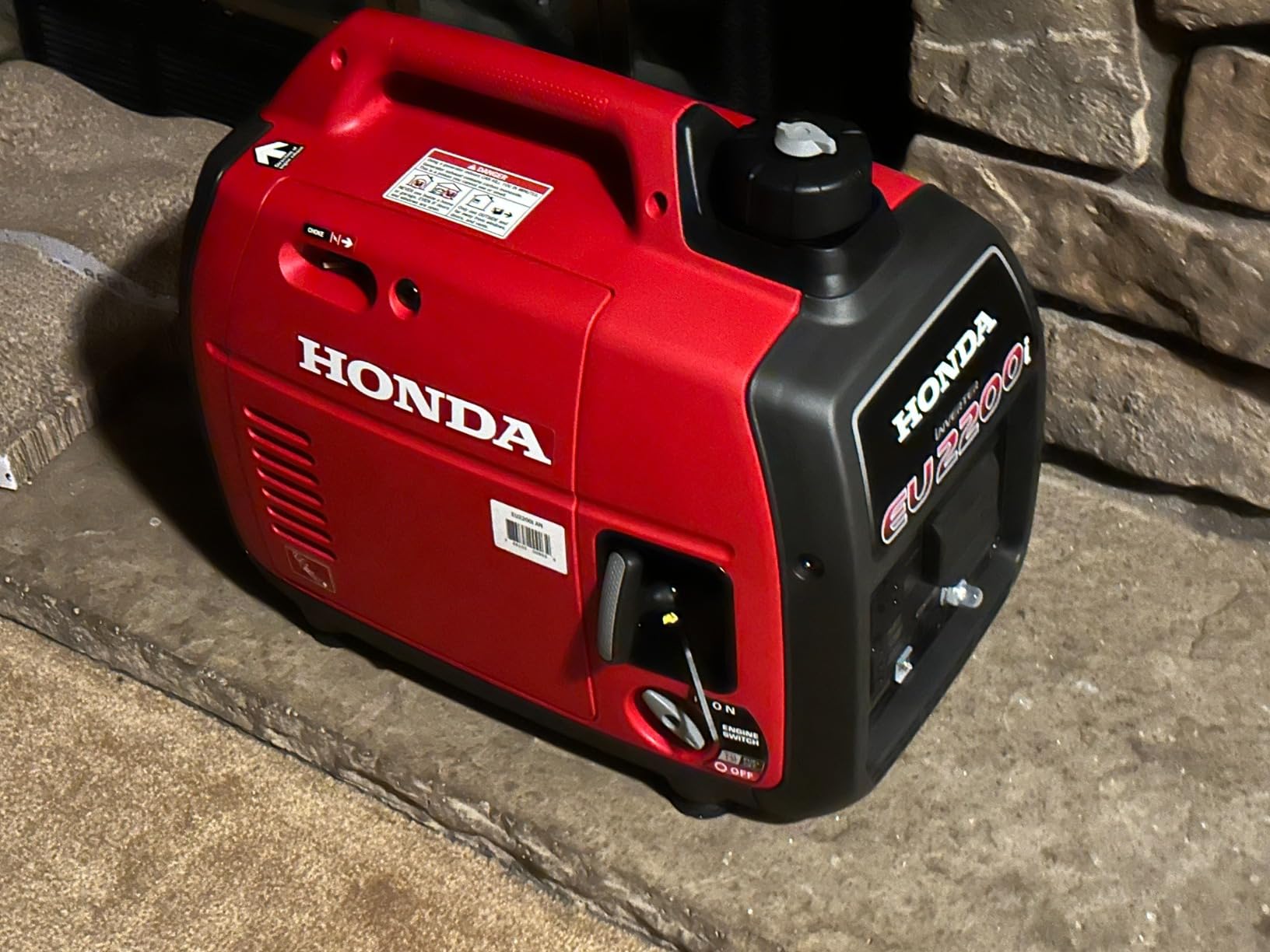
Output is a clean inverter sine wave, which is the reason the EU2200i shows up on CPAP machines, laptops and medical gear without complaint. Total harmonic distortion stays low enough that sensitive electronics do not need a separate conditioned-output box. CO-MINDER shuts the engine down if carbon monoxide climbs too high, and the My Generator app adds Bluetooth monitoring and a remote stop.
At 46.5 pounds and 21 by 20 by 13 inches, it slides into a pickup bed or a small generator compartment without a fight. The enclosed frame means the hot exhaust stays directed away from you, which is another safety point in dry brush country.
When the EU2200i is the right call
This is the generator to buy if your boondocking is about evenings: a fan, a laptop, a CPAP machine, lights and a small television. Owners running full-time setups off grid pair it with a battery bank and call it a day, because the 0.95-gallon tank refills quickly and the unit starts on the first pull every time.
It is also the safest pick for a first-time boondocker. The combination of low weight, low noise and automatic carbon monoxide shutdown means you are less likely to misjudge placement on a first night alone in the woods.
When the EU2200i is the wrong call
If your rig has a 13,500 BTU rooftop air conditioner and you intend to run it through a desert night, 1800 running watts is not enough on its own. The compressor surge will trip the overload protection or stall the engine, and the fuel gauge will empty long before the night is over.
It is also gasoline only, with no propane capability. On a long trip where you do not want to carry a jerry can of fuel, that is a real limitation. And if you are buying purely to run a big roof unit, spend the money on something in the 3,000-plus running watt class instead.
2. Champion 4000W Dual Fuel – Best for Running a Rooftop A/C
- Reported to run a rooftop A/C for hours on one tank
- 25 hours runtime on a standard propane tank
- 51.8 lb for 4000 starting watts
- 25A TT-30R RV outlet plus household duplex
- CO Shield auto shutdown
- 3-year warranty with lifetime technical support
- 64 dBA is louder than the smaller Champion models
- Machines may refuse propane until broken in on gasoline
- CO sensor can trip nuisance shutdowns
- Cannot run the A/C and a microwave at the same time
This is the dual-fuel unit that changes what a boondocking trip feels like in July. The Champion 4000-watt dual-fuel delivers 3000 running watts on gasoline and 2700 on propane, with 4000 starting watts, and owners report running a 15,000 BTU Dometic rooftop unit in a 27-foot travel trailer continuously for seven hours on a single tank of fuel.
The dual-fuel layout is the reason it earns a place on a boondocking list. A standard 20-pound propane cylinder carries it up to about 25 hours, which means most weekend trips need no refuelling at all, and propane stores indefinitely without the varnish problems that ruin a gasoline unit left half full for a month.
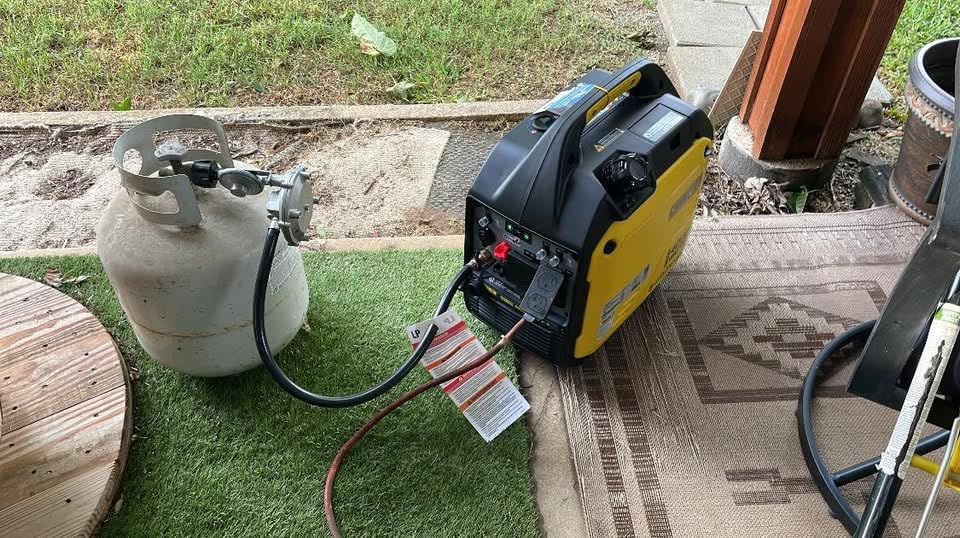
The control panel covers the essentials: a 25A TT-30R RV receptacle, a 20A household duplex running under 3% total harmonic distortion, a 12V automotive outlet, and parallel ports if you ever want to pair two of them. CO Shield shuts the engine down on dangerous carbon monoxide levels, and overload recovery is a red panel button rather than a full restart.
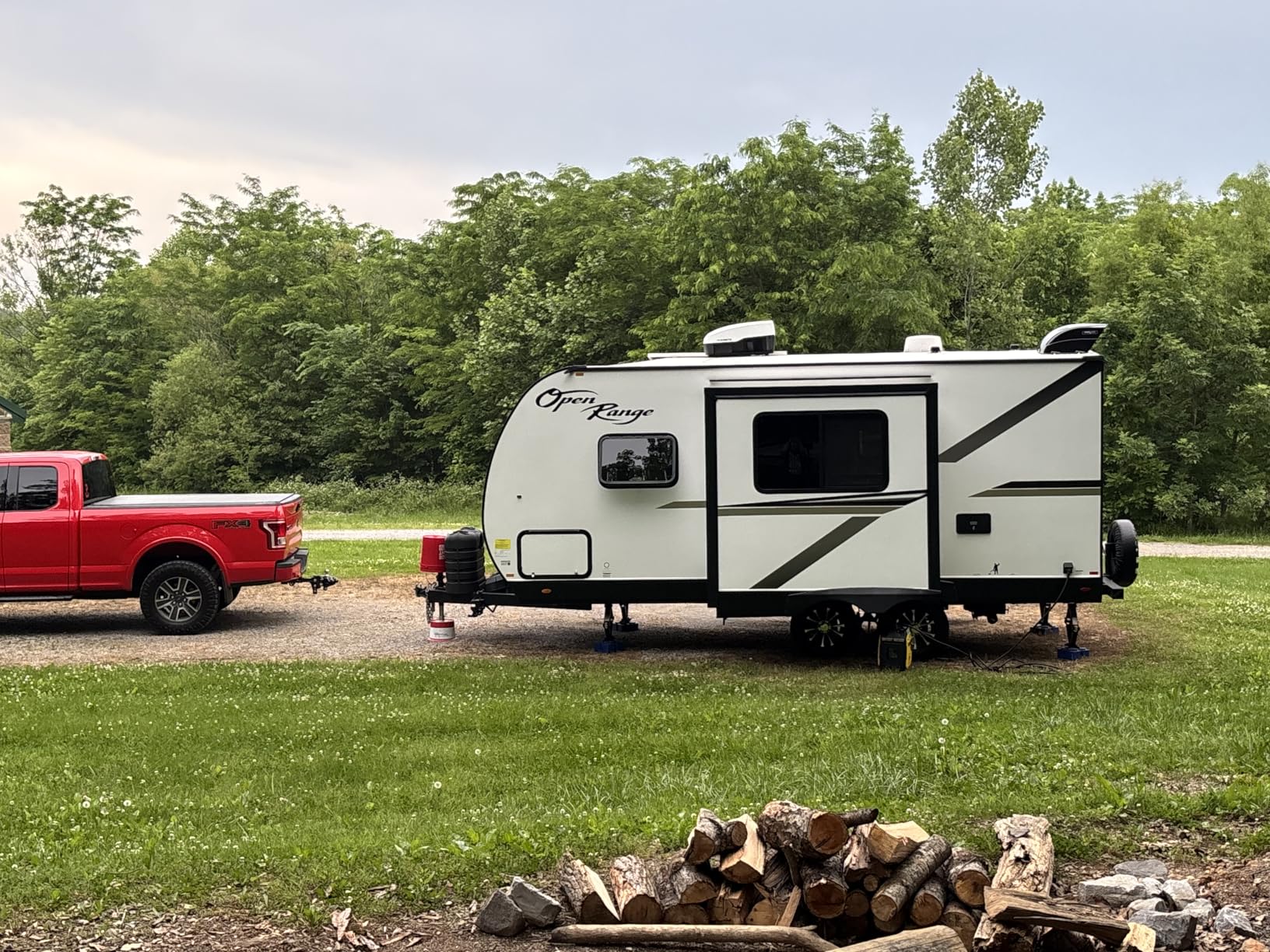
At 51.8 pounds and just under 20 inches on its longest side, it stays portable. Several owners mount it permanently on a trailer tongue or in a small forward compartment, which is the most common long-trip arrangement for this class.
Where the Champion earns its keep
Hot-weather boondocking is the scenario. When the alternative is a rooftop compressor cycling through a hot afternoon, a unit that holds 3000 sustained watts and starts from a quarter tank of propane is worth more than two quiet small generators.
Full-timers and long-trip owners also appreciate that they can carry one cylinder rather than a jerry can, and that the fuel does not degrade while the rig sits between trips. The oil access fasteners are quarter-turn, so a seasonal check does not require a tool roll.
Where the Champion disappoints
It is the loudest enclosed inverter in this group at a quoted 64 dBA measured at 23 feet, and owners who also own smaller Champions report a noticeable step up. One owner measured 53 dBA on a 2,500-watt model and estimates up to 70 dBA at full load on this one, which is a fair warning for close quarters.
Two practical wrinkles. Some machines will not fire on propane until they have been broken in on gasoline first, so run it on gas before you rely on it. And the CO sensor can be trigger-happy in a still, enclosed campsite, shutting down a running unit for no clear reason. Neither is a dealbreaker, but both are real.
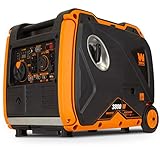
3. WEN 56380i – Best RV-Ready Plug with Electric Start
WEN Super Quiet 3800-Watt RV-Ready Portable Inverter Generator with Fuel Shut-Off and Electric Start (56380i)
- Dedicated 30A NEMA TT-30R RV receptacle plus household outlets
- Electric start removes night pull-starting
- 8.5 hours at half load on a 2.2 gallon tank
- Fuel shutoff drains the carburetor on shutdown
- Digital load and fuel display
- 4.7 average over 2459 reviews
- 99.2 pounds is heavy for one person to load
- Gasoline only with no propane capability
- 212cc engine is larger and louder than the 150cc units
The WEN 56380i is one of the most straightforward RV-ready units in this group. It outputs 3400 running watts and 3800 starting watts from a 212cc four-stroke, runs about 8.5 hours at half load on a 2.2-gallon tank, and carries a 4.7 average across roughly 2,460 reviews with 84% five-star ratings.
The outlet layout is the reason most buyers pick it: two 120V three-prong household outlets, a NEMA TT-30R RV receptacle, a 12V DC port and a USB charging port. That is everything an RV distribution panel wants in one box, so you can plug the trailer in directly and keep the household circuits available for tools or a coffee maker.
Electric start ignition is the sleeper feature. On a boondock at midnight in the cold, a recoil cord is a genuine annoyance, and starting a 212cc engine by hand repeatedly is where forum complaints about overnight use usually start. The fuel shutoff system drains the carburetor on shutdown, which protects the engine when the unit sits between trips.
A digital load and fuel display shows remaining fuel and current draw, so you can tell whether the air conditioner is about to push you into overload before it happens rather than after.
Why owners keep this one
It is the pick for anyone who wants a genuine RV connection rather than an adapter. The TT-30R receptacle is the standard your trailer inlet expects, so there is no adapter to lose in the dark and no question about whether the plug will fit.
The 2.2-gallon tank is one of the larger fuel capacities in this list, and the half-load runtime figure is one of the more honest numbers in the category.
Where it falls short
Ninety-nine pounds is the honest drawback. That is a two-person lift into a truck bed for most owners, and it is at the point where a generator stops being genuinely portable. Several buyers note that a 2,300-watt class unit delivers similar quiet running at a fraction of the weight.
It is also gasoline only. If your plan is to store fuel for months between trips or carry a single propane cylinder on a long loop, this is not the tool for that job. And the larger 212cc engine is a step louder under full load than the 149cc and 79cc units here.
4. PowerSmart 3800W Dual Fuel – Best Value for Long Boondocks
- Dual fuel with up to 24 hours on a 20 lb propane tank
- 59 dBA in Eco Mode at 25% load
- Under 3% THD clean inverter output
- 30A L5-30R twist-lock plus household 12V and USB ports
- Starts on the first pull after break-in
- Two-year warranty with lifetime technical support
- 1.3 gallon gasoline tank is small for overnight runs
- Access panels need a Phillips screwdriver
- Display is poorly documented and hard to read on the ground
- No Bluetooth
- Noise climbs above Eco Mode under load
PowerSmart 3800W dual-fuel punches above its tier. It runs 3300 watts on gasoline and 3100 on propane, with 3800 starting watts on gas, and carries a 4.5 average across about 1,125 reviews with 78% five-star ratings. Several owners running camping setups call it the strongest value in the dual-fuel class at this tier.
Two owner reports stand out. One boondocker with a 32-foot travel trailer ran a 15,000 BTU air conditioner off it. Another found the 59 dBA Eco Mode figure at 25% load quieter than a comparable Honda. Both are the kind of reports you rarely see on units at this level.
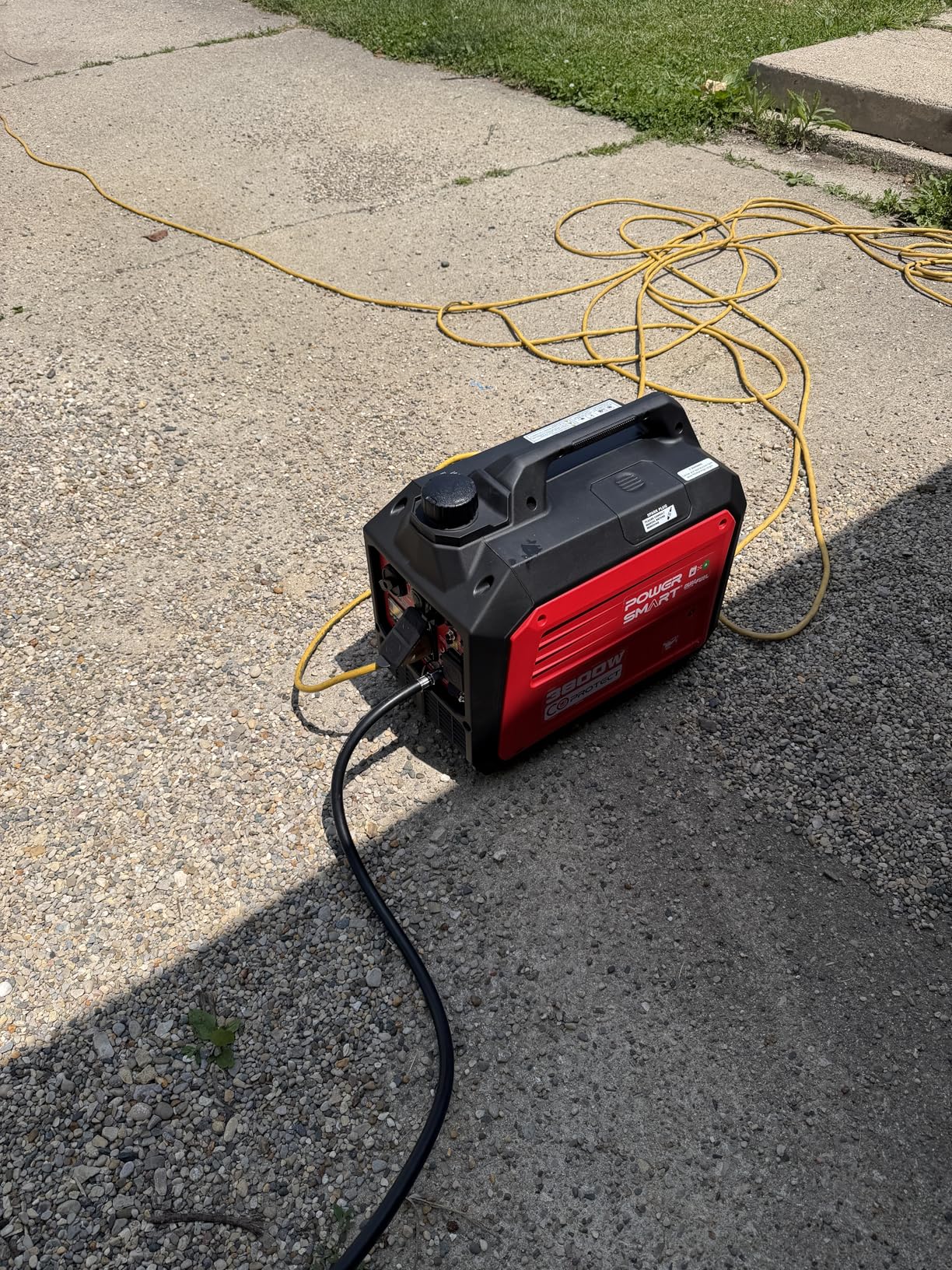
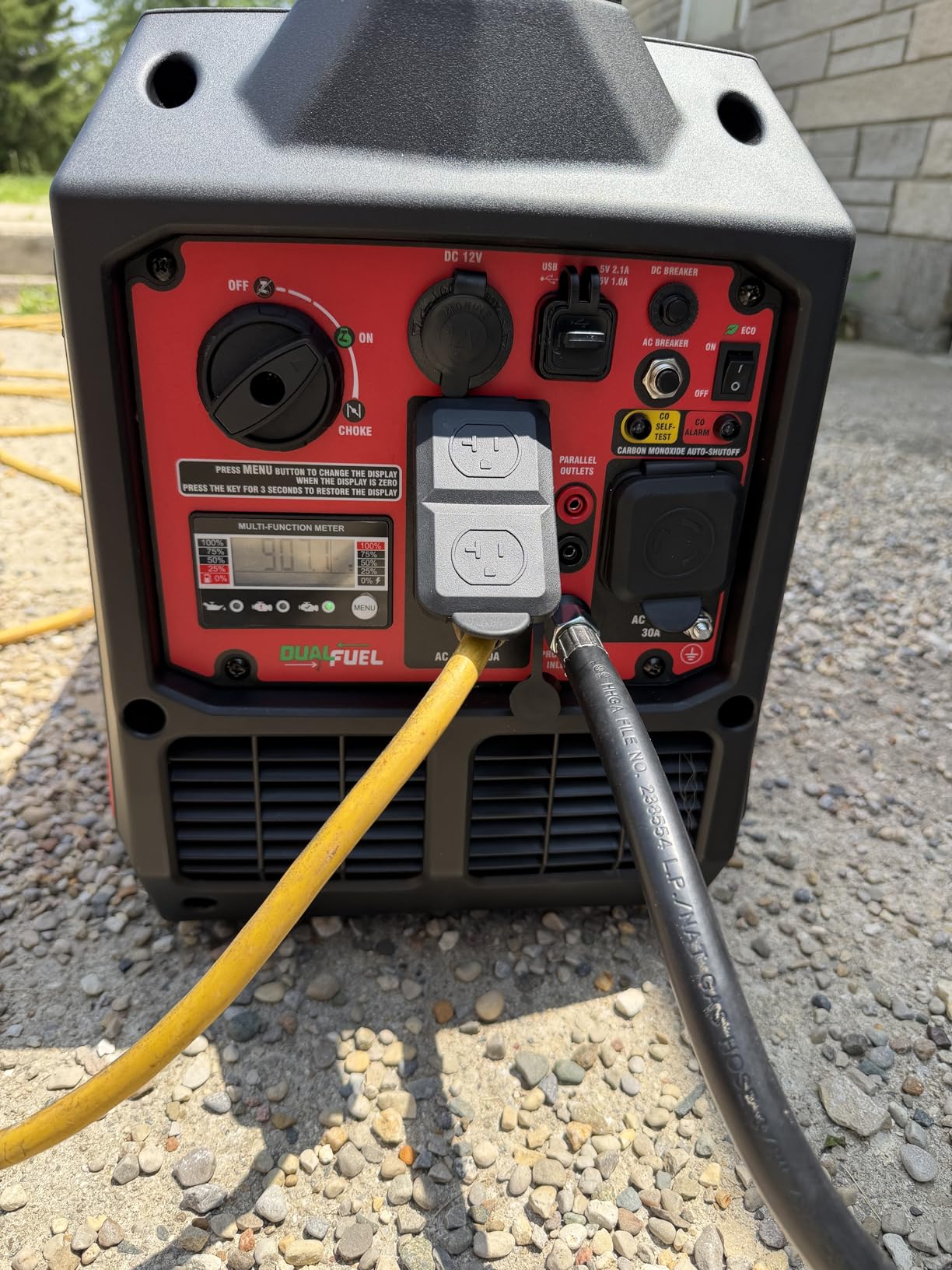
Power is clean, with output under 3% total harmonic distortion, so radios, battery chargers and laptops behave. The panel carries a 120V 30A L5-30R twist-lock, a 20A household duplex, a 12V 8A DC outlet and dual USB ports, and it is parallel ready. Protection includes overload, short circuit, carbon monoxide sensor and low oil shutdown.
At 50.7 pounds and 21.9 by 13.4 by 19.5 inches, it fits a truck camper compartment without removing anything. A 5-foot two-stage LP regulator hose, oil funnel and spark plug wrench come in the box.
The case for this one
Propane is the reason. Carrying one 20-pound cylinder and getting up to 24 hours of run time changes trip planning completely, and the fuel does not go bad in a garage over winter the way gasoline does.
It is also the sweet spot for a Class B or a small travel trailer. You get 3,000-plus running watts and a real RV twist-lock outlet at roughly half the weight of the bigger framed units, which is what actually limits you in a small generator bay.
Where it gets awkward
The 1.3-gallon gasoline tank is genuinely small. Owners running overnight on gas will be refilling, and the smart move is to switch to propane before you go to bed. The panel is quiet in Eco Mode but climbs noticeably as load rises, so manage the air conditioner cycle rather than running everything flat out.
Serviceability is the other weak spot. The access panels and oil change door need a Phillips screwdriver, the control display is barely documented in the manual and hard to read with the unit on the ground, and there is no Bluetooth despite the display. A small minority of owners also report machines that would not start, and warranty support that was hard to reach.
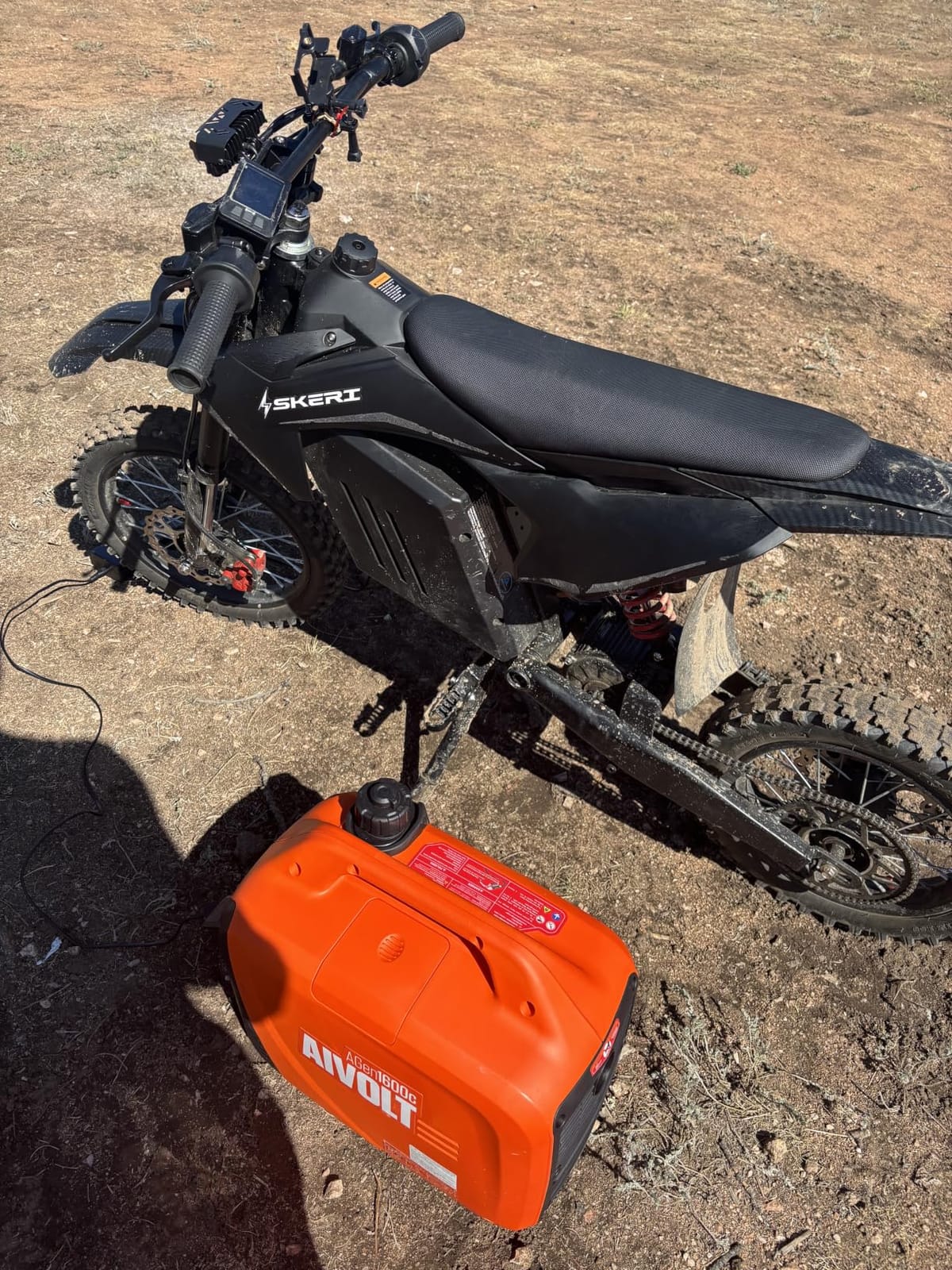
5. AIVOLT 4300W – Best for Clean Power to Sensitive Electronics
AIVOLT 4300W Inverter Generator Gas Powered Quiet RV Generator for Camping
- Under 3% THD clean inverter power
- Light 50.7 pound frame for 4300 starting watts
- 60 dBA at 23 feet
- 30A locking outlet plus included RV adapter
- 5-in-1 LCD shows oil fuel and overload status
- CO Alert auto shutdown
- Small 0.69 gallon tank gives roughly 5.5 hours in ECO mode
- Engine oil is not included and must be added before first use
- Parallel kit sold separately
- 12% one-star share is the highest in this group
The AIVOLT 4300-watt pairs high output with a compact frame. It produces 3450 running watts and 4300 starting watts from a 149cc four-stroke, weighs 50.7 pounds, and measures 21.45 by 13.78 by 18.7 inches.
Power quality is its argument. Output stays under 3% total harmonic distortion, which puts it in the same class as the units most recommended for CPAP machines, laptops and audio equipment. The panel includes a 120V 20A outlet, a 120V 30A locking outlet, 12V DC and both Type-A and Type-C USB, and a 30-amp RV adapter is included in the box.
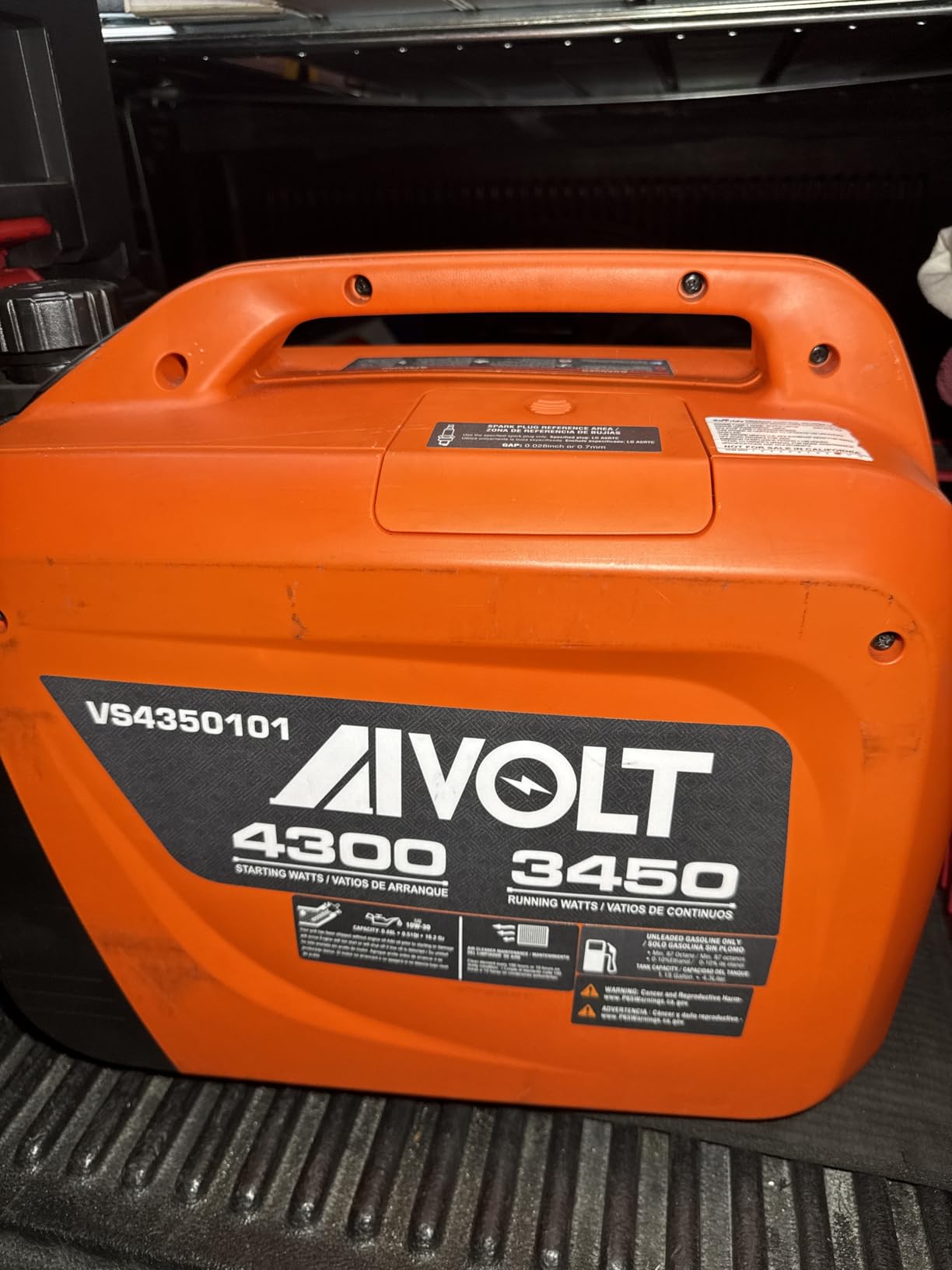
Noise is rated at 60 dBA at 23 feet, around conversational level and workable in a campground. A 5-in-1 LCD shows oil, fuel, overload warning and operating status, and CO Alert shuts the unit down on dangerous carbon monoxide readings. It is ANSI/PGMA G300-2018 and EPA compliant with a two-year manufacturer warranty.
It is also parallel ready, so two of them can be paired to double output if your rig ever outgrows one. The parallel kit is a separate purchase, which is worth knowing before you plan around it.
What it does better than the rest
Three things. Clean power for medical and audio gear, a weight and footprint that will fit spaces other 4,300-watt units will not, and an outlet count that covers RV hookup plus USB charging without a second box.
It also holds 60 dBA while pushing 3,450 running watts, which is a good ratio for a boondocking site where you need power but cannot afford to be the loud neighbour.
What to watch out for
The 0.69-gallon tank is the weakest spec in this roundup. Runtime is roughly 5.5 hours in ECO mode, which means a mid-trip refuelling on any trip longer than a long weekend. Plan refuelling into the drive, not into the evening.
Engine oil is not included, so the first start requires adding it first, which trips up more than one owner. And the honest context on this model is the 4.1 average: it has the highest one-star share of anything here, with reports of first-start difficulty and a few machines failing early. We would pair it with a soft-start device and expect to test it thoroughly before relying on it alone.
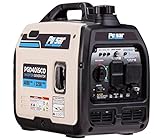
6. Pulsar PGD40ISCO – Best for Small Trailers and Tight Compartments
Pulsar PGD40ISCO Ultra Light Quiet 4000W Portable Gas Inverter Generator, white
- Lightest of the 4000-watt class here at 47.3 pounds
- Rated by the manufacturer to run air conditioning up to 13500 BTU
- 59 dB operation suits campground use
- Compact footprint fits tight generator compartments
- Parallel ready for doubling output
- 3-year limited warranty
- Only 4 hours runtime at half load on the 1 gallon tank
- Gasoline only with no propane option
- 9% one-star share on a very high sales volume
- Three total power outlets is the fewest in this group
The Pulsar PGD40ISCO stands out because it carries a manufacturer rating to run air conditioning units up to 13,500 BTU. At 3200 running watts and 4000 peak watts, that claim is at least directionally plausible, which puts it ahead of the small 2,000-watt units on paper for A/C duty.
Portability is the real reason to buy it. At 47.3 pounds and 18.9 by 11.4 by 17.3 inches, it is the lightest unit of this class in this roundup, and its footprint is among the most compact. It slides into generator compartments where a 99-pound framed unit simply will not go.
Running noise is quoted at 59 dB, which sits comfortably inside typical campground tolerance. Automatic voltage regulation handles the output, magneto ignition keeps starting simple, and it is parallel ready if you later decide two small units suit you better than one large one.
Warranty coverage is a three-year limited warranty, which is among the longer commitments offered in this category. A 4.4 average across roughly 488 reviews with 74% five-star ratings reflects a solid unit with a couple of recurring gripes.
Where it fits best
Smaller travel trailers, pop-ups and Class B vans with a shallow generator bay. The 47-pound weight is a genuine one-person lift, and the 11.4-inch width is narrow enough to secure with a simple strap.
It also makes sense as a second unit in a parallel setup. Forum owners who want two quiet small machines instead of one loud large one point to parallel-ready compact units like this as the strategy, and a 3-year warranty makes the pairing less of a gamble.
Where it falls down
Runtime is the big one. A 1-gallon tank yields about 4 hours at half load, the shortest in this group, and on a boondocking trip that means refilling in the evening whether you planned to or not.
It is gasoline only, so no propane option for long storage or carrying a single cylinder. Three power outlets is the fewest here, which limits what you can run simultaneously. And with a 9% one-star share on a very high sales volume, there are enough early failures to justify registering the unit on day one and running a full test cycle before your first trip.
7. WEN 56235i – Best for Carrying One Unit Solo
WEN Super Quiet 2350-Watt Portable Inverter Generator with Fuel Shut Off, Gasoline Power, Ultra Lightweight (56235i), Black
- Lightest unit in the group at 39 pounds
- One owner ran a 13500 BTU Dometic A/C with a soft-start device
- First-pull starting reported down to 16 degrees F
- Clean inverter output with no flicker at altitude
- 10 hours on a 1 gallon tank
- Fuel shutoff extends carburetor life
- 1900 running watts is below what most rooftop A/C units draw
- Struggles with high-surge appliances
- No hour meter included
- Low oil shutdown can trip on a gentle slope
- No oil filter so a magnetic dipstick is effectively needed
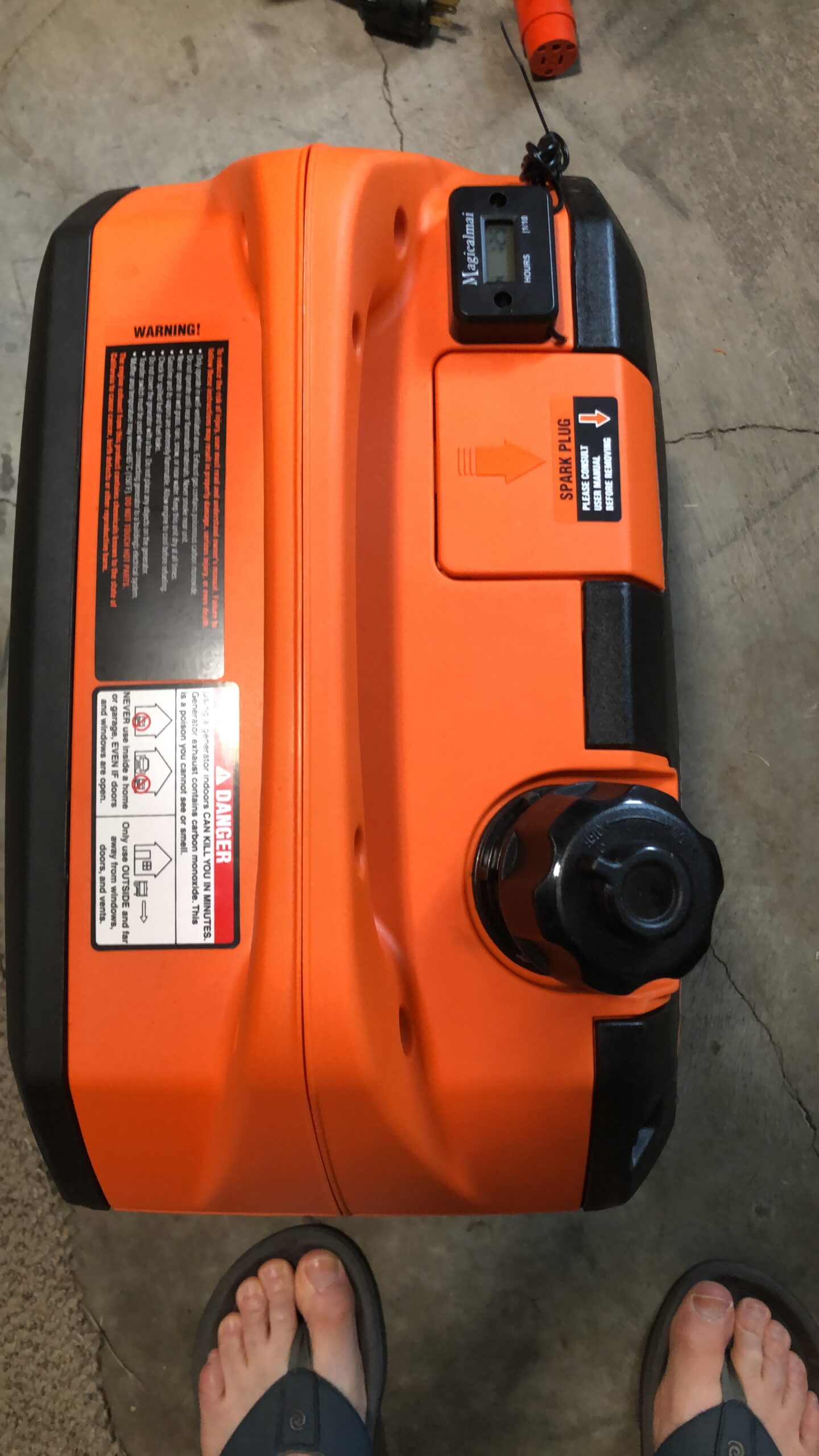
At 39 pounds the WEN 56235i is the lightest unit here, and it has a 4.5 average across roughly 2,630 reviews. The 79cc four-stroke gives 1900 running watts, 2350 starting watts and about 10 hours on a 1-gallon tank.
The interesting data point comes from a boondocking owner who ran a 13,500 BTU Dometic rooftop air conditioner on it, with a Micro-Air EasyStart soft-start device fitted, and reported it working even in ECO mode. Another owner reported first-pull starting in cold weather down to 16 degrees F. Both are the kind of result that changes how you think about a small inverter.
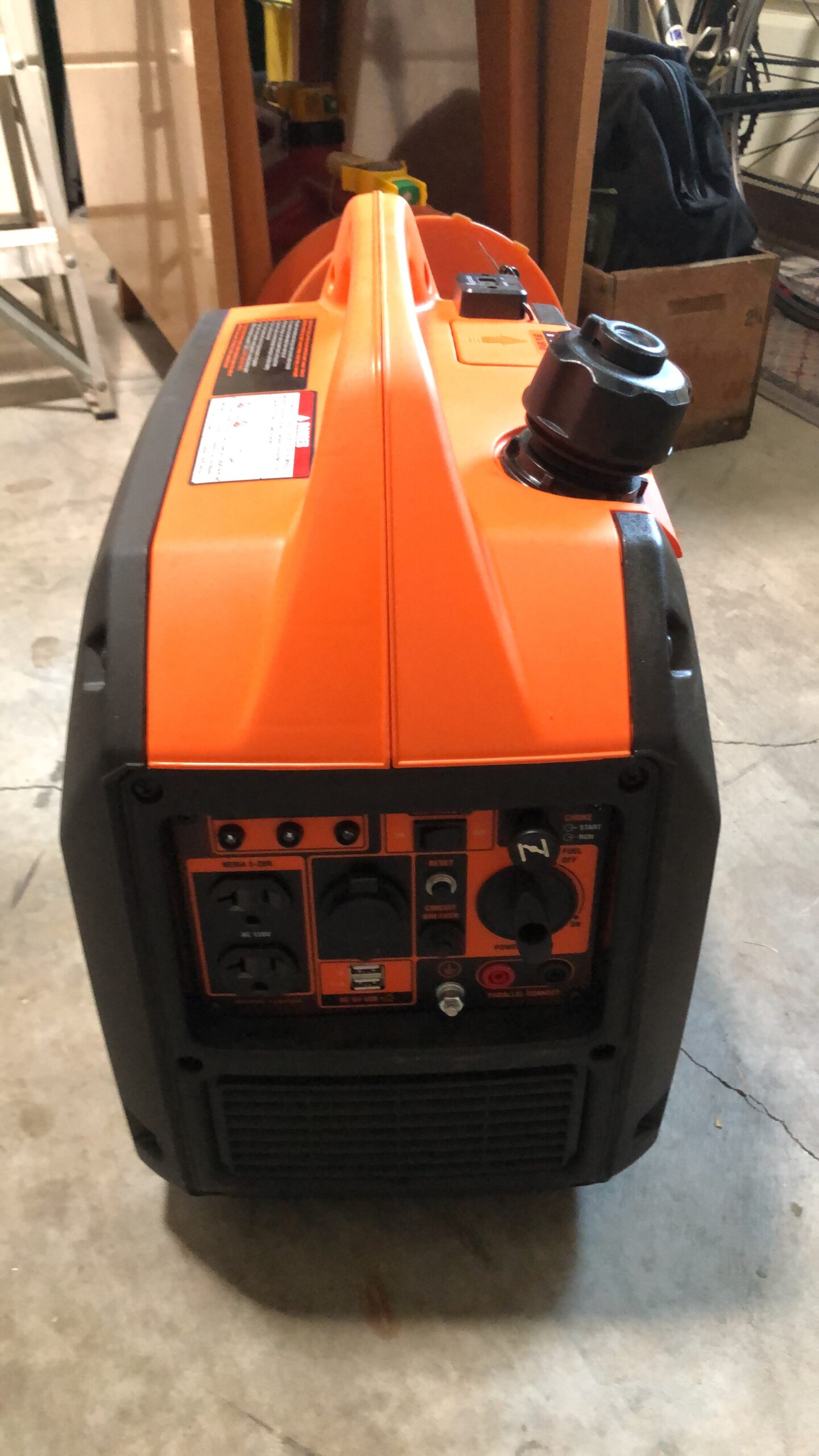
Output is clean, with consistent voltage and frequency and no light flicker even at altitude. Outlets are two 120V three-prong, a 12V DC port and two 5V USB ports, and the fuel shutoff system drains the carburetor on shutdown to extend engine life. It is CARB compliant and sized at 17.3 by 11.5 by 17.5 inches.
For high-altitude boondocking there is an optional high-altitude kit sold separately for operation between 6,000 and 9,000 feet, which matters if your winter route runs through mountain passes.
Why the small inverter still matters
Because for a lot of boondocking trips, the air conditioner is the only thing that would stop you. Run a CPAP machine, a laptop, a television and a couple of LED lights and this unit has generous headroom, at 39 pounds and 10 hours of runtime.
It also makes a strong second unit. Owners who pair two small quiet inverters with a parallel connection get more output and redundancy without carrying a single heavy machine, and forum owners recommend exactly this approach over one large noisy unit.
When to step up instead
If the air conditioner is non-negotiable and you do not want to modify the A/C circuit, 1900 running watts is a hard ceiling. Starting high-surge appliances on this unit is its known weakness, and owners consistently recommend starting the largest loads first.
Two smaller annoyances: there is no hour meter, so you are tracking runtime by memory, and the low oil shutdown can trip on the gentlest slope unless the unit is perfectly level. It also has no oil filter, which makes a magnetic dipstick close to necessary. A small number of owners report long waits for parts through authorised service centres.
8. Oxseryn 4400W – Budget Pick with Real Running Watts
- 3400 running watts at a budget entry point
- Up to 14 hours at 25% load in ECO mode on the 2 gallon tank
- 56 pound weight is manageable
- RV port plus two 120V AC outlets and 12V DC
- Fuel gauge and cold start technology
- Only a 1-year manufacturer warranty
- Under 72 dBA is the highest figure in this group
- Gasoline only with no propane option
- Open frame is more exposed than enclosed inverter models
The Oxseryn 4400-watt is an entry point that still delivers real capacity. It produces 3400 running watts and 4400 peak watts from a 208cc four-stroke, weighs 56 pounds, and holds a 4.5 average across about 785 reviews with 73% five-star ratings. For a first generator on a strict budget, the wattage is not a compromise.
Runtime is the standout. A 2-gallon tank runs up to 14 hours at 25% load in ECO mode, which is the longest gasoline figure in this roundup and the reason owners running weekend trips like it. Cold start technology, low oil shutdown and overload protection are all present, and a fuel gauge sits on the panel.
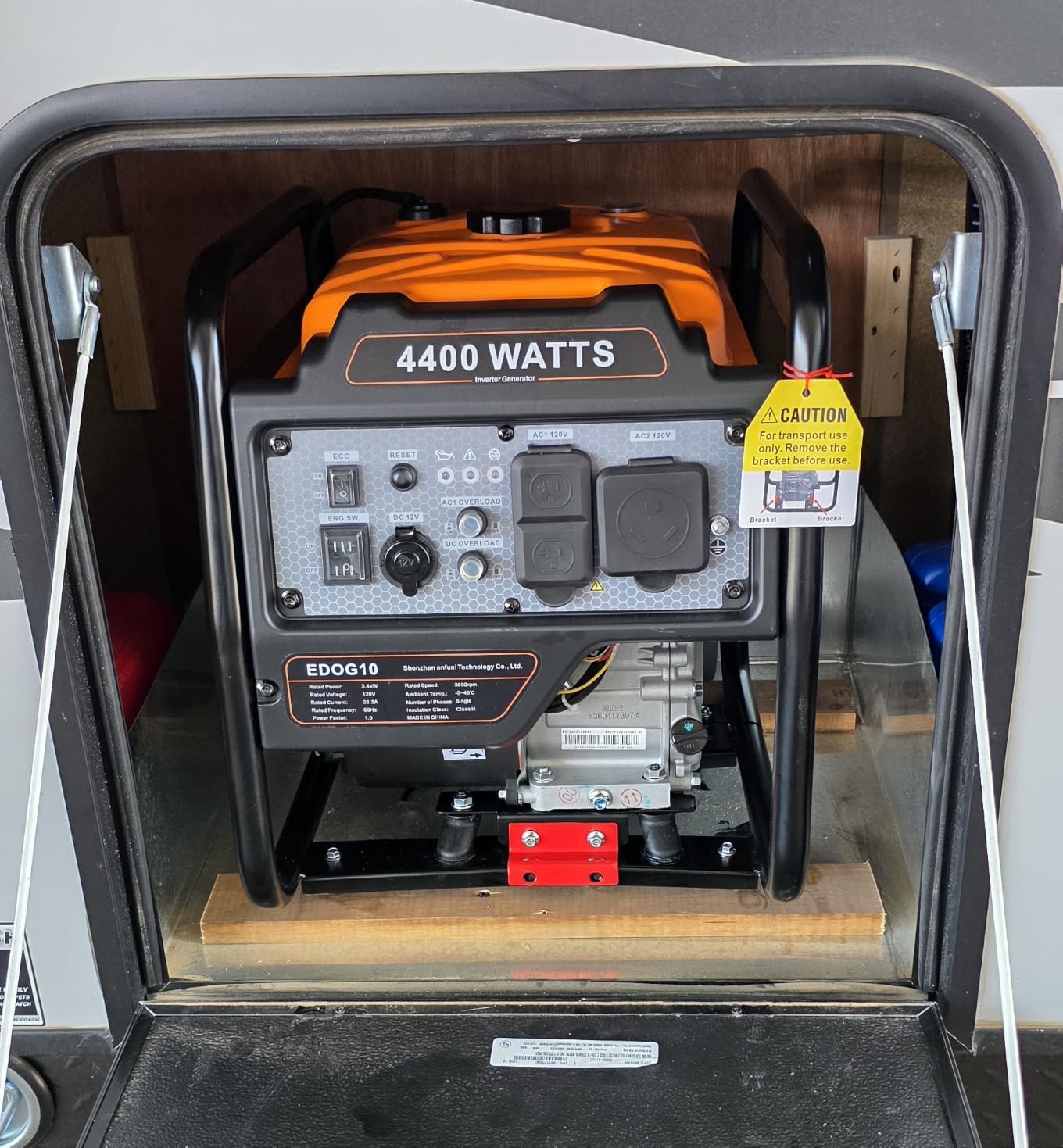
Outlets are two 120V AC, a 12V DC port and a dedicated RV port, which is the minimum viable set for plugging a trailer in. At 19 by 15.6 by 19.1 inches it is compact for a 4,400-watt open-frame unit, and every unit is functionally tested before shipping.
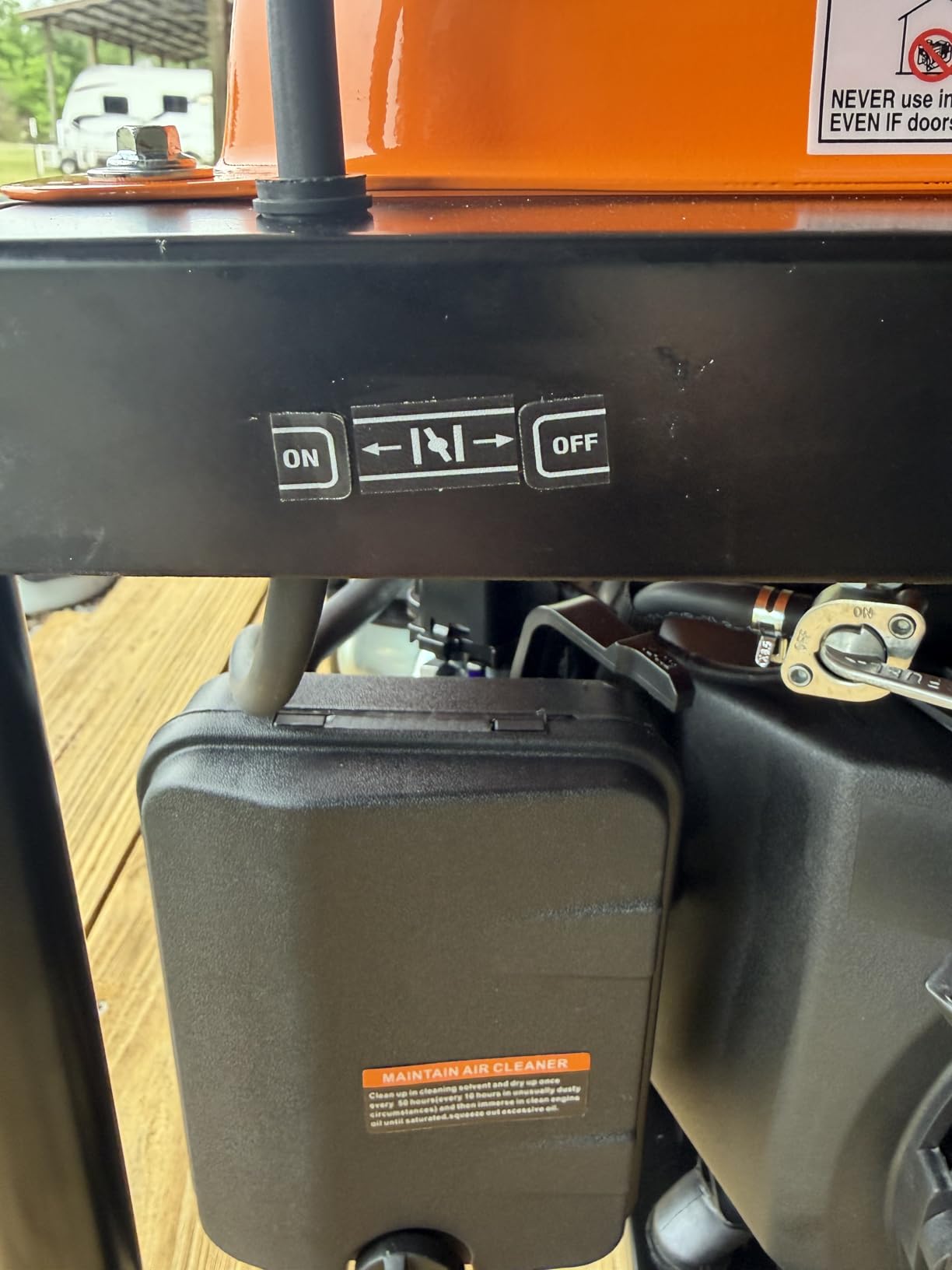
Be aware that this is an open-frame design rather than a fully enclosed inverter cabinet. It is lighter and cheaper, and it is also more exposed, which matters if you run it in brush or blowing dust.
Who this works for
A first-time boondocker on a tight budget who needs more than 2,000 watts but does not need propane or premium refinement. The 14-hour half-load runtime means most two and three night trips need no mid-trip refuelling on gas.
It also suits owners running a lot of low-draw electronics rather than an air conditioner. In ECO mode at a quarter load, a television, a laptop and a battery charger will not push the engine hard.
Where budget shows
Noise is the honest drawback. The under-72 dBA rating at 23 feet, and the open frame plus a 208cc engine means it will draw attention at a quiet site. Owners of open-frame contractor-style units regularly describe them as too loud for a campground.
The 1-year manufacturer warranty is also the shortest here, and there is no propane capability for long storage. If you plan to run this on a rooftop air conditioner, plan on long-run noise from the neighbours before you plan on the comfort.
Generator vs Portable Power Station for Boondocking
Search results for this topic have drifted hard toward battery power stations, and for quiet hours they are genuinely good. A unit of a couple kilowatt-hours will run a television, a CPAP machine and phone chargers all evening without a sound. On the r/GoRVing forum, owners with 2,000W-plus Jackery, Bluetti, Pecron and EcoFlow setups use them specifically to cover the quiet part of the evening.
What a power station will not do is start a 13,500 BTU rooftop air conditioner and then run it for six hours. The compressor surge alone can exceed a mid-sized station’s inverter limit, and once the battery is empty, recharging to full takes many hours of sun. That is the whole argument for keeping a fuel generator on board.
The strongest position is both. Run a solid battery bank for the hours when noise matters, and start the generator in the morning for the A/C, the microwave and the battery charger. Our guide to dual battery systems for boondocking covers the storage side of that plan.
Portable or Installed: Which One Boondockers Actually Need
The gap between portable units and installed RV-ready systems is enormous, and no editorial page bridges it. Portable inverter generators in this roundup sit at the entry end of the market, while installed brands such as Cummins Onan and RVMP sit several times higher. The decision comes down to how often you actually need the power.
Choose portable if you camp off-grid occasionally, if your rig already has a large battery for the quiet hours, and if you want the option of not carrying a separate machine at all. A full-timer posting on the r/RVLiving forum made the point clearly, carrying a 3,500-watt Champion dual-fuel and using it three times in three years. Frequency of use, not capability, should drive that purchase.
Choose installed if you are out for weeks at a time, if you run the air conditioner daily, or if you do not want to handle a heavy machine in the dark. The trade-offs are real: installed units take up coach space, are far harder to service yourself, and cost substantially more up front. A built-in unit also has to be exercised regularly or it develops the same varnish and carburetor problems as a portable one.
There is a third option worth knowing about. Owners on the r/RVLiving forum describe running a truck with a factory inverter, plugging the trailer into it and using the truck’s generator mode, which removes the need to carry a separate machine on a truck-and-trailer setup.
Noise Rules, Quiet Hours and Carbon Monoxide Safety
The commonly cited campground and national park standard is 60 dB measured at 50 feet, with posted quiet hours that on most public land run from around 10 pm to 7 am. Individual campgrounds and land managers set their own limits, and several states regulate generator noise specifically in designated camping or residential areas. Read the sign at your site before you start the engine, not after someone knocks.
Decibels are not linear, which is the point RV owners on the iRV2 forum keep making. A 68 dB open-frame unit does not sound 18% louder than a 59 dB unit, it sounds dramatically louder, because 10 dB is roughly a doubling of perceived loudness. That gap is the difference between an accepted background hum and a neighbour complaint.
To make a generator quieter: run it in ECO mode whenever the load allows, place it at least 20 feet from the RV and point the exhaust away from other campsites, close the RV windows and screens so you are not fighting the noise indoors, keep it off soft or dead grass where the frame can heat, and pick a lower-decibel unit in the first place rather than trying to manage it after.
Carbon monoxide is the one rule with no exceptions. Never run any generator in a garage, a storage compartment, a pop-top cavity or under an awning where exhaust can pool. Maintain the 20-foot standoff from openable windows and doors, aim the exhaust away from the RV and any ignition source, and only use a unit in a compartment with a properly designed and tested exhaust route to open air. CO sensor auto-shutdown, offered on several picks here, is a backup layer and not a substitute for placement.
Boondocking Generator Buying Guide
Inverter versus open frame. An inverter generator uses a closed enclosure and produces a clean sine wave under 3% total harmonic distortion, which is what CPAP machines, laptops and audio gear want. An open-frame unit is lighter, cheaper and louder. For boondocking, the inverter class is almost always the right answer, and the consensus on the Forest River and Jayco owner forums is that conventional non-inverter units simply burn more fuel for the same work.
Running watts versus starting watts. Running watts are what the unit sustains. Starting watts are the burst a motor needs to get going. Size on running watts, then confirm the starting figure covers your largest compressor. A rooftop air conditioner is the usual culprit, and a soft-start device is the standard fix for smaller units.
Dual fuel versus gasoline only. A dual-fuel unit runs on gasoline or a standard 20-pound propane cylinder. Propane stores indefinitely, gives you a much longer runtime per tank on the picks here, and means one cylinder instead of a jerry can in the truck bed. Gasoline only units are lighter and cheaper, and they need ethanol-free fuel plus a stabilizer if they sit between trips.
The 30-amp outlet. Your RV inlet expects a 30-amp twist-lock or NEMA TT-30R. A unit with only 20-amp household outlets forces you into an adapter, which is one more thing to lose in the dark. Several picks here include the RV receptacle or ship an adapter.
Weight and handling. Anything past about 100 pounds stops being genuinely portable, even with wheels. Below 50 pounds, one person can load and unload it alone, which is the difference between using the generator and leaving it in the truck. We have covered small units separately in our portable generator picks for RV air conditioners.
Fuel tank and runtime. Boondocking runtime is a planning problem, not a spec sheet problem. Tanks range from 0.69 gallons to 2.2 gallons in this group, which is roughly 5 hours to 14 hours at part load. If you plan to run the air conditioner overnight, either pick a large tank or run on propane.
Warranty length. Coverage here ranges from 1 year to 3 years, and the shortest warranty belongs to the open-frame unit. A longer warranty on an intermittent-use machine matters because you may only run it a handful of times a year, and a unit that sits unused is exactly the one that develops a fuel problem.
Parallel operation. Two small quiet inverter units on a parallel connection can outperform one large loud generator, and several picks here are parallel ready. This is a genuinely sensible strategy for owners who want quiet rather than raw capacity, and it is discussed at length on RV owner forums.
Altitude and cold. Gasoline engines lose power at altitude, typically around 3% per 1,000 feet. One pick here has a factory high-altitude kit for 6,000 to 9,000 feet. In cold weather, carburetor units need a fuel shutoff or a stabilizer run through the carburetor, and a choke you can reach in the dark matters more than owners expect.
Exercising an intermittent machine. A generator used twice a year is the one most likely to fail. Run it under load monthly, keep ethanol-free gasoline or run the carburetor dry before storage, and use propane if the unit will sit for months.
Frequently Asked Questions
Can you run a generator while boondocking?
Yes, and in most places it is the expected way to power your RV away from a hookup. You start the generator, run a 30-amp shore power cord from its twist-lock outlet to your RV inlet, and your outlets, refrigerator and air conditioner run normally. You must keep a 20-foot standoff from windows and doors, point the exhaust away from your RV, and follow the posted quiet hours at your site, which on most public land run from around 10 pm to 7 am.
What is the quietest generator for RV camping?
Among the units we compared, the Honda EU2200i is the quietest, with owners measuring 48 to 57 dB(A) at roughly 23 feet, quieter than a normal conversation. The PowerSmart 3800W dual-fuel is close behind at a quoted 59 dBA at 25% load, and the Pulsar PGD40ISCO is quoted at 59 dB. Decibels are not linear, so a 68 dB open-frame unit feels far louder than the number suggests.
What size generator do I need to boondock an RV?
For lights, a television, a laptop and a CPAP machine, a 2,000-watt class inverter with 1,800 to 1,900 running watts is enough. To run a 13,500 BTU rooftop air conditioner you want 3,000 running watts or more, which is the 3,500 to 4,300-watt class. Size on running watts, not starting watts, and check that the unit has a 30-amp twist-lock or NEMA TT-30R outlet for your RV.
Can a 2,000 watt generator run an RV air conditioner?
Not reliably on its own. A 13,500 BTU rooftop unit needs a large startup surge that most 2,000-watt class generators cannot deliver, which stalls the engine or trips the overload protection. The workaround owners report using is a soft-start capacitor device such as a Micro-Air EasyStart fitted to the air conditioner circuit, after which some 1,900-watt units will run a 13,500 BTU unit. Otherwise buy 3,000 running watts or more.
Do I need an inverter generator for my RV?
Yes, for boondocking. An inverter unit runs a closed enclosure and delivers a clean sine wave under 3% total harmonic distortion, which is safe for CPAP machines, laptops, televisions and audio equipment. An open-frame conventional unit is louder, burns more fuel and produces a dirtier waveform. The weight of many RVs also reflects how much sensitive electronics sit in an RV distribution panel.
How long does a 20 lb propane tank run a generator?
For the dual-fuel picks in this roundup, a standard 20-pound propane cylinder carries the Champion 4000W dual-fuel for up to 25 hours and the PowerSmart 3800W dual-fuel for up to 24 hours. Those figures fall at part load; running a rooftop air conditioner continuously will cut that noticeably. Gasoline-only units in this group run roughly 4 to 14 hours on a single tank depending on capacity and load.
What is an acceptable noise level for a generator when camping?
The commonly cited campground and national park standard is 60 dB measured at 50 feet, and most public land also posts quiet hours, commonly around 10 pm to 7 am. Individual campgrounds set their own limits and some states regulate generator noise in designated areas. Remember that decibels are not linear, so 10 dB higher is roughly twice as loud perceptually, which is why a 68 dB unit draws complaints and a 59 dB unit usually does not.
Is a portable generator better than a power station for boondocking?
A fuel generator is better for sustained high-draw loads, and a battery power station is better for quiet evening hours. A power station will not reliably start a 13,500 BTU rooftop air conditioner, and once the battery is empty it takes many hours of sun to recharge. The strongest setup is both: a battery bank for CPAP, phones and a television after dark, and a generator for the air conditioner, microwave and battery charging during the day.
Conclusion
The best rv generators for boondocking in 2026 depend on what you are actually powering. For quiet evening power and a unit one person can handle, the Honda EU2200i is the pick, with the lowest noise figures and the deepest owner history. For rooftop air conditioning and week-long trips, the Champion 4000W dual-fuel carries the air conditioner and a propane cylinder at the same time.
Match the running watts to your largest motor, the outlet to your RV inlet, and the weight to the person who will lift it. Keep the 20-foot standoff, follow the quiet hours, and give the unit a monthly run under load so it does not become a paperweight between trips. If you are still building out the rest of the rig, start with our portable shower picks and our portable toilet guide to finish the off-grid setup.