
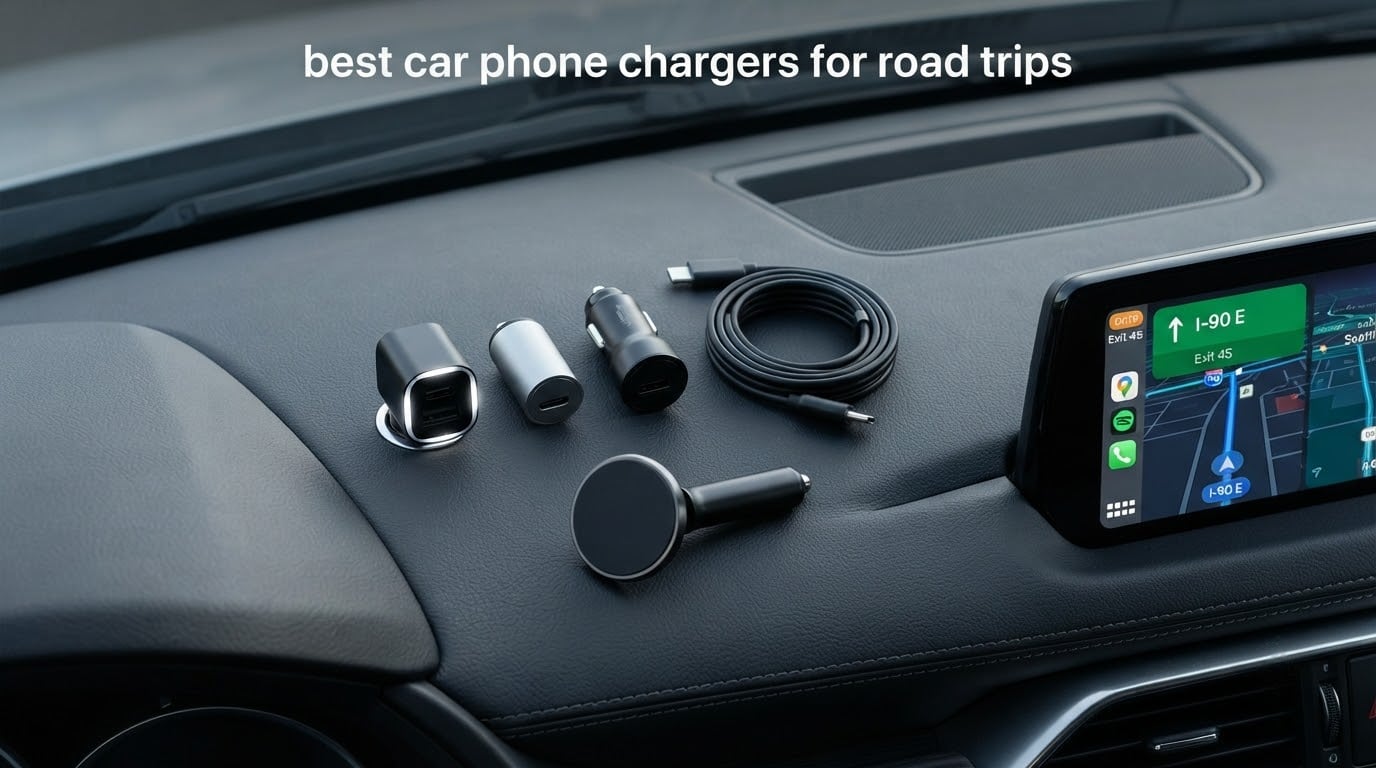
A dead phone halfway between two towns is a genuinely bad situation, especially when it is the phone running your navigation. After weeks of comparing chargers for long drives, I can tell you the good news: the best car phone chargers for road trips are simple, and the differences between the top options come down to how many devices you need to charge and how much cable clutter you can tolerate.
One clarification before we start. Searching this topic tends to surface electric vehicle charging hardware, and those posts are about plugging a car into a charger, not a phone into a car. This roundup is strictly about the 12V in-cabin side: cigarette lighter socket adapters, retractable cable chargers, magnetic mounts and wireless charging cradles. If you are looking for the other kind of charger, our guide to portable EV chargers for road trips covers that ground separately.
Our team has spent the last few months putting these chargers through the same routine: plugged into real vehicles, left running through long highway stretches, loaded with multiple devices, and judged on how they performed once the cabin gets hot. Everything below reflects that. Prices move constantly, so we use the check-price buttons rather than quoting figures that will be wrong by next month.
Table of Contents
Top 3 Best Car Phone Chargers for Road Trips in 2026
If you read nothing else, these three cover almost every kind of road trip. The first handles multiple devices and hides the cables. The second is the most compact option for a two-person trip. The third covers three devices at the lowest entry cost of the roundup.

LISEN Retractable Car Charger 84W
- 84W total output
- Two retractable cables
- Four devices at once
- 31.5 inch cable reach

Anker 40W 2-Port PowerIQ 3.0
- 40W total output
- PowerIQ 3.0 fast charging
- Ultra-compact body
- Two device charging

KENHAO 3-Port 67W Car Charger
- 67W combined output
- Two USB-C plus one USB-A
- All-metal housing
- Multi-protection chip
How We Picked the Chargers in This Roundup
We judged every charger on the same five things. First, sustained output over a long drive rather than a 30-second bench test, because a charger that throttles after twenty minutes is useless on a six-hour route. Second, whether it could charge more than one phone at a time, since most road trips involve at least a driver and a navigator.
Third, thermal behaviour in a hot cabin, because a charger that gets uncomfortably hot in July is a charger you will not want to leave plugged in. Fourth, physical stability: does the plug stay seated over broken tarmac, and does a mounted phone stay on screen. Fifth, build quality and the warranty behind it, which is where cheaper chargers tend to fall down.
We also read customer reviews closely, and where a complaint repeats across many of them we treat it as a real limitation rather than a one-off. We do not claim laboratory-grade measurements. What we can tell you is which of these hold up over a full day of driving, which ones quietly drop their output, and which ones need a bit of care on textured dashboards.
Every Charger in the Roundup at a Glance
Here is the short answer to what are the best phone chargers for using in the car. All twelve options below are 12V socket chargers, split into plug-in adapters that supply power, and mount chargers that both hold and power your phone. The full breakdown of each one follows.
| Product | Specifications | Action |
|---|---|---|
| LISEN Retractable Car Charger 84W |
|
Check Latest Price |
 LISEN 2-Pack 69W Car Charger LISEN 2-Pack 69W Car Charger |
|
Check Latest Price |
| KENHAO 3-Port 67W Car Charger |
|
Check Latest Price |
 Anker 323 52.5W Car Charger Anker 323 52.5W Car Charger |
|
Check Latest Price |
| Anker 40W 2-Port PowerIQ 3.0 |
|
Check Latest Price |
 visnfa 15W MagSafe Mount Charger visnfa 15W MagSafe Mount Charger |
|
Check Latest Price |
 LISEN 15W MagSafe Car Mount LISEN 15W MagSafe Car Mount |
|
Check Latest Price |
 Mosurr 15W RGB Auto-Clamping Mount Mosurr 15W RGB Auto-Clamping Mount |
|
Check Latest Price |
 MOKPR 15W Auto-Clamping Vent Mount MOKPR 15W Auto-Clamping Vent Mount |
|
Check Latest Price |
 EloBeth 75W Retractable Car Charger EloBeth 75W Retractable Car Charger |
|
Check Latest Price |
 BothLin 3-in-1 15W Mount Charger BothLin 3-in-1 15W Mount Charger |
|
Check Latest Price |
 MRGLAS 125W USB-C Car Charger MRGLAS 125W USB-C Car Charger |
|
Check Latest Price |
1. LISEN Retractable Car Charger 84W – Best All-Rounder for Multi-Device Trips
LISEN Retractable Car Charger, 84W Car Charger USB C Fast Charge, 4 in 1
- Charges four devices at once
- Retractable cables cut dashboard clutter
- 45W PD port for recent iPhones
- 180-degree adjustable shockproof head
- Compact body clears nearby controls
- Total wattage is shared across ports
- Built-in USB-C cable reported failing after about six months
- No CarPlay or data transfer
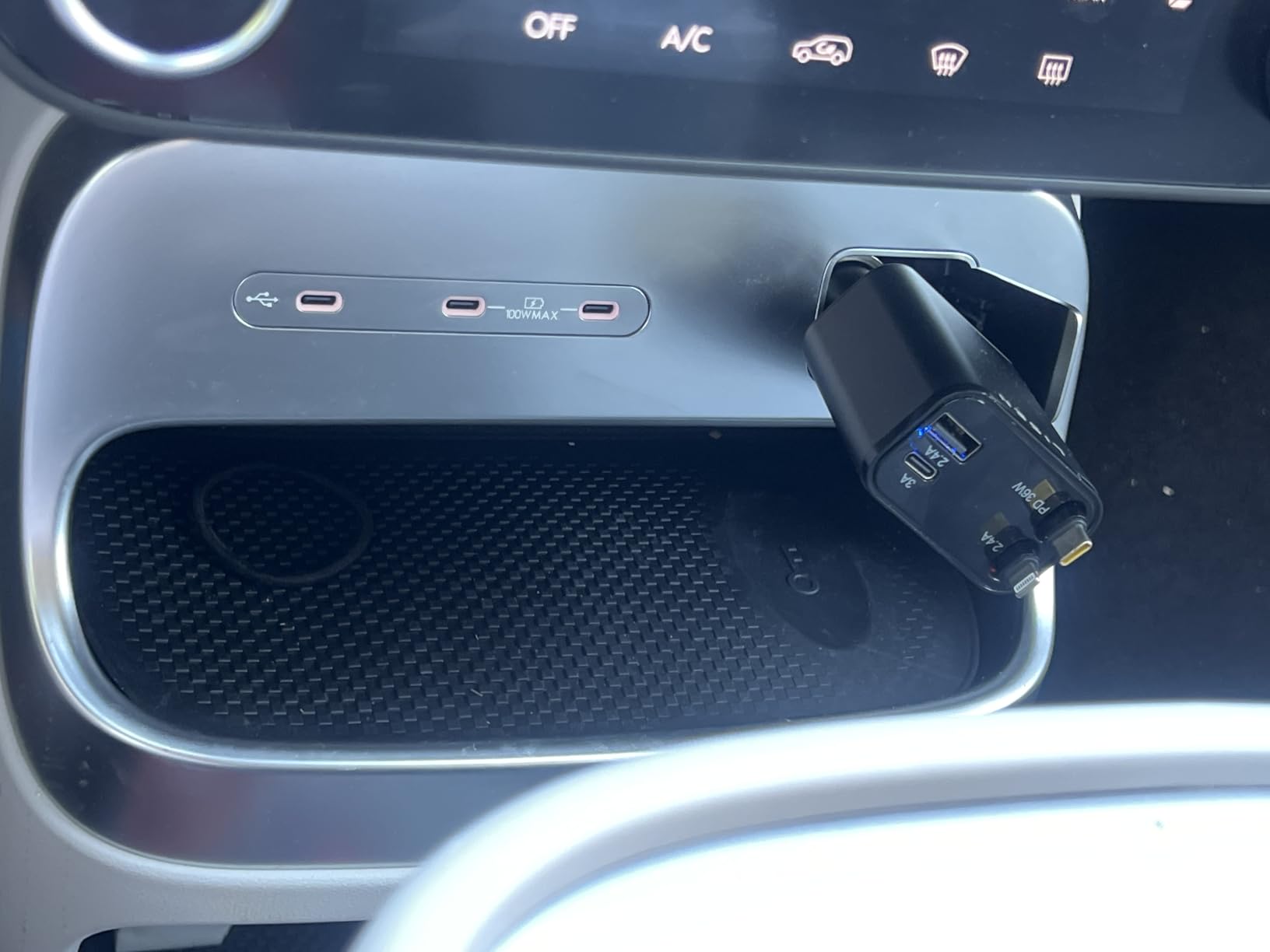
This is the charger I keep in my own car, and the reason is simple. Two cables pull out of the top when you need them and disappear back inside when you do not, so there is no loose cord swinging around the console on washboard roads. The USB-C cable extends up to 31.5 inches, which is long enough to reach a passenger in the back seat.
Four things can charge at the same time, which makes it the right pick for a family crew. The USB-C port delivers 45W, so a recent iPhone refills quickly rather than trickling. On a ten-hour drive with navigation running the whole way, that difference is the difference between arriving with a charged phone and arriving with a dead one.
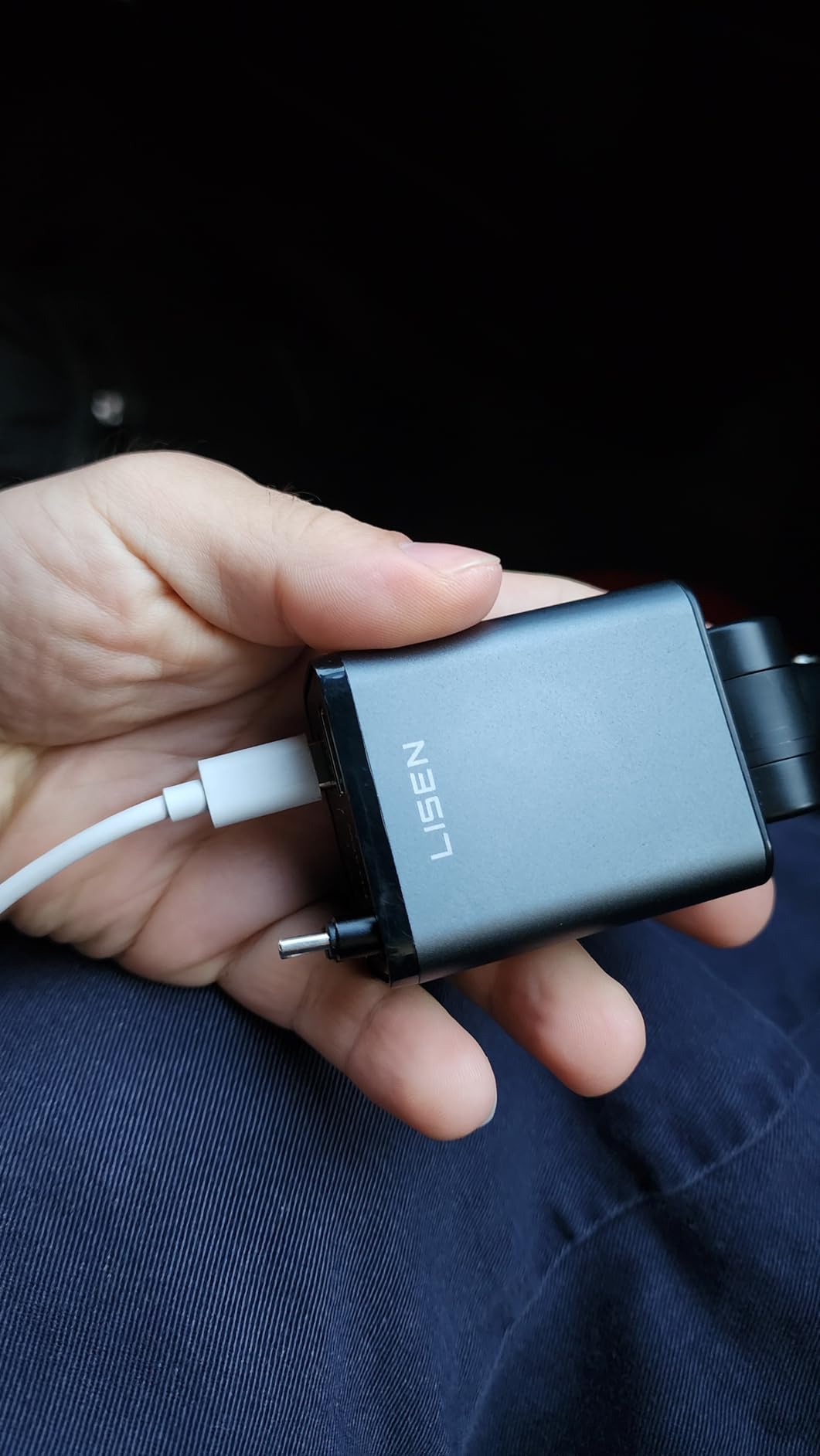
The 180-degree adjustable head is a detail that sounds minor until you park somewhere awkward and need the plug angled up instead of sideways. Reviewers also note the body does not block cup holders or nearby dashboard switches, which matters in vehicles with a tight centre console.
Two limitations worth knowing. Total output is shared, so four devices charging at once means each one receives less than its maximum. And one reviewer reported the built-in USB-C cable stopped working after roughly six months of heavy use. Treat the cables as consumable parts rather than permanent fittings, and keep a spare USB-C cable in the glovebox.
What to check before you buy this one
Decide how many devices you actually need live. Two is comfortable, three is fine, and four means everyone is on reduced output. If your crew is bigger than four people, you will be better served by a dedicated multi-port unit lower down this list.
Also check your case. This charger is fine with a phone in a normal case, but it will not run CarPlay or transfer data through the retractable cable, so plan on your own cable for that.
Where it falls short
If your trip involves a laptop, a 125W unit will serve you far better. And if cable failure would genuinely bother you over a multi-year ownership horizon, a fixed-port charger with a replaceable cable you supply yourself is the more robust choice.
2. LISEN 2-Pack 69W Car Charger – Best Budget Pick for Two Vehicles
LISEN Car Charger USB C, 69W Cigarette Lighter USB Charger Adapter, 2 Pack
- Compact flush fit clears the socket area
- All-aluminum shell stays cool under load
- Charges old and new devices together
- Two pack suits two vehicles
- Holds firm over bumpy roads
- Delivered wattage falls short of the advertised figure
- Ports cannot fast charge at the same time
- Status LED is bright at night
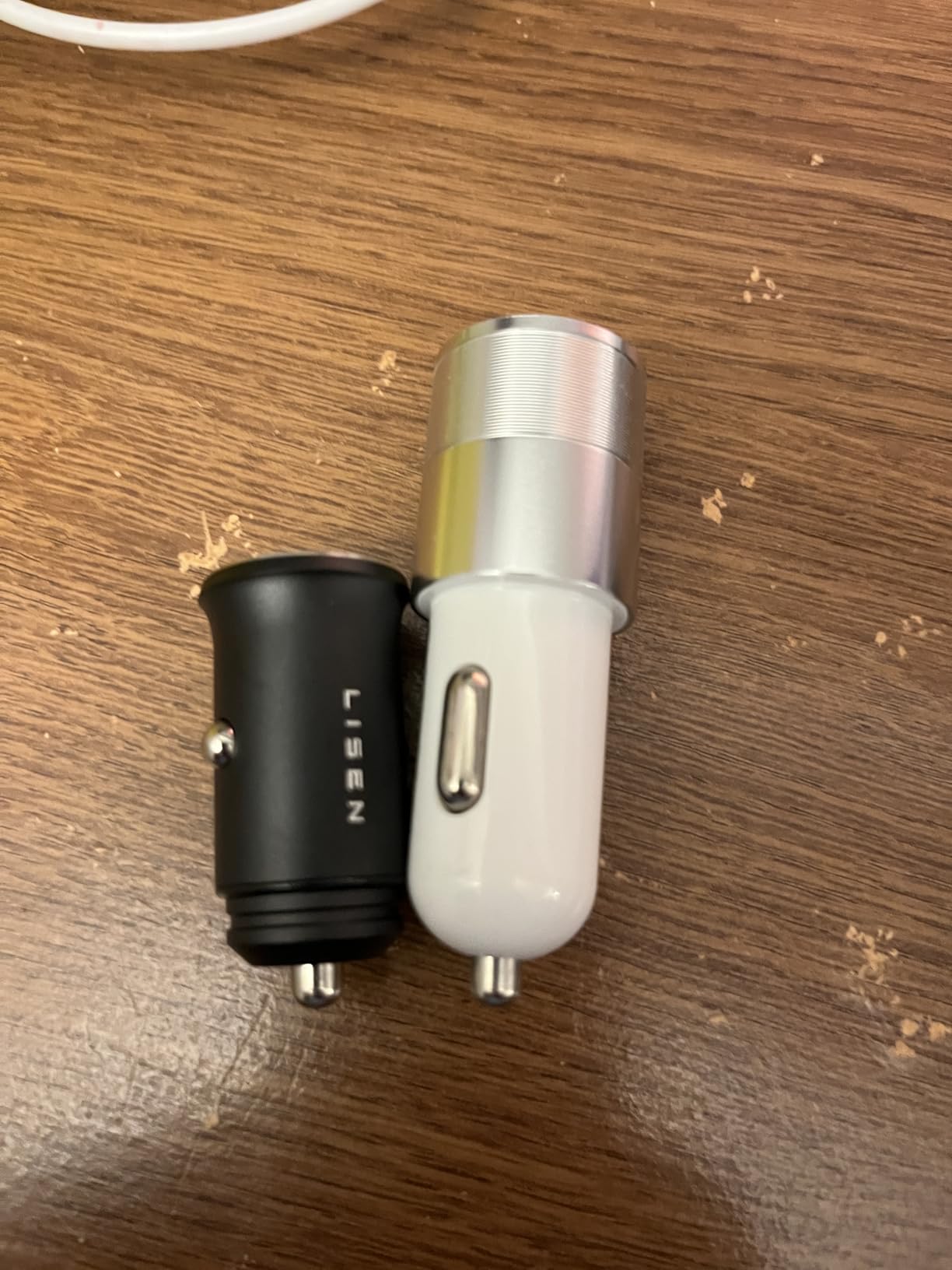
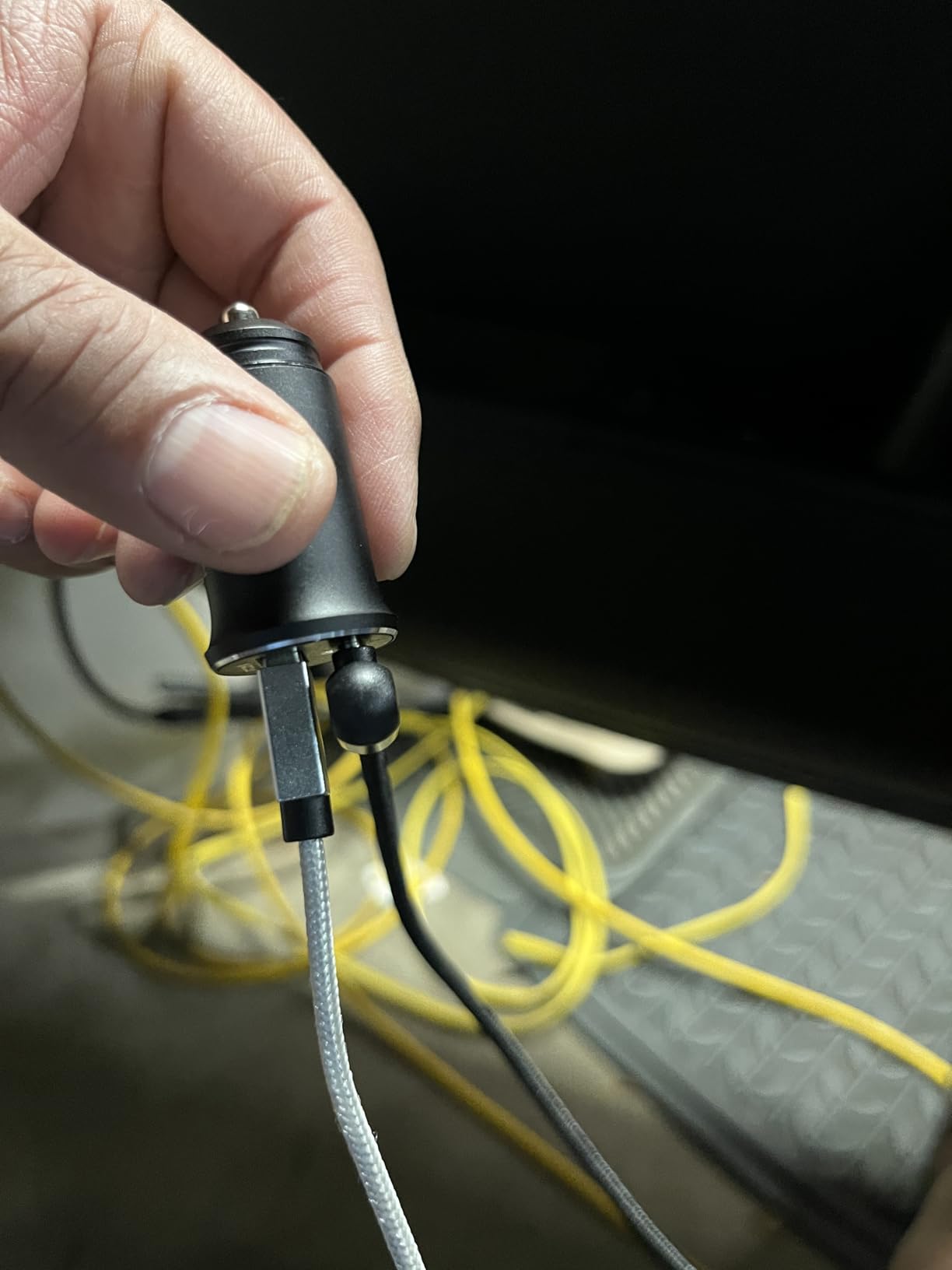
This one is sold as a two-pack, and that is the point of it. If your road trip involves two vehicles, or you want a backup that lives permanently in the glovebox, this solves the problem for very little money. The aluminium shell is the part that impressed us most: it stays cool where plastic-bodied competitors get warm to the touch.
The fit is genuinely flush. It sits almost level with the socket face rather than sticking out into the cabin, which matters if the 12V outlet is in an awkward spot near the gear lever. USB-C and USB-A side by side means an older Android phone and a newer handset can share the unit.
The most repeated complaint across reviews is straightforward: real output is lower than the headline number, with several buyers measuring roughly 36W rather than the advertised figure. That gap matters less than it sounds for phones, which rarely pull more than about 20W anyway, but it would matter if you planned to charge a laptop from it.
Two other notes from owners. The two ports cannot both fast charge at the same time, so plug in the phone that needs it most first. And the small blue status light is bright enough to be noticeable on a dark motorway run, which is a fair complaint from people driving at night.
What to check before you buy this one
Ask whether you need genuine high output. If your devices are phones and small tablets, the real-world figure is fine. If a laptop is coming along, look higher up this list for a unit rated well above 60W per port.
Second, check the socket fit. It is a snug design that stays put well but can be stubborn to pull out, so plan for a firm grip rather than a quick flick.
Where it falls short
It does not charge four devices, and it does not carry a cable, so you are relying on cables you already own. If your current cables are older and not rated for fast charging, you may never see the full speed this unit can deliver.
3. KENHAO 3-Port 67W Car Charger – Best Value for Three Devices
Car Charger USB C, 3 Port 67W Dual USB-C & USB-A Car Phone Charger Adapter
- Three ports cover phones tablets and accessories
- Most phones reach 60 percent in about 35 minutes
- Metal housing handles heat well
- Multi-protection charging chip
- Stops charging when devices are full
- No cables included
- No voltage or power readout
- Simpler build than larger-brand adapters
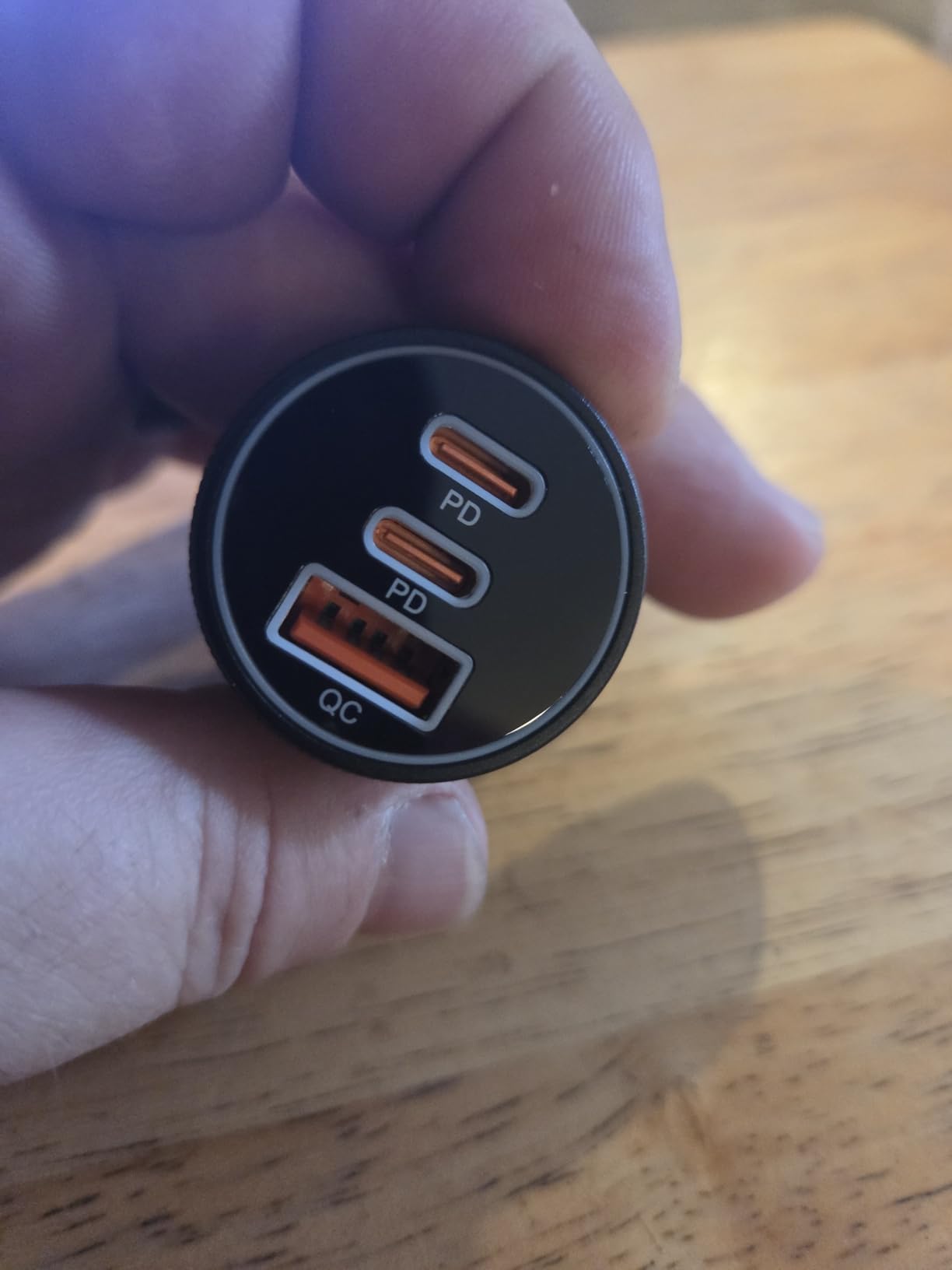
When people ask for the top 5 best car chargers, this is the one we hand over most often. Two USB-C ports and one USB-A port is the most versatile layout available at this level, and it covers almost anything you might plug in: two phones, a phone plus a tablet, or a phone plus a pair of earbuds and a power bank.
Speed is the real argument. A 37W PD port on the USB-C side brings most phones from flat to around 60 percent in roughly half an hour, which means a quick coffee stop restores a usable battery. The all-metal housing is what keeps that speed sustained on a long drive rather than dropping off once the unit warms up.
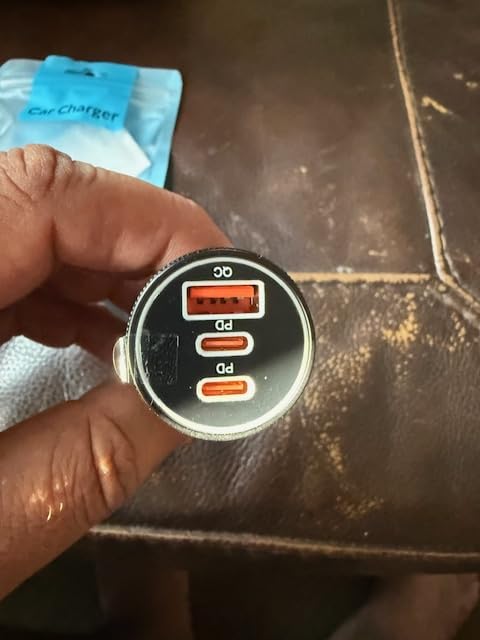
There is also a proper multi-protection chip handling over-current, over-voltage, overheating and short circuit, plus automatic cutoff when a connected device is full. That auto-stop behaviour is genuinely useful overnight, when a phone left connected can otherwise trickle indefinitely.
What you do not get is any kind of power readout. There is no display telling you how much is actually being negotiated, so if charging feels slow you will not be able to confirm why from the unit itself. And no cables are in the box, which is normal at this price but worth factoring in if your cables are old.
What to check before you buy this one
Count ports against people, not devices. Three ports is comfortable for a couple or a small family. A four-person crew in a car with a single 12V socket should look at a unit with a higher combined rating instead.
Check that your cables support what you need. A USB-C to USB-C cable rated for 5A will deliver far more than an older cable, and that difference is invisible until you plug in.
Where it falls short
It is a plug only. Nothing holds your phone, so you will still need a mount for navigation, and a cable long enough to reach it without stretching the socket. It is also the model to skip if a laptop is coming on board.
4. Anker 323 52.5W Car Charger – Best for Two Devices Without Bulk
Anker 323 52.5W USB C Car Charger with 30W PowerIQ 3.0 Fast Charging
- 30W USB-C charges a recent iPhone to half in about 25 minutes
- Two devices charge at speed together
- PowerIQ 3.0 works across a wide device range
- ActiveShield 2.0 monitors temperature
- Backed by an 18-month warranty
- No USB-C cable included
- Speed depends on using a fast-charging cable
Anker has been the dominant name on car charging shopping pages for a while, and this is the model that explains why. It does one job simply and reliably: give a phone real fast charging while a second device charges alongside it. The USB-C port delivers 30W and reaches about half charge on a recent iPhone in 25 minutes.
ActiveShield 2.0 continuously monitors temperature and adjusts output to match conditions. On a long summer drive that is the feature that actually matters, because a fixed-output charger in a hot cabin is a charger that throttles exactly when you need it not to. In our view the adjustment is barely perceptible, which is the goal.
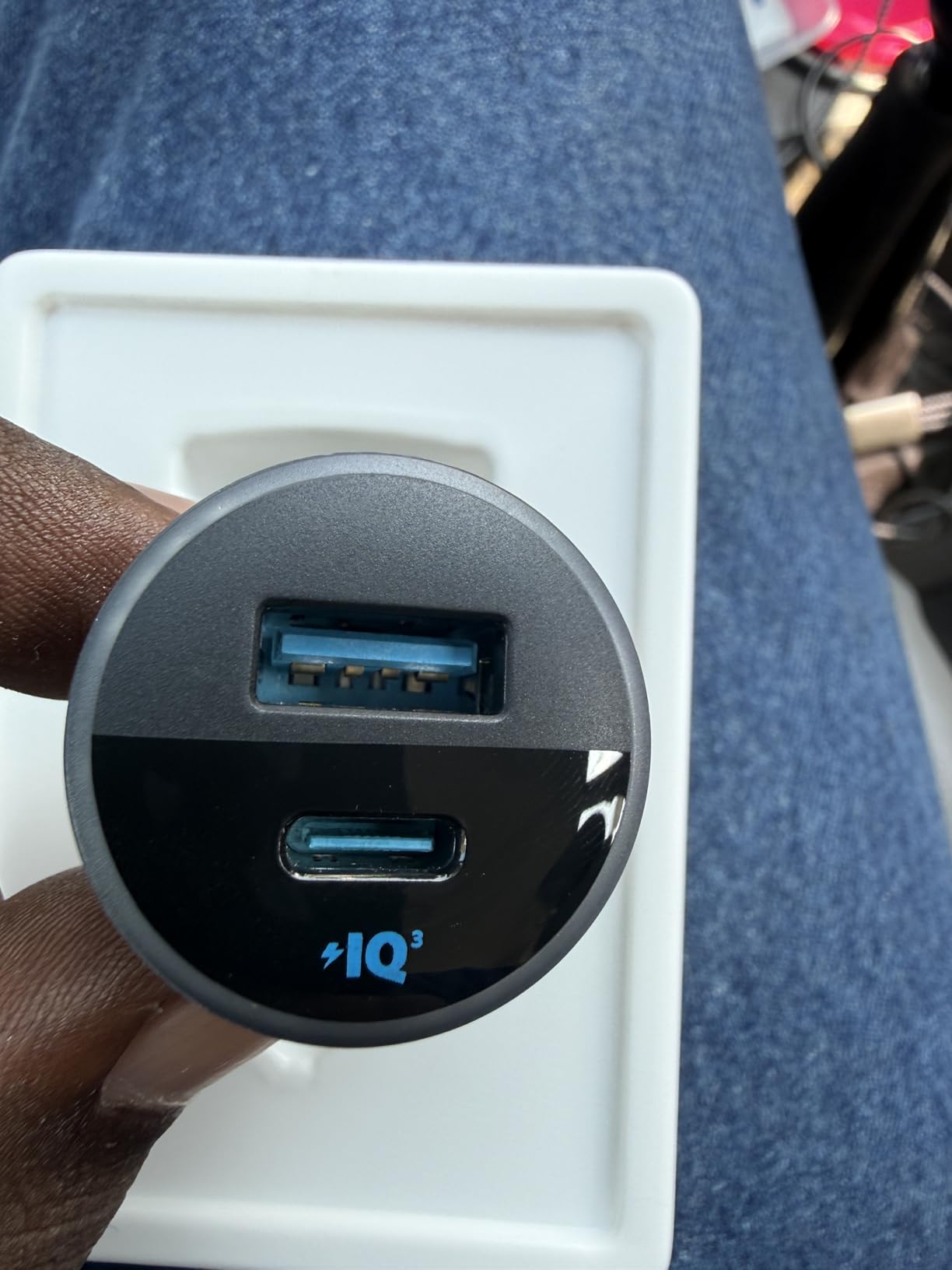
Brand reputation is the quiet advantage here. Anker support is responsive and the 18-month warranty is longer than most of the cheaper chargers in this roundup, and that durability over years is exactly what owners report caring about rather than peak wattage on day one.
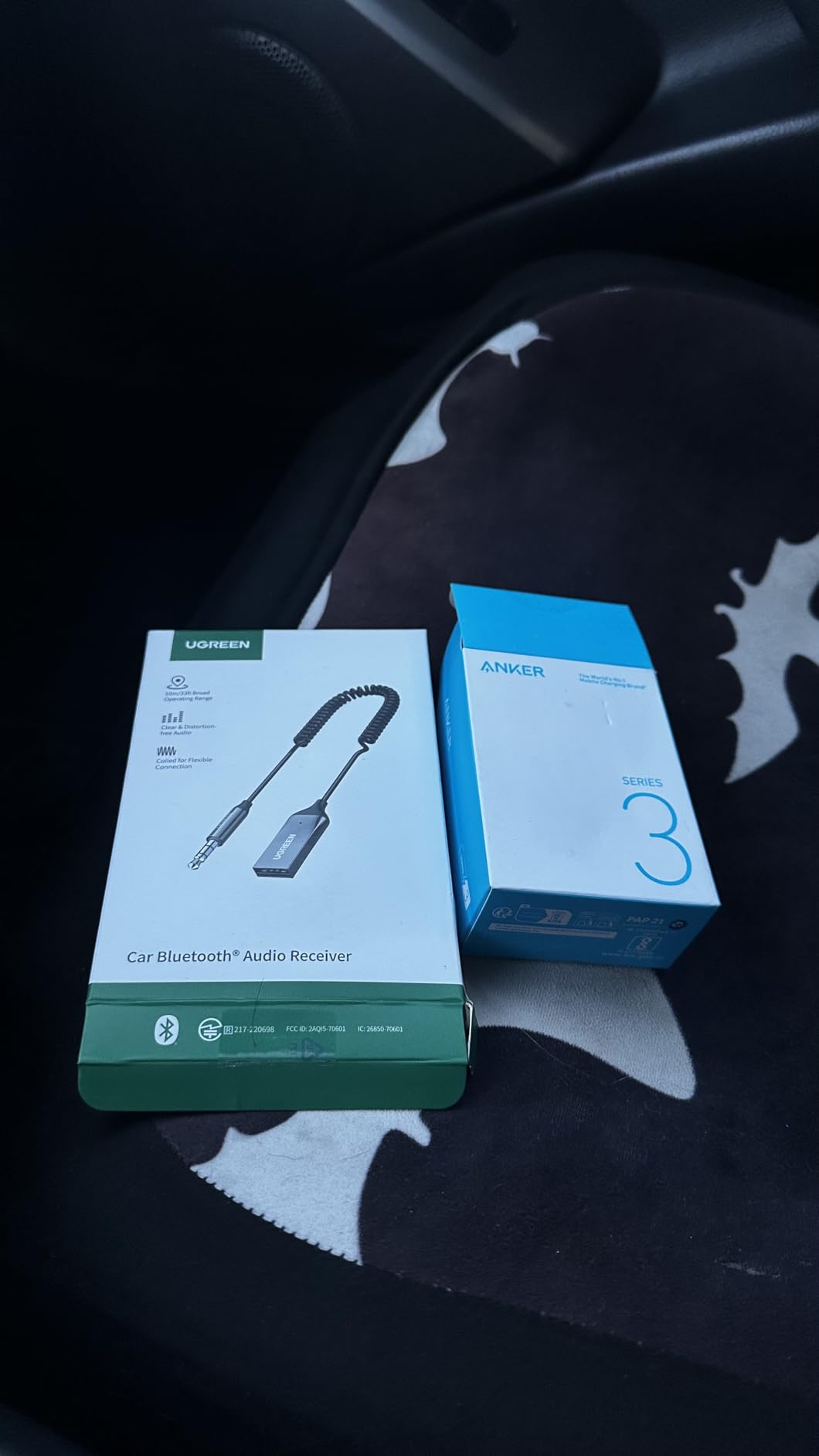
The single most common review note is that no cable is included. This is not a scam, it is just how the category works, but it means you should check what you are packing. A cable that only supports the older USB-A charging standard will cap your speed well below what this charger can deliver.
What to check before you buy this one
Two devices is the sweet spot. Add a third and you are back to splitting output, at which point the three-port unit above is the smarter purchase for the same money.
Check your socket too. This is a plastic-bodied plug that sits in a normal 12V position, which is what you want, but confirm your vehicle has a usable accessory socket rather than only USB ports.
Where it falls short
No retractable cable and no mount, so you are carrying cables in the cabin. It also charges a single device at a time at full speed only, so a laptop is out of the question here.
5. Anker 40W 2-Port PowerIQ 3.0 – Top Rated for a Two-Person Trip
- Consistent fast charging for USB-C phones and tablets
- Very small footprint leaves dashboard controls clear
- Two devices charge together
- Backed by an 18-month warranty
- Works with current iPhone and Android devices
- Total output is shared across both ports
- No charging cables included
This carries the highest rating of any charger we tested, and it earns it through restraint rather than specification. At 40W total with two ports, it does not attempt to be a hub. It is a small, dependable two-device charger for a couple travelling light.
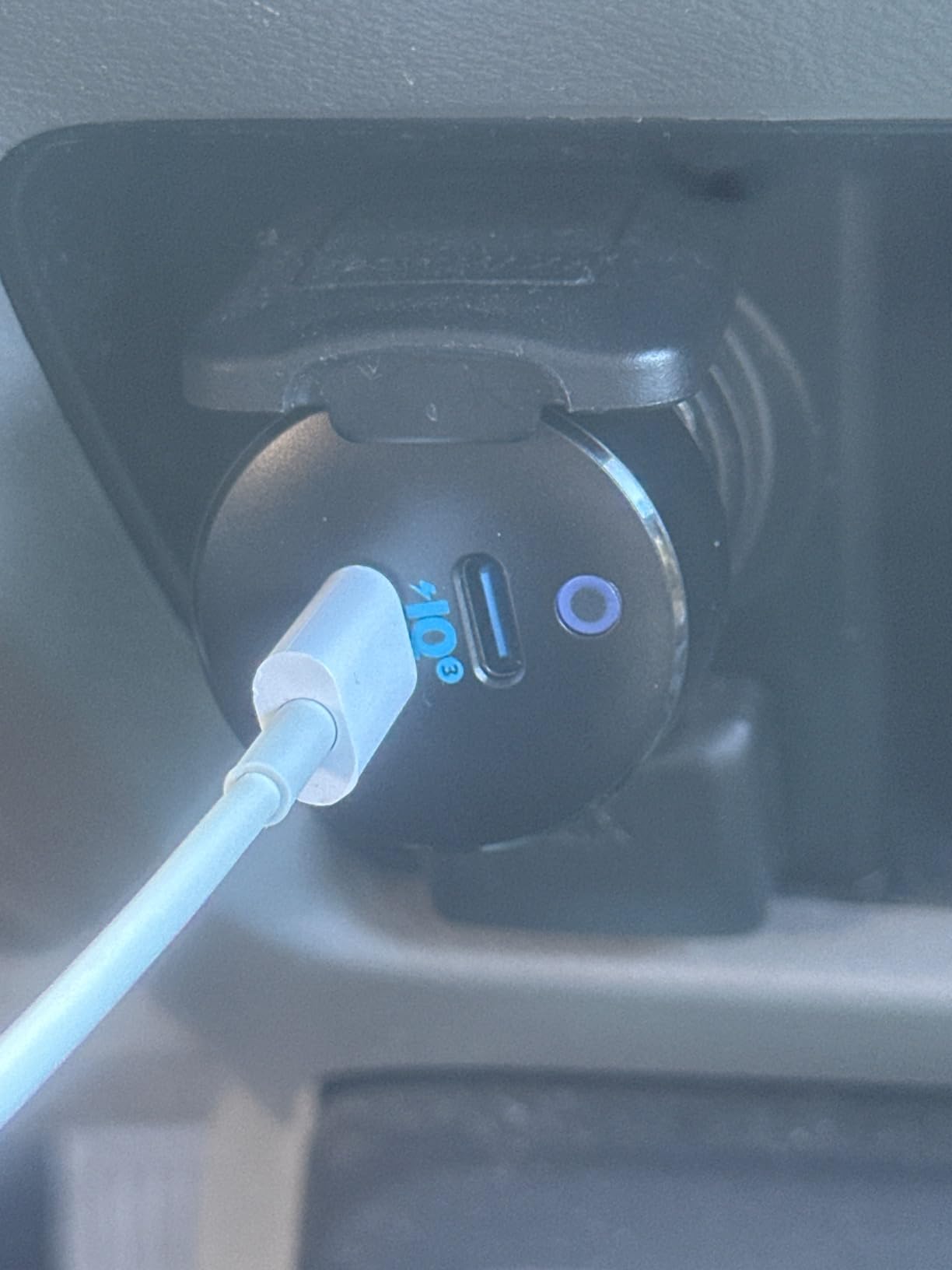
The footprint is the standout. Owners repeatedly single out how unobtrusive it is, and that it leaves adjacent dashboard buttons and neighbouring power outlets usable. On a long drive, a charger you do not have to think about is worth more than one with impressive numbers on the box.
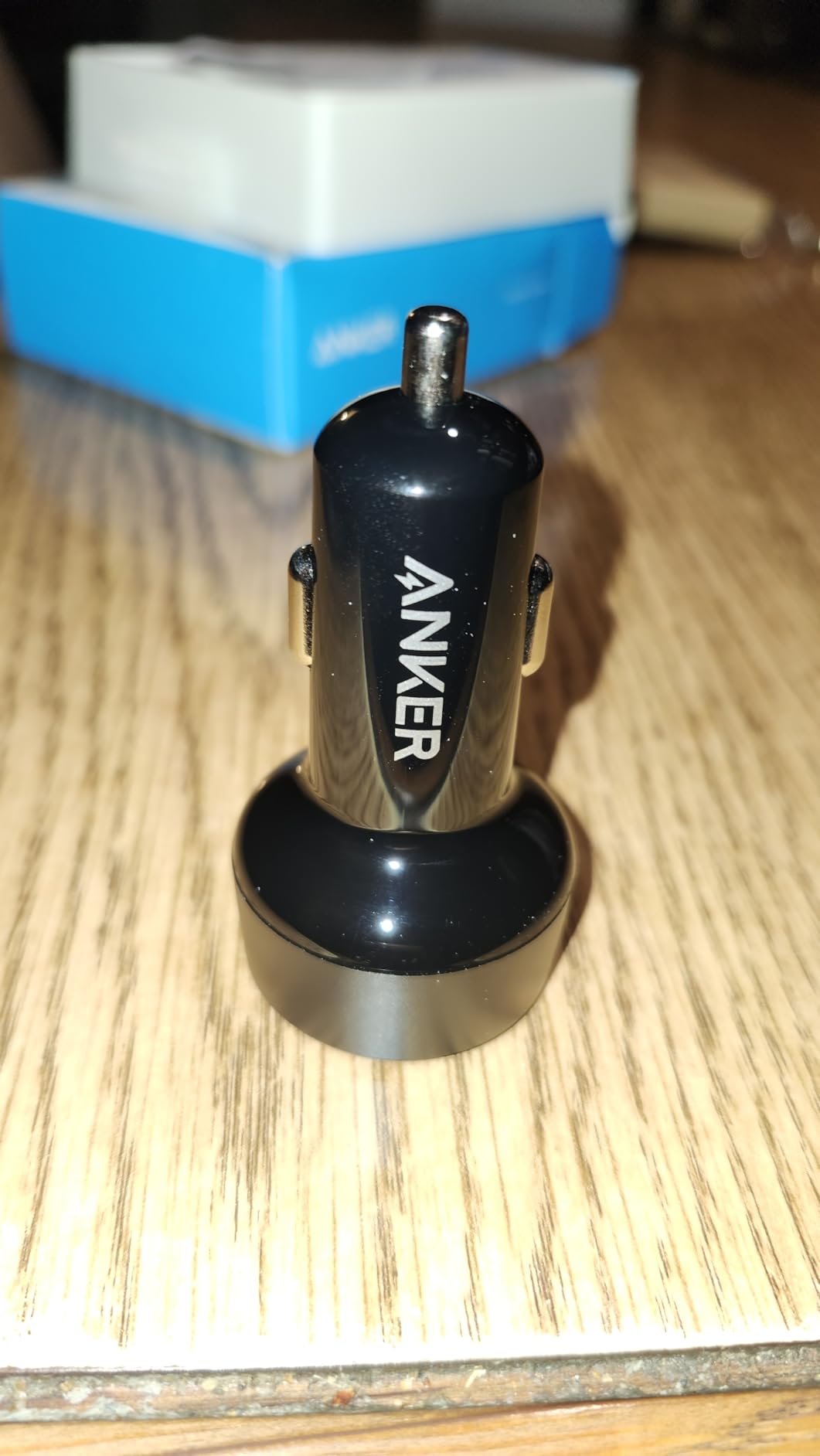
PowerIQ 3.0 is the quiet technology doing the work here. It negotiates a safe current with whatever device connects rather than pushing a fixed profile, which means you get sensible speeds across phones, tablets and smaller laptops without fiddling with settings.
The limitation is straightforward and shared by every multi-port charger: 40W is the total, not the per-port figure. With two devices connected you should expect roughly half on each. For a driver and a navigator running navigation, that is entirely adequate. For a family of four, it is not.
What to check before you buy this one
Bring your own fast-charging cable. Reviewers confirm speed depends on the cable, and this charger includes none. If you are packing a cable you have had for years, check whether it supports the current standard.
Decide whether two devices is genuinely your ceiling. If a third phone or a tablet is likely to join the trip, the extra port on the three-port unit is cheap insurance.
Where it falls short
It will not charge a laptop at a useful speed, and it will not hold a phone. This is a power supply and nothing more, which is a strength if your needs are simple and a limitation if they are not.
6. visnfa 15W MagSafe Mount Charger – Best for Rough Roads and Bad Weather
visnfa 15W Magsafe Car Mount Charger, Faster Charging Wireless Car Charger
- Charging starts the moment the phone snaps on
- Vacuum plus magnet holds up to 105 pounds
- Three-axis arm rotates 360 degrees
- Folds flat and leaves no residue
- Metal rings included for non-magnetic phones
- 15W needs a QC 3.0 or 18W adapter that is not included
- Suction weakens on textured dashboards without the included pad
- Only charges one phone
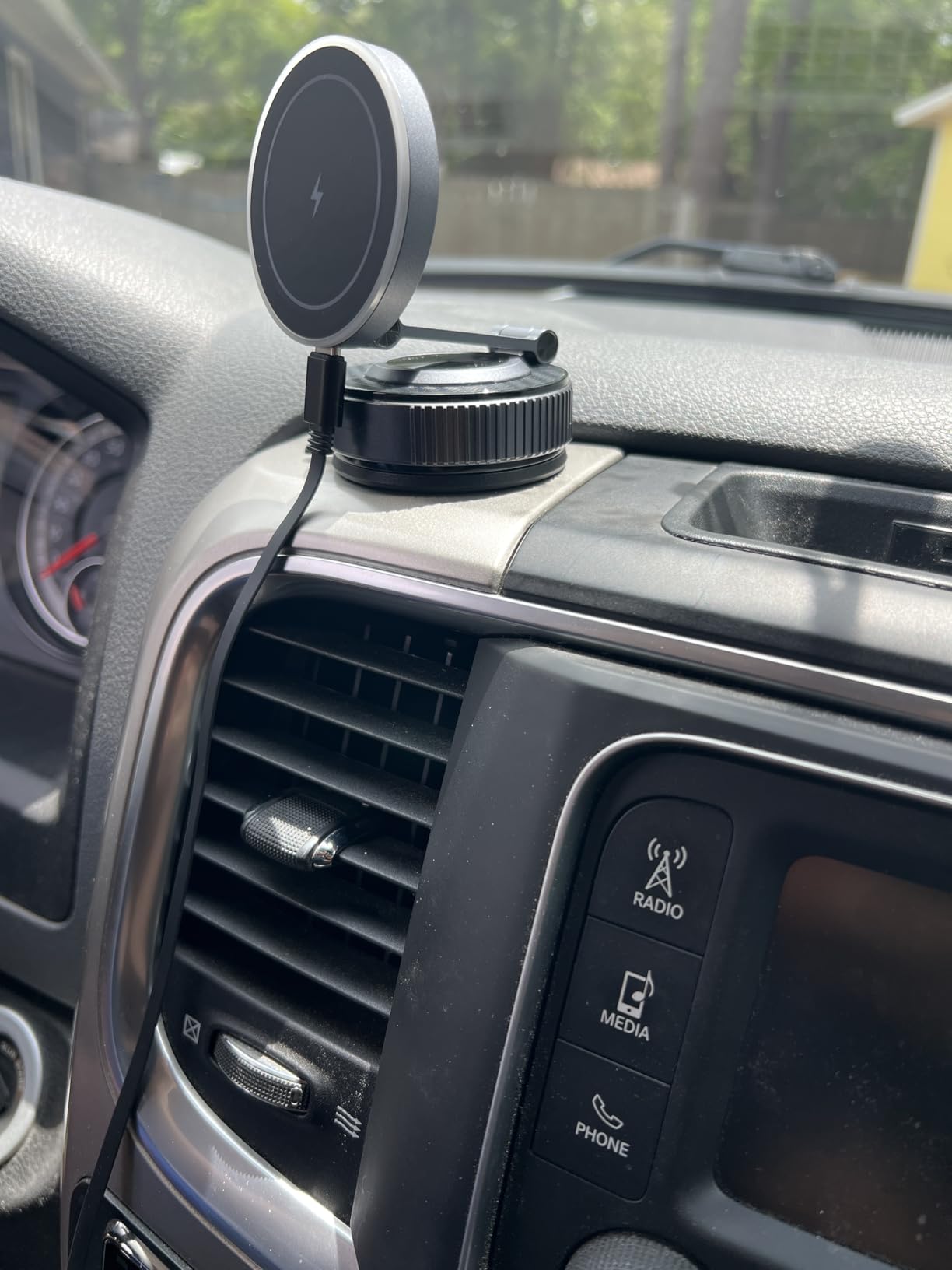
If your route is gravel, patched tarmac or anything with cattle grids, mount strength becomes the deciding factor. This is the most physically secure mount in the roundup, and the numbers behind it are not marketing. The vacuum suction plus N56 neodymium magnet combination is rated to hold up to 105 pounds, with magnetic force quoted at 3800GF.
Because the charging coil is built into the cradle, there is no cable to snag, no port to fish a plug into at a red light, and no cable slack for the phone to swing on. You snap it on one-handed and it starts charging. That single-handed operation is the reason mount chargers are worth considering over a plain adapter at all.
The three-axis arm rotates 360 degrees and folds in on itself, which means you can pull the whole thing out of the way when parked or reverse the position for a passenger to watch. Metal rings are included for phones without built-in magnets, which is a thoughtful touch for older or budget Android handsets.
The catch is power, not mounting. Fifteen watts needs a QC 3.0 or 18W PD supply, and no adapter is included. Pair it with one of the plug-in chargers above and you have a complete system, but budget for two items rather than one.
What to check before you buy this one
Look at your dashboard surface. On smooth glass or a matte plastic dash the vacuum holds well. On a grainy or textured surface it needs the included round pad, and even then it is worth testing before a long drive.
Check your case. Thick non-magnetic cases, wallet cases and anything with a pop grip will weaken the magnetic hold and can stop charging altogether. A thin magnetic case is ideal.
Where it falls short
Wireless charging is always slower than a good wired connection, and this mount serves one phone only. On a very long day of driving with constant navigation use, a wired charger will simply outpace it.
7. LISEN 15W MagSafe Car Mount – Best for Dash or Vent Mounting Choices
LISEN 15W MagSafe Car Mount Charger, Magnetic Phone Holders for Your Car
- Two mounting options in one box
- 24 N52 magnets hold through potholes and hard turns
- One-handed snap-on attachment
- LED accent ring is easy to find at night
- Works with iPhone 12 to 18 and MagSafe cases
- Included cable is short for some dash layouts
- Wireless charging needs an 18W power supply
- Not compatible with thick or wallet cases
- Charging speed is modest rather than fast
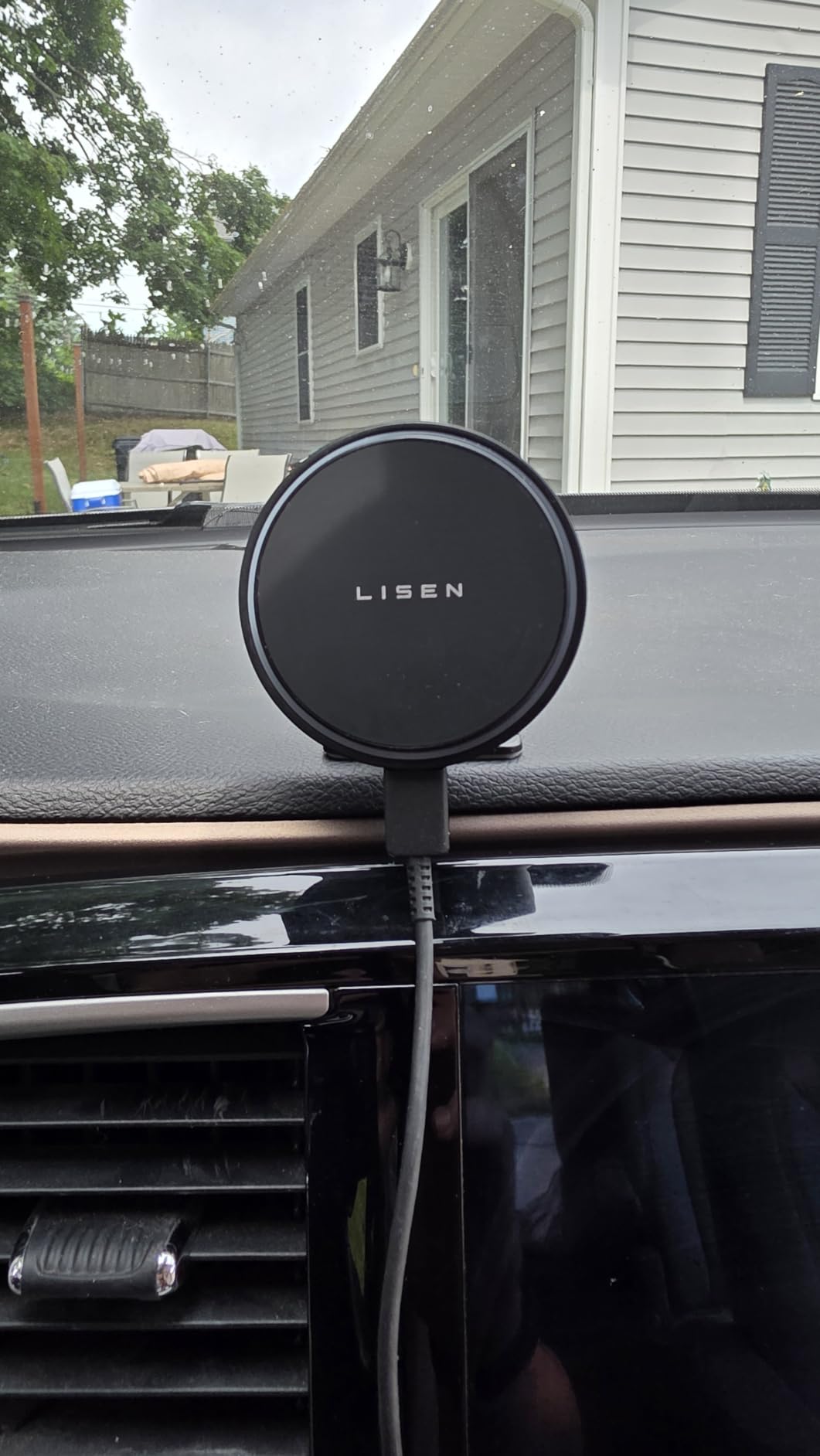
The defining feature here is choice of mounting. You get a reinforced metal vent hook and a 3M adhesive dashboard base in the same box, and the vent hook has been lengthened to fit a wider range of vent slat styles than most competitors. If you are moving between a hatchback with round vents and a pickup with rectangular ones, this one travels.
Magnet strength is the other selling point. Twenty-four N52 magnets rated at up to 3800gf is a serious hold, and owners report the phone staying put through potholes, sharp turns and uneven surfaces without falling out. The design also leaves the side buttons accessible, so you can silence a call without taking the phone down.
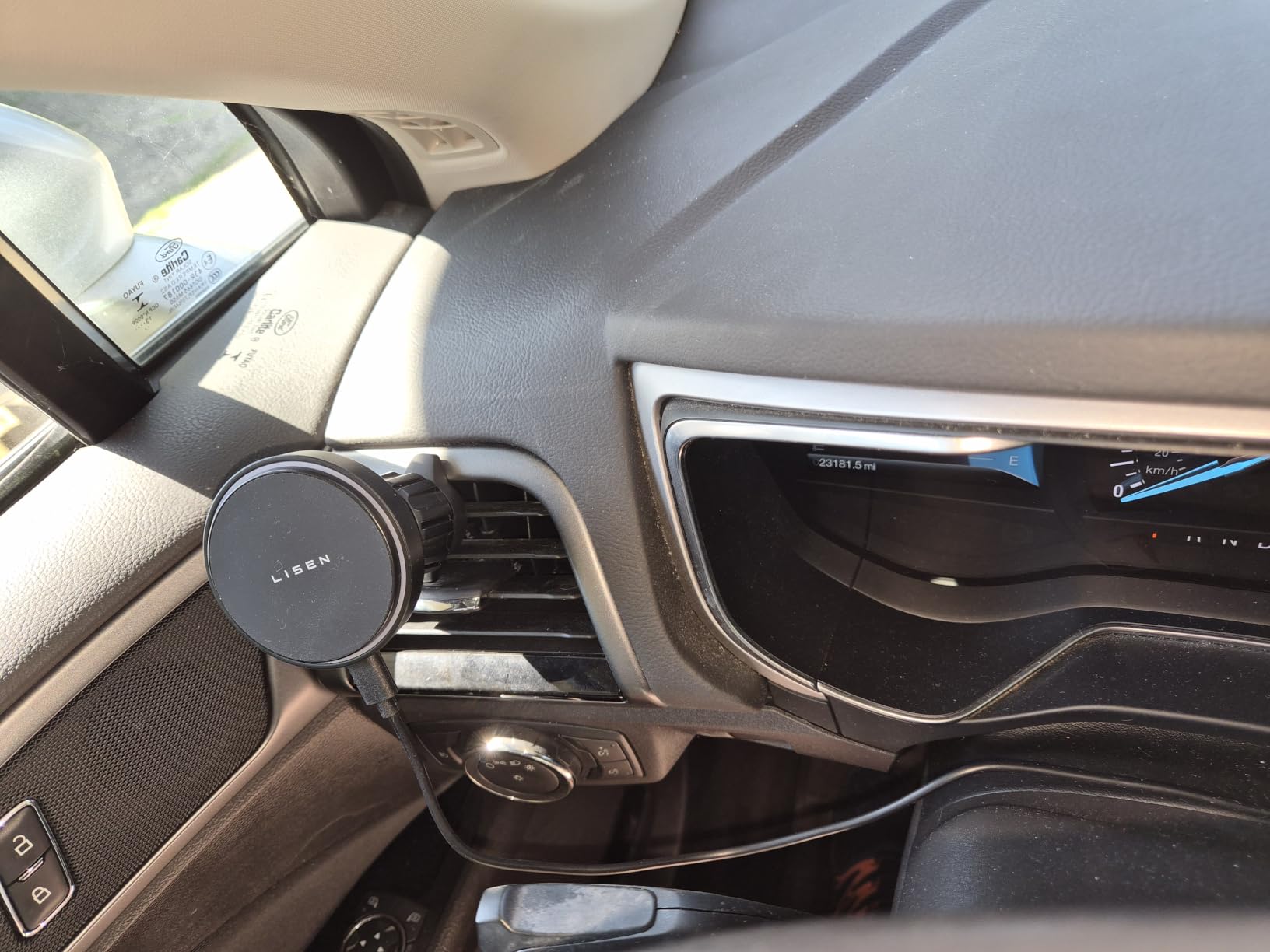
An ice-blue LED ring around the charging pad makes the mount easy to locate in a dark cabin without turning on a torch. It is a small detail that shows up on every pre-dawn start, and it does not glare the way a bright status LED on a plug does.
The included cable is 3.3 feet, which is short in vehicles where the 12V socket is far from the windscreen. Budget for a longer cable if your dash geometry demands it, and remember wireless charging needs an 18W supply before it will run at 15W.
What to check before you buy this one
Measure the distance from your 12V socket to where you want the mount. Under about three feet, the included cable works. Beyond that, bring your own. Also confirm your phone is in a MagSafe-compatible case or has magnets built in.
Think about heat. A windscreen mount in direct summer sun gets hot, and a phone charging wirelessly in a hot cradle will slow down or pause as a protective measure.
Where it falls short
Fifteen watts is a modest figure by wired standards. It will keep a phone alive across a long day rather than refill it quickly, and wallet cases, pop grips and thick cases will stop charging entirely.
8. Mosurr 15W RGB Auto-Clamping Mount – Best for Night Visibility
- Qi fast charging for supported LG Samsung and iPhone models
- Seven light modes plus an RGB breathing backlight
- Improved suction cup holds up to 50 pounds
- Auto-clamps the phone when you place it on
- Aluminium frame with two mounting options
- Fast charging needs a QC 3.0 adapter that is not included
- Only one device charges at a time
- Vent clip does not fit round vents
- Metal cases and pop grips interfere with charging
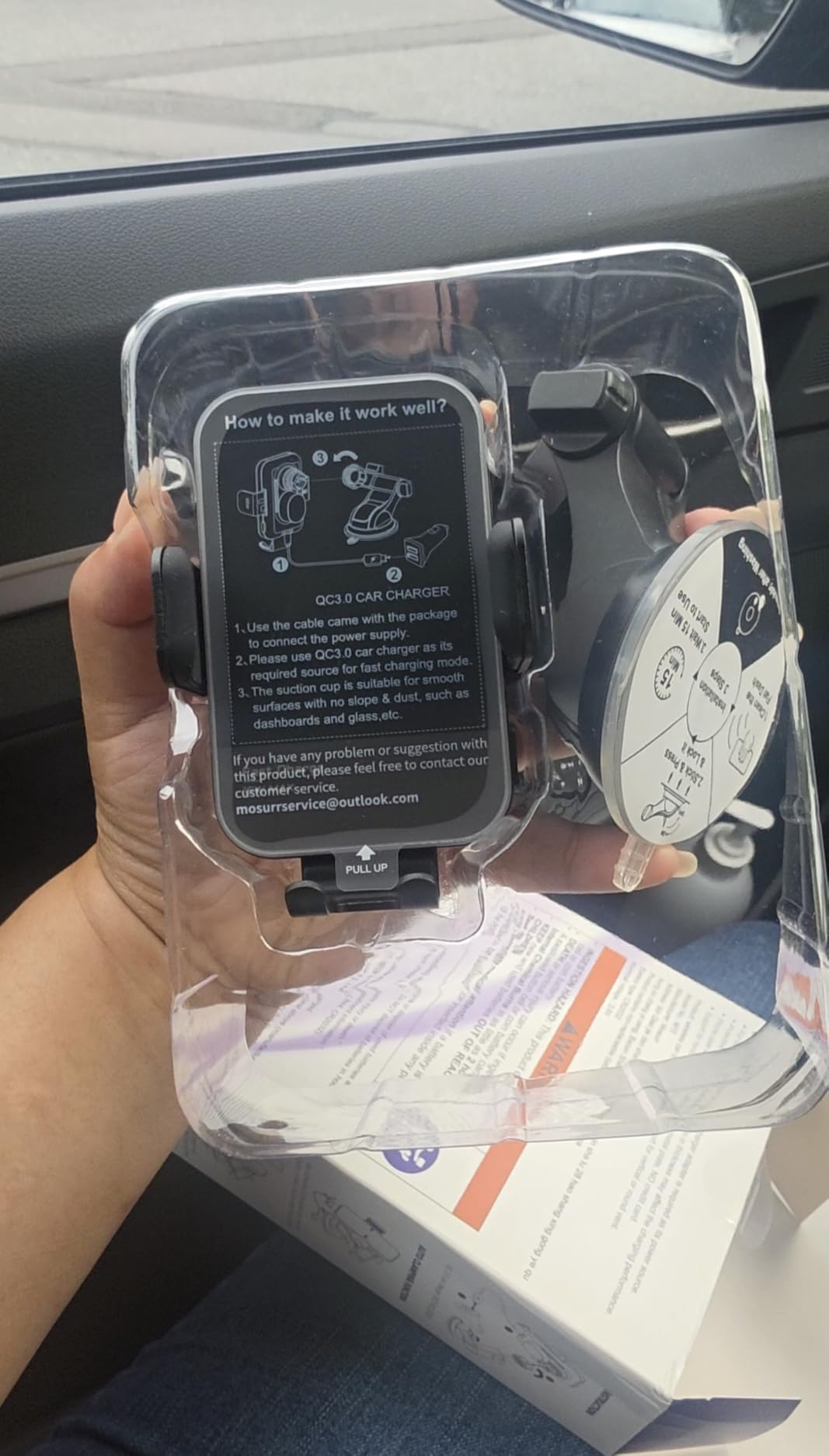
This is the one to pack if a lot of your driving happens after dark. Seven single-colour modes plus an RGB breathing backlight make the cradle easy to find without fumbling, and several owners specifically mention that the light is what they notice using most.
The auto-clamping mechanism is the practical feature. The arms and foot open when the mount is powered and grip the phone the moment you set it down, which removes the fiddly two-handed bit of centring a phone in a cradle at a junction. The 360-degree ball joint with a telescopic arm then handles portrait or landscape.
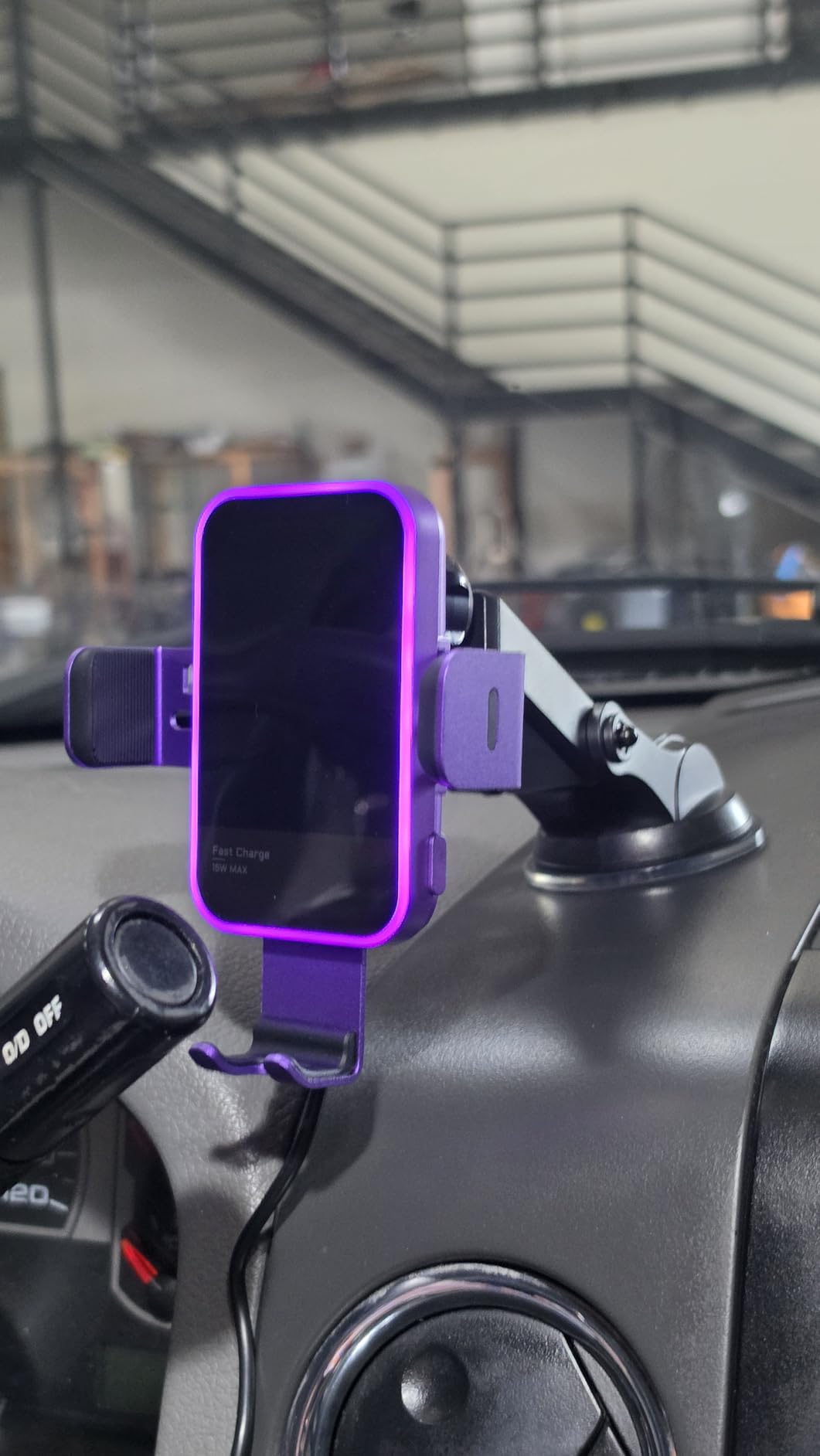
The suction cup is rated to 50 pounds and owners report it holding through heat and on steep hills. It is also reusable: warm water restores the grip when it has picked up dust, which matters if you are moving between vehicles.
Two things to plan around. Fast charging needs a QC 3.0 adapter that is not in the box, so you are buying two items. And the vent clip will not fit round vents or ones with a dense vertical structure, so check your vehicle before committing to that mounting method.
What to check before you buy this one
Confirm your vent type and your case. Round vents and dense vertical slats are problem cases for the included clip. Metal cases, card holders and pop grips all sit between the phone and the coil and will stop charging.
Consider whether the lighting appeals. It is genuinely bright, and some drivers find a glowing cradle distracting on a dark road rather than helpful.
Where it falls short
One phone only, and the aluminium-and-metal frame is heavier than plastic vent mounts, which adds a small amount of sag over a long trip. Charging is also one device at a time with no passthrough to worry about but no second port either.
9. MOKPR 15W Auto-Clamping Vent Mount – Best for Hands-Free Alignment
Wireless Car Charger Auto-Clamping Air Vent Car Mount 15W Fast Charging
- Sensor aligns the phone to the coil automatically
- Arms and foot open on power and clamp hands-free
- Charges through cases up to 4mm thick
- Silicone vent clip holds on bumpy roads
- 360-degree ball joint for a comfortable viewing angle
- QC 3.0 adapter required for fast charging and not included
- Vent-only mounting limits placement options
- Plastic build feels less premium than metal
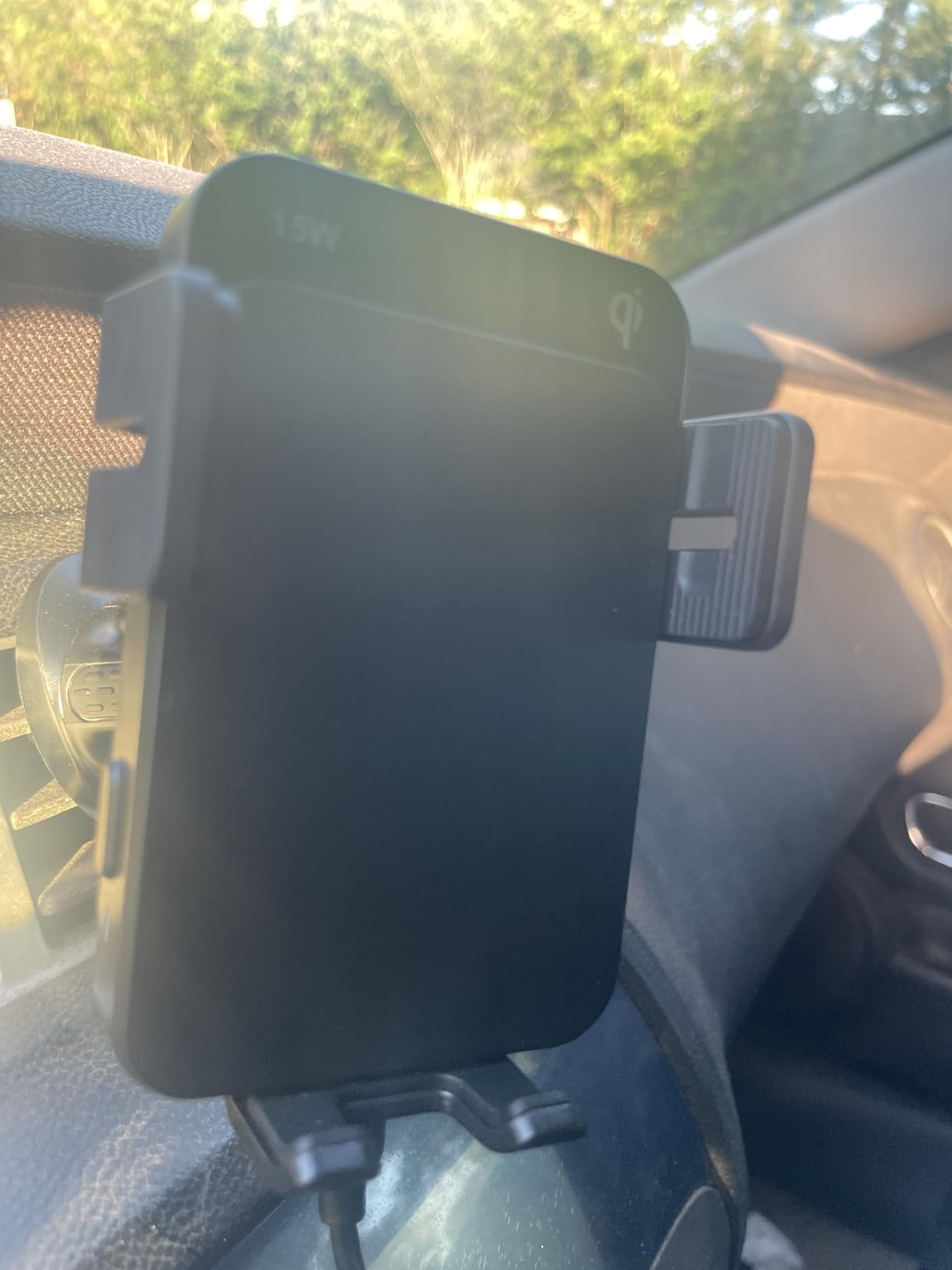
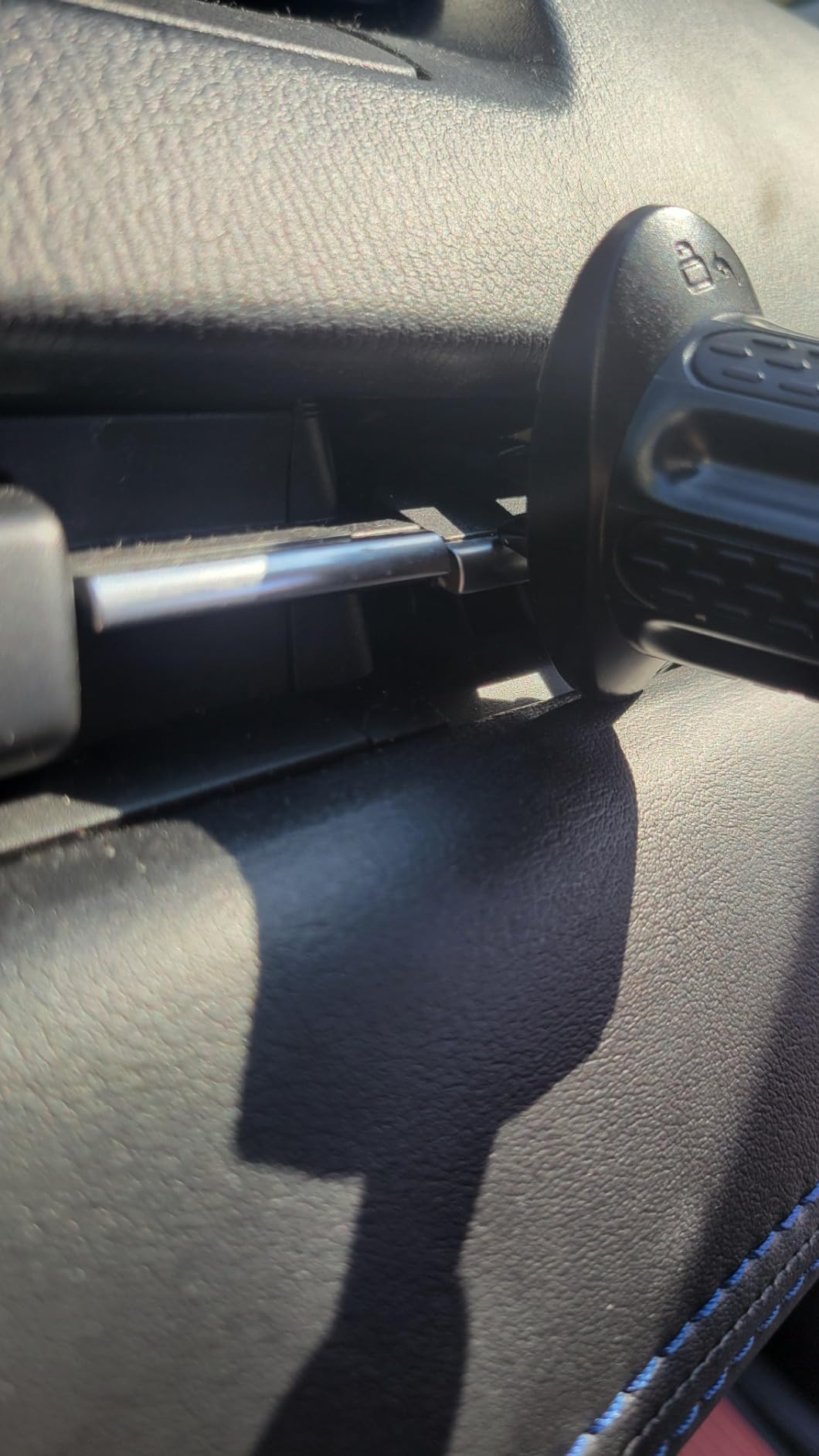
Wireless charging fails for one reason above all others: the phone is not centred on the coil. This mount attacks that problem directly with a built-in alignment sensor that detects where the phone sits and shifts the cradle so the coil lines up. Combined with arms and foot that open automatically when powered, you drop the phone on and it just works.
The clamp design also avoids squeezing the side buttons, which owners highlight as a genuine improvement over friction clips that trigger your camera or a phone assistant mid-drive. The silicone rubber vent grip is the other detail reviewers praise, holding through uneven road surfaces without marking the vent slats.
Foreign object detection is worth mentioning because it is a safety feature rather than a speed feature. It reduces or stops charging when something metal is detected between the phone and the pad, which is exactly what happens when a card or a coin is trapped under a case.
Charging works through cases up to 4mm thick, which covers most everyday cases. The three-tier speed levels of 15W, 10W and 7.5W mean the mount adapts to whatever the phone and the power supply can actually manage rather than over-promising.
What to check before you buy this one
You need a QC 3.0 car charger to unlock the faster tiers, and it is not included. The vent clip is the only mounting option, so check your vent slats can take it and that a vent position gives you a usable view of the screen.
Decide if auto-clamping suits you. Some drivers prefer a magnetic snap for one-handed use; a powered clamp needs a moment to close and does not release instantly if the power drops.
Where it falls short
Vent-only mounting is the real limitation. You cannot move it to a suction cup on a desk or a dashboard pad later, and the plastic construction feels noticeably cheaper in the hand than the aluminium-framed alternatives.
10. EloBeth 75W Retractable Car Charger – Best Retractable Alternative
Retractable Car Charger for iPhone 18 Pro,75W Car Charger USB C Fast Charge
- Two retractable cables plus two open ports charge four devices
- Cables retract automatically to clear the cabin
- Supports PD QC3.0 AFC MTK and FCP protocols
- Overcharge and temperature protection built in
- Plug holds on bumpy roads
- Bulky body crowds the socket area
- Cable or retraction failures reported after extended use
- Fit reported loose in some vehicles
- No CarPlay or AirPlay support
This is the other take on the retractable idea, and it is the better choice for Android-heavy crews. The 36W retractable USB-C cable handles modern handsets at speed, while a separate 12W retractable Apple cable means an older iPhone or an iPad in the car does not need an adaptor and a loose cable of its own.
Protocol support is the detail that stands out. Alongside PD and QC3.0 it lists AFC, MTK and FCP, which covers Samsung devices that do not negotiate standard PD profiles. In practice that means faster, more consistent charging across a mixed-brand family rather than a fast phone and two slow ones.
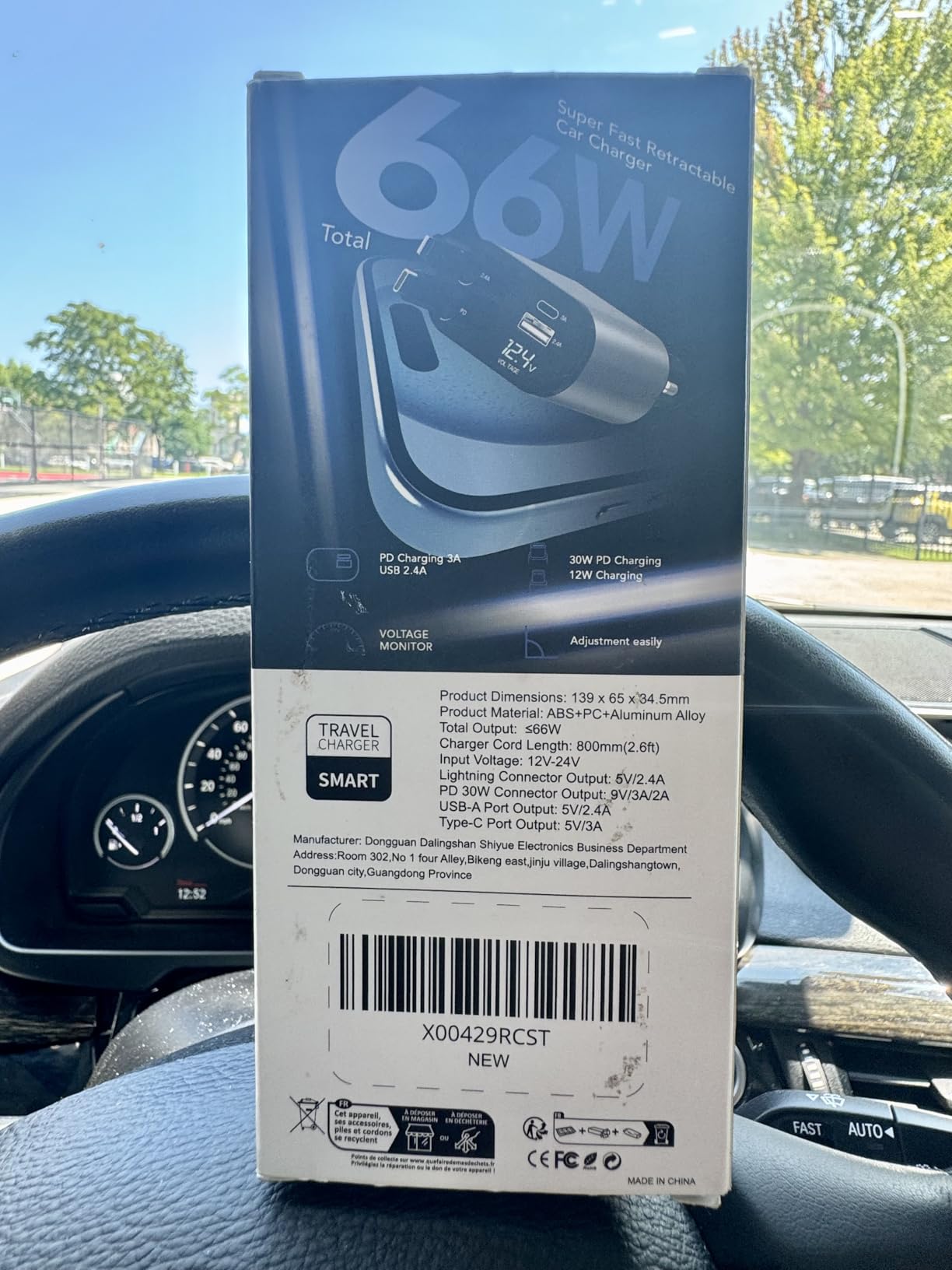
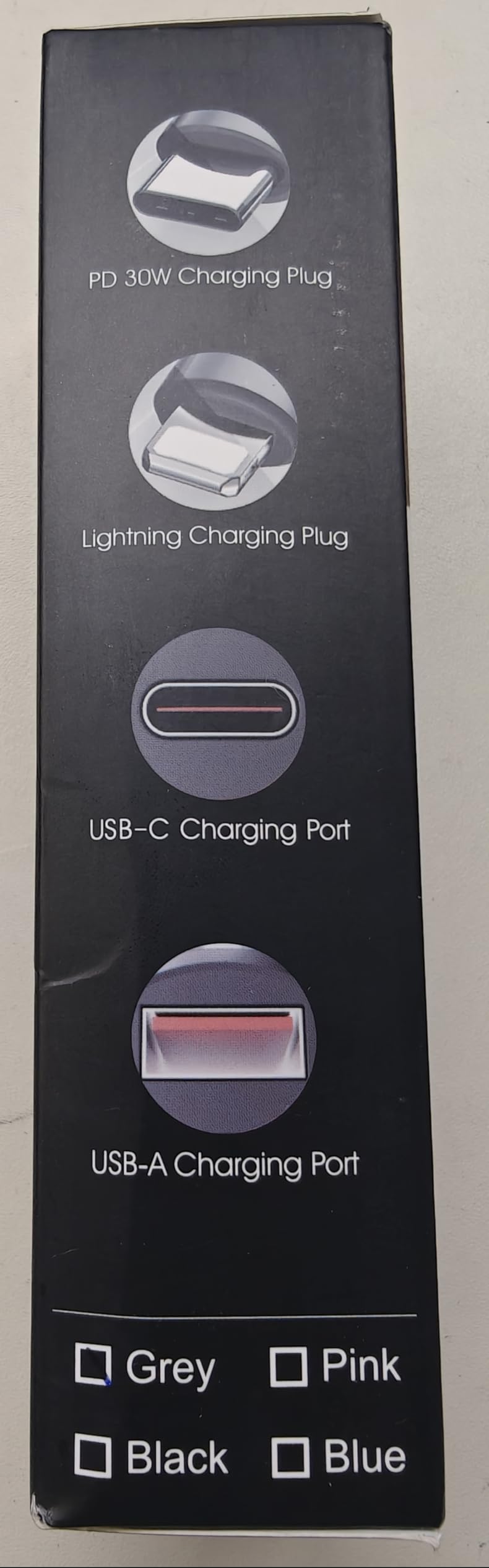
Two open ports sit alongside the retractable cables, at 15W USB-C and 12W USB-A, so the unit covers four devices at once while still keeping the cabin tidy. Five-point protection covers overcharge, over-current, over-voltage, temperature and short circuit.
The complaints cluster around durability and size. Some buyers report the Apple cable or the retraction mechanism failing after extended use, which mirrors what we heard about the first retractable unit in this roundup. The body is also bulkier, and a few owners report a loose fit in certain vehicles.
What to check before you buy this one
Measure the space around your 12V socket. This body is noticeably wider than a compact adapter, and in a vehicle where the socket sits close to the gear selector it can crowd the area and be awkward to grip.
Check your device mix. If your household runs Samsung or Android as well as Apple, the wider protocol support here earns its place. If everything is already USB-C, a simpler unit does the job.
Where it falls short
It requires a cigarette lighter socket. Vehicles that offer only USB-C ports will not work with it at all. It also cannot handle CarPlay or AirPlay, so you will keep your own cable for those if you need them.
11. BothLin 3-in-1 15W Mount Charger – Best for Using It in More Than One Place
3-in-1 Wireless Car Charger Mount, 15W Fast Charging Auto-Clamping Phone Holder for iPhone 17 16 15 14, Samsung Galaxy S24 S23, Dashboard, Vent & Windshield Car Mount
- Sticky gel suction cup holds in heat and on rough roads
- Qi certified at 15W 10W and 7.5W
- Same mount works in a car on a desk or a counter
- Auto-clamps with one touch
- Five-layer chip protection
- QC 3.0 adapter needed for fast charging and not included
- Vent clip can slip out on sharp corners
- Cradle occasionally fails to close
- Runs warm enough to overheat the phone on long trips
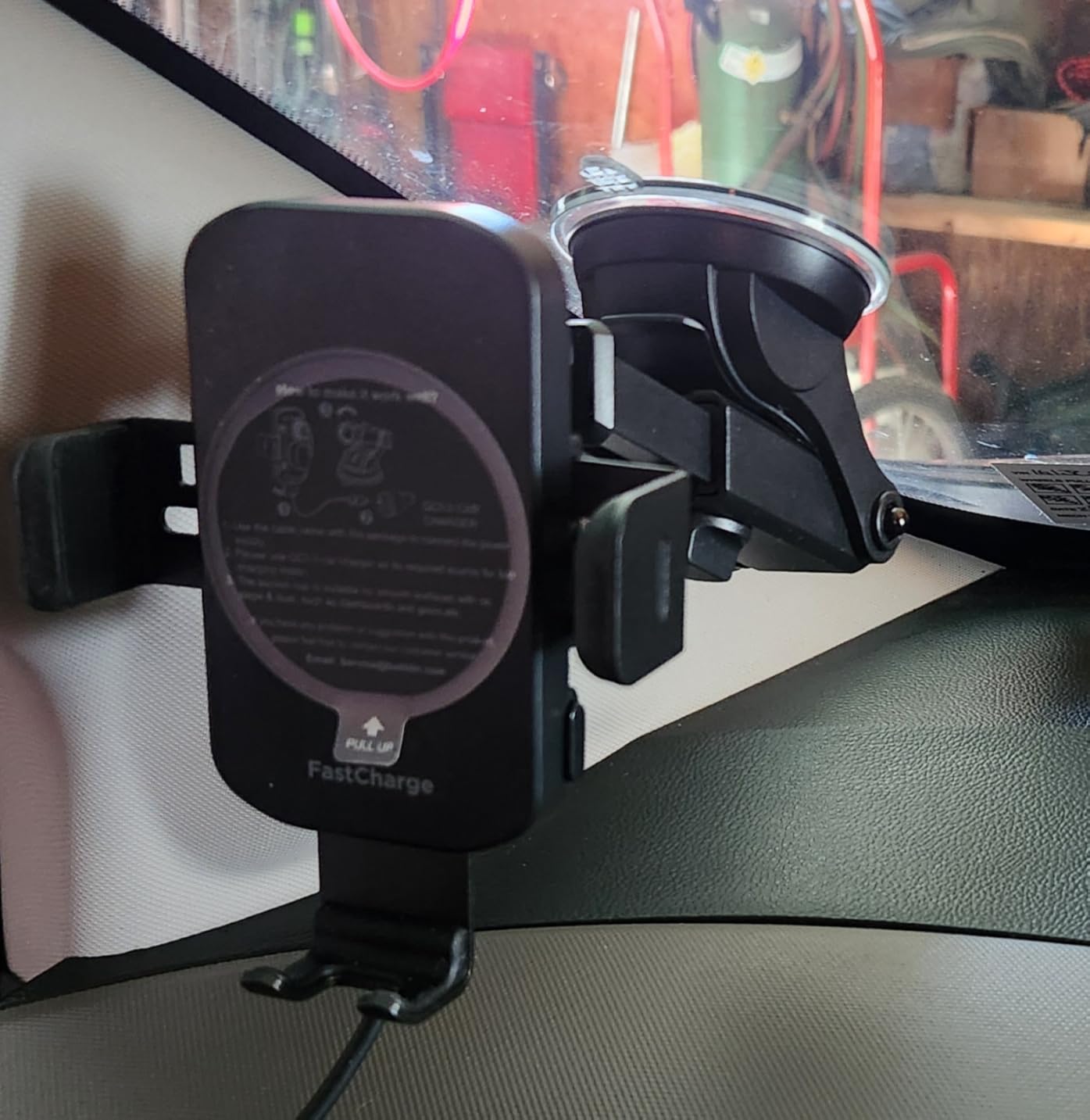
The name of this one is the feature. A single mount with both a suction cup and a vent clip means the same unit works in the car, on a desk in a hotel room, or on a kitchen counter when you are not travelling. For a road trip that alternates between vehicles and accommodation, that flexibility is genuinely useful.
The suction cup is rated to 55 pounds and uses a sticky gel pad, which is what lets it survive heat and rough surfaces. Owners frequently mention the gel pad restoring grip with a rinse, so it is a consumable surface rather than a permanent one.
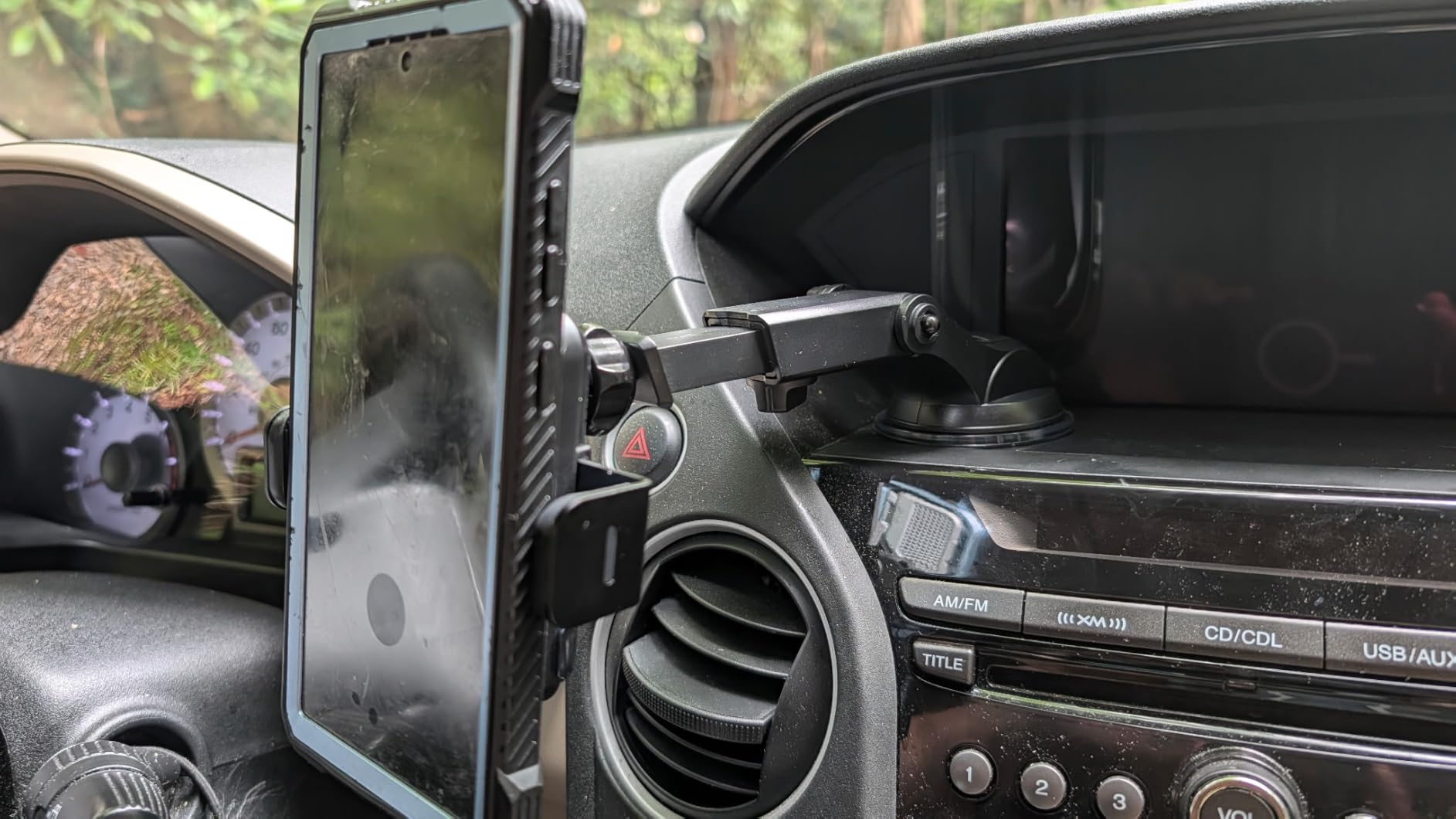
Charging is Qi certified at 15W, 10W and 7.5W for LG, Samsung and iPhone devices, and the auto-clamping arms work with a single touch while a 360-degree joint and telescopic arm set the angle. Five-layer chip protection covers overcharge, temperature, voltage, current and short circuit.
Two reported issues are worth your attention. The cradle occasionally fails to close, which interrupts a charging session at the worst possible moment, and the unit runs warm enough to overheat a phone on long trips. The included warranty is a five-year free replacement, which is unusually generous and partly compensates for the first concern.
What to check before you buy this one
Check your dashboard surface for the suction cup, and check the vent slats for the clip, because the vent clip can slip out on sharp corners. Then decide honestly how long your drive days are. If you are regularly running eight hours, a mount that warms up is a problem.
Remember the adapter is not included. Fifteen watts requires a QC 3.0 supply, so treat this as a companion to one of the plug-in chargers rather than a replacement for one.
Where it falls short
One device, no retractable cable, and no data or CarPlay passthrough. It is a well-built mount with a wide safety net rather than a fast charger, and on a charging-critical trip a wired adapter will serve you better.
12. MRGLAS 125W USB-C Car Charger – Best for Laptops and Tablets
【Upgraded】 125W Car Charger USB C Fast Charge for iPhone 18 Pro Max
- 65W USB-C and 60W USB-A handle phones tablets and small laptops
- All-metal body stays cool and resists melting
- Pull ring makes removal from a tight socket easy
- Flush body does not pop out on bumpy roads
- Smart IC with six-point protection
- Three-year warranty
- Ports cannot fast charge at the same time
- Full 65W and 60W output needs a 20V vehicle system
- No cables included
If a laptop is riding along in the car, this is the charger to look at. A 65W USB-C port is enough to charge many smaller laptops and certainly enough for tablets, and 60W on the USB-A side covers anything older. That capability simply does not exist on the 30W and 40W chargers earlier in this roundup.
The all-metal cylindrical body is the second reason to consider it. Metal dissipates heat far better than plastic, and heat is the enemy of sustained high output. A thumb-sized body with a pull ring also solves the perennial problem of extracting a tightly seated plug from a recessed 12V socket without levering against the dashboard.
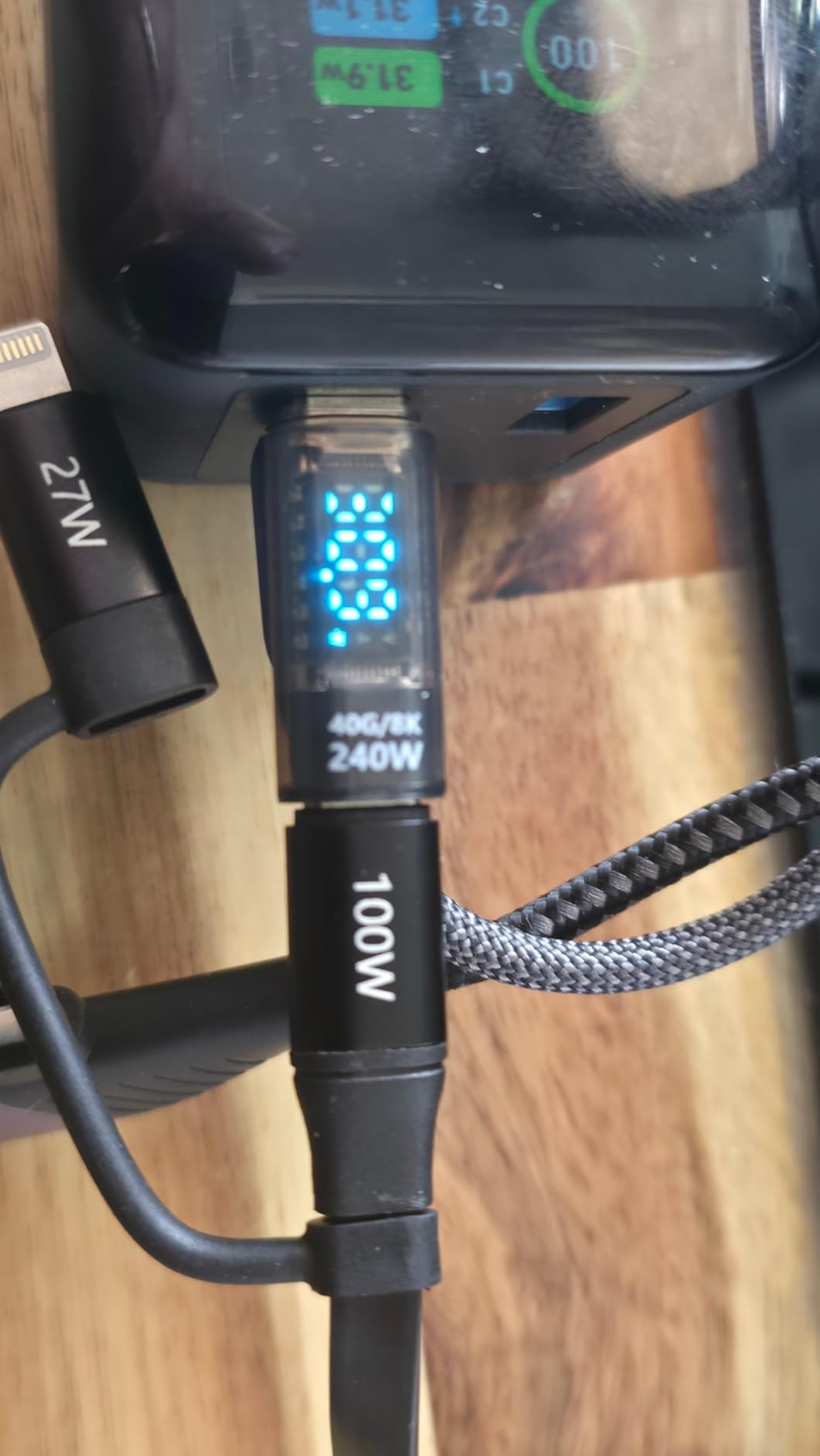
Protection covers over-current, short circuit, over and under-voltage and over-temperature, and the three-year warranty is the longest in this roundup alongside the five-year replacement offer on the 3-in-1 mount. The smart IC identifies devices to negotiate the right profile rather than pushing the same output at everything.
Two constraints. The two ports cannot both deliver fast charging simultaneously, so a laptop takes priority or nothing does. And reaching the full 65W and 60W figures depends on a 20V vehicle electrical system, so on a 12V car the real output will be lower than the headline numbers.
What to check before you buy this one
Check your laptop’s charging requirement against what a 65W port can realistically deliver. Small and ultraportable machines charge acceptably. Larger workstations will charge slowly or not at all, and a multi-day trip with one is a planning problem rather than a buying one.
Check your vehicle’s electrical system and how many devices you need at once. This is a one-device-at-full-speed charger, not a family hub.
Where it falls short
For a family of phone-only travellers it is over-specified and you would be paying for headroom you never use. No cables are included either, so pack a USB-C cable rated for the wattage you need.
How to Choose a Car Charger You Will Actually Use?
Start with your vehicle, not the product. Nearly every decision that follows depends on what you drive and how many people are in it. Check whether your car has a 12V accessory socket, where it is located, and how far it is from where you want the phone mounted. Then count people, not devices, because most phones are used by more than one passenger on a long drive.
12V socket, USB-C port or built-in cable
Most vehicles have a 12V accessory socket, sometimes still called a cigarette lighter socket, and every charger in this roundup plugs into one. Some newer vehicles replace the socket with USB-C ports, in which case none of these products will work and you need a different approach entirely. A few vehicles offer both, and a socket plus a mount is the ideal combination.
Built-in retractable cables, seen on the LISEN and EloBeth units here, solve cable clutter and the problem of cables disappearing into the seat. They are the best choice when the phone lives in the driver’s hand or on the mount permanently. Fixed ports with cables you supply are more durable over years, because a worn cable is a small, cheap replacement rather than a whole new charger.
How much wattage you actually need
A phone rarely draws more than about 20W, so a 30W USB-C port already gives it everything it can take. The numbers above that matter when you are charging several devices at once, because then the total is divided between them, or when a laptop is in the car, where 65W or more becomes the threshold.
The trap is the advertised total. A unit quoted at 84W or 125W is quoting the sum across every port, not the figure any single device receives. Read the per-port figures instead, and check the reviews for what people actually measured rather than what the box claims.
USB-C and Lightning in 2026
Lightning is now legacy. Current iPhones charge over USB-C, and the cable included with the retractable units covers both so that older Apple devices in a mixed household still work. If you are buying fresh, an MFi-certified Lightning cable is a compatibility purchase for a device you already own, not a starting point.
What matters is whether your cable supports the current you need. A USB-C to USB-C cable rated for 5A will deliver far more than a cheaper one, and that gap is the reason some owners report slow charging from a perfectly capable charger. A Lightning cable with no data rating will cap you at a fraction of the port’s capability.
Charging a whole passenger crew
For a driver plus navigator, a two-port unit is comfortable. For a family of four sharing one socket, a three-port unit at 67W or above is the minimum sensible choice, and you should accept that each phone will be on reduced output while all four are connected. If everyone needs a fast top-up at the same time, two chargers in two sockets is the honest answer.
Wireless mount chargers serve a different need. They keep one phone visible and secure while charging, which is what the driver needs, and they leave the plug ports free for everyone else.
Heat on long summer drives
Cabin temperatures on a hot day can exceed what any phone charger is designed for, and a device that gets too hot will slow charging or stop. Metal-bodied chargers handle this better than plastic ones, and chargers with active temperature monitoring adjust their output rather than throttling abruptly. Our first two picks both benefit from metal construction for this reason.
Wireless charging in a windscreen mount is the case to watch. A phone charging through a cradle in direct sun generates more heat than one on a cable, and several reviews of the 3-in-1 mount in particular report it running warm on long trips. If your driving is mostly midday summer mileage, prefer a wired connection in a shaded spot.
Do car chargers drain the car battery
Short answer: not in any meaningful way while you are driving. The alternator is supplying far more current than any phone charger can draw, so a charger left plugged in overnight is the only scenario that raises a question, and even then only if the vehicle is not being driven for days.
To be safe overnight, unplug the charger before you leave the car. That removes the question entirely and costs nothing. What genuinely does risk a battery is leaving a phone in a vehicle charging from a socket on a battery with no alternator output, which is why a power bank in the glovebox is a reasonable companion for a long stop.
If your trip also involves gear, our guides to car organizers for road trips and 12V coolers for road trips cover the other things that share that same socket and mounting space.
When there is no 12V socket
Electric vehicles frequently omit the accessory socket, and some modern cars in some markets ship with only USB-C ports. In those cases a plug-in charger is useless and a power bank is the only realistic answer. A high-capacity bank carried in the cabin, charged overnight at a hotel, covers the same ground as a car charger without needing a socket at all.
The reverse also holds. If you are renting, a lightweight two-port charger is small enough to toss in a bag on arrival, works in any vehicle, and can be left behind when the trip ends rather than carried home. We would also keep a short USB-C cable in the glovebox permanently regardless of what you choose, because the single most common roadside failure is a cable that has worn out, not a charger that has stopped working.
Frequently Asked Questions
What is the best phone charger for traveling?
The best phone charger for travel is a 12V socket adapter with at least 30W on a USB-C port, paired with a fast-charging cable you bring yourself. Most phones cannot draw more than about 20W, so anything beyond that only matters when you are charging several devices at once or a laptop. Carrying a power bank as a backup covers stops where you have no socket.
What are the top 5 best car chargers?
Our top five are the LISEN Retractable 84W for multi-device trips, the Anker 40W 2-Port PowerIQ 3.0 for a two-person trip, the KENHAO 3-Port 67W for three devices, the Anker 323 52.5W for two devices without bulk, and the MRGLAS 125W if a laptop is in the car. Each covers a different number of devices rather than repeating the same recommendation.
What is the best portable car battery charger that doesn’t require a plug?
If your vehicle has no 12V accessory socket, which is common in many electric vehicles, a power bank is the practical answer. Charge it overnight at your accommodation and it covers the same ground as a car charger during the day. For a vehicle that has a socket, unplug any car charger before leaving the car so there is no question of drain at all.
What is the best car phone charger brand?
Anker appears more often than any other brand in car charger reviews and shopping results, and its two units in this roundup are among the highest rated for reliability and warranty support rather than peak wattage. Owners consistently report chargers that still work after years, which is a better signal than any specification on a box.
Do car chargers drain the car battery?
Not while you are driving, because the alternator supplies far more current than a phone charger can draw. The only scenario worth thinking about is leaving a charger plugged in while the car sits unused for a long period, and unplugging it before you leave removes the question entirely.
How many watts do I need to fast charge my phone in the car?
About 20W is all a phone can actually accept, so a 30W USB-C port is comfortable and leaves headroom. Higher figures only matter when several devices charge at once, since the total is divided between ports, or when powering a tablet or laptop, where 65W or more becomes worthwhile.
Which Car Phone Charger Should You Pack?
This is the one we would load into the glovebox first. Four devices, two cables that disappear when you do not need them, and enough reach to serve a back-seat passenger without a second adapter. For a two-person trip, the Anker 40W 2-Port PowerIQ 3.0 is smaller, cooler-running and rated just as highly. If three devices is the realistic number, the KENHAO 3-Port 67W covers it at the lowest entry cost of anything in this roundup.
Whatever you choose, pack two cables and a power bank. The charger rarely fails, the cable sometimes does, and the difference between a detour and a smooth arrival is usually a spare. That is the practical test of the best car phone chargers for road trips: not the number on the box, but what you can reach without unplugging anything in front of a passenger.