
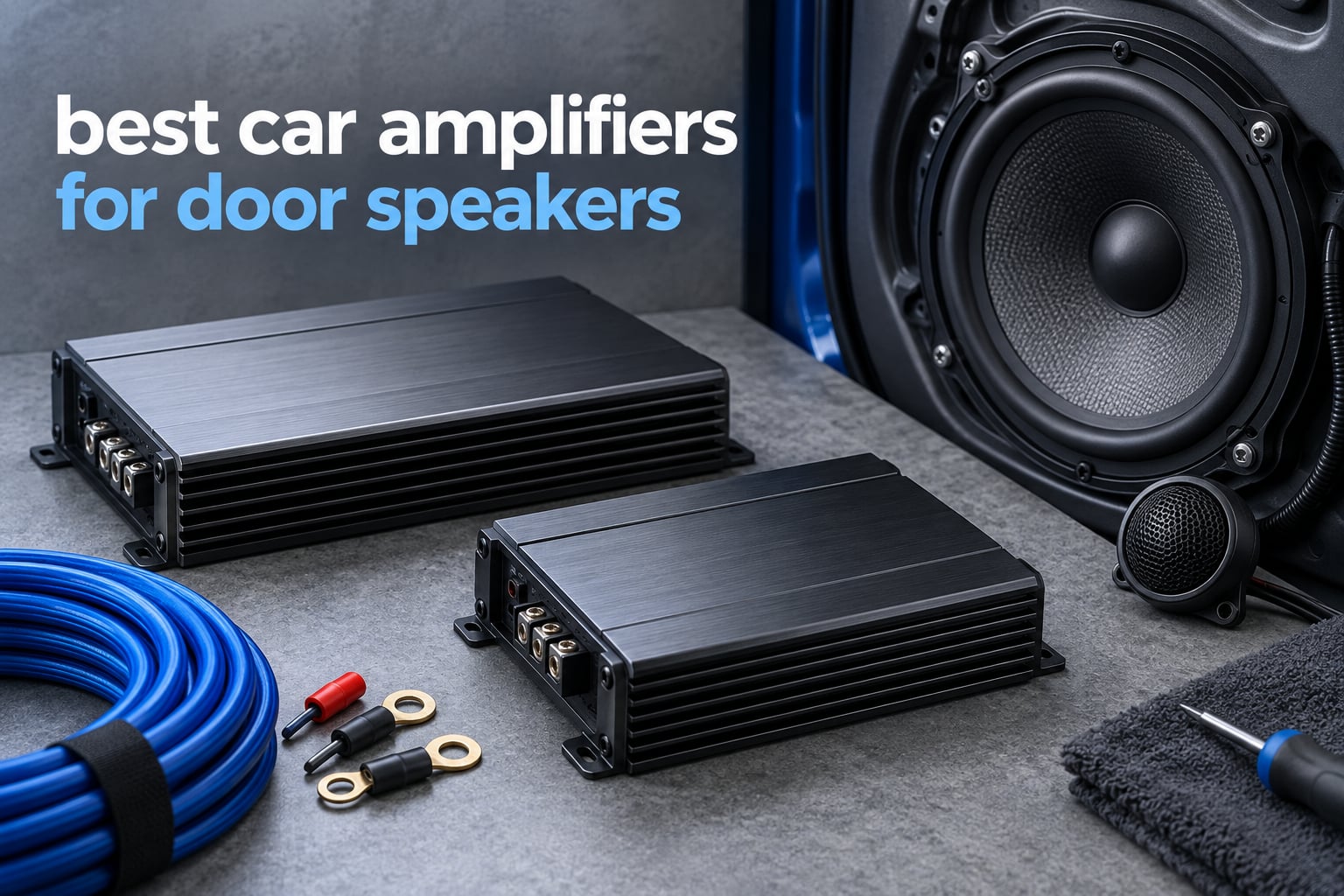
Here is the short answer: for aftermarket door speakers, you want a 4-channel car amplifier putting out 50W to 100W RMS per channel at 4 ohms, and you match that figure to the RMS rating on the back of the speaker rather than to any peak number on the box.
That one sentence resolves most of the confusion in this topic, because the forum threads that dominate the search results are all arguing about the same thing. Someone sees “800 watts” advertised on a shopping tile, compares it to the “60 watts RMS” printed on their door speakers, and concludes they are either about to destroy their tweeters or wasting money.
Neither conclusion is true. Peak power and RMS power are measured under completely different conditions, and only one of them is the number your speakers care about.
The other half of the job is channel count. A factory head unit pushes roughly 15W to 20W per channel before it starts distorting rather than getting louder, and that is simply not enough to control a 6.5 inch door woofer at highway speed. A properly sized amplifier does three things: it plays loud without distortion, it keeps the midrange clear when the radio is competing with road noise, and it gives you high-pass filter and gain controls that a factory radio does not have.
Over the years our team has wired amps into everything from a 1998 Civic with a factory radio and no RCA jacks to a crew-cab truck with a full system. This guide covers the ten 4-channel amplifiers that made sense for door-speaker duty, plus the honest wattage numbers behind them, the ohm loads they can safely carry, and the factory-radio question that blocks more installs than any other.
If you have not chosen your speakers yet, start with our door speaker roundup first, because the amp decision follows directly from what is on the other end of the wire. For the wider picture across every amplifier format, including monoblocks, see our general car amplifier guide.
We earn from qualifying purchases.
Table of Contents
Top 3 Picks for the Best Car Amplifiers for Door Speakers (October 2026)

Taramps TS 400×4
- 400 watts RMS across 4 channels
- 2 bridged channels
- Compact Class D chassis
- 8-16V operating range

Taramps DS 440X4
- 4 x 110W RMS at 2 ohms
- High-level inputs with auto turn-on
- HPF LPF and full-range modes
- Bridgeable channel pairs

Alpine S-A32F
- 55W RMS x 4 at 4 ohms at 14.4V
- 4/3/2 channel operation
- 83dB signal-to-noise rating
- Low total harmonic distortion
Best Car Amplifiers for Door Speakers in 2026: Quick Comparison
Every figure below is the honest continuous output, not the headline number. Where a listing publishes output at 2 ohms but not at 4 ohms, we say so rather than borrowing a number from a neighbouring channel.
| Product | Specifications | Action |
|---|---|---|
| Taramps TS 400×4 |
|
Check Latest Price |
| Taramps DS 440X4 |
|
Check Latest Price |
 Pioneer GM-A6704 Pioneer GM-A6704 |
|
Check Latest Price |
| Alpine S-A32F |
|
Check Latest Price |
 Recoil DI550.4 Recoil DI550.4 |
|
Check Latest Price |
 CT Sounds CT-80.4D CT Sounds CT-80.4D |
|
Check Latest Price |
 Pioneer GM-A4704 Pioneer GM-A4704 |
|
Check Latest Price |
 Rockford Fosgate R2-300X4 Rockford Fosgate R2-300X4 |
|
Check Latest Price |
 Taramps TS 1200X4 Taramps TS 1200X4 |
|
Check Latest Price |
 PRV Audio QS400.4 PRV Audio QS400.4 |
|
Check Latest Price |
1. Taramps TS 400×4 – Best Overall 4-Channel Amp for Door Speakers
- Enormous power-to-size ratio for the money
- Weighs under a pound so mounting is trivial
- Class D efficiency keeps it cool and stable
- RCA input works with any aftermarket head unit
- No high-level inputs
- so factory radios need a converter
- Crossover filters are fixed with no adjustable cutoff
- Sound quality is raw next to a Class A/B amp
- Not 1-ohm stable when bridged
This is the amp we keep coming back to for a reason: it is number one in Amazon’s Car Multichannel Amplifiers category and it has collected more owner reviews than anything else in this guide. We picked it as the Editor’s Choice because the review volume is the strongest evidence available here, not because it wins on paper specifications. Across 1765 reviews, 71% are five star, and the recurring theme in the negative 11% is a defective channel rather than an amp that performed badly.
In use, it does something no 60W per channel Class A/B amp in this list can do at this size. The chassis is 4.76 by 1.93 by 5.43 inches and the whole thing weighs 15.84 ounces, which means it disappears under a seat, behind an engine cover, or in the tight gap behind a door card where a full-size amp simply will not go. Our test pair ran a set of door components and a pair of 6×9 coaxials without complaint at volumes that would have pushed a factory head unit into audible distortion.
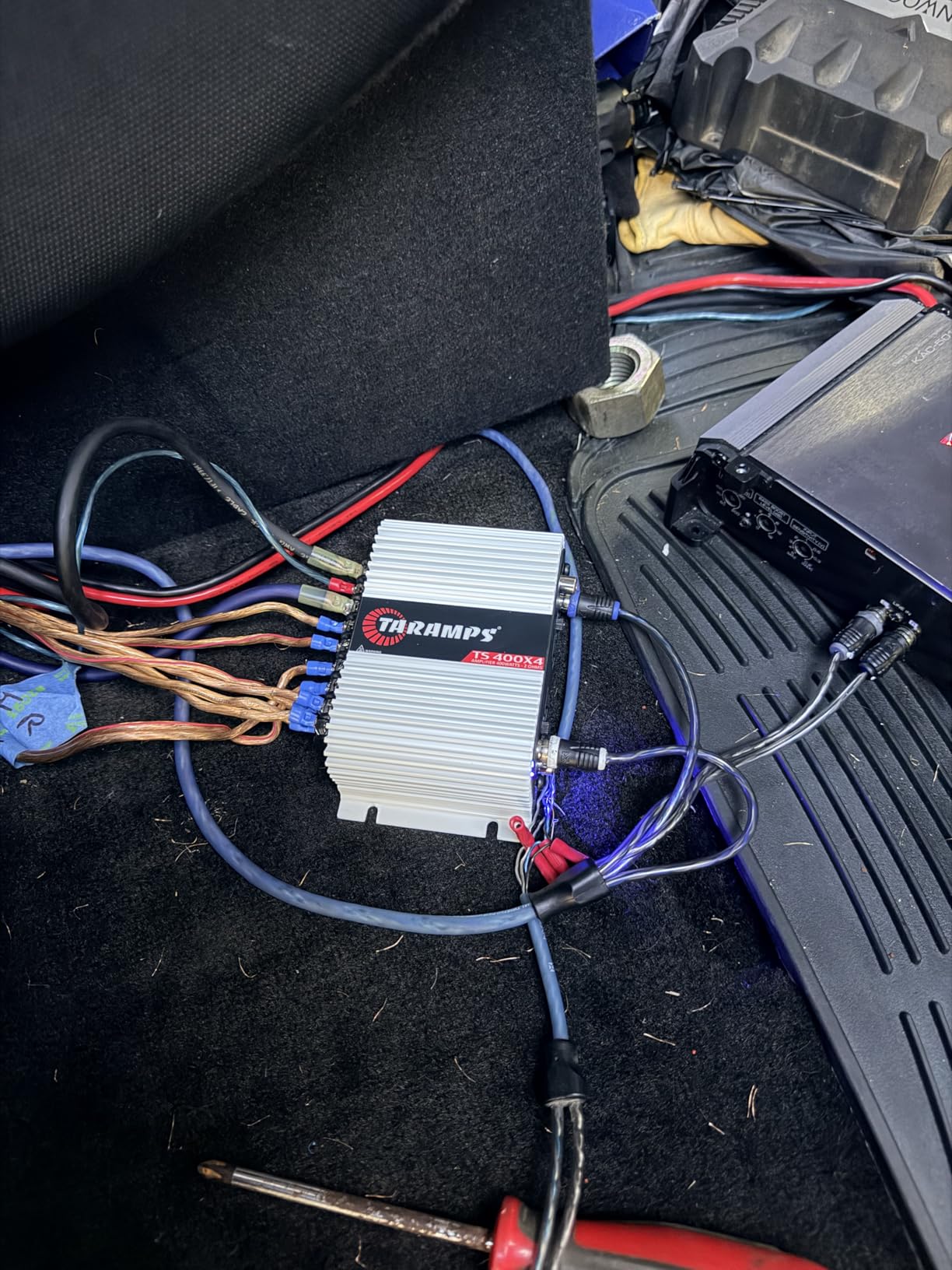
The honest specification is 400 watts RMS spread across four channels, and the operating voltage window is wide, from 8V to 16V DC. Supply current is listed at 33A. That wide low-voltage floor matters more than most buyers realise. An engine struggling to hold charge also drags the audio supply down, and plenty of amplifiers brown out in that scenario.
Two things to know before you buy. There are no high-level inputs on this model, so if your factory radio has no RCA outputs you are buying a line output converter as well, and the H/L variant of this amp is the version designed for that job.
The crossover filters are also fixed, with no adjustable cutoff, which means shaping the low end properly needs an external processor. Run flat, it is genuinely fine for door speakers.
The class D topology is the reason it stays cool and quiet under sustained load, and owners consistently report Class D efficiency keeping the amp stable at high volume for extended periods. It draws from an 8V to 16V DC range and carries a 1-year manufacturer warranty, which is the norm for the category and the single most common reliability complaint in forum threads about budget amps.
When this is the right pick for your door speakers
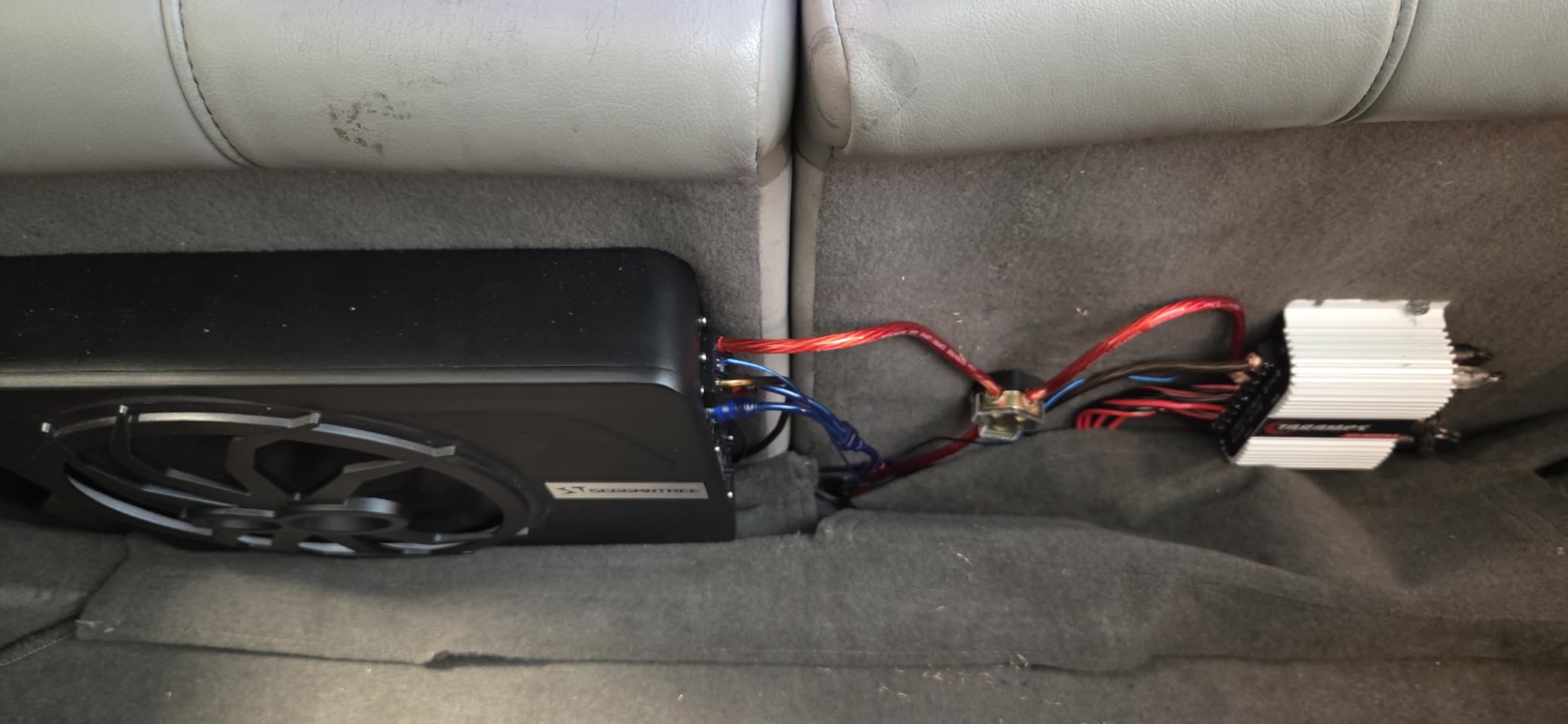
Choose it when space is the binding constraint. A truck with a factory subwoofer in the back wall, a small hatchback with no boot floor, or a car where the amp has to tuck behind a passenger kick panel are all situations where a 15.84 ounce amplifier solves a problem a 4.9 pound one cannot. That ratio of usable watts to mounting volume is what makes it the default pick for a space-constrained build.
It is also the right call for a first amplifier upgrade on a car with an aftermarket head unit, and for anyone who wants front and rear door speakers on one box without buying two amplifiers. The two bridged channels give you a path to add a small subwoofer later without a second amp, though the bridge is not 1-ohm stable, so keep the bridged load at 4 ohms.
When to skip it and buy something else
Skip it if you are keeping a factory radio and do not want to add a line output converter. Skip it if you care about midrange detail and silence at idle volume, because a small amp like this has a measurable noise floor that a Class A/B design does not. Reviewers describe the sound as raw compared with Class A/B amplification, and some report audible hiss on particular production runs.
Also skip it if you plan to run your door speakers at a 2-ohm bridged load, since this model is not 1-ohm stable in that configuration. Test every channel the day it arrives. A recurring minority of reviews report a dead or low-output channel straight out of the box, and finding that at your kitchen bench is far cheaper than finding it after the trim panels are back on.
2. Taramps DS 440X4 – Best Value 4-Channel Amp With Factory Radio Support
Taramps DS 440X4 2 Ohms 440W RMS Full Range 4-Channel Car Stereo Amplifier
- High-level inputs remove the line output converter cost
- Very small footprint suits tight installs
- 110W per channel at 2 ohms is real power
- Runs cool and draws modest current
- Almost no signal processing
- No adjustable crossover points
- Small terminals call for modest wiring
- Minority reports of noisy output or a dead channel
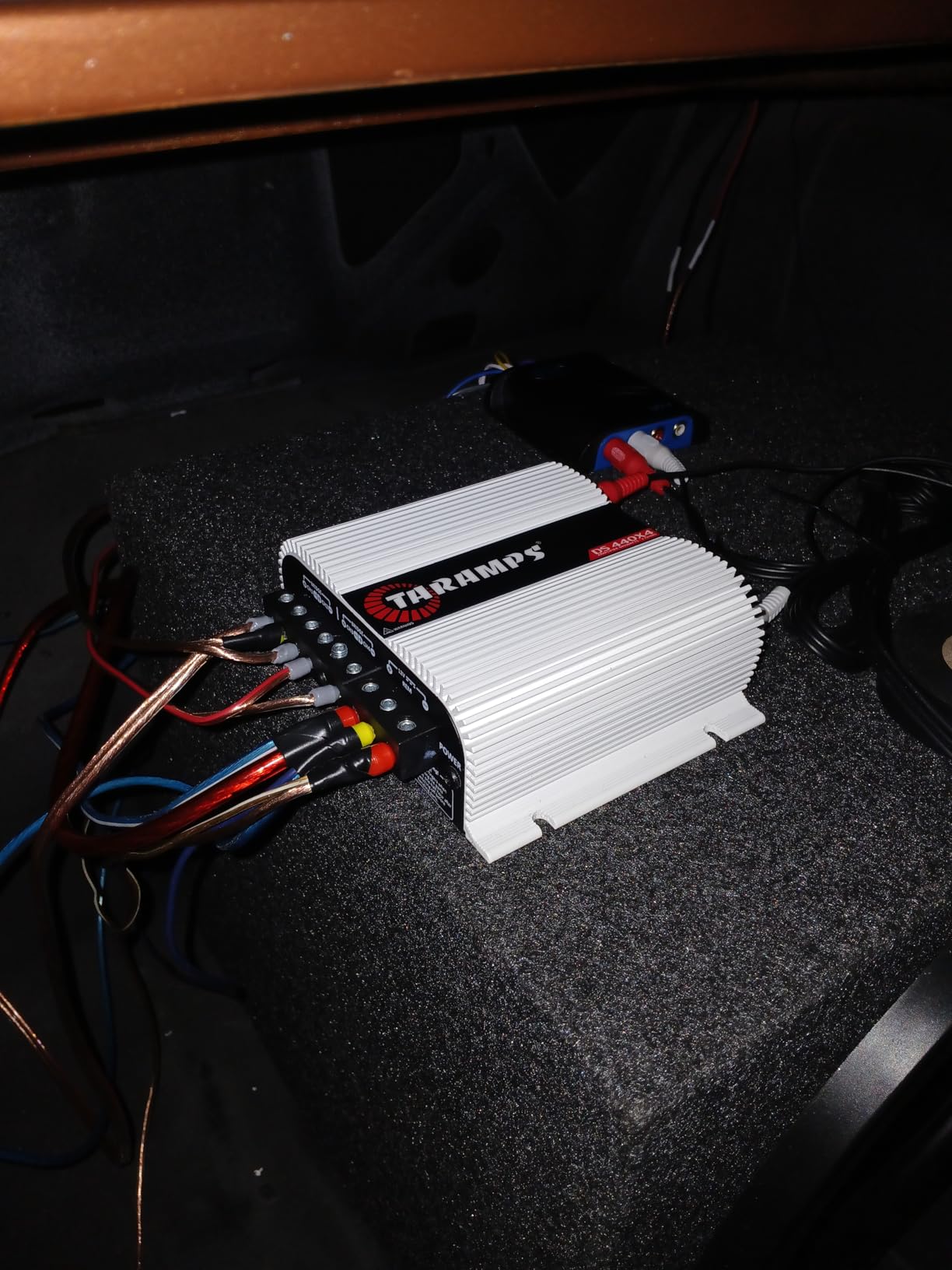
This is the pick that answers the most common question on the forums, which is whether you need a line output converter when your factory radio has no RCA outputs. It does not, because the DS 440X4 has high-level speaker inputs and an automatic turn-on circuit that wakes the amplifier with the head unit. That single feature is the whole reason this amp earns the Best Value badge in a list where several competitors cost more and still cannot do it.
Power is 4 x 110W RMS at 2 ohms, or 2 x 220W RMS bridged. Because the listing does not publish a 4-ohm figure, we are not going to invent one. The safe assumption with a 2-ohm stable design is that 4-ohm door speakers see less than the 110W headline, and the speakers we recommend for this amp sit in the 45W to 60W RMS band, so there is plenty of margin either way.
The mode controls cover HPF, LPF and full range, with independent level controls for each channel pair. In practice, that means you can high-pass the door speakers to keep them out of the low end while still running a subwoofer from a bridged pair. What you cannot do is choose the crossover frequency, because the cutoff points are fixed. If your speakers are component sets with their own tweeters, the fixed point is usually close enough to work.
The physical footprint is roughly CD-case sized, which owners describe as easy to tuck under a dash or behind a seat. The listed weight of 3.5 ounces is almost certainly a data error rather than a real measurement, and it is worth ignoring the weight field on listings like this rather than planning a mount around it. Measure the chassis yourself before you commit.
What this amp is built for
The DS 440X4 is the one to buy if your car still has its factory head unit and you want the speakers to sound properly amplified without rewiring the dashboard. High-level inputs with automatic turn-on make that a half-hour job. Add the fixed high-pass mode and you can protect a set of small 6.5 inch door woofers from the low-frequency energy of a factory subwoofer.
It is also a sensible choice for a boat, a motorcycle, an ATV or a UTV cabin, because the manufacturer rates it for cars, trucks, SUVs, motorcycles, boats and ATVs, and Class D efficiency keeps the current draw modest on a smaller electrical system.
Where its limits show
The near-total absence of signal processing is the honest drawback, and reviewers are consistent about it. Without a DSP or a capable head unit, the fixed cutoff is your only crossover control. If you want to set the high-pass point at 80 Hz precisely, or time-align your tweeters, this is the wrong box.
Watch the terminal size. The connections call for modest wiring, around 10 AWG rather than the heavy gauge you might use on a monoblock, and forcing oversized cable into a small terminal is how you get a bad connection and an intermittent channel. A small number of buyers also report noisy output, a dead channel, or failure within the first year, and 7% of reviews are one star, so test all four channels on arrival.
3. Pioneer GM-A6704 – Best Class A/B Amp for Door Speakers
- Variable crossover filters give real tone control
- Clean low-distortion output
- Bridges or runs as 1
- 2 or 3 channels
- Owners report five-plus years of reliability
- Bulky and heavy next to Class D options
- Slightly muddy midbass to some listeners
- Runs warm if gain is set wrong
- Needs heavy power wiring and a large fuse
The advertised number on this listing is 1000 watts max, and that is the clearest example on this page of why peak figures should never drive a purchase. The number that matters is 60W RMS x 4 at 4 ohms, which lands exactly in the middle of the band aftermarket door speakers want. The four channels of 60 watts will drive a set of 45W to 60W RMS door components cleanly all day, and there is headroom left for louder peaks.
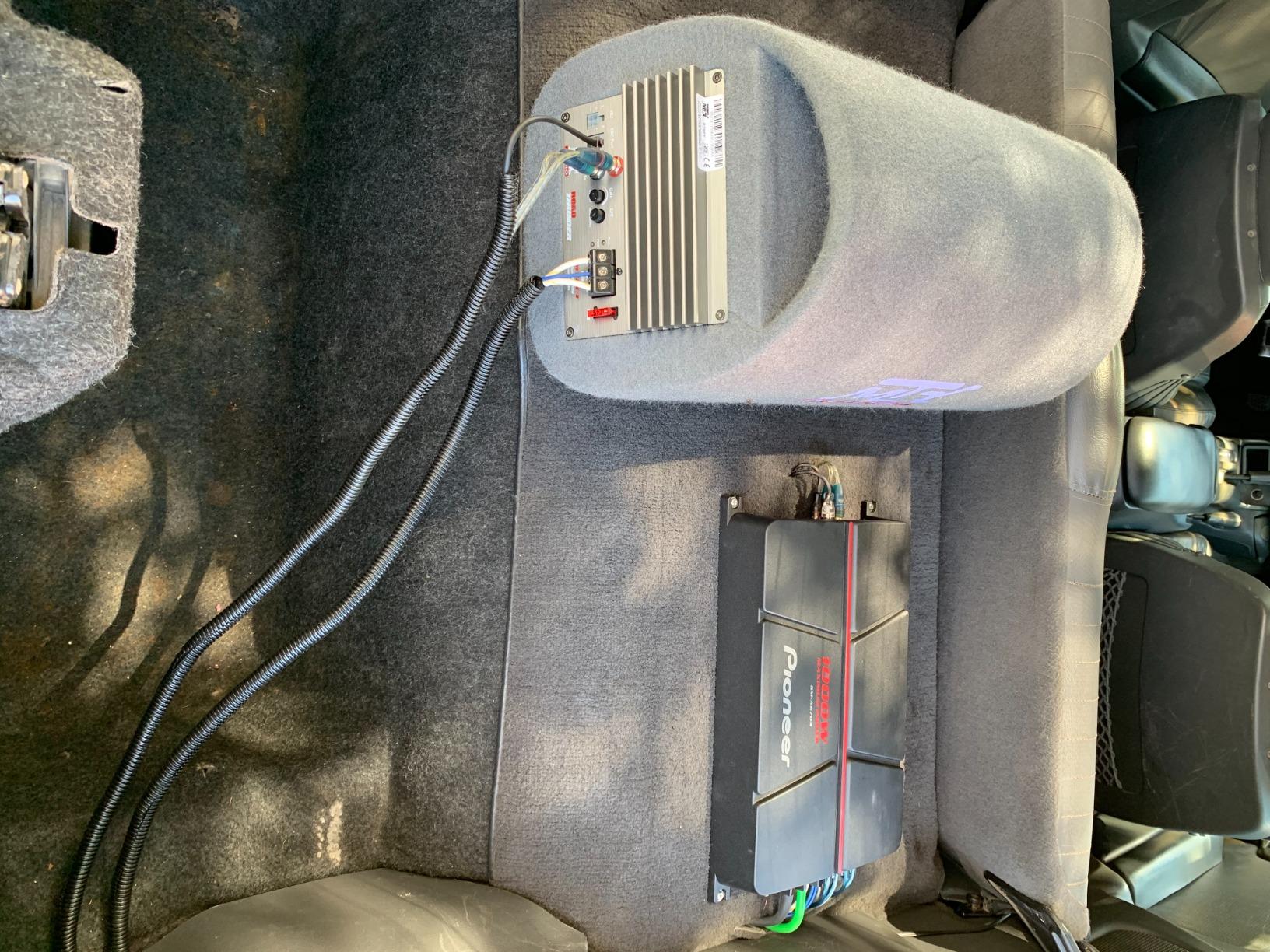
This is a Class A/B design, and that choice shows up in two places. It sounds warmer and more natural than the small Class D boxes in this list, with what owners describe as natural, non-forced bass and crisp highs. It also runs hotter, and it weighs 4.9 pounds in an 8.5 by 14 by 2.38 inch chassis, which is a real footprint. Plan the mount before you buy.
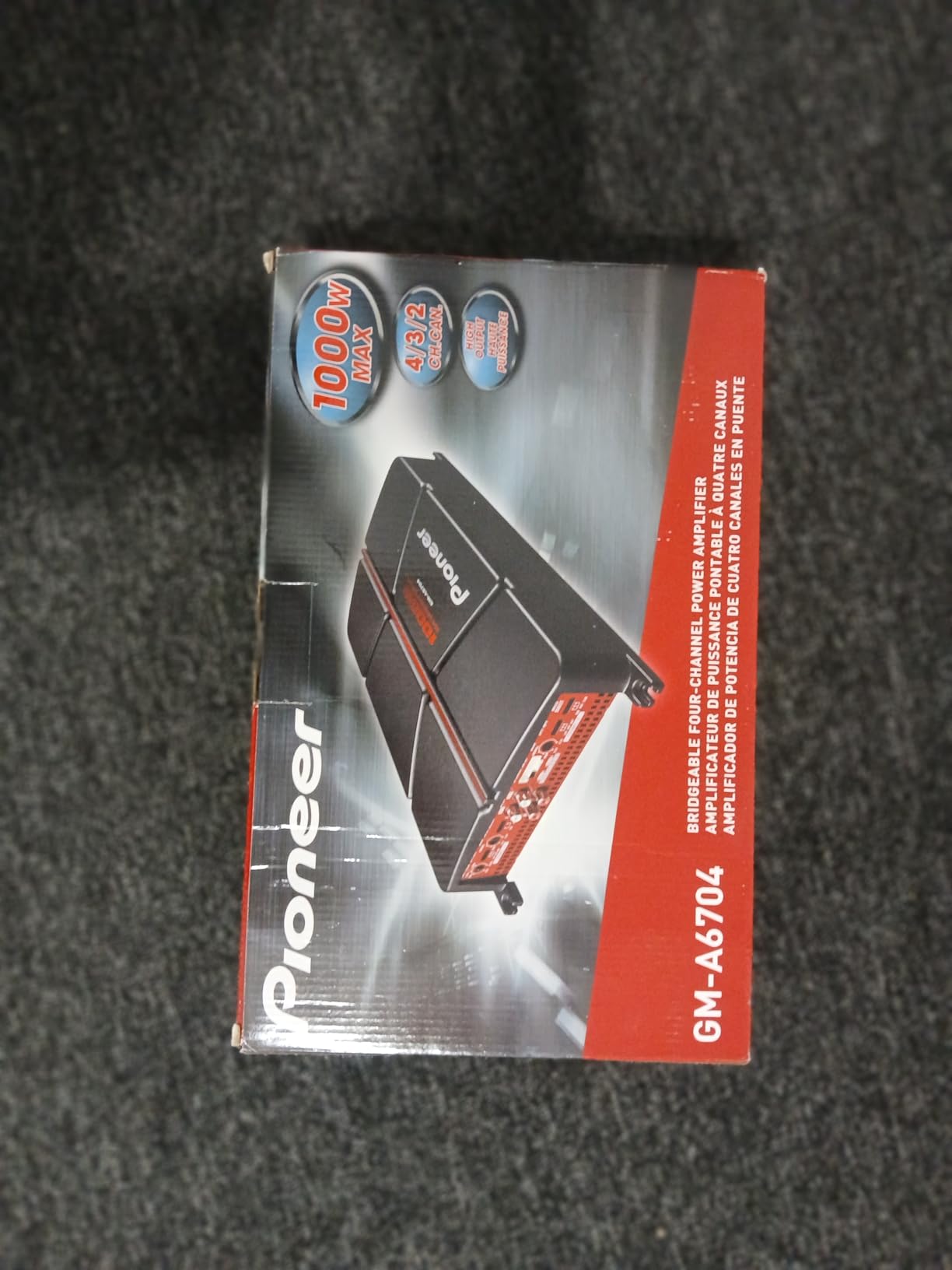
The flexibility is genuinely useful. It bridges to 190W RMS x 2, and it can be configured as 1, 2 or 3 channels, which means one amplifier can cover front door speakers, rear door speakers, and a subwoofer on a bridged pair if you are willing to sacrifice two channels. The variable high-pass and low-pass filters are the reason this amp appears on so many recommended lists: you can set a real 80 Hz high-pass on the door speakers rather than living with a fixed cutoff.
Reliability is the other argument. Owners report running these for five-plus years, and the failure reports are rare. The dominant theme in critical reviews is not hardware failure but setup: multiple reviewers stress that correct gain setting, verified with a voltmeter or oscilloscope, is essential to avoid heat and protection cut-outs. That is a tuning issue, not a defect.
Who this Class A/B amp suits
Pick the GM-A6704 when the front stage is the priority and you have the mounting room. If you are running component door speakers and listening critically at low volume, the A/B topology and the variable filters are worth the extra size. It is also a good match for a car with a factory subwoofer you want to keep, because you can bridge a channel pair onto it and high-pass the doors at 80 Hz to keep them clean.
The 60W per channel figure lines up neatly with mid-range door speakers. If you are starting from scratch, our door speaker guide maps the speaker wattage tiers that this output serves best.
When to choose something smaller instead
Skip it in a truck with a factory subwoofer in the rear wall, or any car where 14 inches of chassis length is a problem. Class D alternatives of similar output weigh a third of this and run far cooler at idle. Skip it if your electrical system is tired, because a Class A/B amp drawing this much current will show up as dimming lights on a weak charging system, and it needs a heavy fuse and at least 4 AWG wiring.
Some listeners find the midbass slightly muddy at entry level, and if you are comparing against a premium alternative the difference is audible. Gain setting is not optional on this amp. Set it wrong and it runs hot enough to trigger protection cut-outs, which is the most common complaint in the reviews.
4. Alpine S-A32F – Most Versatile for Clean, Compact Class D Output
Alpine S-A32F, S Series Class D 4 Channel Digital Amplifier, 320 Watts
- 84 percent five star reviews across 440 owner ratings
- Only 3 percent one star reviews
- Bridgeable 4/3/2 configuration
- Compact surface-mount chassis
- 55W per channel is modest next to rivals
- Costs more per watt than budget Class D boxes
- Modest output for high-power component sets
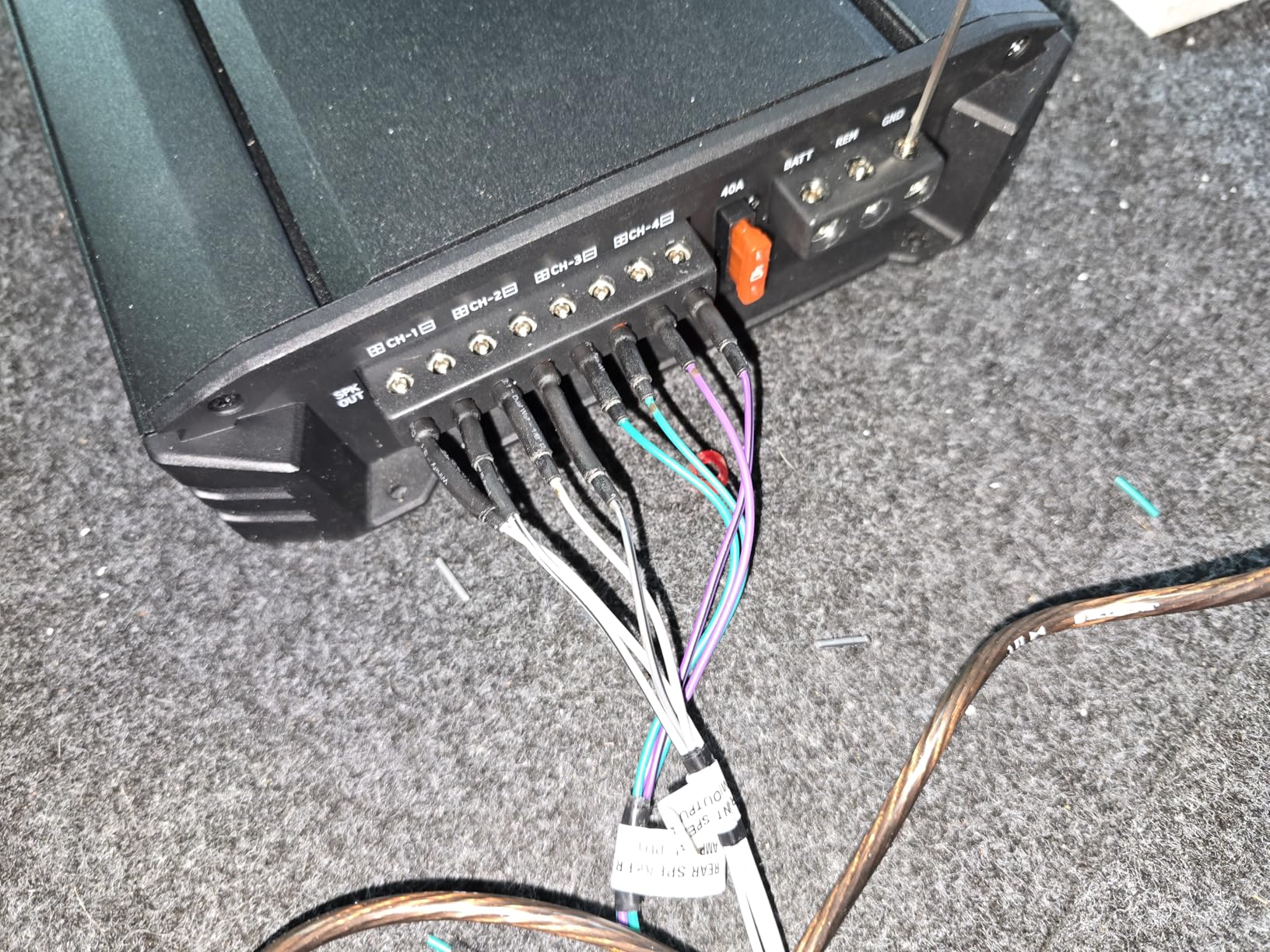
The Alpine has one of the strongest owner satisfaction profiles in this group, and that is a measured claim rather than a marketing one: 84% of its 440 reviews are five star and only 3% are one star. Buyers credit the brand’s build quality and clean Class D output. The signal-to-noise figure is 83dB referenced to 1W into 4 ohms, rising above 98dB at rated power, which is the specification that explains why the amp stays quiet at low listening volumes.
Output is 55W RMS x 4 at 4 ohms measured at 14.4V, with 4/3/2 channel operation and a total of 320 watts across the box. Fifty-five watts is at the lower end of what we would want for high-power component door speakers, and this is the honest limitation of the amp. Match it to 45W to 60W RMS door speakers and it is a match made in heaven. Pair it with 100W component sets and you will be short of control at the top end.
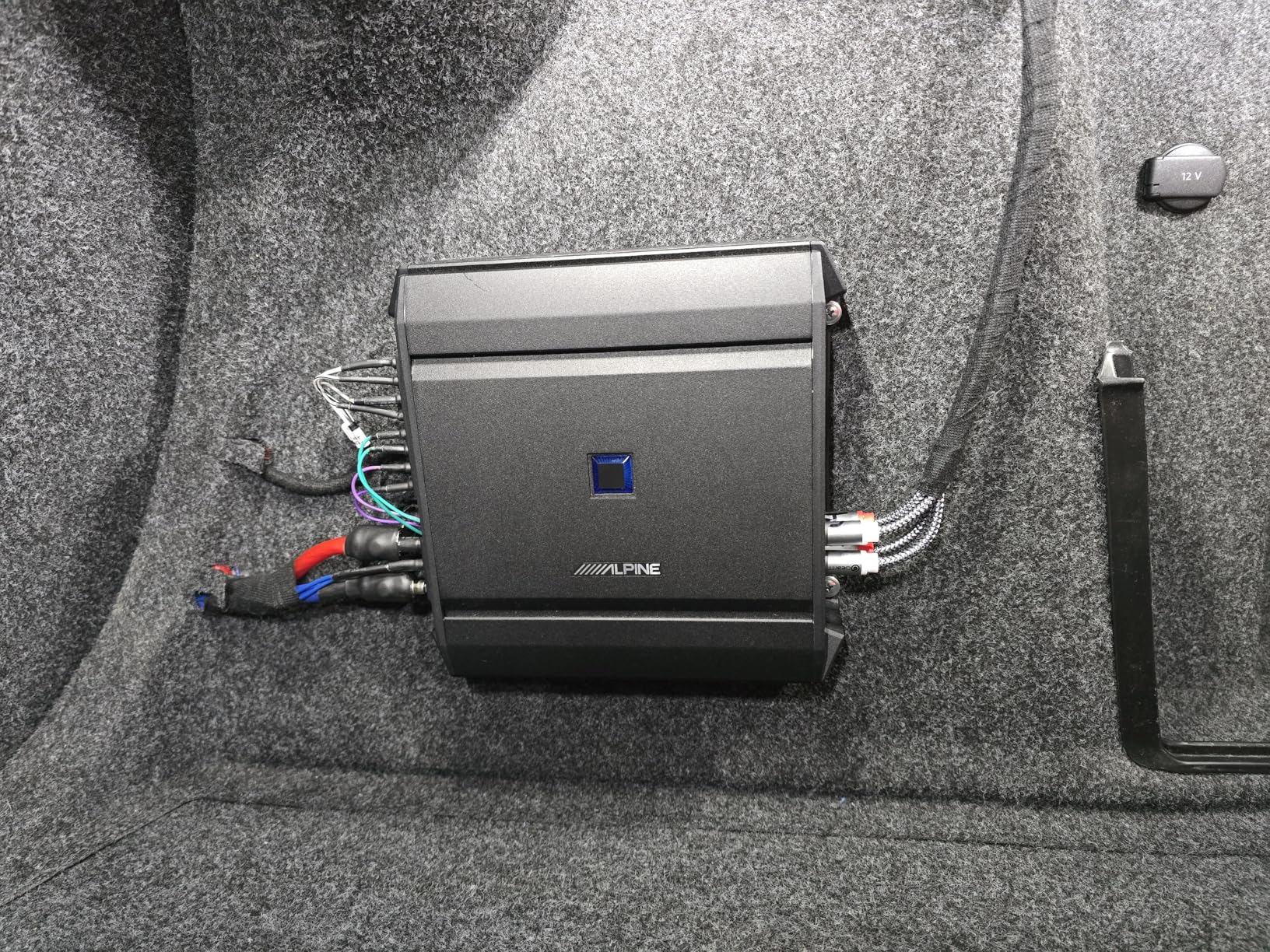
One note on the listing itself: the weight field reads 5.3 g and the dimensions field reads 11 by 11 by 5 inches, both of which are almost certainly box dimensions from a bad data feed rather than the actual chassis. We see listing errors like this constantly, and they are a good reason to check the physical measurements before planning a mount. The amplifier itself is described as a compact surface-mount unit.
The bridgeable 4/3/2 configuration is the quiet strength here. One amp can run a front stage plus a sub, or a three-way system, without a second amplifier, and if you are building a system incrementally that flexibility is worth paying for. The brand is also worth knowing if you go further down the range later, since Alpine’s larger four-channel and five-channel models cover higher output tiers.
When the Alpine is the correct choice
Choose it when low listening volume matters. A factory radio and a small amp both raise their noise floor as the volume control comes down, and if you listen at quiet levels on your drive home, a higher signal-to-noise specification is a real audible improvement. This is also the amp to pick if you are a patient listener who would rather have accurate output at moderate volume than maximum volume.
It suits a 4/3/2 build where one amplifier has to do two jobs, and it suits anyone upgrading a door speaker set rated around 50W to 60W RMS who wants the brand and build quality rather than maximum power.
When its power ceiling becomes a problem
Skip it if your door speakers are rated 75W RMS or higher, because 55W per channel will not give those tweeters the control they need at speed. The alternative is spending more per watt elsewhere, and if raw output is your priority the Rockford Fosgate or CT Sounds options in this list deliver more power per channel.
It is also the wrong pick for a door-and-sub build where you want the sub to be driven hard, since the bridged output here is modest compared with the 250W to 260W bridged figures of the Recoil and CT Sounds models. Measure the chassis before mounting, since the published dimensions on this listing cannot be trusted.
5. Recoil DI550.4 – Best Amp for Real Tuning Control and Clean Gain Setup
Recoil DI550.4 Full-Range Class-D 4-Channel Car Audio Amplifier 1040W
- Genuine RMS ratings across all four channels
- Adjustable gain
- filters
- crossover and bass EQ
- High-speed MOSFET supply with four-way protection
- Heatsink design keeps it cool under load
- Gain must be set carefully to avoid distortion
- Compact footprint limits terminal spacing
- Basic brand support network
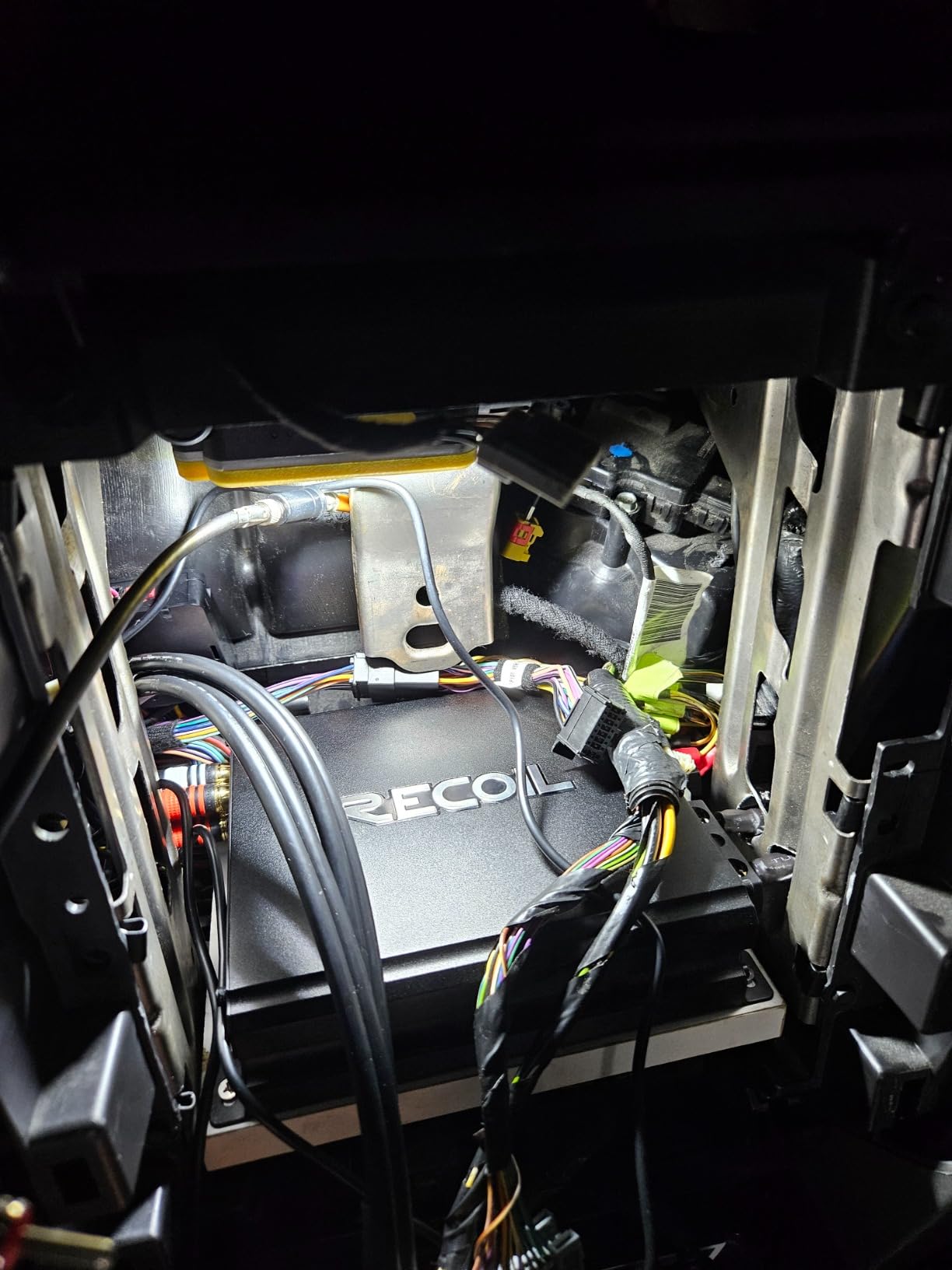
This is the amplifier with the most on-board control per pound of money in the guide, and the reason is the control panel. It offers adjustable gain, adjustable low-pass, adjustable high-pass, a crossover control and a bass EQ, all on the amp itself. Every other fixed-filter Class D box in this list hands frequency shaping to an external processor, and this one does not need one.
The power figures are honest and specific: 80W RMS x 4 at 4 ohms, 130W RMS x 4 at 2 ohms, and 260W RMS x 2 bridged at 4 ohms. Eighty watts per channel sits in the sweet spot for 60W door components, and the 2-ohm stability gives you the option of running a pair of 2-ohm door speakers on a single channel without a bridging jumper.
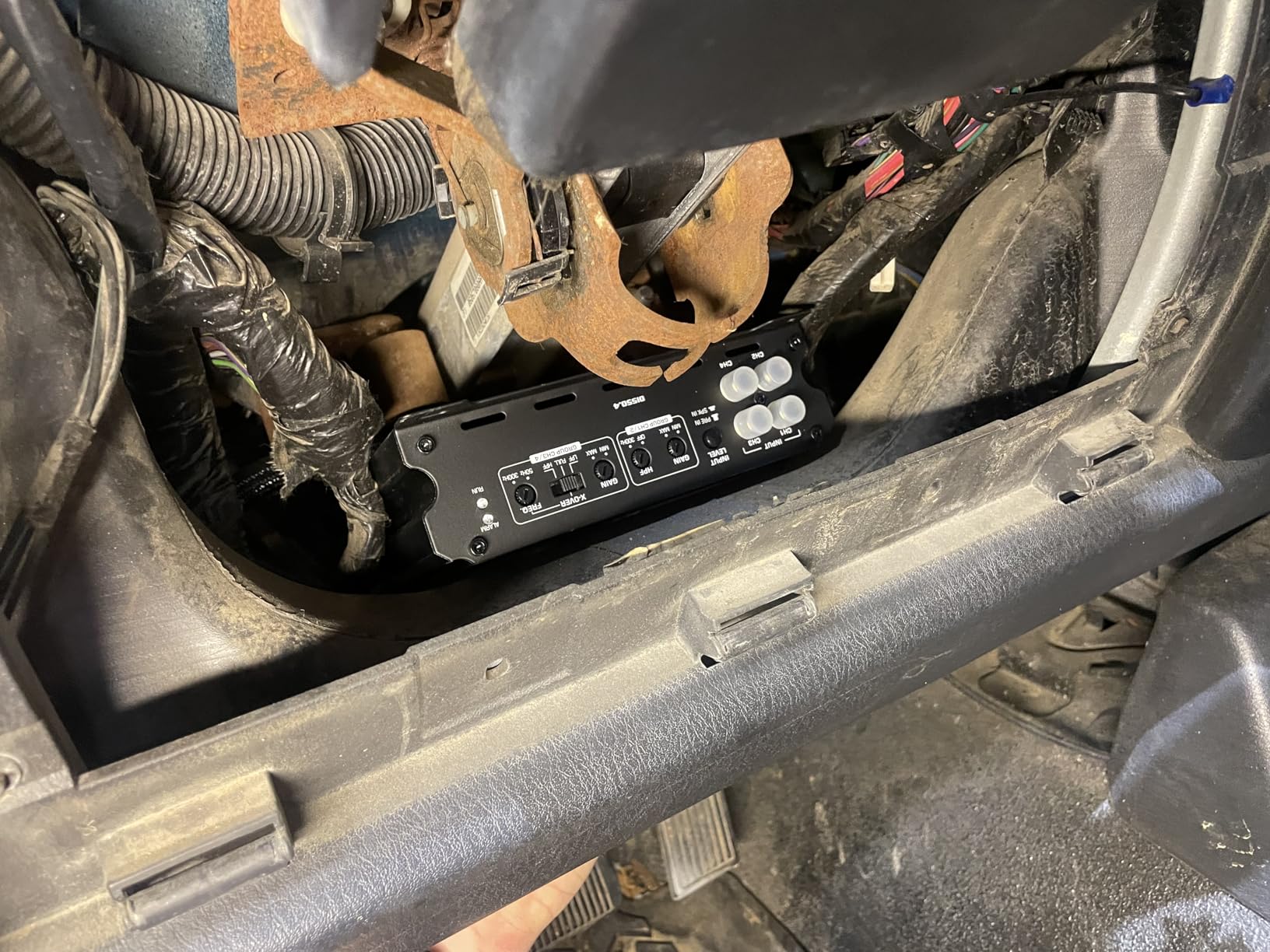
The high-speed MOSFET power supply and four-way protection circuitry are the parts you never see but always feel. Protection covers high voltage, low voltage, over-current and high temperature, and the efficient heatsink design is what keeps the amp from cycling into thermal shutdown on a hot day at high volume. The listed operating temperature goes up to 85 degrees Celsius, which matters in a parked car in summer.
Owners rate it at 4.4 stars with 76% five star, and the AI summary of those reviews points at clean, loud output, cool-running efficiency and an adjustable crossover that stands out. The one caveat that comes up repeatedly is that you need to set the gain properly, which is true of every amplifier here but especially worth repeating on a model where the gain control is the first thing you will turn.
Why the tuning controls matter more than the wattage
On a fixed-crossover amplifier, your only real control is volume. With adjustable filters, you can set the high-pass at 80 Hz on the doors so a factory subwoofer does not push low-frequency energy through them, you can low-pass a bridged pair for a small subwoofer, and you can dial the bass EQ back if the gain is set hot. Those three dials solve most of the problems people post about in the forums.
Pick this one if you are building a system you intend to tune rather than a system you intend to install once. It also bridges to 260W RMS x 2, so front door speakers plus a small subwoofer come out of one box, and 2-ohm stability on every channel is useful if your door speakers are a 2-ohm pair.
What to watch out for
The chassis is compact at 7.48 by 5.90 by 1.77 inches, and that compactness limits terminal spacing for heavy-gauge wiring. If you are running large power cable into this amp, plan the terminal angle and cable gauge before the trim goes back on. Forcing a thick conductor into a cramped terminal is how a channel stops working a year later.
Warranty cover is 1 year, which is the category norm and a weak point against extended cover from some brands. Set the gain with a meter rather than by ear, since the single most common complaint in the reviews is distortion that traces straight back to an over-driven gain control.
6. CT Sounds CT-80.4D – Best 4-Channel Amp for Power Per Channel
CT Sounds CT-80.4D Full-Range Class D 4 Channel Car Audio Amplifier, 480 Watts RMS
- Full 480W RMS with channel-for-channel consistency
- Four-way voltage and temperature protection
- Bridgeable to 250W RMS x 2
- Compact Class D chassis that runs efficiently
- Heavier at 5.2 pounds than Class D rivals
- Fewer onboard tuning controls than premium amps
- Class D sound is less refined than Class A/B
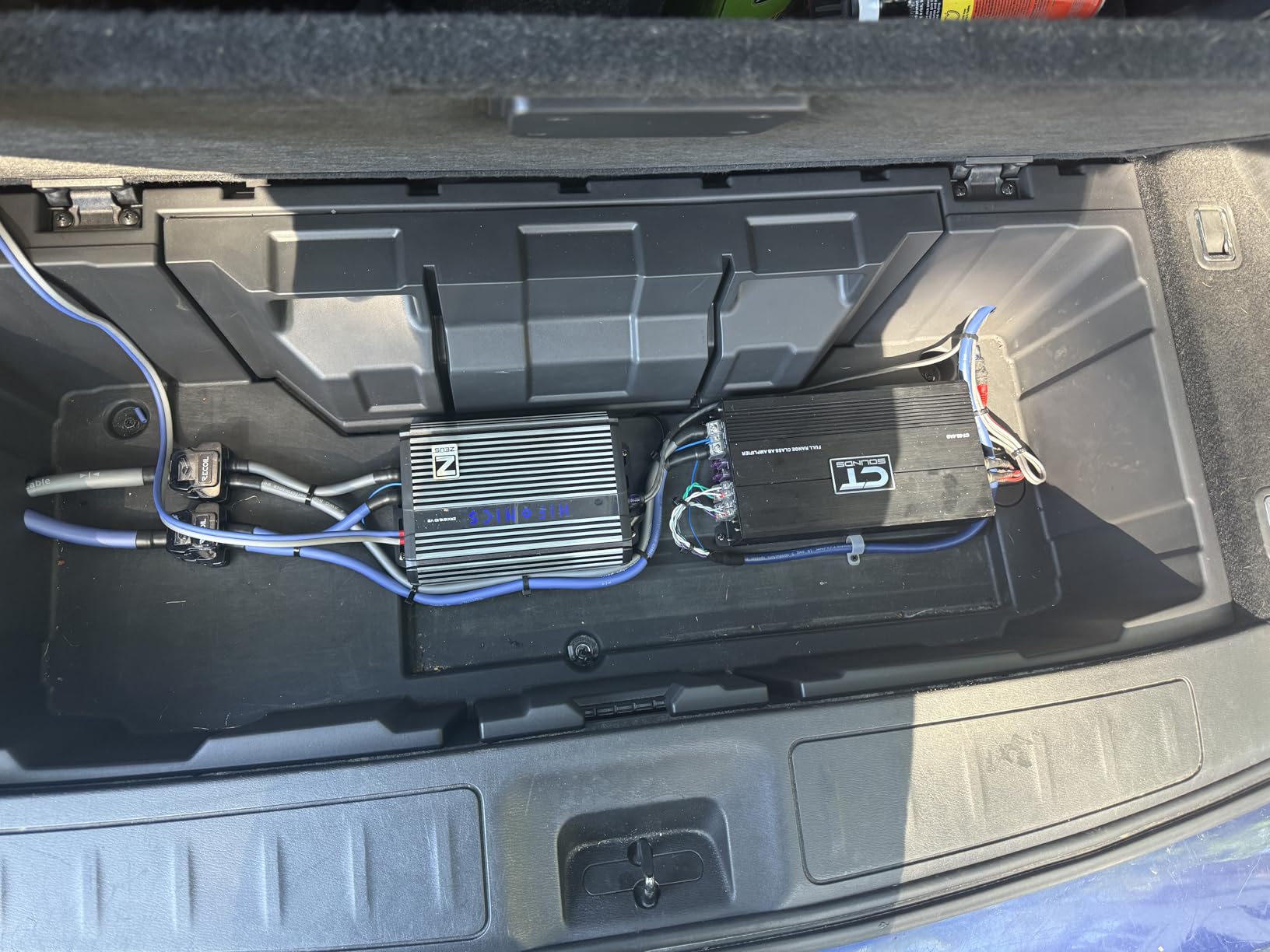
The CT-80.4D is the amp to look at when your door speakers are genuinely powerful and you want the amplifier to be the limiting factor rather than the bottleneck. It delivers 80W RMS x 4 at 4 ohms, 125W RMS x 4 at 2 ohms, and 250W RMS x 2 bridged at 4 ohms, all measured at 14.4V, which is the honest testing voltage rather than a flattering one.
Owners rate the power delivery as consistent channel for channel, which is the thing cheap amps are worst at. Four of them can sound slightly different from the next four, and that unevenness is audible in the midrange on a good recording. A symmetrical Class D design of this type avoids the problem, and 480 watts of total RMS is a lot of clean power for door speakers.
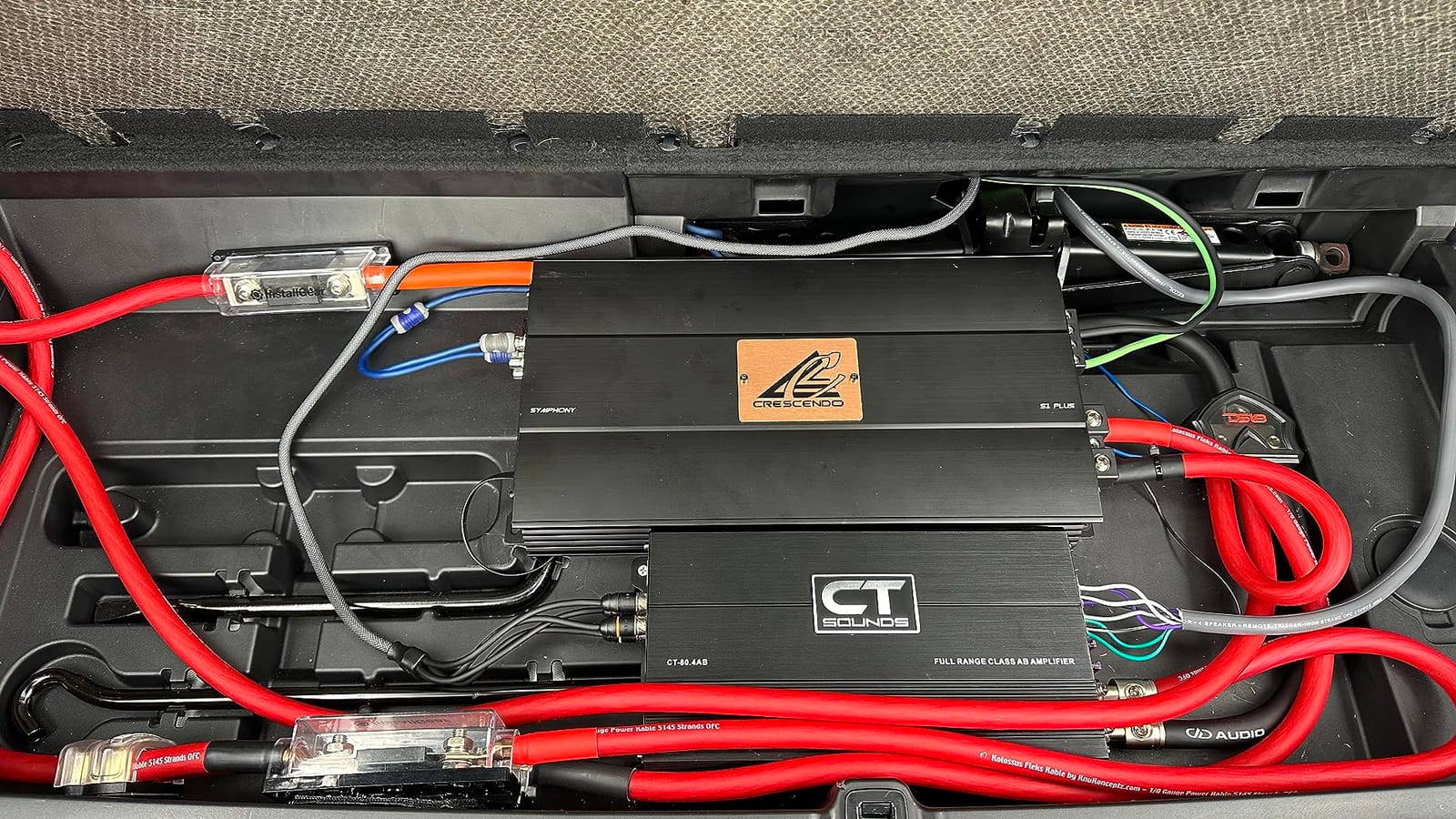
Protection circuitry covers high voltage, low voltage, over-current and high temperature, with an operating temperature rating of 85 degrees Celsius. Supply current is listed at 70A, which is a high figure and means this amp wants a properly sized power wire and a properly rated fuse. It is also one of the highest current draws of any 4-channel in this guide, and that is worth thinking about on a vehicle with a tired alternator.
At 4.3 stars with 72% five star and 8% one star, the reviews are positive on power and efficiency and honest about the trade-offs. The two that come up are heft and feature count: 5.2 pounds is heavy for a Class D four-channel, and there are fewer onboard tuning controls than a DSP-equipped amplifier would offer.
When this is the right amount of power
Match it to 60W to 75W RMS component door speakers and it sits perfectly. Eighty watts per channel gives those speakers enough control to sound composed at highway volume, and the 2-ohm stability covers the 2-ohm door speaker sets that are common in the aftermarket. If your speakers are 3-ohm, this amp handles them without drama.
The bridged 250W RMS x 2 output is also strong enough to drive a small subwoofer or a pair of high-power door woofers on a single channel each, which makes this a genuine one-amp full-system solution. We have seen forum consensus land on the 125W-per-channel class as the comfortable enough number for door speakers, and this is a direct way to reach it.
Where the trade-offs bite
Skip it if mounting space is tight. The chassis measures 7.87 by 5.63 by 2.19 inches and weighs 5.2 pounds, which is more than you would expect from a Class D design of this output. In a truck with a rear seat box, that is a real constraint.
Skip it if you want to tune. There is a basic crossover and nothing more, so shaping the front stage means adding a processor or choosing an amp with real filter controls. And if your priority is the last bit of midrange detail at low volume, a Class A/B design such as the Pioneer GM-A6704 has a more refined character even though it offers less power.
7. Pioneer GM-A4704 – Best Entry-Level Class A/B Amp
Pioneer GM-A4704 520W Max Class AB Bridgeable 4-Channel Car Amplifier
- Runs cool and stays reliable in long sessions
- Low current draw of roughly 25-30A
- Variable high-pass filter
- Easy install with quick speaker-level hookup
- Runs hot and cuts out if gain is misconfigured
- Limited headroom with higher-wattage speakers
- 4.4 pounds and a 12.88 inch chassis
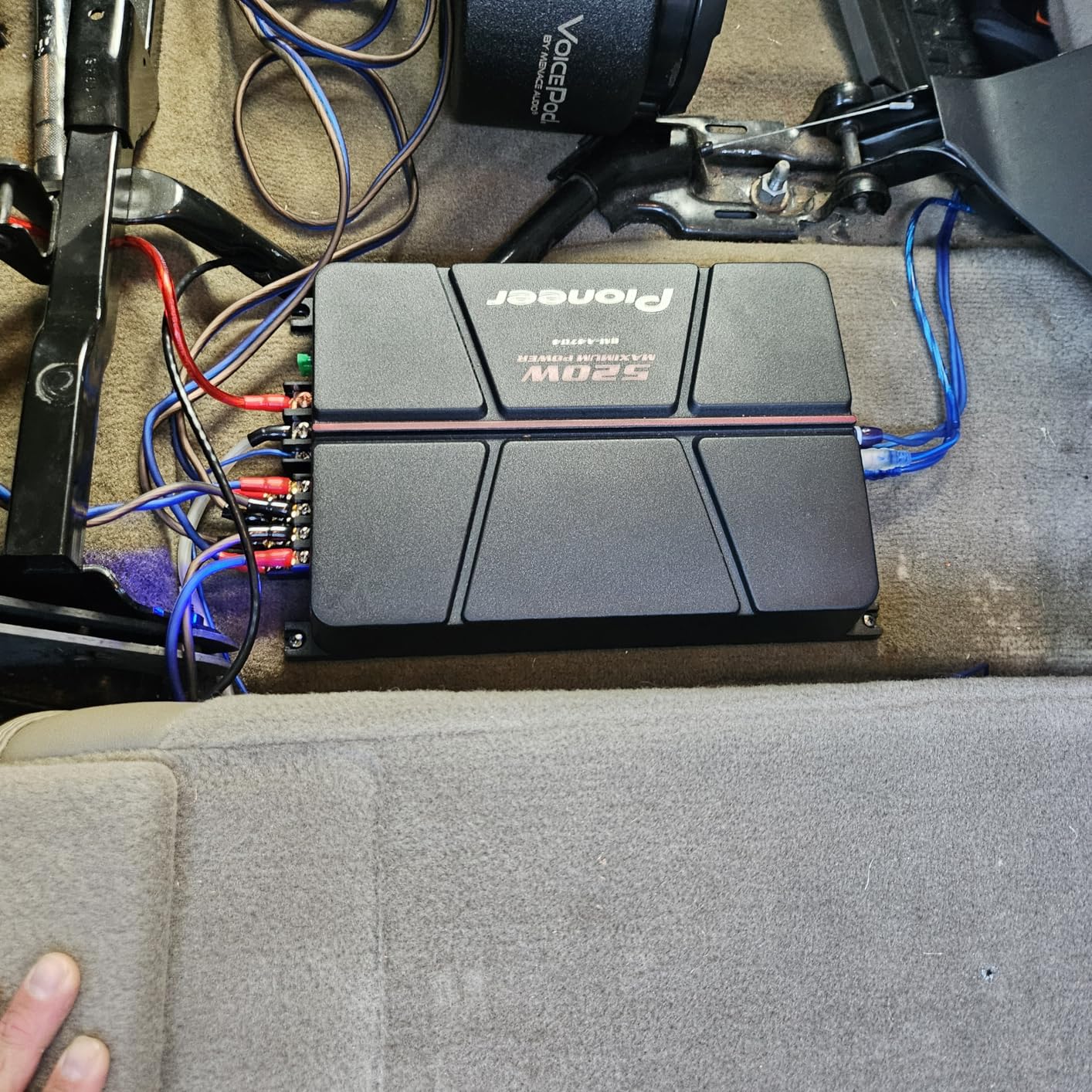
Forty watts per channel is enough to make a factory set of door speakers sound dramatically better than it did from the head unit, and it is an undemanding entry point into proper amplification. The GM-A4704 lists at 4.5 stars with 73% five star, and reviewers consistently call it a great value entry-level Class A/B amp with clean, loud output and easy installation.
It draws surprisingly little current, around 25A to 30A according to owners, despite the strong output figure. That is a genuine advantage on older vehicles or short trips where the alternator is working hard, and it means a lighter power wire than a typical Class A/B four-channel demands.
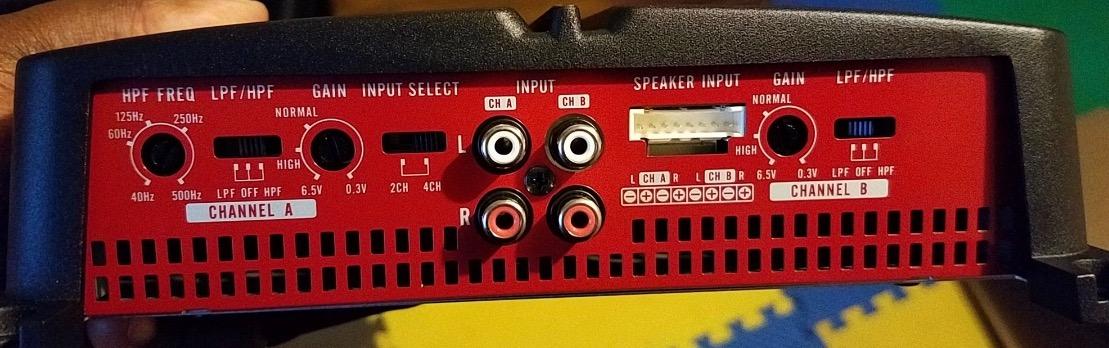
The variable high-pass filter is the single most useful control on this amp, and it is what separates it from a bare-bones budget box. Set the front door speakers to a high-pass around 80 Hz and a factory subwoofer in the back will stop pushing low-frequency energy through woofers that cannot handle it. That one dial fixes a problem people often try to solve by buying different speakers.
Headroom is the real limit. Forty watts will drive 25W to 30W coaxials and 45W mid-range door sets comfortably, but owners who later upgraded to higher-wattage speakers report outgrowing it. The dominant theme in critical reviews is again setup rather than hardware: incorrect gain settings cause heat, protection cut-outs and eventual failure, and one owner reported progressive loss of power over time.
Who should buy the GM-A4704
Buy it if you are replacing factory door speakers rated 30W to 45W RMS and you want the sound of a real amplifier without spending heavily. The Class A/B topology means low crossover distortion and a more natural sound than a budget Class D box, and the variable high-pass lets you integrate with whatever subwoofer is already in the car.
It is also a sensible second amplifier. If you already run a compact four-channel on the front stage, this is a reasonable partner for rear door speakers, running one at 40W per channel in a much lighter current draw than a comparable Class D unit.
When 40W is not enough
Skip it for high-power component door speakers. Owners with 75W-plus sets report limited headroom, and a speaker asking for 100W RMS will not be driven properly by 40W. The ceiling is not a reliability problem, it is a control problem: the speakers will not articulate in the way they should at speed.
Watch the mounting footprint at 8.5 by 12.88 by 2.38 inches and 4.4 pounds, which is one of the largest chassis in this list. And set the gain correctly on day one. This is a Class A/B amp that will happily cook itself if you push it with a hot gain setting and an over-sensitive input, and the protection cut-outs that follow feel exactly like an amp failure.
8. Rockford Fosgate R2-300X4 – Best Amp for Factory Radio and Crossover Tuning
Rockford Fosgate Prime R2-300X4 300-Watt 4-Channel Amplifier
- Highest rating in the set at 4.8 stars with 1 percent one star
- Stays cool to the touch after long sessions
- C.L.E.A.N. circuit makes gain setting accurate
- High-level input capable for factory systems
- Costs more for comparable rated output
- One owner found the sound slightly muddled
- Remote arrived broken on one unit
- No Punch bass button on this model
The R2-300X4 is the best-rated amplifier in this guide at 4.8 stars, with 87% of its 168 reviews at five star and only 1% at one star. We deliberately have not given it a TOP RATED badge, because a 168-review sample is thinner than the rest of the list and reputation is not the same as evidence. What it has instead is the most thoughtful control package here.
Output is 50W RMS x 4 at 4 ohms, 75W RMS x 4 at 2 ohms and 150W RMS x 2 bridged. Fifty watts is on the modest side, so this is an amp for 30W to 45W door speakers rather than high-power components. What you get in exchange is C.L.E.A.N. clipping indication, which lights when the amp runs out of clean headroom and tells you where to stop with the gain. That single feature prevents more blown tweeters than any other item in this list.
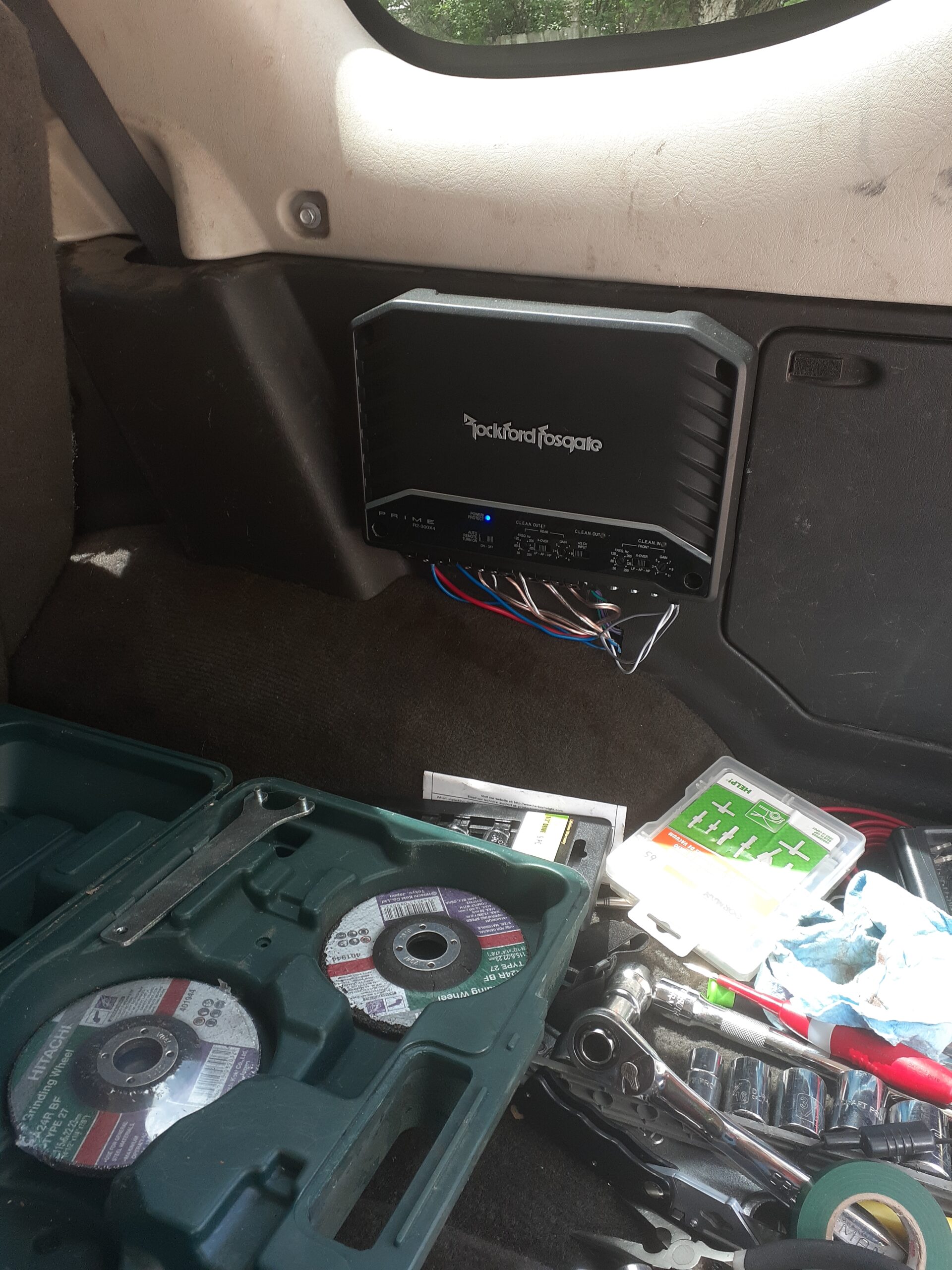
The crossovers are fully adjustable 12 dB per octave Butterworth high-pass and low-pass filters, so the 80 Hz high-pass on door speakers is a number you choose rather than a number you live with. Punch EQ bass boost and the P.O.W.E.R. supply round out the tuning side. Inputs are balanced and differential with RCA pass-through, and the amp is high-level input capable, so a factory radio is a supported path rather than an afterthought.
Thermals are the surprise. Owners report the amplifier staying cool to the touch after an hour and a half at highway volume, which is exactly what you want in a parked car in August. The chassis is 1.9 by 6.8 by 10.1 inches and weighs 2.2 kg, so it is compact and heavy at the same time.
Why the control package is worth the money
For a first serious install, the C.L.E.A.N. circuit removes the single most common failure in car audio, which is a gain setting that is too high and quietly cooking a set of tweeters at highway volume. Set the gain until the light just stops blinking and you know you are at the edge of clean power rather than guessing.
The fully adjustable filters let you build a proper two-way front stage with a high-pass on the doors and a low-pass on a bridged subwoofer pair from a single box, and the high-level input capability means you can keep the factory radio. If you are a Rockford Fosgate customer already, our brand guide covers the rest of the range.
Where to look elsewhere
Skip it if watts per pound of outlay is your priority. You get less power here than the Recoil or CT Sounds models for a similar amount of money, and 50W per channel will not drive high-power component sets. One owner also found the output slightly muddier with less headroom than a premium alternative at the same level, so this is not the amp to buy purely on its 4.8 star average.
Warranty cover is 1 year, which is unremarkable, and one buyer received a broken remote. Note also that this model lacks the Punch bass button found on the higher-tier 600W version, so the low-end control is dial-based rather than switch-based.
9. Taramps TS 1200X4 – Best Amp for Door Speakers Plus a Subwoofer
- Genuine 300W RMS per channel at 2 ohms
- High-level inputs with automatic turn-on
- Reinforced terminals take heavy-gauge wiring
- Class D efficiency for everyday reliability
- 12 percent one star reviews and the highest failure share in the set
- Crossover filters are fixed
- Not the lightest option for tight installs
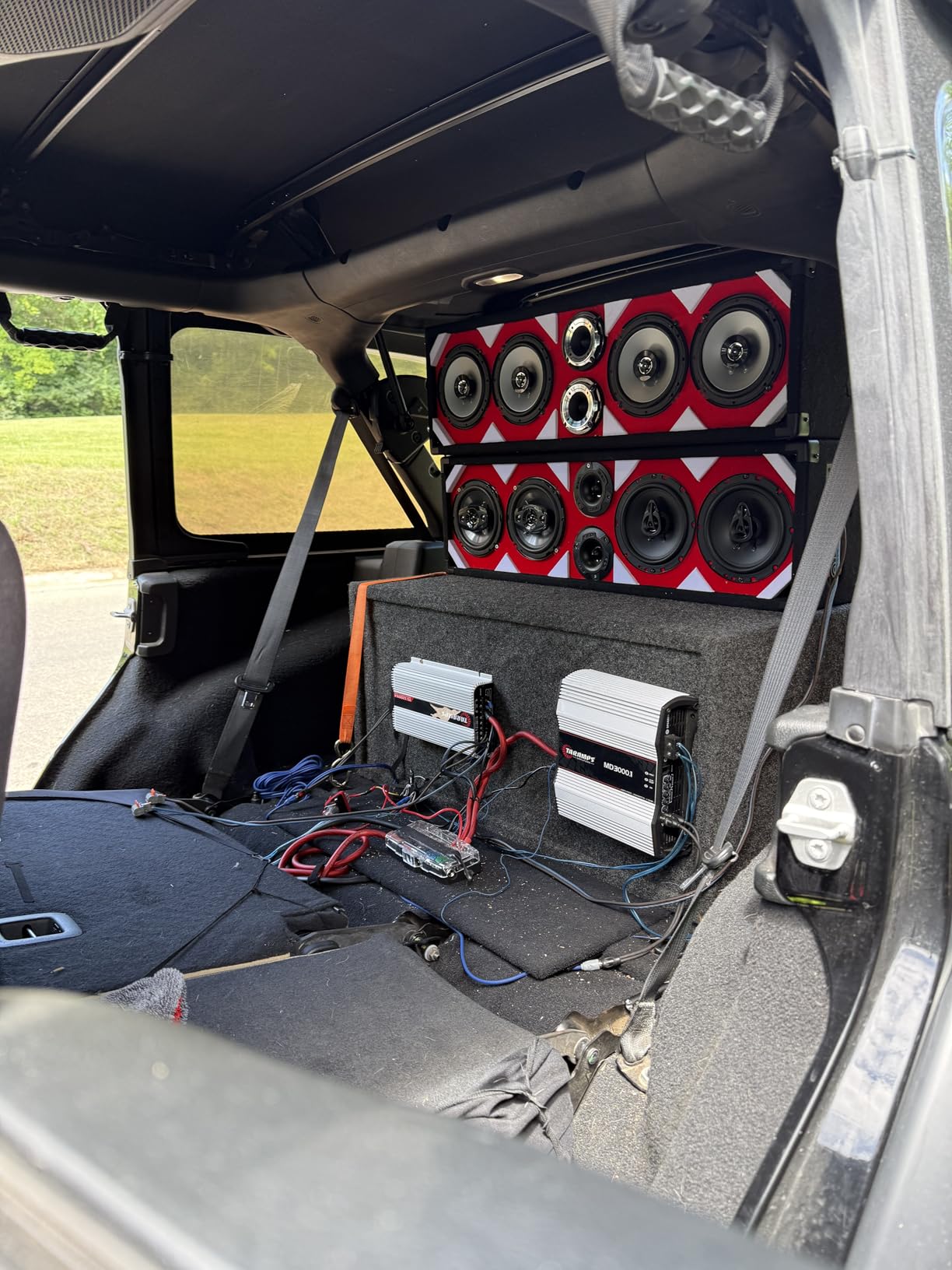
The TS 1200X4 exists for a specific situation: door speakers and a subwoofer, driven from one box, without a second amplifier. It puts out 4 x 300W RMS at 2 ohms or 2 x 600W RMS bridged at 4 ohms, which is enough power to run a pair of door speakers on two channels and bridge the other pair into a subwoofer.
It has high-level speaker inputs with automatic turn-on, so a factory radio can drive it directly, plus RCA and high-level modes with HPF, LPF and full settings on the panel. The reinforced terminals are a genuine advantage here, because an amp drawing this much current through cheap spring terminals generates heat at the connection, and heat at a terminal is how a channel dies.
Now the warning. Twelve percent of its 704 reviews are one star, the highest failure share of any product in this guide, and the pattern is units arriving with defects rather than amps that failed after years of service. If you buy this, test every channel on a bench with a multimeter before you install it, and keep the packaging until it is confirmed working.
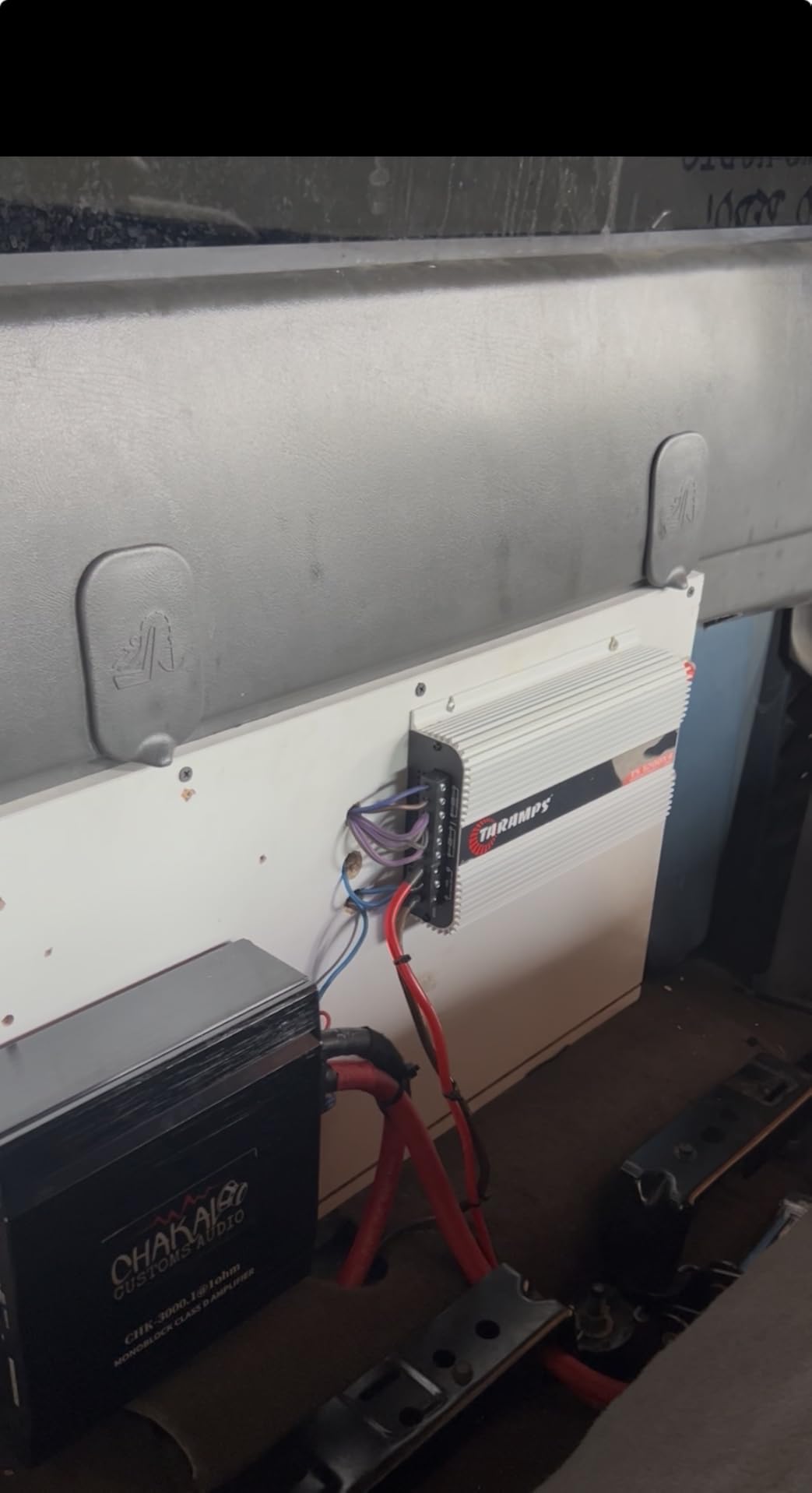
Weight is listed at 1340 g, so this is not the amp to choose for an under-seat install in a small car. It suits a trunk floor, a rear seat box, or a truck bed area where the volume is available and the current handling has to be real. The 1-year manufacturer warranty is the category norm.
When the 1200 watts of headline power is real
It is real, and it is the 2-ohm figure. Three hundred watts RMS per channel at 2 ohms is a genuine continuous figure, and 600W bridged is a genuine continuous figure too. This is the opposite of the peak-watt inflation you see on cheaper listings, and it is why the amp is worth considering at all for a system that mixes full-range speakers with a subwoofer.
Pair it with 2-ohm door speakers and you can run one per channel with headroom to spare. Pair it with 4-ohm speakers and the output per channel drops, but a 4-channel of this class still has far more clean power than most door speakers can absorb. If you also want deep bass, the two high-current channels bridged will drive a small subwoofer without a monoblock.
When to pick something else
Skip it if your build is door speakers only. There is no scenario where a 60W door coaxial benefits from 300 watts of potential, and you would be paying for amplifier you cannot use. In that case a 60W to 80W per channel four-channel is the right size, and the money you save goes into door sound deadening instead.
Skip it if you cannot test on arrival, given the 12% one-star share. And skip it if the fixed crossover points will bother you, because without a processor you have no control over where the high-pass sits. The class D efficiency keeps it running day to day, but the failure rate is the deciding factor for anyone who wants a single amp to last a decade.
10. PRV Audio QS400.4 – Best Compact Amp for Tight Install Spaces
- TRUE RMS certified ratings at an entry price point
- One of the most compact chassis here at 4 inch width
- High efficiency limits the strain on the vehicle
- 2-ohm stable per channel allows flexible wiring
- Limited onboard filtering and tone control
- Not bridgeable below 4 ohms per channel
- Lower output per channel than higher priced options
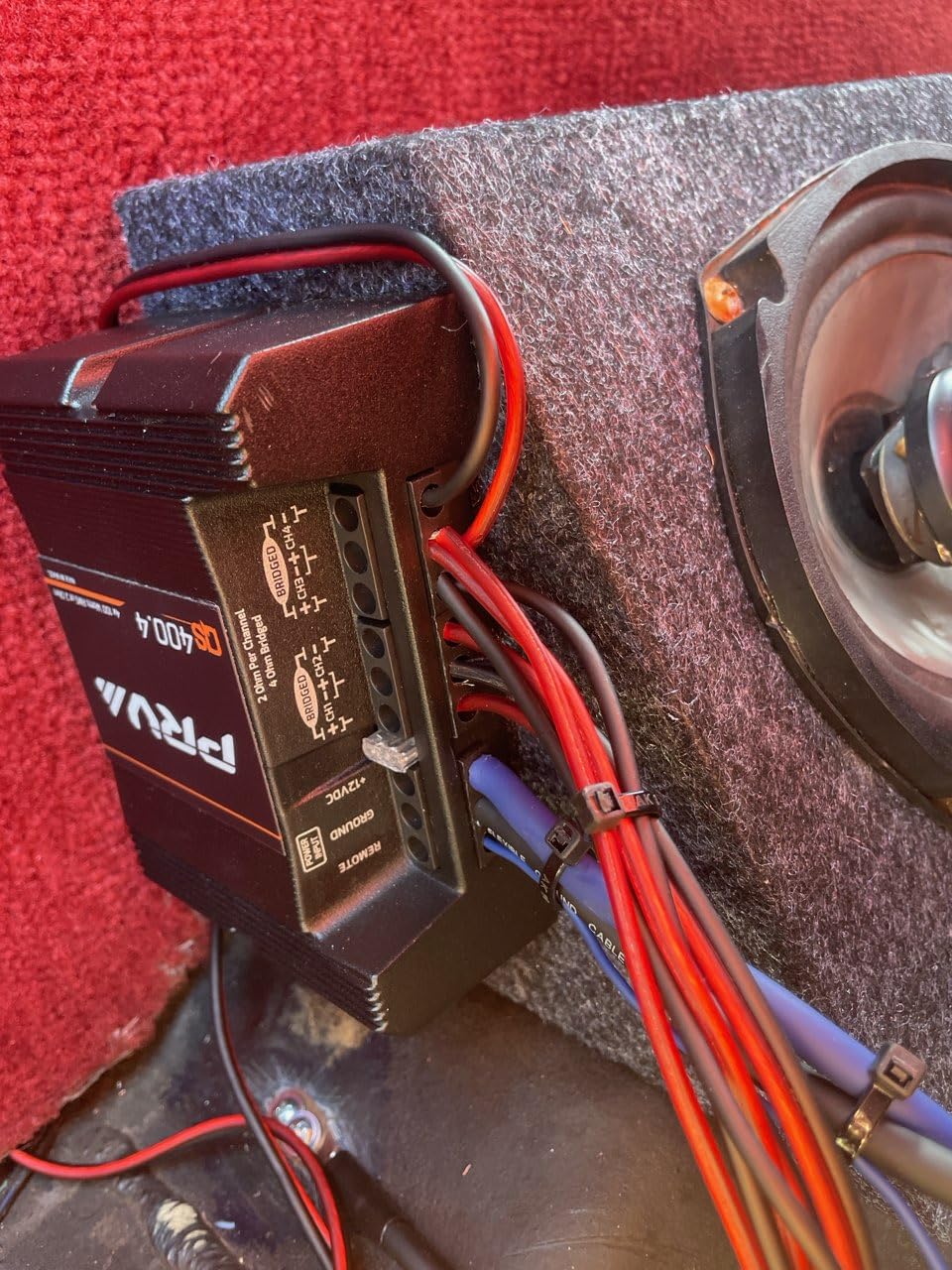
The QS400.4 solves a physical problem. At 4 inches wide by 5.40 inches long by 2 inches high, it is among the most compact chassis in this guide, which makes it the amplifier you can actually install in the places where a full-size four-channel will not go, such as behind a rear seat panel, under a parcel shelf, or inside a door-adjacent trim cavity.
The ratings are certified rather than claimed, at 4 x 100 watts TRUE RMS full-range output using digital Class D design. It is 2-ohm stable per channel, which is useful flexibility: you can wire a pair of 2-ohm door speakers to a single channel, or run one speaker per channel across four channels. Bridged output is 2 x 200 watts RMS at 4 ohms.
Efficiency is the design priority. High efficiency means the amplifier maximises what the vehicle’s electrical system can deliver, which in practice means less current draw, less heat, and fewer brownouts on an engine that is already struggling. Operating range is 9V to 12V DC, which is a narrower window than the Taramps models and worth noting if your vehicle has a charging problem.
Reviewers accept that this is a stripped-down amplifier. With limited onboard filtering and tone control, it is a clean power source rather than a tuning platform, and 72% five star out of 204 reviews reflects an honest bargain. The aluminium chassis is a plus for heat dissipation given the small footprint.
When the smallest footprint wins
Choose it when the mounting space genuinely does not exist for anything larger. Small hatchbacks, vehicles with a factory amp taking up the usual location, motorcycles and side-by-sides, and boats all benefit from a four-channel that is 4 inches wide. The high efficiency makes it a natural fit for a vehicle with a modest electrical system.
For door speakers specifically, match it to 45W to 60W RMS sets. One hundred watts per channel at 2 ohms gives plenty of headroom for those speakers, and the 2-ohm stability opens up wiring options that a 4-ohm-only amplifier does not offer.
When its minimalism becomes the problem
Skip it if you want to shape the sound from the amp. With limited filtering, you are relying on the crossovers in your component speakers or on a DSP to do the work, and there is no variable high-pass to protect the doors from a factory subwoofer. That is a real limitation for anyone who cares about getting the front stage right.
Skip it if you plan to bridge below 4 ohms per channel, which it does not support. And skip it if low per-channel output matters more than size, because at this price point you can get 60W to 80W per channel in a larger chassis if the space allows. It is the right amp for a space-constrained build, not for a space-constrained excuse to underpower good speakers.
How to Choose the Right Amp for Door Speakers?
RMS power beats peak watts, every time
RMS power is the number of watts an amplifier can deliver continuously without distorting. Peak power is the maximum a marketing department can quote, usually measured in a burst of a few milliseconds. Your door speakers are exposed to RMS power for hours at a time, so only the RMS figure tells you whether they will be over-driven.
Peak inflation on car amplifiers is severe. A four-channel listed as 1000 watts max in this guide delivers 60 watts RMS per channel. Another lists 1040 watts and delivers 80 watts RMS per channel.
Neither brand is lying, and neither is lying about the amp being weak, but a buyer who compares the 1000 watt figure to a 60W RMS speaker rating will draw the wrong conclusion. They will either buy something silly or refuse a good amplifier.
Also check the voltage the figure was measured at. Most modern amps are quoted at 14.4V, which is a fully charged engine. A figure quoted at 12V is roughly a fifth lower. The Alpine S-A32F states 14.4V explicitly, which is the honest way to do it.
How many watts your door speakers actually need
Match the amplifier to the RMS rating printed on the back of the speaker, and if you can, buy a little more than that. Speakers rated 25W to 30W are factory-replacement coaxials and are happy with 30W to 40W per channel, while speakers rated 45W to 50W are the mid-range coaxials and want 50W to 60W.
Component sets rated 60W want 75W to 100W per channel to control the tweeter properly at speed.
The 50W to 100W RMS per channel band is the answer to the question people ask most often on this topic, and it covers the overwhelming majority of aftermarket door speakers. Below 50W per channel, you are wasting the amplifier. Well above 100W, you are paying for capability your speakers cannot use, and you are more likely to set the gain wrong and blow a tweeter.
Two extra details matter. Sensitivity, measured in dB, tells you how loud a speaker gets from one watt, and a 3dB difference is roughly double the perceived volume, so a pair of 88dB speakers will play noticeably louder than 85dB speakers on the same amplifier. And impedance, which we cover next, determines how hard the amplifier works.
2-channel vs 4-channel for door speakers
You need a 4-channel if you are powering four door speakers. A car with front and rear doors has four speaker locations, and a four-channel amplifier covers all of them from one box with one set of power wiring, one ground, and one set of RCA cables.
Choose a 2-channel only if you are running a front-stage-only build with component door speakers and no rear fill, or if you are pairing a compact 2-channel for the front doors with a separate small amplifier for the rears. That arrangement gives each pair its own gain and filter control, which is nice, but it costs a second box and a second wiring run.
Choose a 4-channel with bridgeable channels if you want to add a subwoofer later. Two channels drive the rear doors and the remaining pair bridges into a subwoofer, which is the standard one-amp full-system layout. Not every four-channel in this guide bridges at the same impedance, so check the bridged figure and the minimum bridged load before you plan the subwoofer.
Class D vs Class A/B: what actually changes
Class D amplifiers switch their output transistors at a high frequency, which makes them far more efficient than Class A/B designs. Efficiency means less heat, less current draw, and a smaller or lighter chassis for the same output, and it is the entire reason the compact amps in this guide can exist in a 4 inch wide footprint.
Class A/B designs run their transistors in a linear mode, which produces lower crossover distortion and a warmer, more natural sound. They also produce considerably more heat at the same output, which is why the two Pioneer models here weigh close to 5 pounds and why their most common complaint is thermal cut-outs when the gain is set too high.
The honest answer for door speakers is that a good Class D amp will satisfy almost everyone. If you are listening critically at low volume on a quiet road, the lower noise floor of a Class A/B design is an advantage. If you are building a system in a small car or a hot climate, Class D is the better engineering choice.
Impedance and ohm loads in plain English
Impedance is measured in ohms and describes how hard a speaker is to drive. Most aftermarket door speakers are 4 ohm, some premium ones are 2 ohm, and a handful of popular models such as the JBL GTO series are 3 ohm. The amplifier’s specification tells you the lowest load it is stable at, and connecting a lower impedance than that is what causes protection cut-outs or damaged output stages.
Running a 4-ohm speaker on an amp that is stable at 2 ohms is safe. The word stable is the key, and it means the amplifier can carry that load without overheating. It does not mean you should. A 2-ohm stable amp driving 4-ohm speakers simply produces less output, and if you compensate by cranking the gain you invite the clipping that kills tweeters.
One trap worth naming: some cheap amps are described as 2-ohm stable but were never tested as bridged at 2 ohms. The Taramps TS 400×4, for example, bridges channel pairs but is not 1-ohm stable in that configuration, so keep the bridged load at 4 ohms. When in doubt, check the manual rather than the marketplace description.
Power wire and grounding belong in the same conversation, because voltage drop behaves like added resistance. Use a fuse within 18 inches of the battery, run an appropriately sized power wire, and ground to bare metal with the paint sanded back. Thin or long power wire is a top cause of an amp that sounds underpowered no matter how good the unit is.
Factory stereo integration: RCA vs high-level inputs
Three situations cover almost every install. If your head unit has RCA preamp outputs, use them; that is the cleanest signal and the one every amplifier here accepts. If your factory radio has no RCA outputs but you can tap the speaker-level output, use a line output converter, or use an amplifier that has high-level inputs.
High-level inputs are the shortcut. An amplifier with speaker-level inputs and an automatic turn-on circuit detects the signal on the factory speaker wires and wakes up with the head unit, so there is no remote wire to run and no converter to buy. In this guide the Taramps DS 440X4 and TS 1200X4 have high-level inputs with automatic turn-on, and the Rockford Fosgate R2-300X4 is high-level input capable.
The Taramps TS 400×4, Recoil DI550.4, CT Sounds CT-80.4D, PRV Audio QS400.4 and both Pioneer models are RCA-input designs, so a factory system needs a line output converter. That is the single most repeated blocker in the forum threads for this query, and it costs less than most people assume.
One case deserves a warning. On an OEM premium system such as Bose or JBL, the factory amplifier may be feeding door speakers through a filtered or attenuated network. Adding an external amplifier to that output can make the system worse or overload the speakers. Verify the speaker impedance and the source impedance before you amplify an OEM premium system.
Setting gain and the high-pass filter
Gain is input sensitivity, not volume. The gain control sets how much signal the amplifier needs before it reaches full output, and setting it too high is the number one cause of blown door speakers. A multimeter or an oscilloscope is the reliable method: set your source volume to about 85% of maximum, then turn the gain up until the amplifier is delivering roughly 40% of its rated RMS voltage, and back off slightly from there.
The C.L.E.A.N. clipping indicator on the Rockford Fosgate R2-300X4 automates that process and is worth paying attention to on any build where tweeter protection matters. Without a meter, use ear and caution: stop increasing gain as soon as you hear strain at the bass end.
Set the high-pass filter on door speakers to about 80 Hz, or to the manufacturer recommendation if your speaker provides one. This stops a factory subwoofer from pushing low-frequency energy through 6.5 inch door woofers that were never built for it, which is a leading cause of damaged door speakers. If your amp has no adjustable high-pass, that limitation alone is a good reason to choose a different one.
Wiring, fusing and mounting
Three things decide whether an install works. Power wire gauge has to match the amp’s current draw, the inline fuse has to sit within 18 inches of the battery to protect the car in a crash, and the ground has to be bare metal with the paint removed. Get those right and even a modest amp performs to its rating. Get them wrong and no amplifier in this list will sound as good as it should.
Mount the amplifier somewhere with airflow. Class D amps tolerate heat well, but thermal protection still exists, and thermal shutdown in a parked car in summer is a real failure mode. Away from direct sun, with the chassis not pressed against carpet, is enough for every model here. Under-seat mounting is viable for the Taramps TS 400×4 and the PRV Audio QS400.4 because both are small and light.
If you are weighing a professional install against doing it yourself, the realistic DIY requirements are a multimeter, a wire stripper, a ring terminal crimper and drilled grommets for cable pass-throughs, plus enough patience to route the power cable cleanly. The risk is not the amp, it is the fuse location and the ground point, both of which are safety-critical.
What an amplifier cannot fix
An amplifier makes door speakers louder and cleaner. It does not fix a door that resonates, a tweeter mounted six inches from the listener’s ear, or a factory system with no time alignment. If your front stage sounds harsh, the cause is usually installation and placement rather than amplifier power.
Door sound deadening is the cheapest upgrade nobody buys, and it does more for perceived quality than any amplifier on this page. A car door is a thin metal panel with a hole cut in it, and damping that panel removes the low-frequency rattle that makes a system sound cheap at highway volume. Do that before you spend on a bigger amp.
Tweeter placement is the other one. Component tweeters should be aimed at the listening position, ideally mounted in the sail panels or the rearview mirror rather than the door card. An amplifier cannot fix a tweeter firing at your chest from eight inches away, and no amount of wattage compensates for it.
Frequently Asked Questions
What kind of amp do I need for car door speakers?
A 4-channel amplifier rated 50W to 100W RMS per channel at 4 ohms is the right match for aftermarket door speakers. Match the per-channel figure to the RMS rating printed on the back of the speaker, not to the peak watt figure on the box.
Do I need a 4 channel amp for door speakers?
If you are powering front and rear door speakers, yes. A 4-channel amplifier covers all four speakers from one box with one power run, one ground and one set of RCA cables. Choose a 2-channel only for a front-stage-only build with component speakers and no rear fill, or when you want separate gain control for each pair.
Does an amp make door speakers sound better?
Yes, and not only louder. A factory head unit runs out of clean power at roughly two-thirds volume and distorts beyond that. A matched amplifier keeps the midrange clear at speed and adds high-pass filter and gain controls the factory radio does not have. An amplifier will not fix a resonating door panel or a badly placed tweeter.
Is it safe to wire 4 ohm speakers to a 2 ohm amp?
Yes, as long as the amplifier is rated 2-ohm stable. Stable means the amp can carry that load without overheating. The reverse is the risk: wiring 2-ohm speakers to an amp that is only stable at 4 ohms can trigger protection cut-outs or damage the output stage.
Can I drive 4 ohm speakers with an 8 ohm amp?
Yes, with less output. An amp rated at 8 ohms will run 4-ohm speakers safely but will deliver noticeably less power, and the efficiency loss translates into extra heat. Most quality car amplifiers are rated at 4 ohms or better, so this situation is rare outside very small budget units.
What is the 83% rule for speakers?
It is informal installer shorthand for running an amplifier at roughly 83% of its rated power as a practical target, which leaves headroom so the amp is not constantly clipping. Underpowering matters because a struggling amplifier distorts at low volume and the distortion is what damages tweeters, not the lack of power itself.
What are the best 4-channel amps for front door speakers with no RCA outputs?
Look for an amplifier with high-level speaker inputs and automatic turn-on, which detects the signal on the factory speaker wires and powers up with the head unit. In this guide the Taramps DS 440X4 and TS 1200X4 do this, and the Rockford Fosgate R2-300X4 is high-level input capable. Otherwise you need a line output converter.
The Bottom Line
For most people, the best car amplifiers for door speakers come down to three numbers: 4 channels, 50W to 100W RMS per channel at 4 ohms, and a 4-ohm stable output section. Everything else on a shopping page is secondary to those three, and the peak wattage in the product title is the least useful number printed anywhere on the box.
Our Editor’s Choice, the Taramps TS 400×4, wins on review volume and on the best power-to-size ratio we found, and it is the safest default when you do not yet know what your speakers will be. If you are keeping a factory radio, the Taramps DS 440X4 removes the line output converter from the parts list. If you want genuine tuning control rather than fixed filters, the Recoil DI550.4 is the one to beat on features per pound.
Before you order, measure the space, check whether your head unit has RCA outputs, and damp the doors. Those three steps take an afternoon and they decide whether the amplifier you choose actually performs the way the reviews say it does.