
If your succulents have gone pale and stretched, light is almost certainly the reason. A succulent grow light is a full-spectrum white LED or T5 fluorescent fixture that delivers 5000K-6500K color temperature and roughly 2000 lumens per square foot, the minimum intensity that keeps rosettes compact and colorful indoors.
That sentence is the whole buying decision. Form factor, timers, dimmers and mounting hardware are details you can work around. Intensity and color temperature are the two things you cannot, and they are exactly what most listings bury under marketing language.
We compared 10 grow lights across clip-on goosenecks, T5 strips, ultra-thin panels, a screw-in bulb and a floor-standing unit. Clip lamps win for desks and dorm rooms, T5 strips win for shelves, and no light at all fixes an under-lit windowless collection.
Table of Contents
The Short Answer: What a Succulent Grow Light Actually Needs
Succulents want bright, cool, continuous light during the day and a real dark period at night. Three numbers decide whether a fixture works.
Spectrum — full-spectrum white between 5000K and 6500K. White light carries red and blue, and the blue end suppresses the cell-elongation response behind stretching. That is why red-and-blue-only blurple fixtures look dramatic and still produce leggy plants.
Distance — 6 to 12 inches above the canopy. Intensity falls off with the square of distance, so a lamp that is bright enough at 6 inches delivers roughly a quarter of that at 12 inches.
Duration — 10 to 16 hours a day on a repeating timer, with a genuine dark period afterward. Running a weak light 24 hours produces stretching as reliably as running no light at all.
For broader indoor-plant setups, our picks for the best grow lights for indoor plants and grow lights for apartments cover more foliage-heavy situations. This guide stays narrow on purpose: succulents fail from too little light far more often than too much.
Top 3 Grow Light Picks for Succulents in 2026

Briignite A19 Grow Bulb
- E26 standard base
- 1000 lumens at 11W
- Sold as a 2-pack
- No timer or dimmer

Barrina T5 1ft 4-Pack
- 5000K white full spectrum
- Linkable design
- Individually switchable
- No built-in timer
All 10 Grow Lights Compared Side by Side in 2026
Form factor matters more than brand. A strip covering a two-foot shelf and a clip lighting one pot solve different problems, and comparing them on wattage alone tells you nothing.
| Product | Specifications | Action |
|---|---|---|
| GooingTop 6000K Clip-On |
|
Check Latest Price |
| Briignite A19 Grow Bulb |
|
Check Latest Price |
 LEOTER 80 LED Clip-On LEOTER 80 LED Clip-On |
|
Check Latest Price |
 Yadoker Floor Grow Light Yadoker Floor Grow Light |
|
Check Latest Price |
| Barrina T5 1ft 4-Pack |
|
Check Latest Price |
 SANSI Pot Clip Light SANSI Pot Clip Light |
|
Check Latest Price |
 DOMMIA Ultra-Thin Panel DOMMIA Ultra-Thin Panel |
|
Check Latest Price |
 LBW Desk Panel LBW Desk Panel |
|
Check Latest Price |
 RWNTAO Mini LED Strips RWNTAO Mini LED Strips |
|
Check Latest Price |
 GYTF T5 Reflector 3-Pack GYTF T5 Reflector 3-Pack |
|
Check Latest Price |
Only two products here publish a photon measurement. SANSI states 35.78 µmol/m²/s at 6 inches and Briignite states 25 µmol/s. Every other listing advertises lumens or wattage only, so intensity at the canopy is guesswork.
Four Signs Your Succulent Is Not Getting Enough Light
Etiolation. The plant grows tall and narrow instead of a flat rosette, new growth is paler than old leaves, and the gaps between leaves visibly lengthen. Etiolated growth never re-compacts; recovery means beheading the plant to re-root the compact top or starting from an offset.
Fading. Colors that were strong green or deep purple wash out to gray-green. This hits Haworthia, Gasteria and Sansevieria especially, which can look fine in a dim spot for months and then fade rather than stretch.
Leaning. The plant or a single stem bends toward the brightest point in the room. A succulent leaning hard and never straightening is telling you the source is off to one side rather than overhead.
Wide leaf spacing on new growth. Old leaves look fine while the newest center leaves come in spaced apart. That pattern means light is present but below the intensity the species needs to hold its shape.
If two or more apply, adding hours will not help. A plant on a weak lamp for 24 hours still stretches, which is the most common misconception in the r/succulents community. The limit is intensity, not duration.
The 10 Best Grow Lights for Succulents, Reviewed
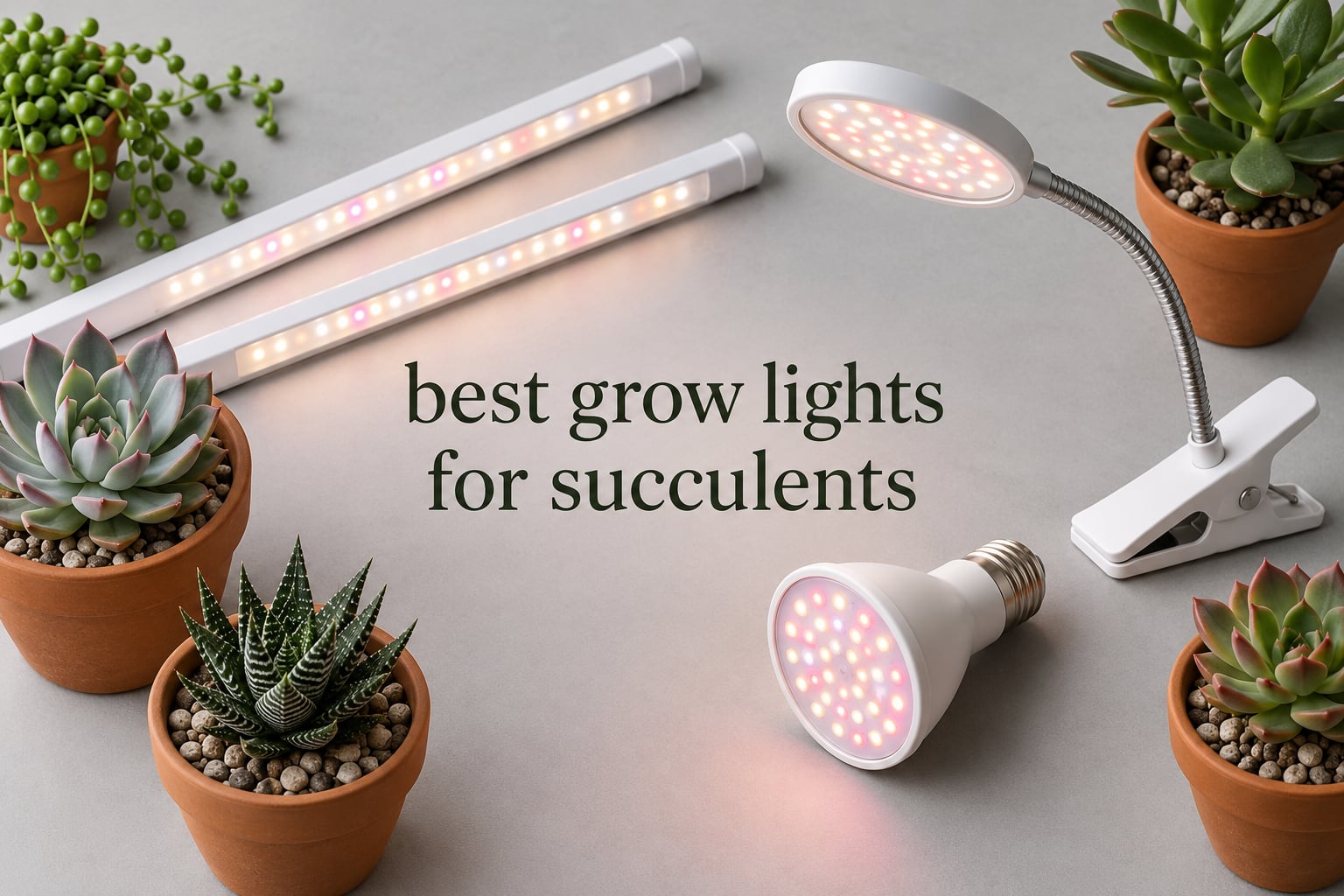
1. GooingTop 6000K Clip-On Grow Light — Best Overall for Desks and Small Collections
- Firm gooseneck holds its position
- Strong clip grips shelves and pot rims
- Bright output for its wattage
- Built-in 4/8/12 hour timer
- Color rendering index of 90 plus
- Timer runs on a fixed 24 hour cycle
- Coverage narrows when mounted very close
- LEDs can arrive without protective film
This is the lamp I keep returning to for anything that is not a full shelf. It runs 84 LEDs at 10 watts with a stated 2500-lumen maximum, and the 6000K color temperature sits in the middle of the band succulents want. The light is neutral enough that it does not tint the room purple or pink.
The gooseneck matters more than most brands admit, and this one holds a bend without creeping, so you set the height once and it stays. The clip grips a shelf edge, table lip or pot rim, and it draws power over USB or the included AC plug.
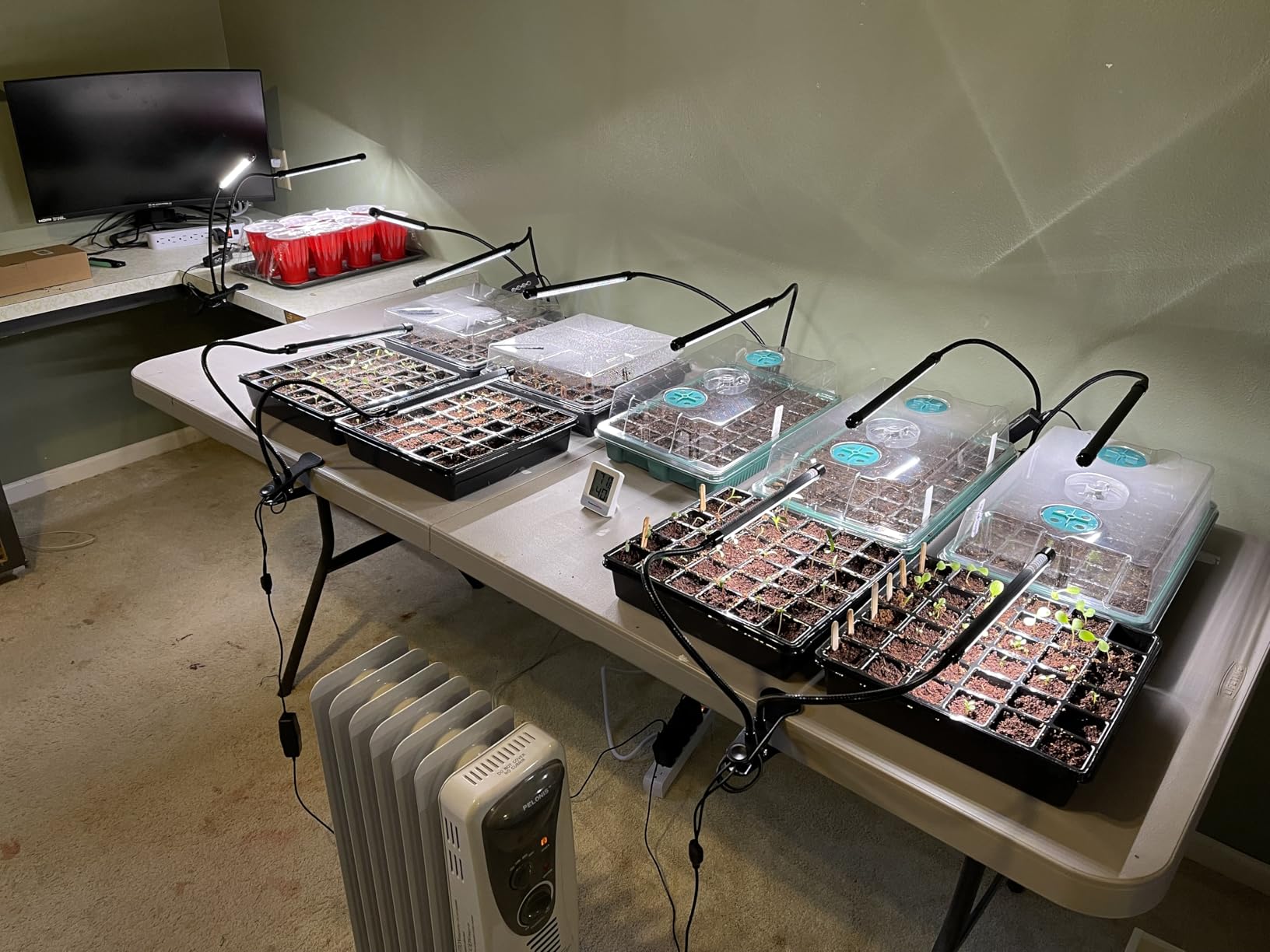
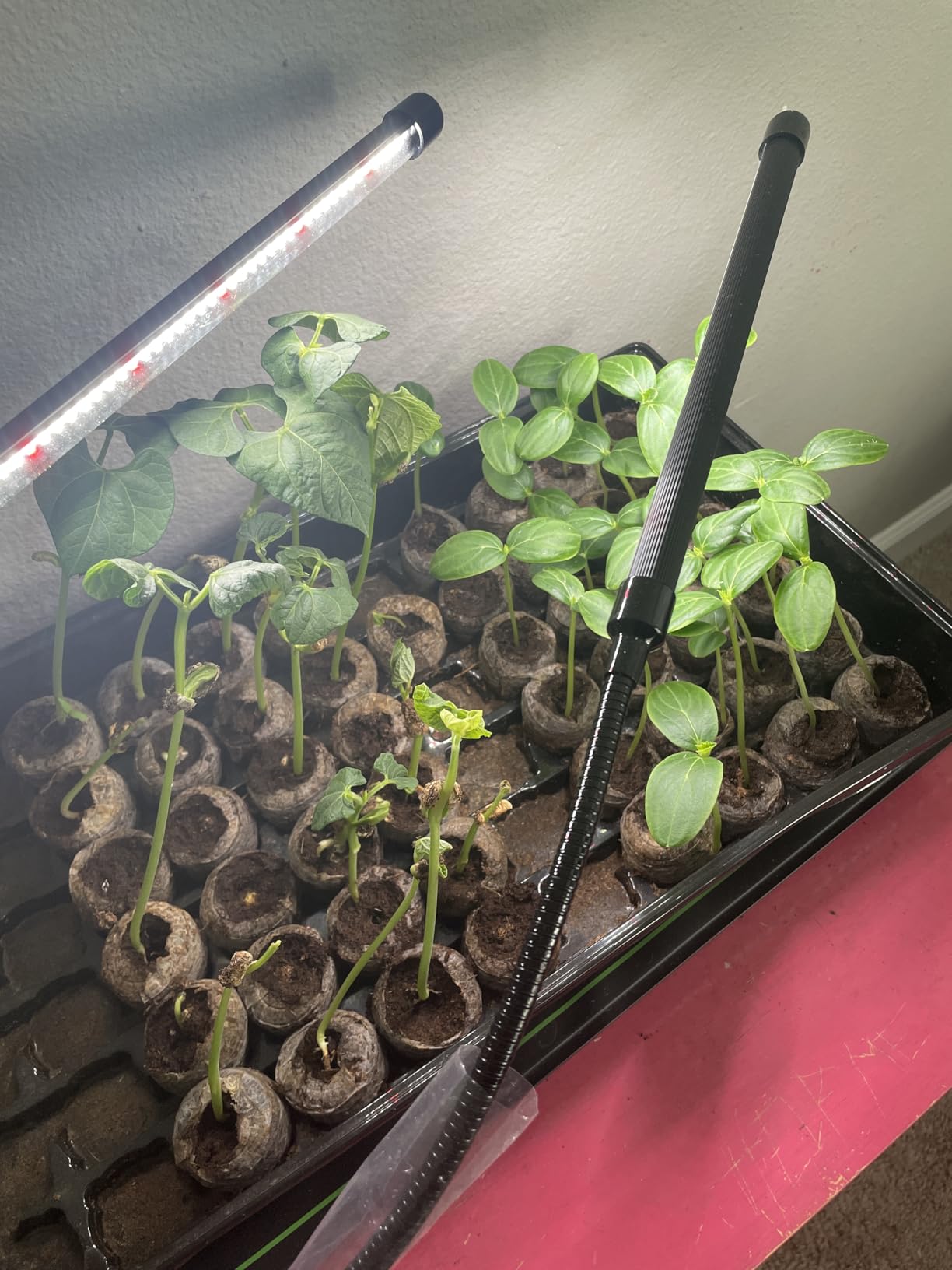
Owners consistently name the clamp and gooseneck as the reasons it holds up, and the brightness is regularly called strong for the wattage. Give it 8 to 12 inches rather than pressing the head down toward the soil, since coverage tightens noticeably at close range.
The timer needs a real explanation. Its 4, 8 and 12 hour settings run on a fixed 24-hour cycle: you choose when the light switches on and it stays on for that many hours daily. That works fine for consistency, but it cannot match a dawn-to-dusk schedule, and it tops out at 12 hours if you want 14 or 16.
What it does well
This is the right pick for a desk with one to four pots, a dorm room, or a windowsill that gets morning light and needs help through the rest of the day. At 10 watts it covers roughly a one-foot square footprint at the recommended distance, which suits a cluster of small rosettes or one larger Echeveria.
Where it falls short
It cannot light a two-tier plant stand. One clip head pointed at one shelf leaves the tier below dark, which reviewers report directly. Plan on one lamp per tier instead of one lamp for the unit, and check the LED head on arrival, since a small number arrive without the protective film and a scratched diode leaves a permanent dark spot in the pattern.
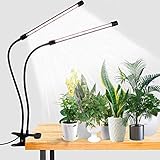
2. Briignite A19 Full Spectrum Grow Bulb — Best Drop-In for an Existing Lamp
- Drops into any standard E26 fixture
- Natural looking light instead of harsh purple
- Low 11W draw for the output
- Cheap way to add light to a lamp you own
- Fixed output with no dimming or timer built in
- Performance depends on the host fixture and socket
If you already own a desk lamp or clamp lamp with an E26 socket, this is the shortest path to adding light. Two bulbs cost about what one cheap fixture costs, and nothing has to be clipped or mounted. The A19 shape also fits sockets a grow-specific bulb would not.
Output is 1000 lumens at an 11 watt draw with a stated PPF of 25 µmol/s, the honest number on this list. The light reads as a 3500K warm white with a 4000K appearance plus red and blue content, and the 180-degree beam spreads wider than a narrow spot.
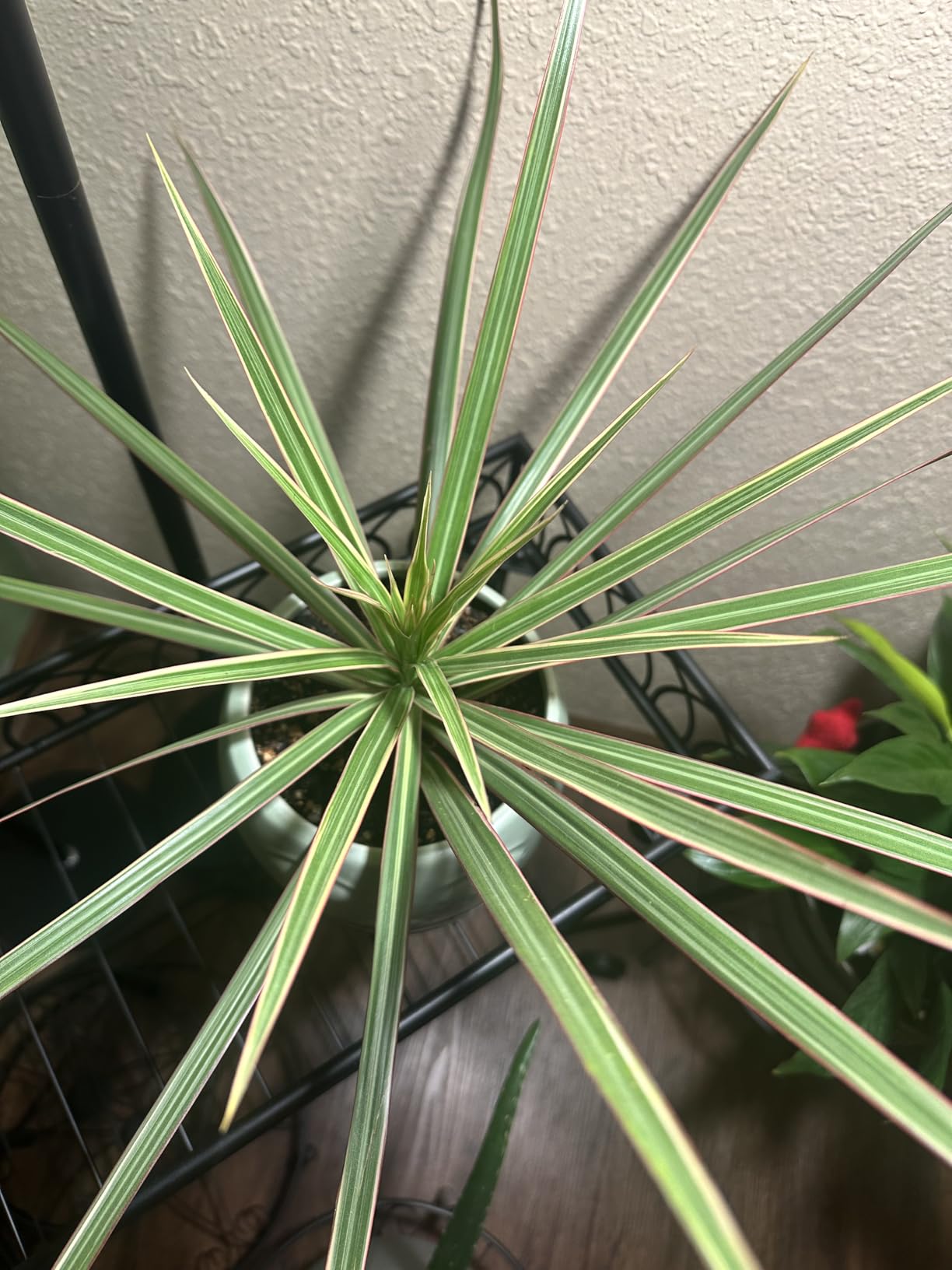
At 4.6 stars across more than 13,000 reviews, this is among the highest-rated plant growing bulbs on the platform. Praise is consistent: natural-looking light rather than the purple wash that makes a living space feel like a lab.
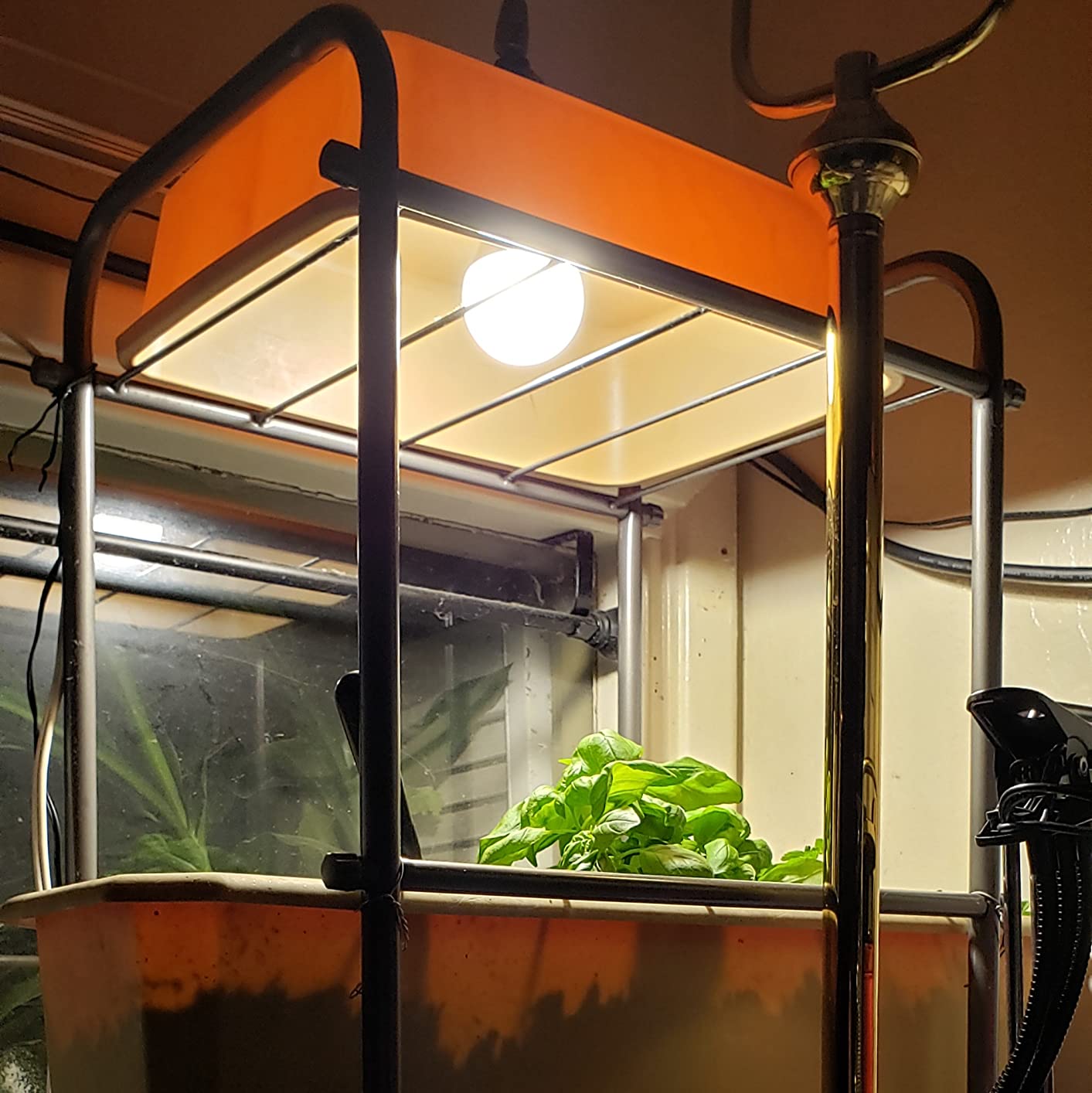
Everything is delegated to the host fixture. A bare bulb in an open socket throws light in every direction, including at your eyes, so a shade or reflector is what turns it into an effective overhead source. Position it 6 to 8 inches above the canopy.
What it does well
The two-pack format matters more than any single spec. Forum users converge on roughly 2000 lumens minimum for a single shelf footprint, so two bulbs spaced 10 to 12 inches apart is how you get there. Spacing them also evens out coverage and fixes the center-hot problem where outer plants stretch.
Where it falls short
Skip it if you need a timer or dimming, since neither is built in and the schedule depends entirely on the smart plug you pair with it. It is also wrong for large collections: at 11 watts per bulb, covering 50 plants would need a dozen of them and a far larger electrical load than a single panel. Our LED grow light picks for indoor gardening cover that higher-output end.
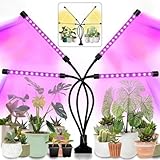
3. LEOTER 80 LED Grow Light — Best for Dimming and Spectral Control
- Ten brightness levels and three spectral modes
- Reliable 3/9/12 hour memory timer
- Flexible arms and clamp reposition easily
- Reported to keep cacti and succulents healthy through winter
- Lower brightness ceiling than higher powered fixtures
- Some gooseneck arms slowly droop
- USB power draw caps brightness
- Occasional reports of early failure
Almost every product here gives you one fixed output. This one gives you ten brightness levels and three spectral modes, which changes what a single lamp can do in a mixed collection. Echeveria and Sedum want the top of the range, while a Haworthia in the same pot group is happier at 30 to 40 percent.
The array splits 32 red, 12 blue, 20 yellow and 16 white across 80 diodes, with modes for full spectrum from 380nm to 800nm, red plus blue, or a mixed setting. The circular memory timer offers 3, 9 and 12 hour cycles and remembers your setting through a power cut.
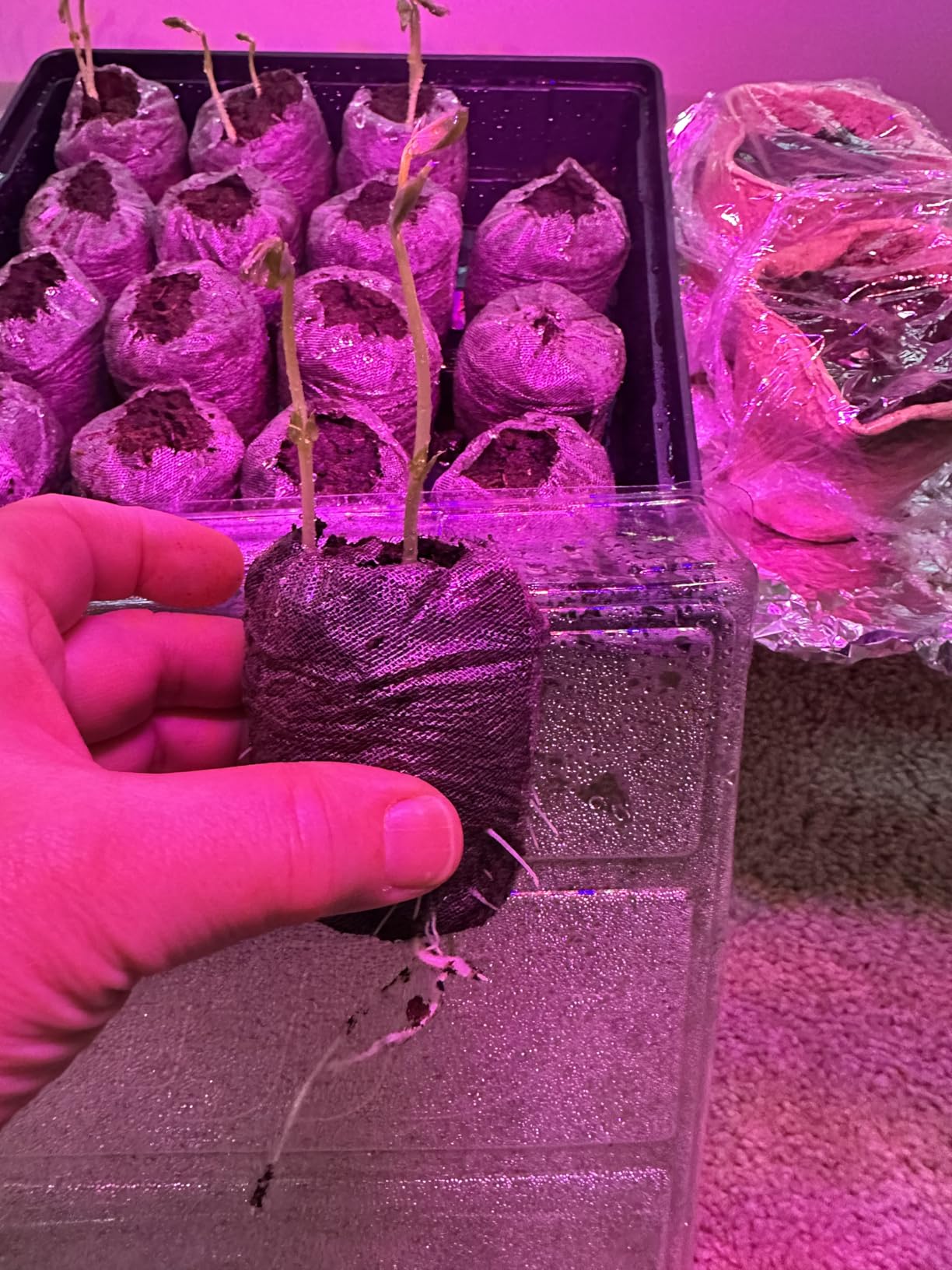
Owners frequently describe it as the light that got their cacti and succulents through a winter without losses. The flexible arms with a metal clamp make repositioning between a desk and a shelf straightforward, and at more than 12,700 reviews it is one of the most established clip-on designs in the category.
Brightness is where it falls short. The USB draw and 5V supply cap the ceiling, and reviewers running seedling setups report it is not enough for propagation trays, where light demands far exceed a succulent rosette. There are also reports of arms drooping and a smaller number failing within a couple of years.
The three modes are a mixed blessing for this hobby. Red plus blue is the blurple spectrum, which is exactly the light profile that leaves plants leggy, so a well-meaning switch to the wrong mode undoes the white-light advantage.
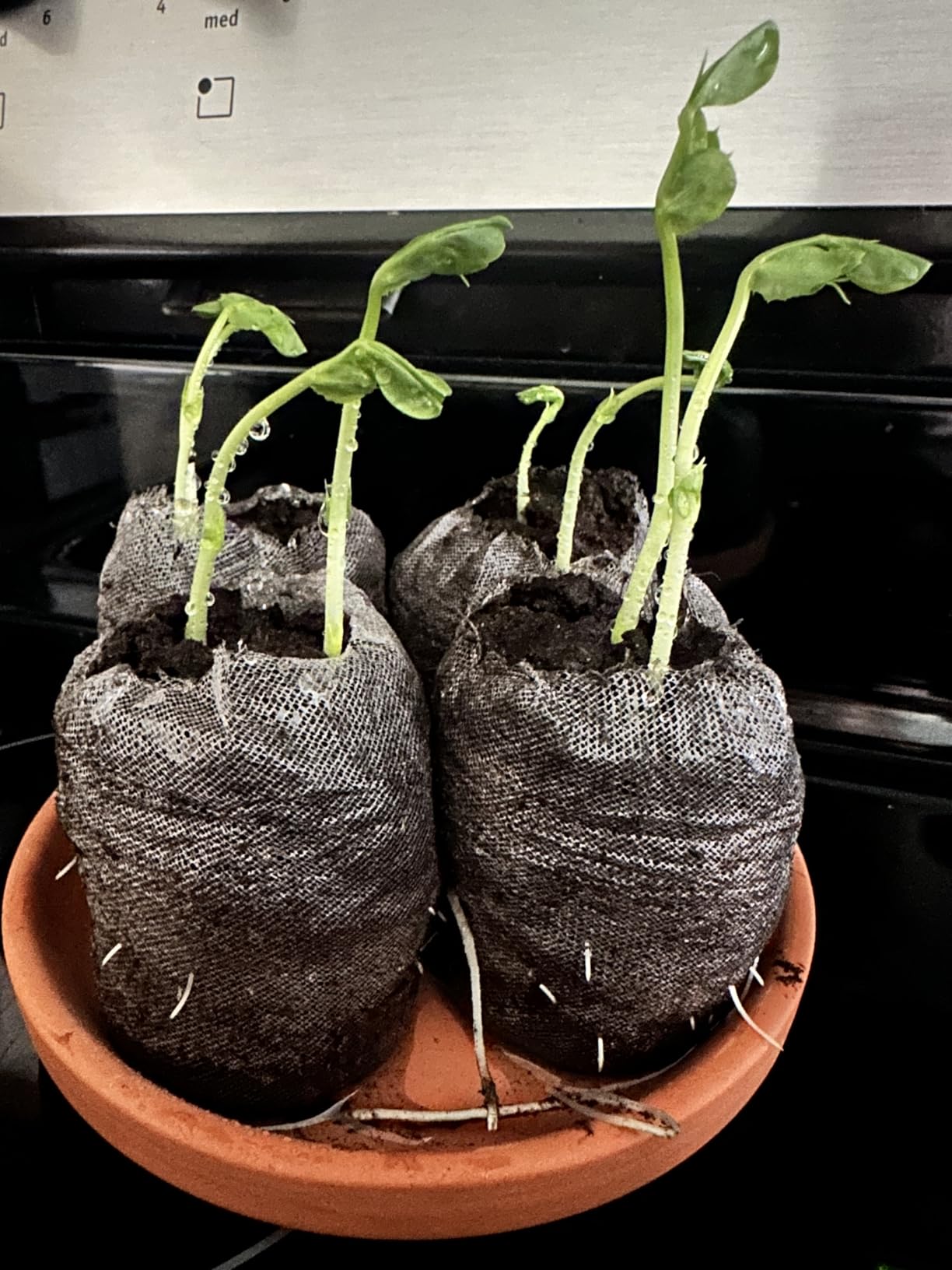
What it does well
A ten-step dimmer is not a gimmick here. It is the difference between forcing high-intensity light on shade-tolerant species and matching each genus to its band. Set Echeveria and Graptopetalum at 60 to 70 percent, drop to 30 to 40 percent for Haworthia and Sansevieria on the same shelf. It also makes acclimation safer, since you can ramp up a notch every few days instead of relying on a fixed output.
Where it falls short
Skip it for propagation or seed starting, where the brightness ceiling becomes the binding constraint, and for tall floor plants, since the clip arm positions the head at desk and shelf height only. Do not skip it over the timer, though: the 3/9/12 hour memory function is among the more reliable ones here, and a 12 hour setting matches the photoperiod most hobbyists run.
4. Yadoker Bamboo Floor Grow Light — Best for Tall Plants and Larger Floor Pots
yadoker Grow Lights for Indoor Plants, Full Spectrum 6.3″ Halo Plant Light
- Telescoping pole covers a wide range of plant heights
- Bamboo finish blends into home decor
- 13 foot cord reaches hanging and floor plants
- Ten brightness levels with an auto cycle
- Lower overall brightness than dedicated panel fixtures
- Stake-in base is designed for soil rather than shelves
- Only 8 of the 72 LEDs sit in the red end
Every other clip-on light here sits at desk height. This one telescopes from 13.7 inches to 61.1 inches, making it the only unit that can light a tall floor plant, a hanging pot or a high shelf tier. The bamboo finish is the other reason it appears: it is designed to be visible in a living room.
The array is 72 LEDs split 36 white at 5000K, 28 warm white at 3000K, 6 red and 2 blue, covering 380nm to 800nm at 10 watts. The 13 foot cord reaches a ceiling hook or a plant across the room, and the automatic timer offers 8, 12 and 16 hour cycles with 10 brightness levels.
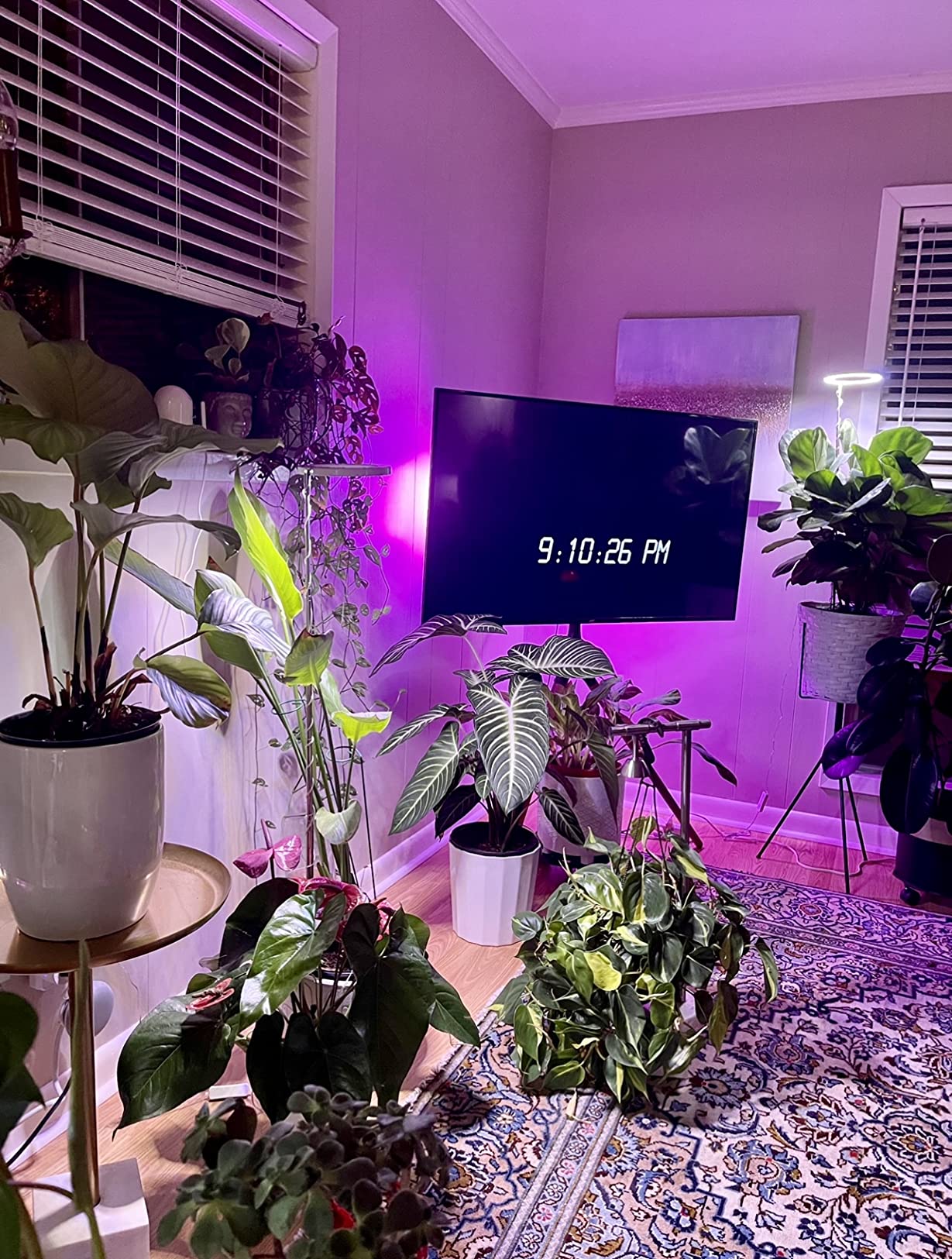
The 4.3 rating across roughly 8,950 reviews reflects a real split. Buyers like the appearance, the height range and the simple stake-in installation, and the design draws almost no complaints about looking out of place. What pulls the score down is intensity: several owners note it is dimmer than dedicated panels even at full brightness.
The diode mix explains part of that. With 2 blue and 6 red LEDs out of 72, the blue content that suppresses elongation is thin, and 3000K warm white pulls the overall color warmer than high-light succulents prefer. Mount it close and run brightness high, but do not expect the result you would get from a dedicated 5000K panel.
One practical note about installation: the stake goes into soil. On a hard floor or a rug, it needs a pot to sit in, which narrows its use compared with clamp-on designs.
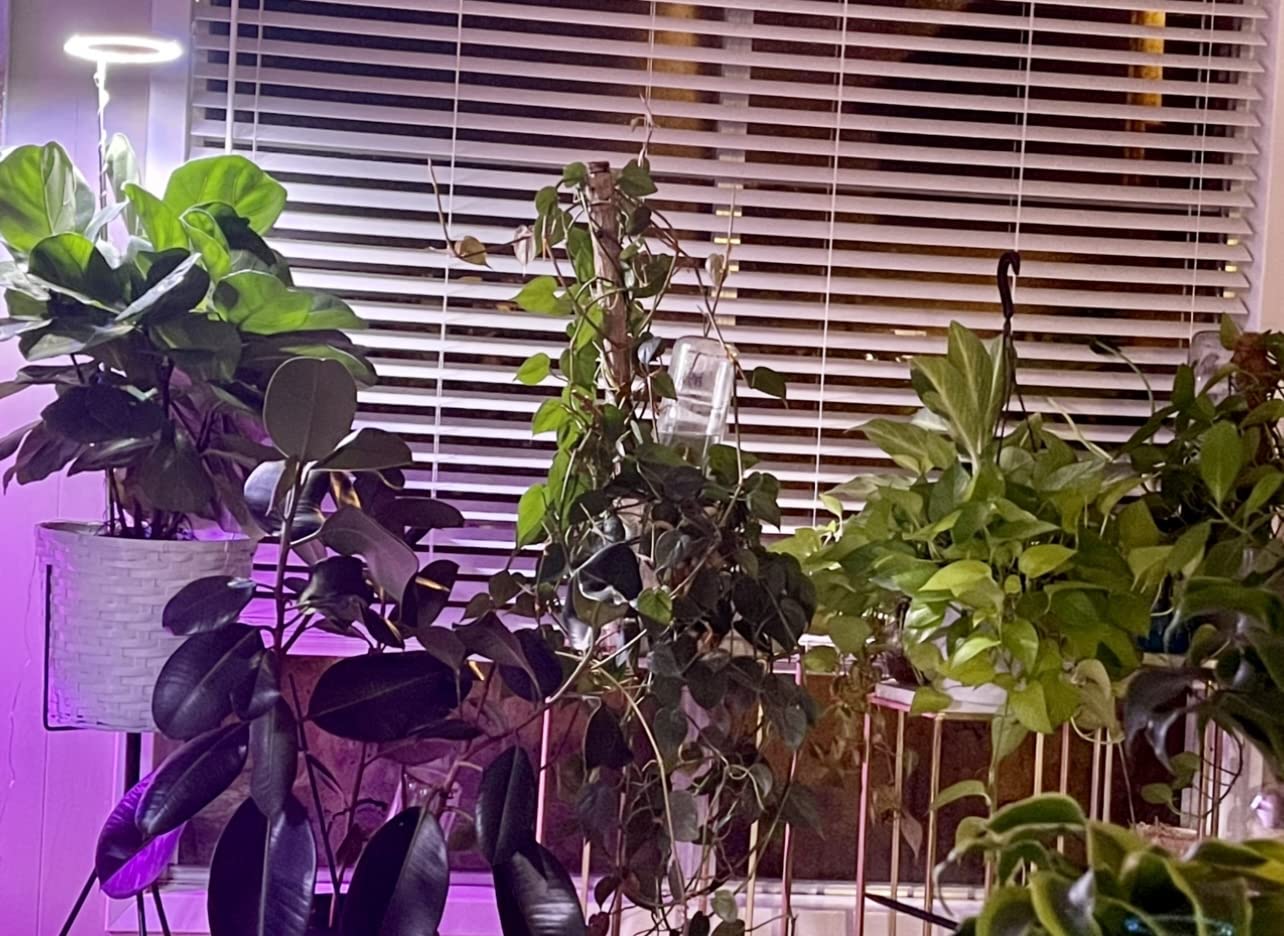
What it does well
Distance is the dominant variable in this whole category, and a pole that puts the head 6 inches above a 3-foot floor plant solves a problem no desk lamp can. Most stretching complaints trace to lamps mounted too high, and this is the one product here where that is physically avoidable on a tall plant. The footprint also spreads light across a wider group, removing the single-bulb center-hot pattern.
Where it falls short
Skip it for shelves and hanging planters with no soil to stake into, and skip it for a color-stress project. The 3000K warm white component and thin blue count work against the red and orange stress coloration growers chase with Echeveria and Graptopetalum. For a plant that lives in a living room, it is the right pick; for a plant that needs to perform, it is not.
5. Barrina T5 5000K Grow Light 1ft 4-Pack — Best for Tiered Shelves
Barrina T5 Grow Lights for Indoor Plants, 5000K Full Spectrum, 1FT, 4 Packs
- Neutral light with no pink or purple cast in the room
- Slim and light enough to fit under shelves and cabinets
- Runs cool and draws very little power
- Linkable with short connectors and long cords
- Two power cords let you split the set
- No built-in timer so an external timer or smart plug is required
- Included power cords are short
- Longer daisy-chain connector cables are not offered
This is the answer to the most repeated setup request in the succulents community: how do I light a tiered shelf. Four one-foot bars, each 5 watts, at 5000K white full spectrum. Total draw is 20 watts for the set, and r/succulents names Barrina consistently for strips and bars.
The bars measure 12.6 inches long and are light enough to tape or screw under a shelf. Each fixture has its own on/off switch plus a master switch, so you can light the tier where growth is happening and shut off the rest. They link in series up to 16 fixtures, and two power cords let you split the pack.
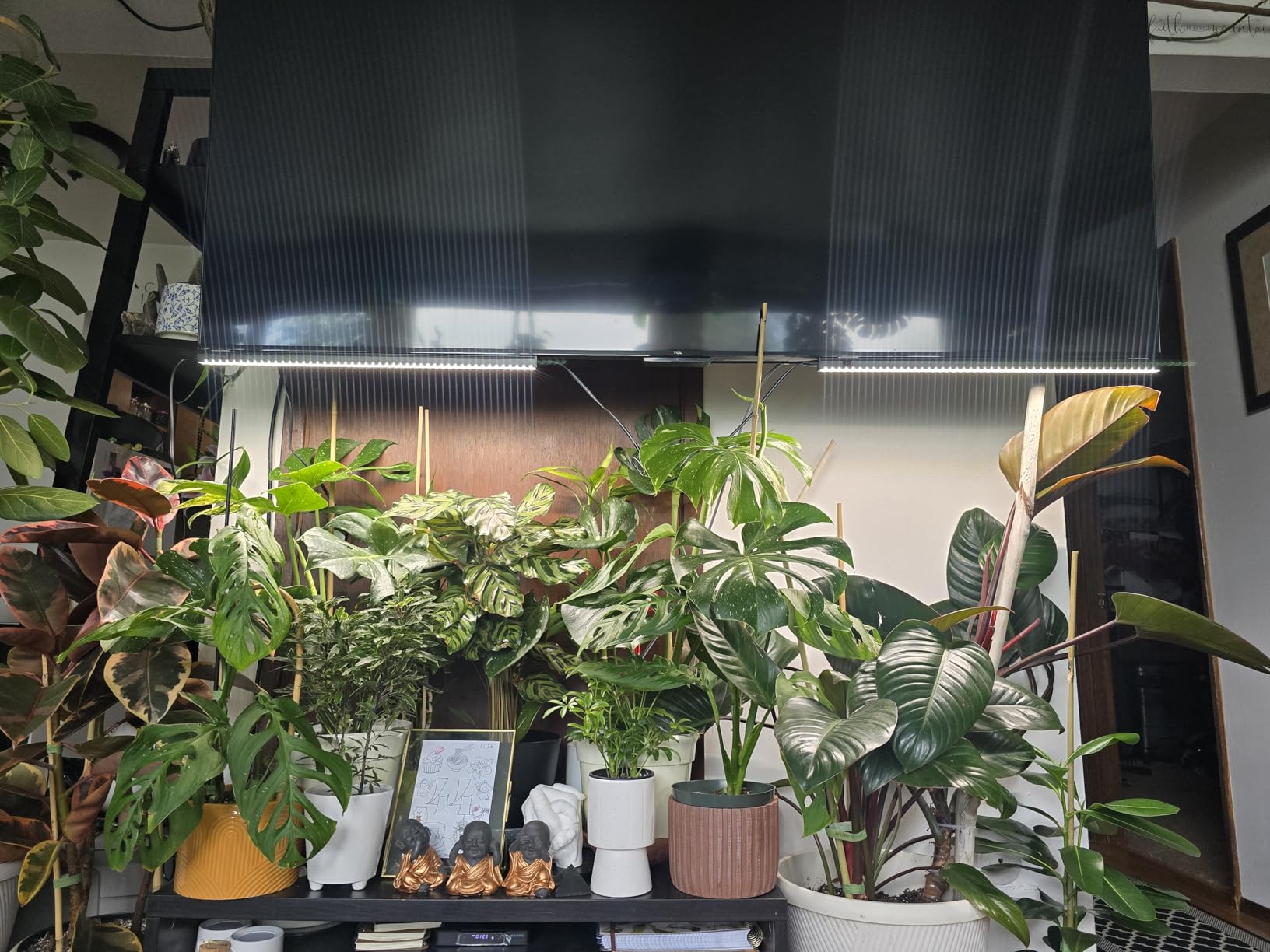
Owners praise the light quality and low heat as much as the brightness. 5000K white is the correct band for Echeveria, Sedum and Graptopetalum, and unlike a blurple fixture it does not tint the room. Running cool is the other practical advantage: a bar you can mount 6 inches from foliage does not need a large standoff to prevent scorching.
At 4.6 stars across more than 7,000 reviews, this is among the best-reviewed strips available. The most common complaint is the missing timer, which is worth planning for rather than treating as a defect. Without one, an accidental 20 hours of light a day is a real risk.
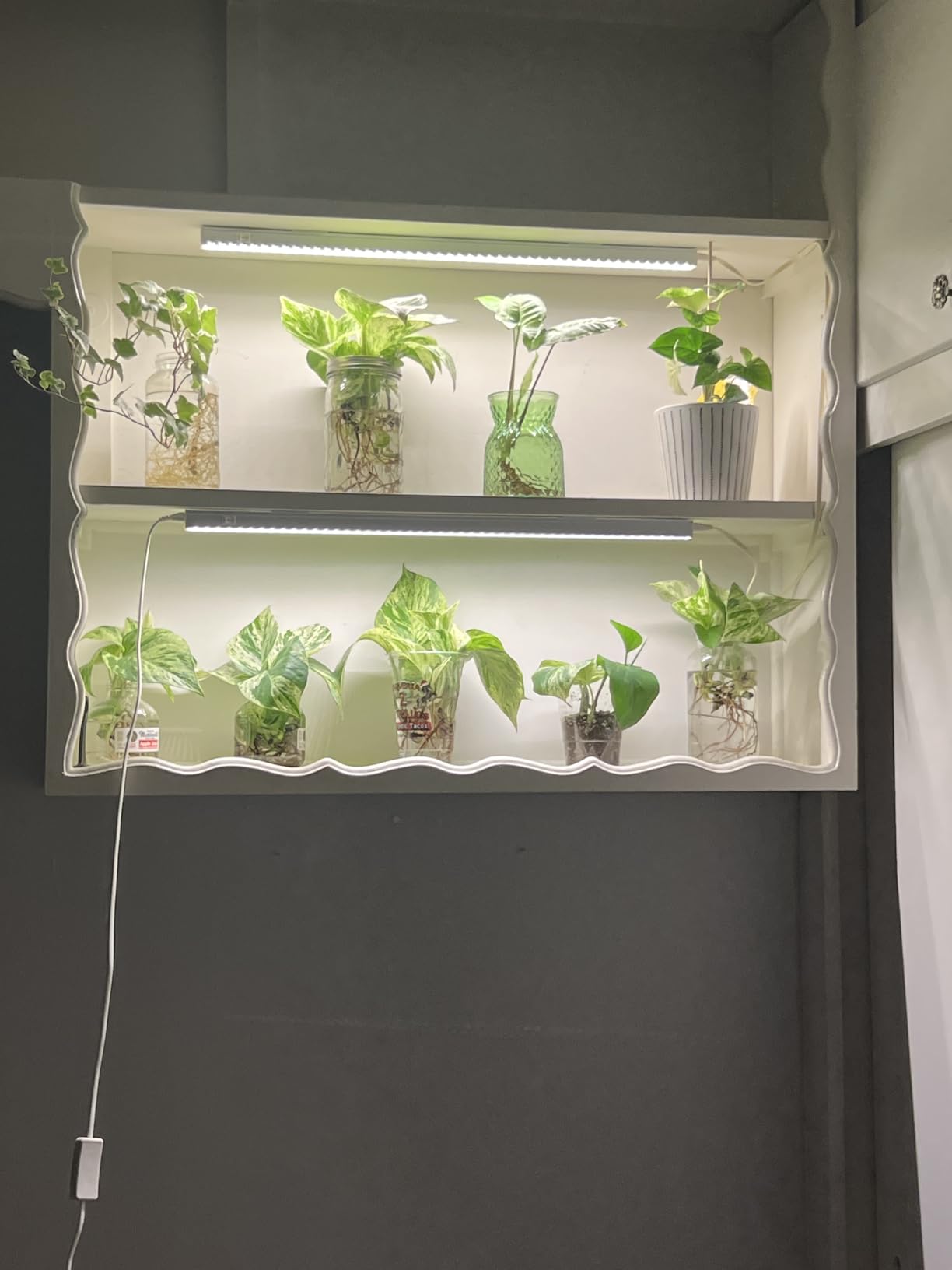
What it does well
Linking matters because it lets you build a continuous bar along a shelf instead of four point sources with dark gaps. Four unlinked bulbs over a two-foot shelf create four bright spots and three dim ones, and plants in the dim spots stretch. A linked run fills the whole length evenly, and the 12.6 inch length fits a standard shelf tier without overhang.
Where it falls short
Skip it for a single pot, and skip it for tall floor plants, since one-foot bars placed low do not reach a stand. Two practical constraints: the included power cords are short, so most installations need an extension cord or a closer outlet, and the longer daisy-chain connector cables are not offered, so build the run with the short connectors supplied.
6. SANSI Ceramic Pot Clip-On Light — Best for One Small Pot at a Time
SANSI Grow Lights for Indoor Plants, Pot Clip-On Plant Light, 1-Pack
- Clips straight to the pot with no drilling
- Ceramic body runs cooler than plastic plant lights
- Compact and unobtrusive on a desk or plant stand
- Four dimming levels plus a 3/6/12 hour timer
- Short throw length limits coverage to one small potted plant
- Indoor use only and not weather resistant
This is the only product in the roundup publishing a photon measurement, and it anchors expectations: 35.78 µmol/m²/s at 6 inches. That is meaningful single-pot intensity from a 5 watt ceramic LED running 5V DC, and a published figure is worth more than any lumen claim.
Installation is the simplest here. The gooseneck clips to the pot rim, so there is no clamp to find a surface for and no drilling. The ceramic and polycarbonate body dissipates heat better than the plastic housings used on most clip lamps, and at 5 watts it runs cool enough to sit close to foliage.
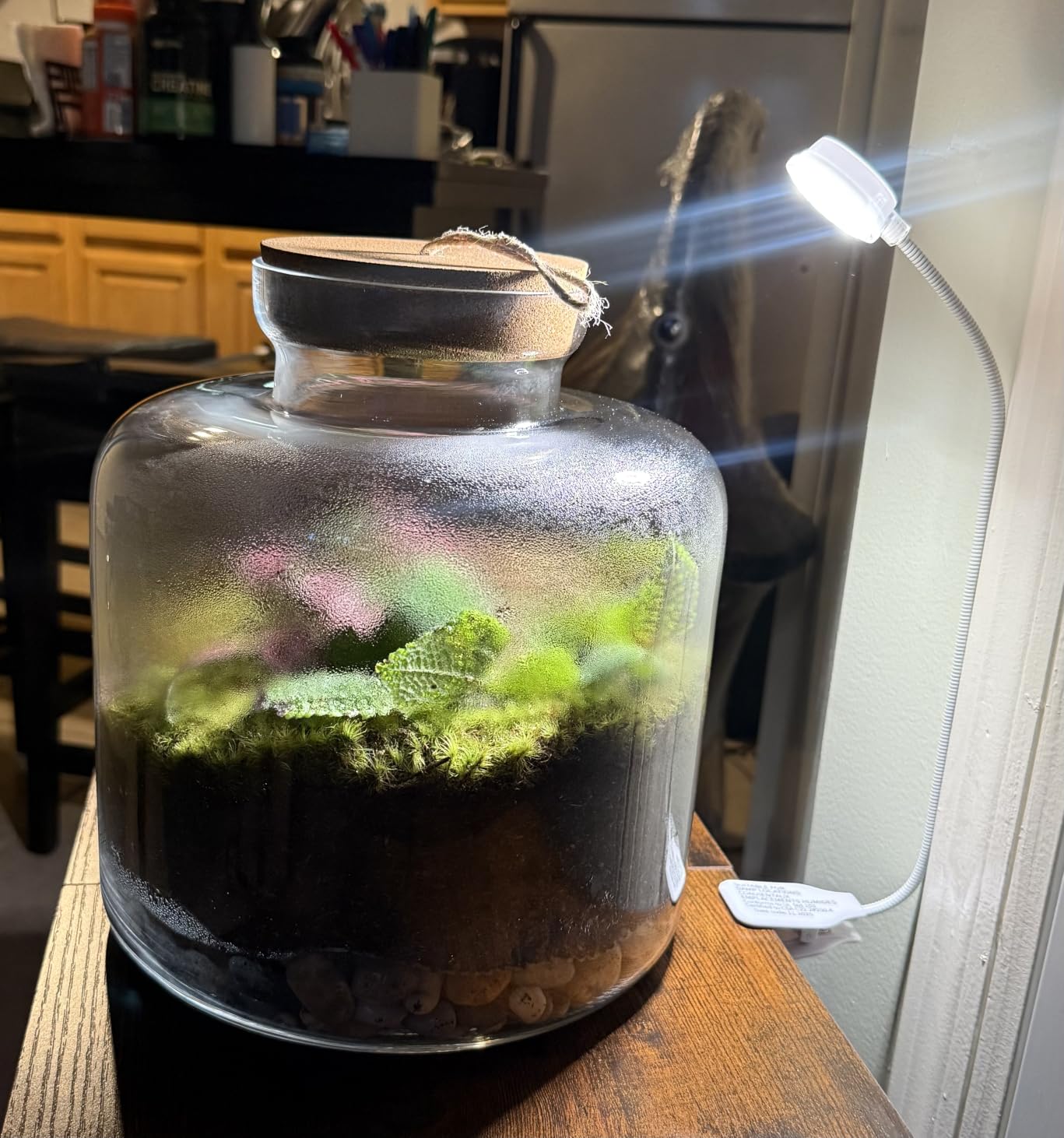
The 4000K natural spectrum sits slightly below the 5000K-6500K ideal, a fair trade for a light that is genuinely pleasant in a room. r/succulents names SANSI alongside Barrina as a brand that works, and this pot clip is the model most often recommended for succulents and aloe specifically.
Controls are better than most competitors at this output: a 3, 6 and 12 hour timer and four dimming levels from 25 to 100 percent. The ETL listing and two-year service matter too, since cheap plastic fixtures frequently offer neither.
Publishing a real number changes how the rest of the category is read. Once one fixture states 35.78 µmol/m²/s at 6 inches, you can compare a 1000-lumen bulb against it and ask whether those lumens become photons where the plant can use them.
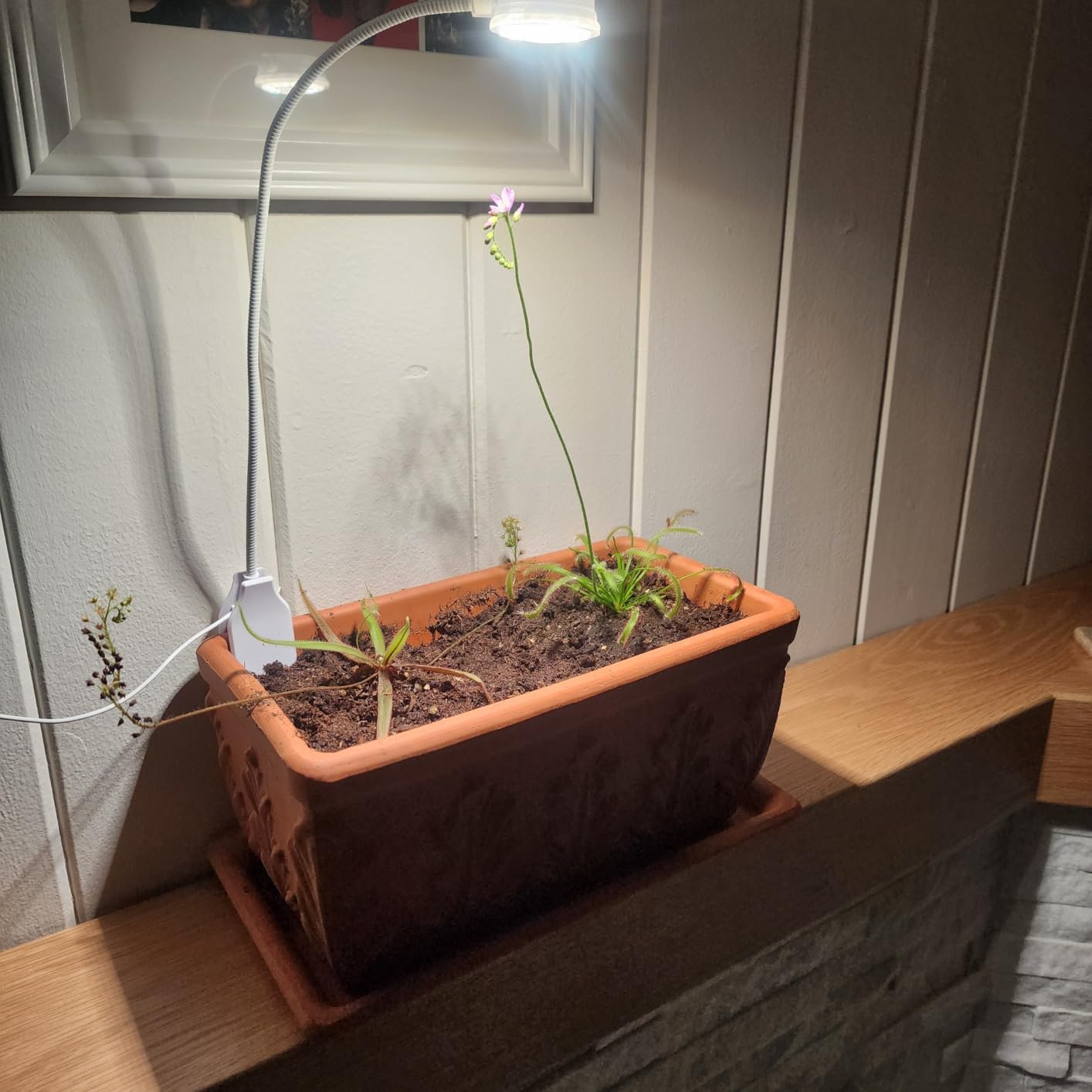
What it does well
It solves the mounting problem outright. A light that clips to the pot can go anywhere the pot goes, which no shelf-mounted fixture can match, and four dimming levels let you tune one unit between a sun-loving Echeveria and a shade-tolerant aloe without moving anything. Six inches is the working distance that makes the published figure meaningful.
Where it falls short
Skip it for anything beyond a single small pot. The short throw means the useful footprint is one plant, and multiple units across a shelf hit the same center-hot and edge-dim problem as a row of bare bulbs. It is also indoor-only and not weather resistant, so keep it away from an open window where condensation would reach it.
7. DOMMIA 20W Ultra-Thin Panel — Best for Under-Shelf and Cabinet Mounting
DOMMIA Panel Grow Light for Indoor Plants, 20W Ultra-Thin Full Spectrum
- Ultra-thin profile fits under cabinets and shelves
- Many owners report years of reliable service
- Timer built into the cord adapter
- Mounts with included ties or screws
- Manufacturer honored warranty replacements
- Brightness is not adjustable on this model
- Timer adapter has failed for some buyers
- Included power cord is short
- Adhesive pads hold poorly
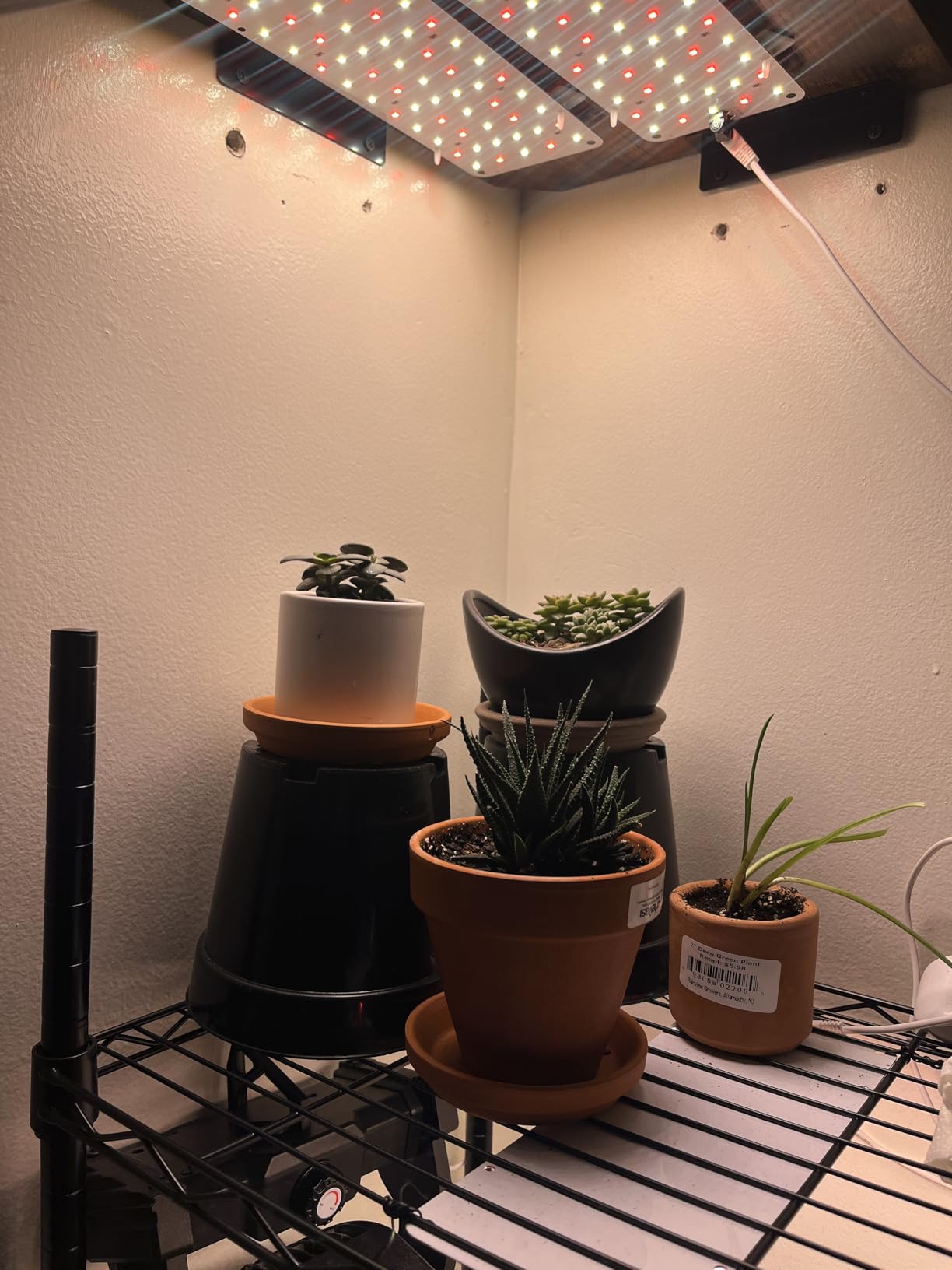
Thickness is the whole idea. At 0.15 inches, this panel slides under a shelf or cabinet without eating the headroom a boxed fixture would take. If your plants sit on a low shelf where a taller light will not fit, this is one of the few options that physically works.
Output is 20 watts across 132 LEDs, a stated 2400 lumens and a balanced 380 to 780nm spectrum. The aluminum body measures 10.31 by 4.02 inches and weighs 300 grams, mounting with adhesive pads, cable ties or screws. Two panels run from a single control.
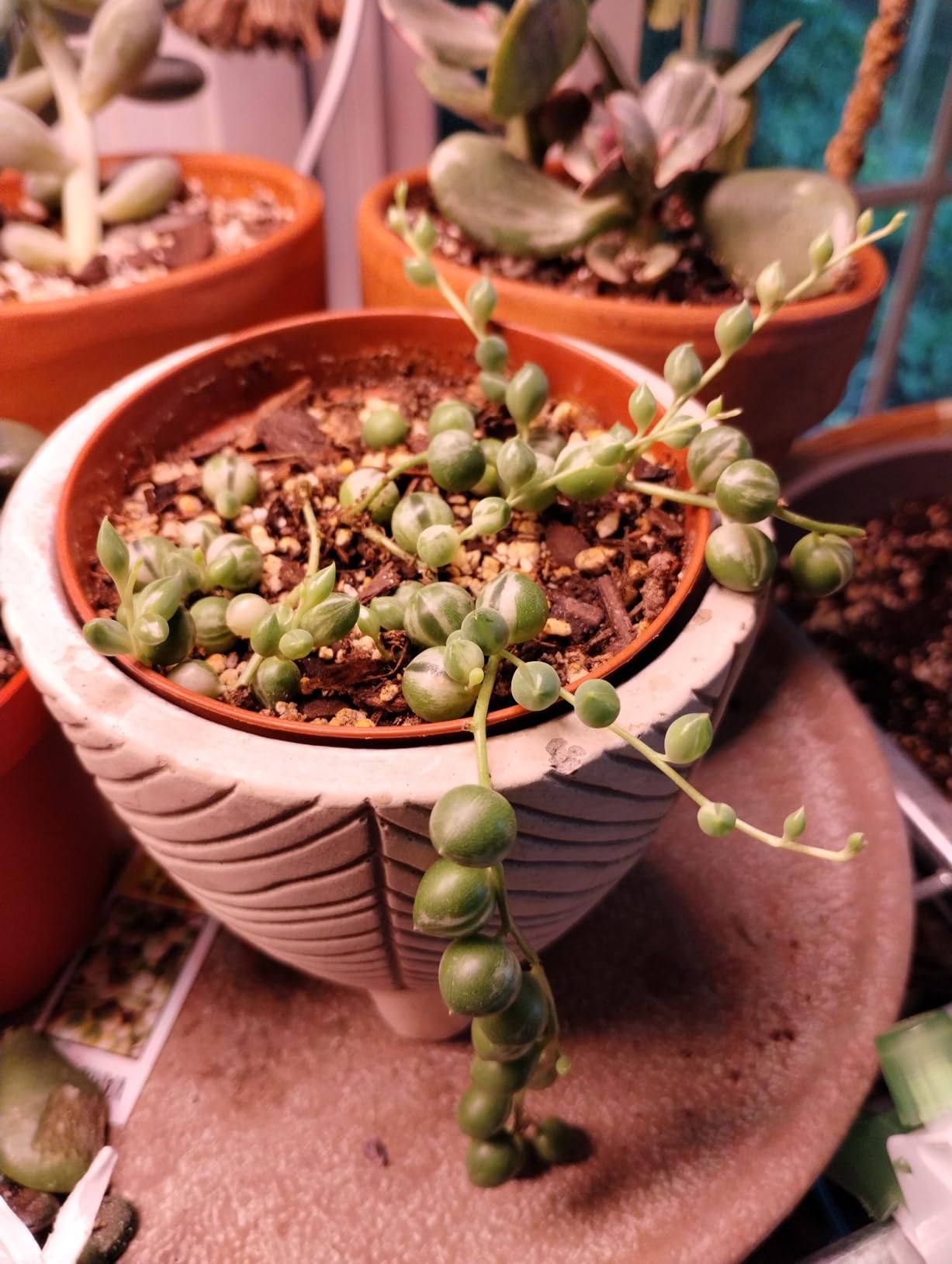
What stands out in the reviews is longevity. A significant number of owners report years of continuous use, several specifically mentioning cacti and succulents thriving. The 6, 12 and 16 hour cord timer settings include the longer photoperiod some forum users run.
The 4.3 rating reflects two real limits. There is no dimmer, so every plant under the panel gets identical output regardless of species. Some buyers also report the timer adapter failing after a few years, and because replacement adapters are not offered, the fix is a new unit. Use the ties or screws rather than the pads.
Because the panel emits across its whole face rather than from a point source, coverage stays even along the 10.31 inch length. That avoids the center-hot pattern people hit with single bulbs, so plants spaced along the panel receive comparable light.
What it does well
It clears a gap no other product here can. Most under-shelf advice fails on one detail: the fixture has to be thinner than the clearance between the shelf and whatever is above it, and a 0.15 inch profile opens up low bookshelves and kitchen cabinets that a boxed fixture rules out entirely.
Where it falls short
Skip it for a mixed collection, since fixed output means shade-tolerant Haworthia and sun-loving Echeveria under one panel get identical light. At 20 watts and 2400 lumens this is a one-foot-class fixture, and stretching it across a four-foot shelf means four panels and four adapters, at which point a linkable bar system is the better architecture. Our large grow tent roundup covers the dedicated-space end.
8. LBW 214 LED Desk Panel — Best Brightness for a Single Growing Area
LBW Desk Grow Light, 214 LEDs Full Spectrum Plant Light for Indoor Plants
- Bright broad panel that improves plant color and new growth
- Reported to bring out pink sun stress coloration
- Height adjustment and goosenecks allow precise angling
- Reliable 3/6/12 hour timer
- Can stand
- hang or tape under a shelf
- Base is light and can tip over risking nearby pots
- 26 inch maximum height will not reach tall plants
- Output is intense at close range
- Power adapter has failed for some owners
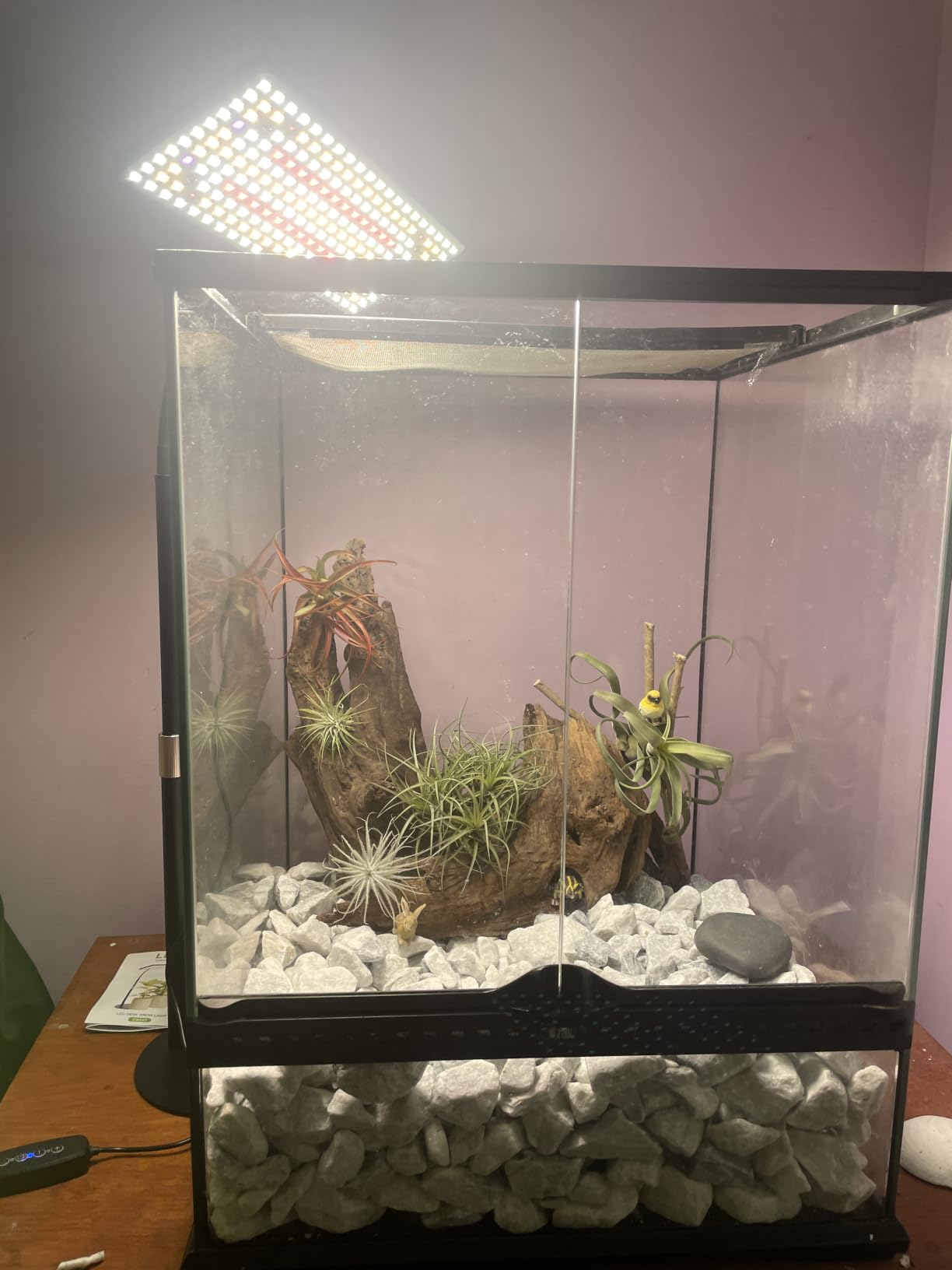
This is the most powerful fixture in the roundup, and for a single dedicated growing area that is the point. 214 LEDs across 380 to 780nm at 25 watts feed an 11 by 4.7 inch panel with heat-dissipating vents. Owners compare it favorably to commercial grow boxes, and several report pink sun stress developing on succulents under it.
Controls are the most complete here: a 3, 6 and 12 hour timer and 6 dimmable brightness levels. Height adjusts from 10 to 26 inches with goosenecks for angling, and included hooks let you hang it, so one unit serves a desk, a plant stand or the underside of a shelf.
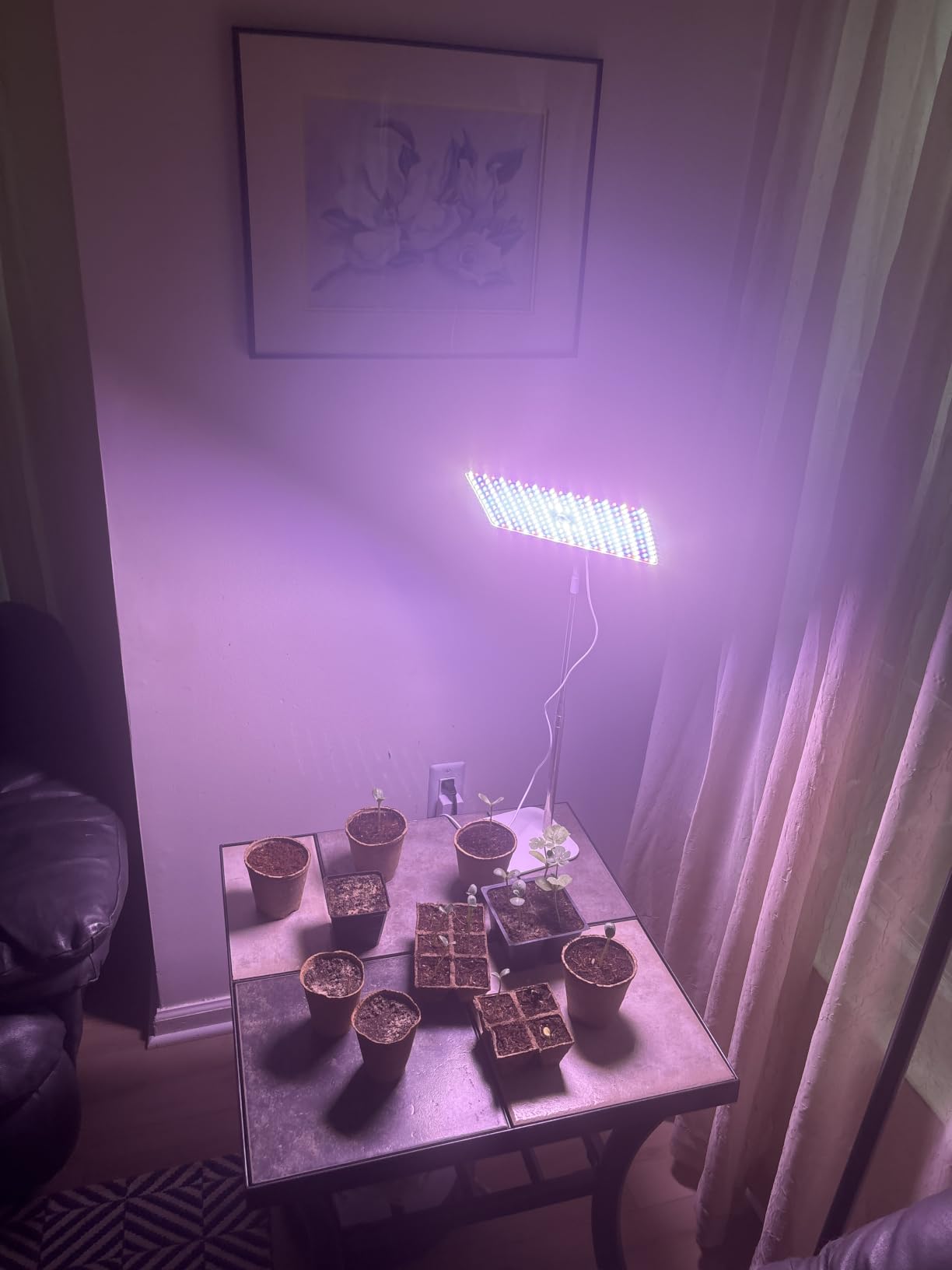
At 1,282 reviews the sample is smaller than the clip-on and T5 products here, but the reports are specific: visible improvement in color, new growth tightening up, and the dimmer working as advertised. The 12 month warranty is shorter than the Barrina and GYTF options, worth noting for a fixture with this many diodes.
The practical caution is proximity. Owners repeatedly warn the output is intense at close range, so treat 8 to 12 inches as the starting distance and ramp up from there. The 1.1 kg total weight is deceptively light for a metal base that size, and tipping is the most repeated complaint.
Brightness only helps if you can control it. Without a dimmer, 25 watts at 4 inches bleaches the top leaves of an Echeveria while the outer growth stays dim, which is photoinhibition rather than healthy growth.
What it does well
Six dimming levels make the power usable. Running a moderate setting and placing the panel further away produces a larger, more even footprint instead of a hot center, and starting a new plant at the lowest level and raising it a step every few days is what prevents the bleaching first-time buyers report.
Where it falls short
Skip it for tall upright plants, since 26 inches is a hard limit and a 3-foot floor plant stays outside its range. The 11 by 11 inch base also crowds a small desk, so this is a fixture for a corner or a plant stand. At 25 watts on a 12 hour schedule it draws meaningfully more electricity than the T5 options here.
9. RWNTAO Mini LED Grow Light Strips — Best for Tight Gaps and Small Shelves
- Compact strips that fit tight shelf and cabinet spaces
- Four mounting options including magnets and tape
- Runs cool enough to sit close to leaves
- Ten dimming levels to tune intensity
- Set-and-forget cycle timer
- Cords are permanently attached and cannot be disconnected
- Bar size is smaller than some buyers expect
- Cord management in shelving setups is awkward
Two 8.6 inch aluminum bars, 26 LEDs each, is the smallest footprint in the roundup. At 8.66 by 0.55 by 0.28 inches these fit inside a cubby or a display cabinet where a boxed fixture will not go, and that is the most common shelf problem people describe.
Output is 3500K full spectrum across 380nm to 800nm with 10 dimmable levels, a 3, 9 and 12 hour cycle memory timer and 3 switch modes. Mounting hardware is unusually complete: screws, zip ties, tape and magnets, with a 71 inch cord for reach.
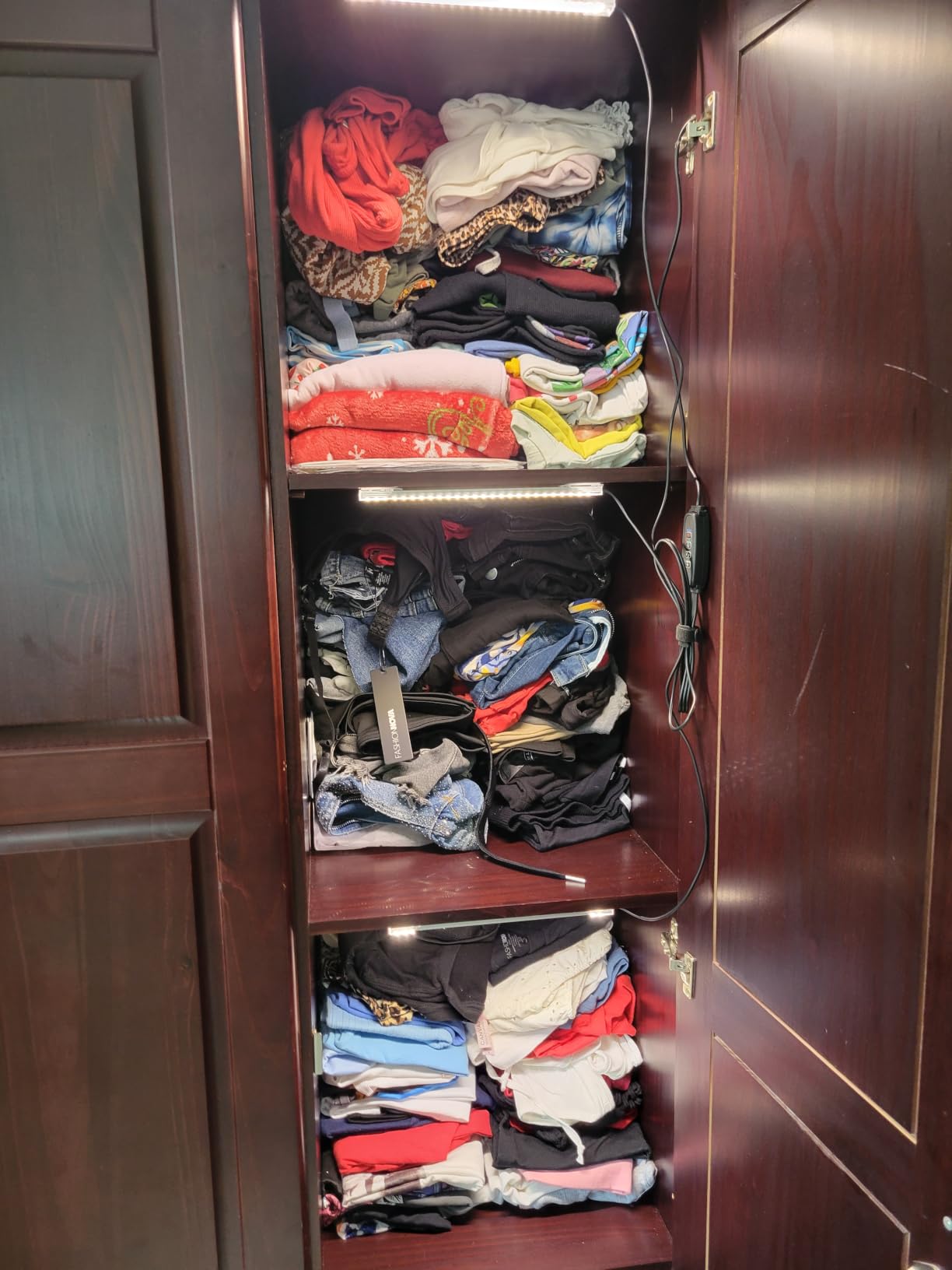
The 4.5 rating across 1,486 reviews reflects a product that does one thing well. Owners like that the aluminum housing runs cool enough to mount close to foliage without a standoff, and the ten dimming levels let the same strip serve a succulent shelf and a seedling tray.
The main complaint is cord design. The cords are permanently attached to each bar, so you cannot unplug a strip to reposition it or run the two bars from separate outlets. In a tight shelf, cable routing happens once and stays that way.
Because the housing is aluminum rather than plastic, heat disperses well enough for the bars to sit 6 inches above a rosette safely, which combined with the dimming makes these a reasonable first light for a shelf of small Echeveria and Sedum.
What it does well
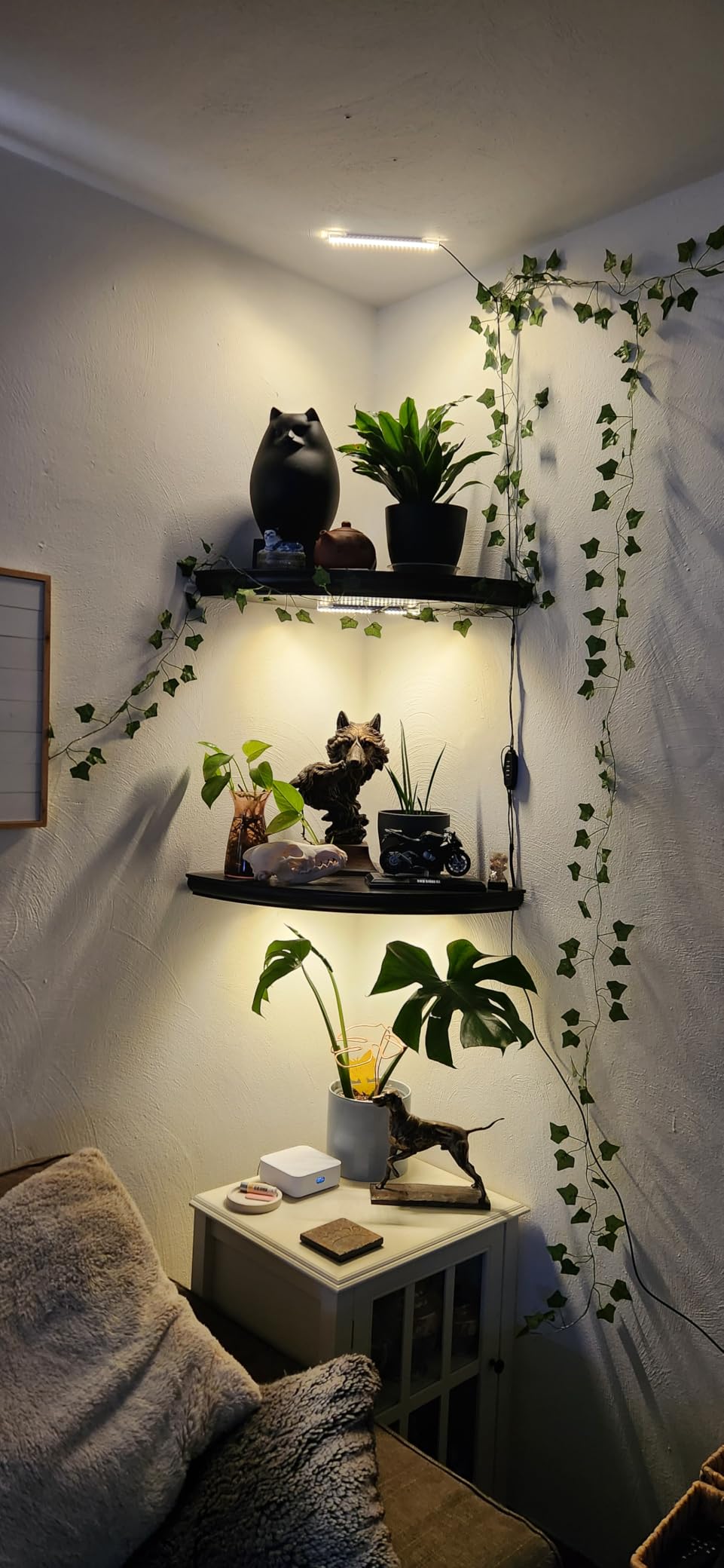
The magnets are the reason to buy this over a bare bulb. You can attach a strip to a steel shelf or a metal lip with no screws, no adhesive and no tools, then move it when you rearrange the plants. For a renter, that flexibility justifies the purchase more than the light output does.
Where it falls short
Skip it for a wide shelf: two 8.6 inch bars cover roughly 18 inches and buyers report the bars being smaller than expected. The timer tops out at 12 hours, so a 14 or 16 hour photoperiod needs an external plug, and 3500K is warmer than the 5000K-6500K band high-light succulents prefer. It is a supporting light, and a shelf-gap filler is what it is best at.
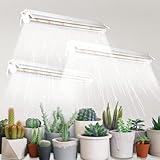
10. GYTF T5 Reflector Strips 1.4ft 3-Pack — Best for a Long Shelf Run
- Bright output that fills a cabinet or indoor greenhouse shelf
- Lightweight strips zip tie or tape into place
- Connector system lets you unplug an end without cutting power
- Runs cool after hours of use
- Three-pack covers a long shelf at 60 watts
- No built-in timer so an external smart plug is required
- All bars must be linked since one power cord is included
- Included adhesive strips did not hold for one buyer
- Connecting cord length is limited
Where the Barrina pack gives four 12.6 inch bars, this gives three 16.7 inch strips with reflector housings. At 60 watts across 153 LEDs and a stated 3000 lumens, it is the most powerful strip-based option here, and the V-shaped aluminum reflector is claimed to improve efficiency by 20 to 25 percent while helping with heat dissipation.
The 5000K white spectrum is the correct band for high-light succulents, and the reflector directs light downward instead of letting it scatter sideways, which is why owners report it filling a cabinet or small indoor greenhouse shelf. The 36 month warranty is the longest in this roundup.
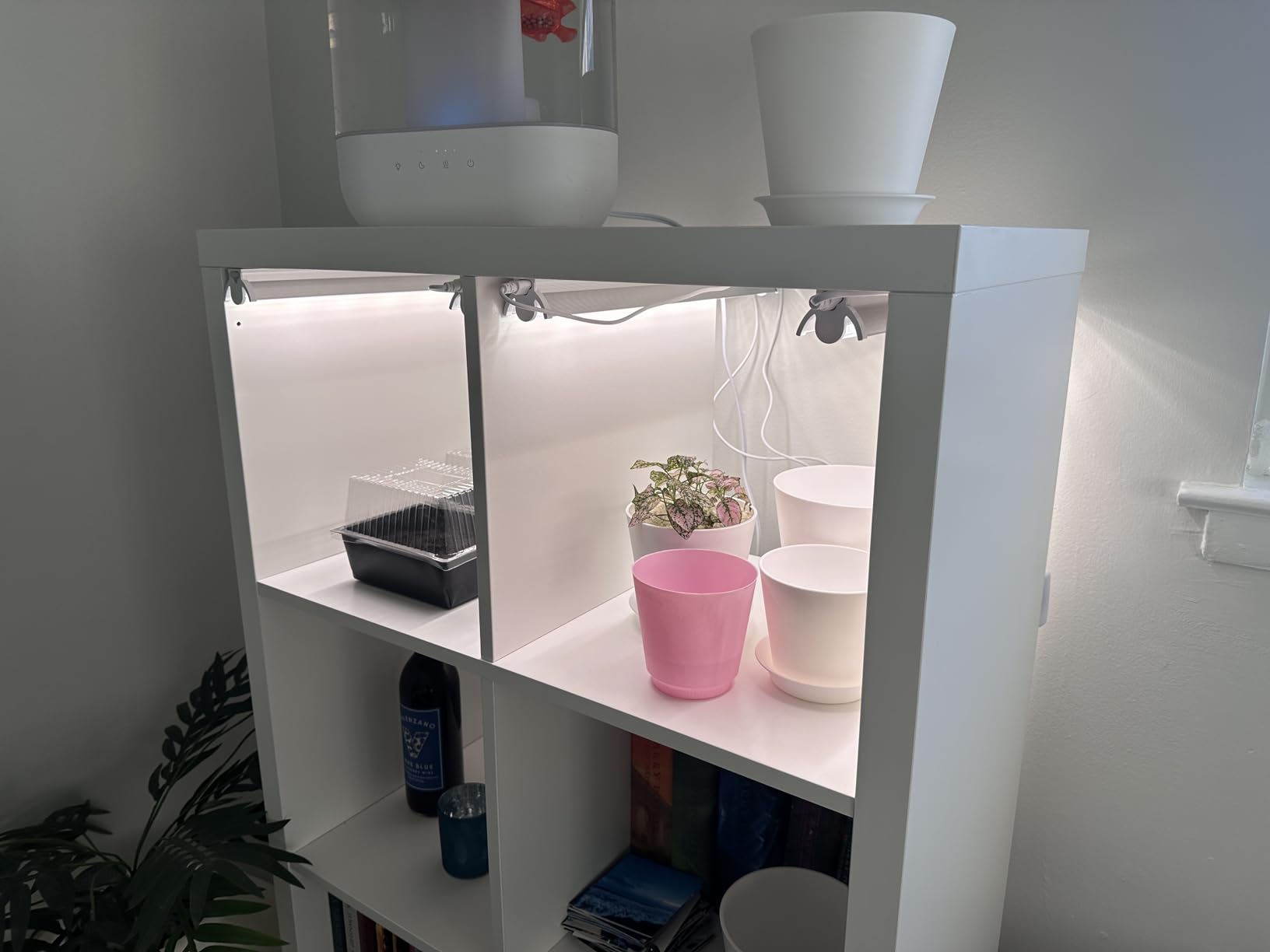
Two linking modes are supported, which is unusual: extension cords and small daisy-chain connectors. One power supply can drive up to 8 linked chains, and the connector design lets you unplug an end without cutting power to everything downstream.
The 4.4 rating comes from a smaller pool of 572 reviews, and the two consistent notes concern logistics rather than light quality. There is no built-in timer, and all bars must be linked because only one power cord is included. One buyer also found the adhesive strips did not hold, so plan on the screws, clips or zip ties.
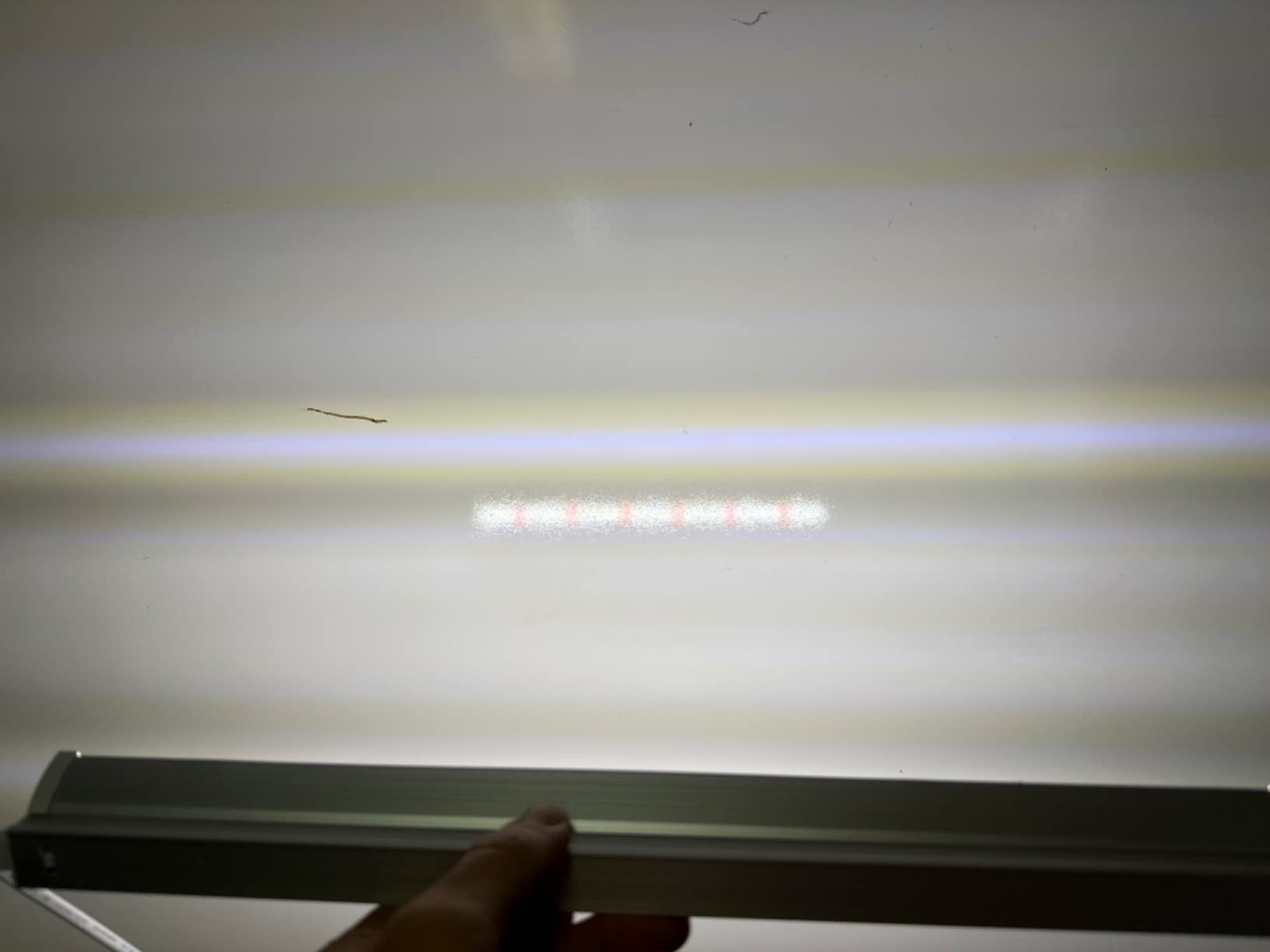
A reflector is a directional improvement over a flat bar: the angled walls catch light that would scatter sideways and redirect it toward the shelf. In a cabinet or a shelf with side panels, that difference is significant.
What it does well
The 1.4 foot length is the deciding dimension. Three linked strips cover a little over four feet of shelf, matching a standard bookcase tier and a two-tier plant stand. At 60 watts this is a proper shelf-lighting solution rather than a supplement, and it runs cool enough to mount closer than a bare bulb would allow.
Where it falls short
Skip it for a small setup, because 60 watts across three strips is a lot of light for two or three pots, and there is no dimmer to soften it. Skip it if you want independent control, since there is no per-bar switch and a shelf needing light on one section forces all three on. Barrina’s individually switchable pack is the better architecture for a partial-shelf setup.
How to Set Up a Grow Light So Your Plants Stay Compact?
Most failed setups are not setup failures at all, they are distance failures. Fix the geometry before you blame the fixture.
Start at 6 to 8 inches and work outward. Intensity follows the inverse square law, so doubling the distance cuts delivered light to roughly a quarter. A lamp that is perfect at 6 inches is weak at 12 and useless at 18. If a light is too weak, move it closer before buying something bigger.
Ramp up over two weeks. A plant from a dim shelf should not meet full output on day one. Add an hour every few days or step the dimmer up, and watch the newest leaves at the center for bleaching or reddening, which is photoinhibition and appears before the whole plant shows damage.
Use a real timer. Six of the ten products here have a built-in cycle timer, which is why we call out the four that do not. A wall timer or smart plug on the others is a two-minute job and removes the most common accident in this hobby.
Run 12 to 14 hours with a dark period. Sixteen hours is a valid winter option that some forum users run, but a genuine dark period is not optional. Continuous light disrupts the cycle many succulents rely on.
Expect to water less. This is the step almost every guide misses. A grow light emits far less infrared heat than sunlight through a window, so soil under a lamp dries down more slowly than it did on the windowsill. Re-check dry-down weekly for a month after moving.
How to Choose a Grow Light for Your Plants and Your Shelf
Start by sorting your collection, not by shopping. Succulents fall into two clearly different light tiers, and one fixture cannot serve both without compromise.
High-light group: Echeveria, Sedum, Graptopetalum, most cacti and Lithops. Target 200 to 250 µmol/m²/s at the canopy for compact growth and stress coloration. These are the plants that stretch first when light is short.
Moderate to low-light group: Haworthia, Gasteria, Sansevieria and most trailing types. Target 75 to 150 µmol/m²/s. Running these at high intensity is as much a mistake as starving a cactus.
Next, match the fixture to the footprint rather than the wattage. A desk with one to four pots wants a clip-on gooseneck or a screw-in bulb. A single shelf of 10 to 20 plants wants linkable T5 bars or an ultra-thin panel under the shelf above. A two-tier plant stand needs one light per tier, because no fixture serves two heights. A 50-plus plant collection belongs in a dedicated grow space.
On light types: full-spectrum LED runs coolest, draws the least electricity, dims cleanly and holds output for years. T5 fluorescent strips are cheaper and spread light evenly along a shelf but run hotter and lose output faster. HID delivers serious intensity for a dedicated space but demands a large standoff and proper exhaust, which is impractical in a home.
On spectrum: full-spectrum white between 5000K and 6500K is the target, because blue light suppresses the cell-elongation response behind stretching. Blurple fixtures concentrate red and blue and skip everything between, which is why they look dramatic and still produce leggy plants, and why forum users describe them as unpleasant to live with. Skip anything marketing purely on lumens without a color temperature, and skip any listing with a vague coverage claim and no square footage.
Two final checks. Confirm whether a timer is included or sold separately, since four products here need an external plug. And confirm the dimming range, because a fixed fixture forces one intensity on every plant sharing it. If a collection spans both tiers, a dimmable light is the difference between healthy plants at both ends of the shelf.
Frequently Asked Questions
Will succulents grow under grow lights?
Yes. Succulents grow well under full-spectrum white LED or T5 fluorescent lights, and they stay noticeably more compact and colorful than plants grown under household bulbs. The two conditions are a 5000K-6500K color temperature and roughly 2000 lumens per square foot, with the light positioned 6 to 12 inches above the canopy. They are CAM plants, so they still need a real dark period each night.
How much PPFD does a succulent need?
High-light succulents such as Echeveria, Sedum, Graptopetalum and most cacti do best at 200-250 µmol/m²/s measured at the canopy. Shade-tolerant types including Haworthia, Gasteria and Sansevieria prefer 75-150 µmol/m²/s. Almost no consumer listing publishes this number, which is why it is worth checking whether a fixture can be dimmed or moved closer instead of relying on lumens.
What color LED light is best for succulents?
Full-spectrum white between 5000K and 6500K is the best color range for succulents. Blue wavelengths are what suppress the cell-elongation response that causes stretching, and they are the reason red-and-blue-only blurple fixtures fail to keep plants compact. Warm household LEDs in the 2700K-3000K range are too warm for high-light succulents and often cause leggy growth even on a long timer.
How many hours a day do succulents need under a grow light?
Most succulents do well on 12 to 14 hours of light per day with a genuine dark period afterward. Running 16 hours is a valid choice for faster winter growth. Running a weak light 24 hours a day does not work, because plants stretch when intensity is short regardless of how long the light stays on.
Will a grow light burn my succulents?
Yes, if the light is too close or the intensity is too high. Symptoms appear on the top leaves closest to the fixture as bleaching, pale patches or reddish-brown scorched tips, and they show up before the rest of the plant is affected. Prevention is simple: start 8 to 12 inches away, dim to the lowest setting if the light has one, and raise intensity gradually over two weeks.
Which Grow Light Should You Buy?
For most people the best grow lights for succulents come down to three answers. The GooingTop 6000K clip-on is the all-round choice for a desk, a dorm room or a small windowsill, with the most reviews in this roundup by a wide margin and a clamp that holds its position. The Briignite A19 bulb is the fastest route if you already own a lamp with an E26 socket. The Barrina T5 5000K four-pack is the one to buy for a tiered shelf.
Before any of them: measure the footprint, sort your plants into high-light and shade-tolerant groups, and check whether a timer is included. Distance does more for your succulents than any spec on the box, and a light mounted 6 inches away beats a brighter one mounted 18 inches up. Set it on a timer, start at the lowest setting and give it two weeks.