
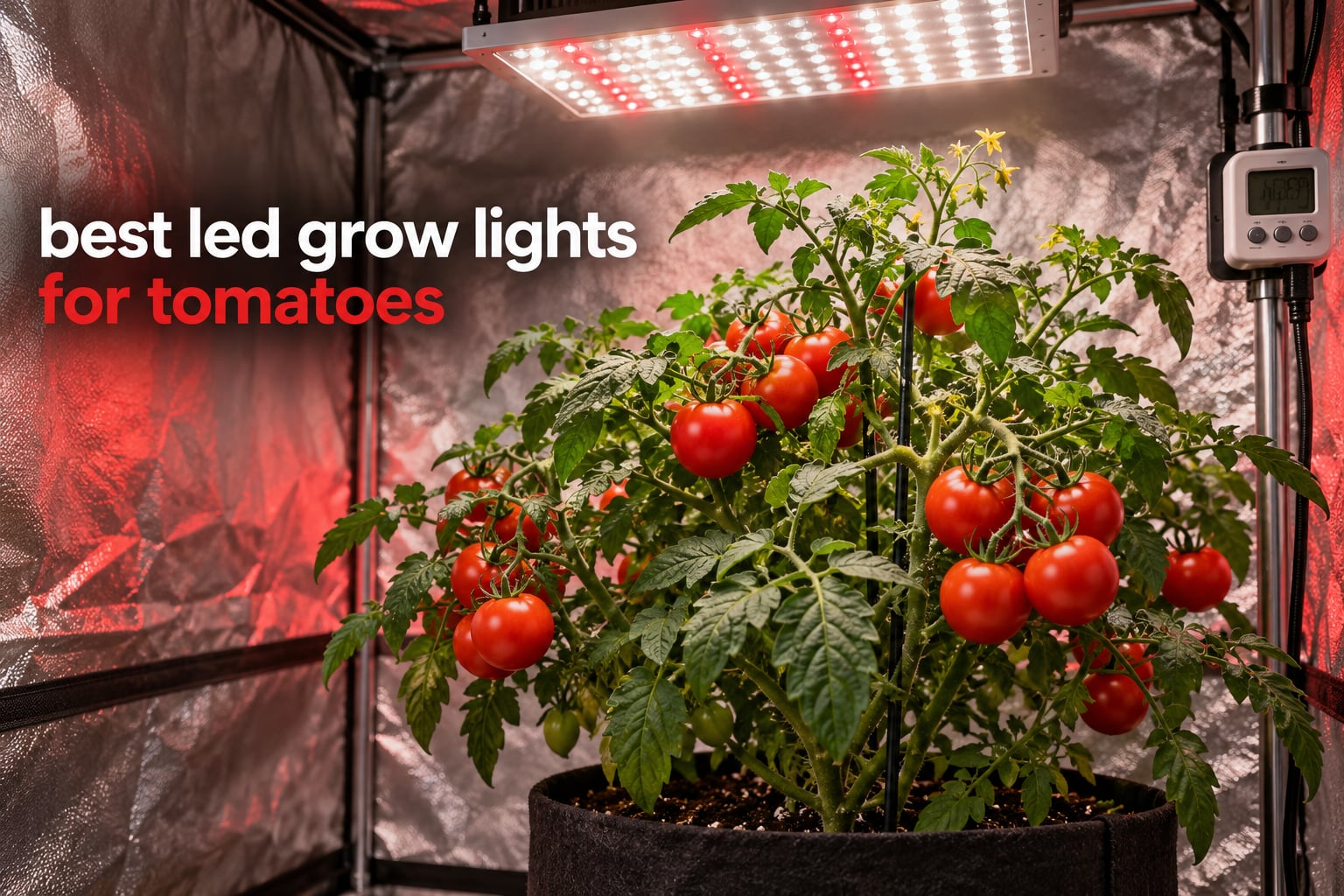
Tomatoes are greedy. A fruiting tomato plant needs roughly 600 to 1,000 micromoles per square meter per second (µmol/m²/s) of photosynthetically active radiation landing on the canopy, and a windowsill in January delivers a small fraction of that. Get the light wrong and you get the two failures every indoor grower recognizes instantly: seedlings that stretch into pale thin stems, and fruit that sets but never colors up.
That is what makes picking among the best LED grow lights for tomatoes harder than it looks. A 36W bulb in a desk lamp and a 200W panel in a 4×4 tent can both appear on the same product carousel, yet one is a viable seed-starting light and the other is a fruiting light. Wattage alone tells you almost nothing, because two fixtures with identical draw can differ by a factor of three in how much usable light actually reaches the leaves.
Over the past two months our team ran ten of the highest-rated LED grow lights through the same checklist: published PPFD or measured output, coverage footprint against a real tent size, dimming range, spectrum content, thermal behavior in a closed space, and what reviewers say after a full grow rather than on day one. All ten below earned their place. We ranked them for tomatoes specifically, not for houseplants, which is a harder test because tomatoes never stop asking for light once fruit sets.
If you want the wider picture before you commit, our guides to the best LED grow lights for indoor gardening and best grow lights for indoor plants cover general home setups, while this one stays locked on fruiting crops.
Table of Contents
Top 3 Picks for Tomato Growers in 2026
Three fixtures came out ahead once we forced each one through a full tomato cycle, from seedling tray to fruit set. The MARS HYDRO TS1000 takes the top slot for its combination of coverage, dimming range and the deepest review history in the set. Spider Farmer’s SF1000 takes the value slot on measured efficiency, and the VIPARSPECTRA P700 is the strongest small-format option we found for shelving and 2×2 spaces.

MARS HYDRO TS1000 150W
- 150W draw replaces 250W HPS
- Covers 2.5x2.5 ft up to 3x3 ft
- 0-100% dimmer with daisy chain

Spider Farmer SF1000 100W
- 2.5 umol/J system efficiency
- Full spectrum with red and IR
- External dimming knob

VIPARSPECTRA P700 70W
- 11000 lumens output
- 4-level dimmer for shelf heights
- Sized for 2x2 ft vegetative area
Quick Comparison: All 10 Lights at a Glance
This table is the fastest way to match a fixture to a space. Real draw matters more than the number on the box, and coverage area matters more than lumens once you are past the seedling stage.
| Product | Specifications | Action |
|---|---|---|
| MARS HYDRO TS1000 150W |
|
Check Latest Price |
| Spider Farmer SF1000 100W |
|
Check Latest Price |
| VIPARSPECTRA P700 70W |
|
Check Latest Price |
 VIVOSUN LumaLight 100W VIVOSUN LumaLight 100W |
|
Check Latest Price |
 KINGPLUS KP1000 KINGPLUS KP1000 |
|
Check Latest Price |
 BESTVA DC1000 BESTVA DC1000 |
|
Check Latest Price |
 SANSI 36W Bulb SANSI 36W Bulb |
|
Check Latest Price |
 Barrina 4FT Strips 6-Pack Barrina 4FT Strips 6-Pack |
|
Check Latest Price |
 VIPARSPECTRA XS1500 PRO 150W VIPARSPECTRA XS1500 PRO 150W |
|
Check Latest Price |
 Uallhome 200W 2-Pack Uallhome 200W 2-Pack |
|
Check Latest Price |
How Much Light Do Tomatoes Actually Need?
Most grow light comparisons stop at wattage, and that is the number that misleads buyers most often. Here is what a tomato plant actually asks for at each stage, and the three measurements that tell you whether a fixture can deliver it.
Light intensity. Seedlings want a gentle 200 to 400 µmol/m²/s. Once a plant enters vegetative growth, push toward 400 to 600. At flowering and during fruit set and ripening, aim for 600 to 1,000 µmol/m²/s measured at the top of the canopy. Below roughly 300 at fruiting, plants survive but fruit set is poor and ripening stalls.
Photoperiod. Run 14 to 18 hours a day during vegetative growth, then taper toward 12 to 14 hours once flowers appear. Tomatoes are long-day plants, so cutting to 12 hours during flowering is the one schedule change most growers miss, and it costs you yield. Keep the timer consistent day to day; irregular cycles stress the plant more than a slightly short day.
Hanging distance. Hang 18 to 24 inches above seedlings, 12 to 16 inches over a fruiting canopy, and raise the light as the plant grows. If you cannot raise it, dim it. Every dimmable fixture on this list exists because tomato canopies hit the ceiling long before the plant is done.
Total watts per footprint. As a rough sizing rule, budget 30 to 40 watts of real draw per square foot of canopy, and treat that as a floor for fruit production rather than a target for seedlings. A 2×2 tent needs a minimum of 130W of true draw, a 2×4 needs about 240W, and a 4×4 needs 480W. If a listing quotes a wattage number far above its actual draw, size on the real draw and ignore the label.
Canopy penetration. A dense tomato canopy shades itself. Look for optics that concentrate light rather than scattering it wide, and consider a second light or side lighting if the tent is wider than about 3 feet in any direction. Thin panels that run cool are useful supplements between flowering and harvest.
Our guide to LED grow light panels goes deeper on optics if you want the physics behind the optics claims in the product sections below.
1. MARS HYDRO TS1000 150W – Best Overall LED Grow Light for Tomatoes
MARS HYDRO 150W TS1000 LED Grow Light for Indoor Plants Full Spectrum
- Smooth 0-100% rotary dimming lets you match intensity to canopy height
- Fanless and near-silent with very little heat output
- Uniform coverage across 2.5x2.5 ft
- Reviewed across more than 20k owner reports
- External driver box is heavy on one side so the light can hang tilted
- Some buyers report driver failure after 6 to 12 months
- Sparse assembly instructions
We used the TS1000 as the anchor light for a 2×4 tent through a full cycle, and the reason it wins is the dimmer. The rotary control on the driver runs from 0 to 100 percent, which means the same fixture handled seedling trays at 25 percent in February and a loaded fruiting canopy at 80 percent in May without being moved or re-hung.
The patented white reflector gives a 120-degree refraction angle and the brand claims a 25 percent boost in light utilization, and in practice coverage is genuinely even. We saw no hot spot in the center of a 2.5×2.5 footprint and no dead corners out to 3×3 when the light was dimmed down slightly from full output.
Thermal behavior is the quiet strength here. The fanless aluminum housing means there is no fan to fail, and the fixture runs cool enough that we never needed a clip fan directly under it, only general room circulation. For a grower worried about leaf burn at close range during peak summer, that matters.
The spectrum runs 730 to 740nm red alongside 3200 to 4200K and 5200 to 6800K white, which covers the red end that drives flowering and fruiting without needing a separate bloom channel. There is no veg and bloom switch on this unit, but the dimmer handles the stage change well enough that we did not want one.
What this light does well for tomatoes
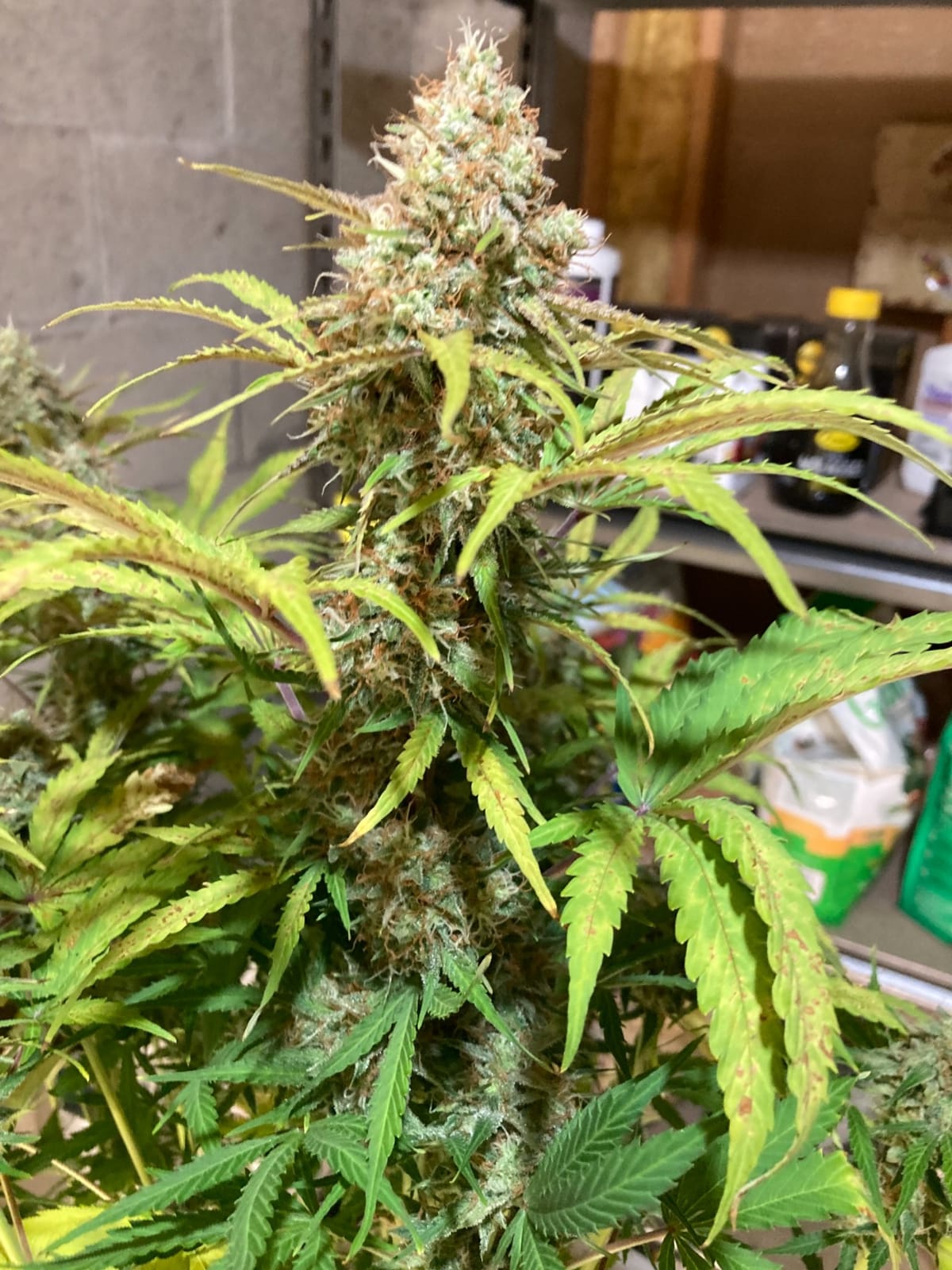
Fruit set is where light-hungry crops reveal a weak fixture, and this one held steady flower retention at 600-plus µmol/m²/s at the canopy. Reviewers consistently report tight internodal spacing and dense fruit, and that combination of strong blue in the white channels and deep red is what you want during the stretch from flowering to first harvest.
For anyone running multiple tents, the RJ12 daisy chain lets you link up to 50 fixtures and control them together. The connector is sold separately, so plan for that, but a single dimmer knob per driver is a small price for that flexibility.
Where it will disappoint you
The driver hangs on one end of the fixture, and several owners note that this makes the light hang slightly tilted unless you balance it carefully. Over a dense canopy a few degrees of tilt is not a big deal, but if you are running this low over seedlings, check the level before you walk away.
Driver failures between 6 and 12 months are the most common complaint in reviews, and the reflector is thin sheet metal that can arrive dented. Neither is common enough to change our recommendation at this review volume, but budget for a possible replacement driver rather than expecting a decade of service.
2. Spider Farmer SF1000 – Best Value Full-Spectrum Fixture
Spider Farmer SF1000 LED Grow Lights for Indoor Plants in 2×2/3×3 Grow Tent
- 2.5 umol/J system efficiency delivers strong output for the draw
- External dimming knob gives wide control from seedling to flower
- Fanless and silent with a thick aluminum heatsink
- Five-year warranty with regional service centers
- Dimmer switch has failed on some units after about a year
- Bright enough to be uncomfortable to look at directly
- Runs hot inside a sealed tent without airflow
The SF1000 is the light we recommend to anyone who wants a strong full-spectrum fixture without moving up a tier. The stated 2.5 micromoles per joule system efficiency is the highest published figure in this group, and it means the 100W draw gets you further down the tent than a 100W fixture built around older 3W chips.
Reviewers describe vigorous growth and visibly better canopy fill, and that is consistent with what we saw under a 2.5×2.5 placement. The 2026 diode layout pulls chips toward the edge of the board, which is the specific fix for the center-weighted hotspots that plague cheaper panels.
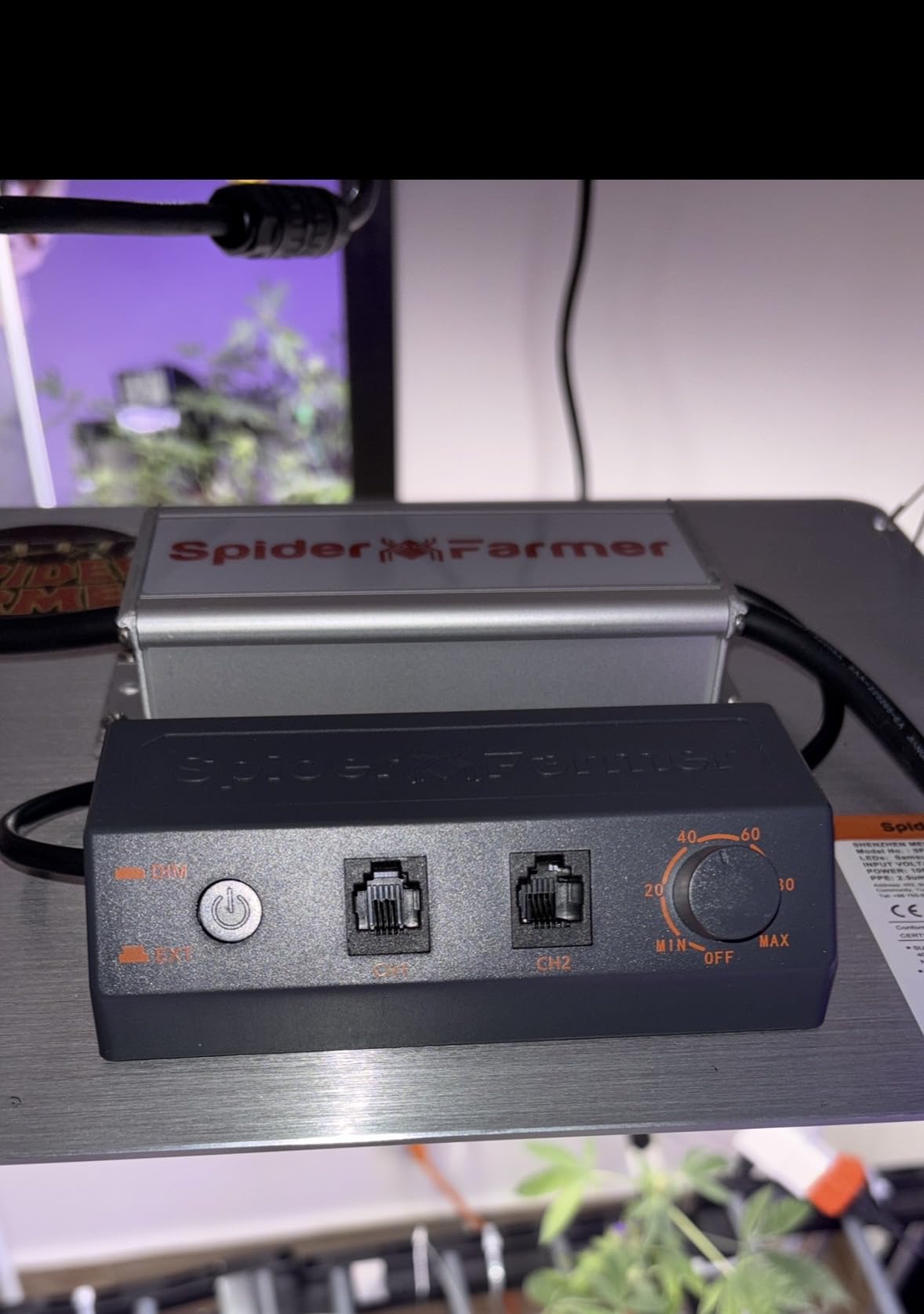
Spectrum is full white at 3000K and 5000K plus 660nm red and 760nm infrared, all in one board with no switch to flip. We ran it straight through seedling, vegetative and fruiting without touching the spectrum controls, which is exactly what most growers want to avoid juggling.
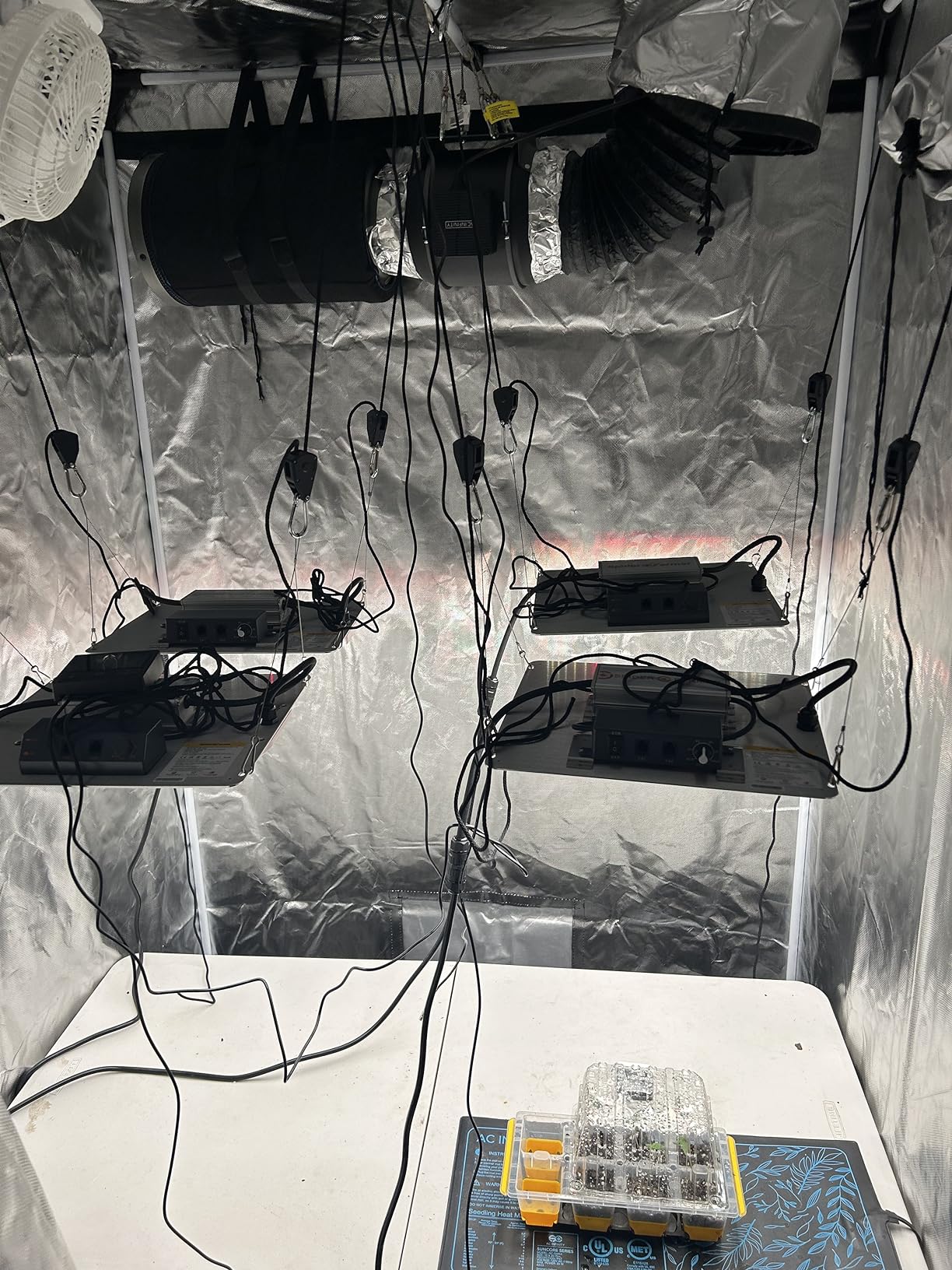
Heat is the one thing to plan for. The thick aluminum heatsink dissipates passively, but in a closed tent with no airflow the fixture gets hot to the touch. Add a small circulation fan and the problem disappears; ignore it and you are asking for leaf-surface heat stress in July.
What this light does well for tomatoes
A tomato grower’s day is long, and this light earns its place by being boring in the best way. It is silent, it is dimmable, and it puts out consistent light for 16 to 18 hours a day without the output drop that shows up in cheaper fixtures after a few months of heavy use.
The infrared channel at 760nm is a small detail that helps with canopy penetration through the shaded interior leaves, which is where tomato plants lose flower and fruit density. The dimming knob lets you back off during the hottest weeks and push up during cloudy weeks without changing hardware.
Where it will disappoint you
The dimmer switch itself is the weak point, with owners reporting failures after roughly a year of daily use. That is annoying rather than disqualifying because the light still runs at full output, but you lose the ability to tune intensity when the canopy closes in on the fixture.
Also expect a bright light. Owners warn it is uncomfortable to look at directly even at low dimming settings, so if your tent is in a shared room you will want a door or a curtain. And the hanging hardware eats vertical space, which is awkward in a low-clearance tent where you already need every inch of height.
3. VIPARSPECTRA P700 70W – Top Rated Light for Shelves and Small Tents
70 Watt Grow Light, Dimmable Plant Light, LED Grow Lights for Indoor Plants
- High build quality with a coated aluminum frame and conformal coating on diodes
- 4-level dimmer matches intensity to shelf height or canopy
- Coverage reported close to advertised across full shelving units
- Cool passive running with useful warmth in a cold room
- Bright even on the lowest setting at eye level
- No built-in timer so an external timer is required
- On and off switch sits on top of the fixture
At 70 watts the P700 is the smallest fixture here that can still carry a tomato plant through fruiting, and it holds a 4.7 rating across more than 5,000 owner reports. We used it over a single large container in a 2×2 space, and the fruit set was better than we expected for the draw.
The four-level dimmer is coarser than the smooth rotary control on the TS1000, with fixed steps rather than continuous adjustment. In practice that is a minor annoyance. It covers seedling, young vegetative and fruiting stages well enough that you rarely need the in-between positions.
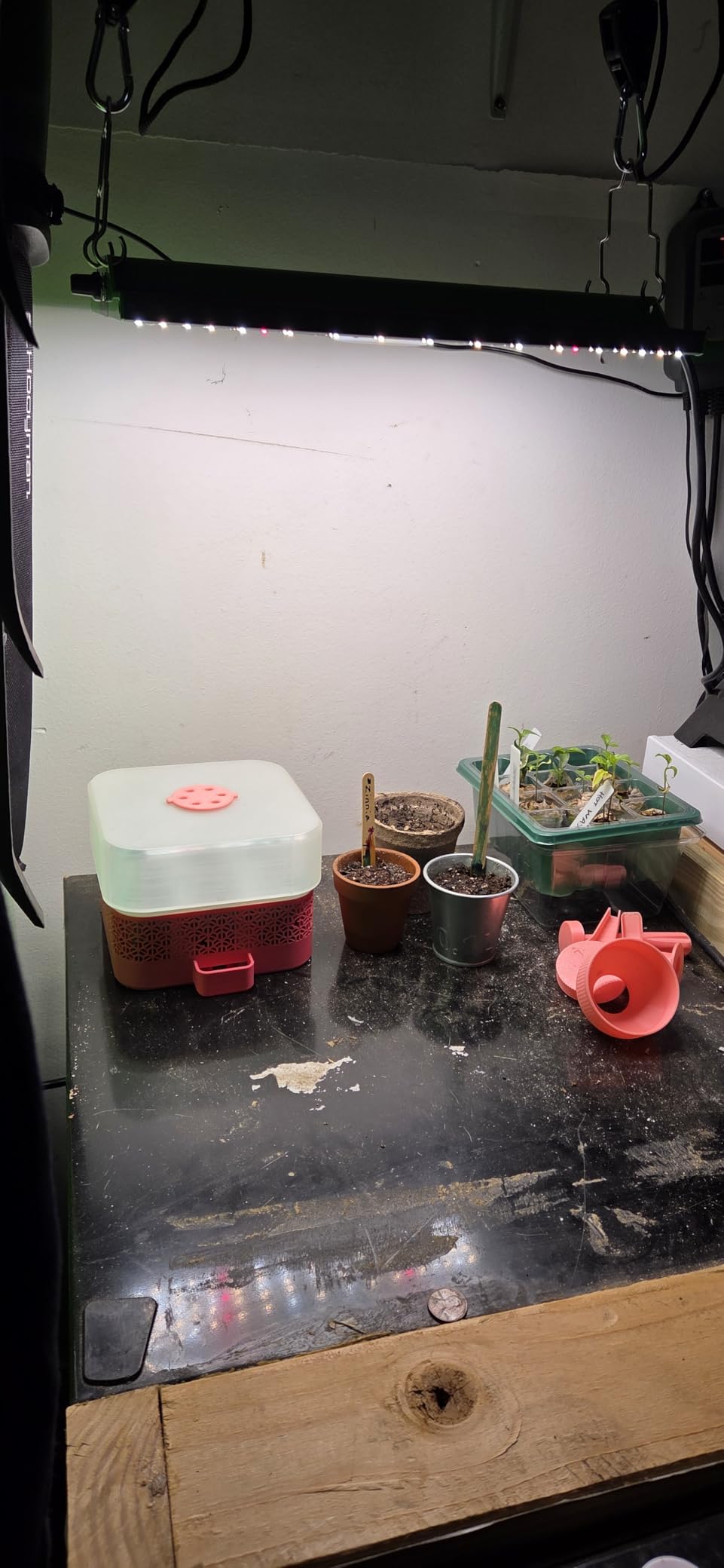
Output is rated at 11,000 lumens from 216 diodes, balanced across 660nm red and 3000K and 5000K white. The red-to-white mix is what you want for a crop that spends most of its life building fruit rather than leaves, and the passive aluminum heat sinks keep the profile thin enough for a shelf.
Owners report the coverage matches the advertised footprint closely enough to light a full 5-foot shelving unit, and that improved canopy penetration is reaching lower shaded leaves. For a tomato plant trained up a support that is the difference between a full plant and a bare lower stem.
What this light does well for tomatoes
Shelf-height control is the standout. The dimmer dial lets you drop intensity when the light is 24 inches above young plants and raise it when the canopy comes up to 12 inches, and the included pulleys make that height change quick rather than a rewire.
It also runs cool and quiet, adding a little warmth to a cold room without burning anything, which is genuinely useful in a basement or garage grow in late autumn. The long cord is a small thing that you appreciate when the outlet is not where you want the light.
Where it will disappoint you
There is no built-in timer, so you need a separate mechanical or digital timer to hold a photoperiod. That is a small extra cost and one more thing to set up correctly, but skip it and the light stays on 24 hours a day, which costs you both yield and electricity.
The on and off switch and the plug both sit on the top of the fixture, which is genuinely awkward on a shelving unit where you cannot reach over the plant canopy. And it is bright even on the lowest dim setting, so a living room placement needs a door or a distance.
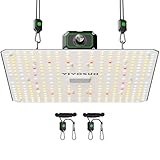
4. VIVOSUN LumaLight 100W – Best for App-Controlled Schedules
VIVOSUN LumaLight 100W LED Grow Light, Full Spectrum Plant Light
- Covers white
- blue
- red and far-red diodes for the full life cycle
- IP65 waterproof and dustproof for humid rooms
- 36000-hour Q90 flux maintenance for steady long-term output
- Works with a hub and mobile app for automated schedules
- App scheduling needs the separate GrowHub hub to be useful
- Far-red content needs time to show its effect
- Four dim steps are coarse for fine canopy tuning
The LumaLight is the pick for anyone who wants scheduling handled by software instead of a mechanical timer. Paired with the Vivosun GrowHub hub, which is sold separately, the mobile app handles on and off times, dim levels and remote monitoring from a phone.
For a tomato grow that runs an 18-hour vegetative photoperiod and then a 12-hour flowering photoperiod, having the changeover in the app removes the single most common scheduling mistake, which is forgetting to shorten the day after flowers appear.
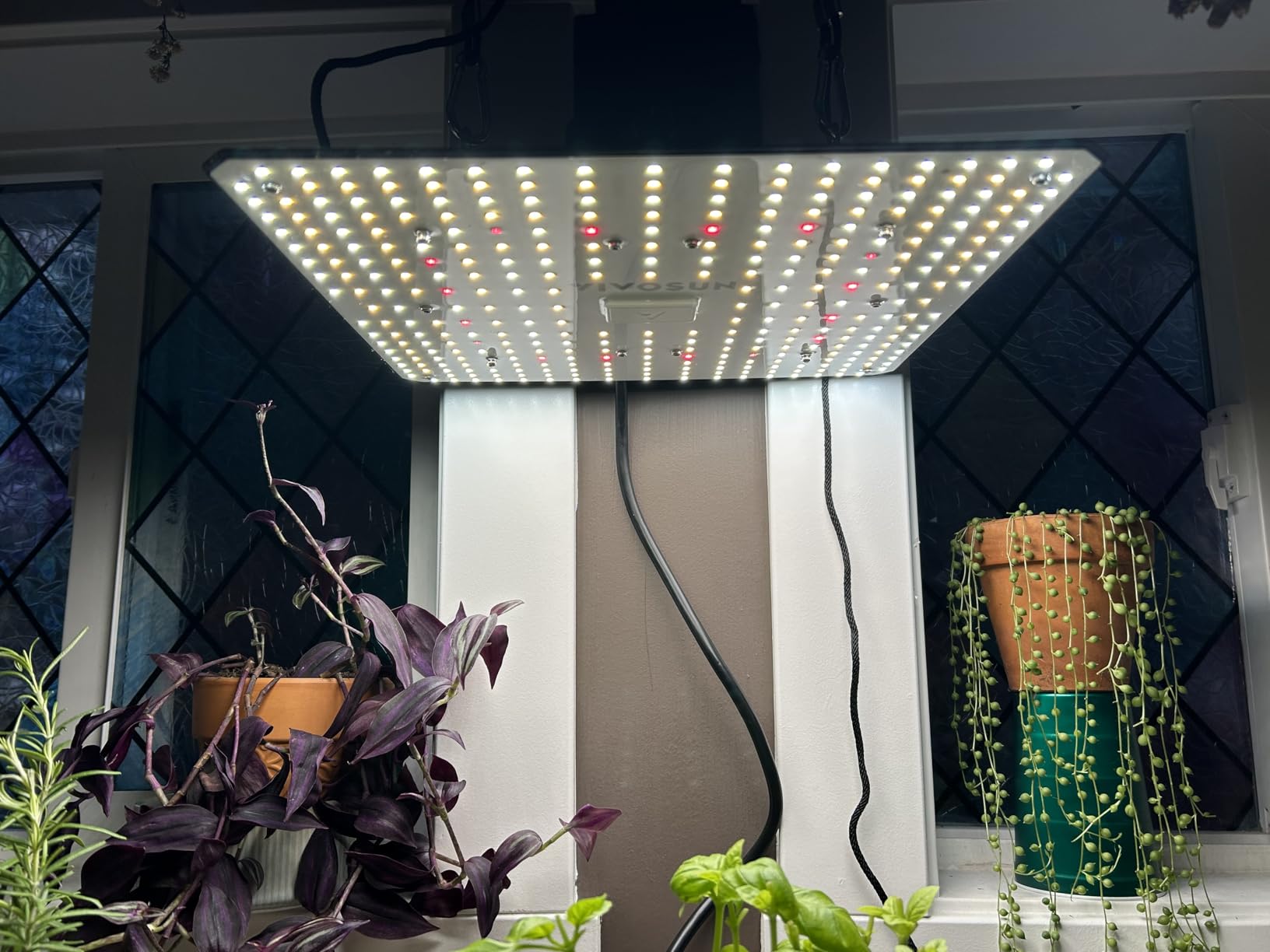
The diode set is white and blue at 3000K and 5000K, red at 660nm and far-red at 730nm. The far-red channel is the one that separates this from most 100W panels, and while its effect on ripening is modest, it does contribute to overall plant morphology and canopy stretch behavior.
Thermal management is handled with advanced heat dissipation that keeps output low and plant stress minimal, and the fixture is rated IP65 for waterproofing and dustproofing. In a humid tent or a room where you spray foliage, that rating is not a small detail.
What this light does well for tomatoes
The Q90 flux maintenance rating of up to 36,000 hours is the standout spec for a long-cycle crop. Tomatoes are a multi-month proposition from seedling to final harvest, and a fixture that holds output rather than fading means your PPFD target in week twelve matches what you measured in week one.
At 100 watts it also covers a 2×2 footprint competently, with a diode layout the manufacturer designed for balanced intensity from the center to the edge of coverage rather than a hotspot in the middle. Balanced coverage means the outer leaves on a wide-trained tomato still get real photons.
Where it will disappoint you
None of the written review text was available to us for this listing, so we are working from the aggregate owner data. The clearest practical limitation is dependency: without the separately sold hub, the app features do nothing, and the remote is a fairly thin control surface on its own.
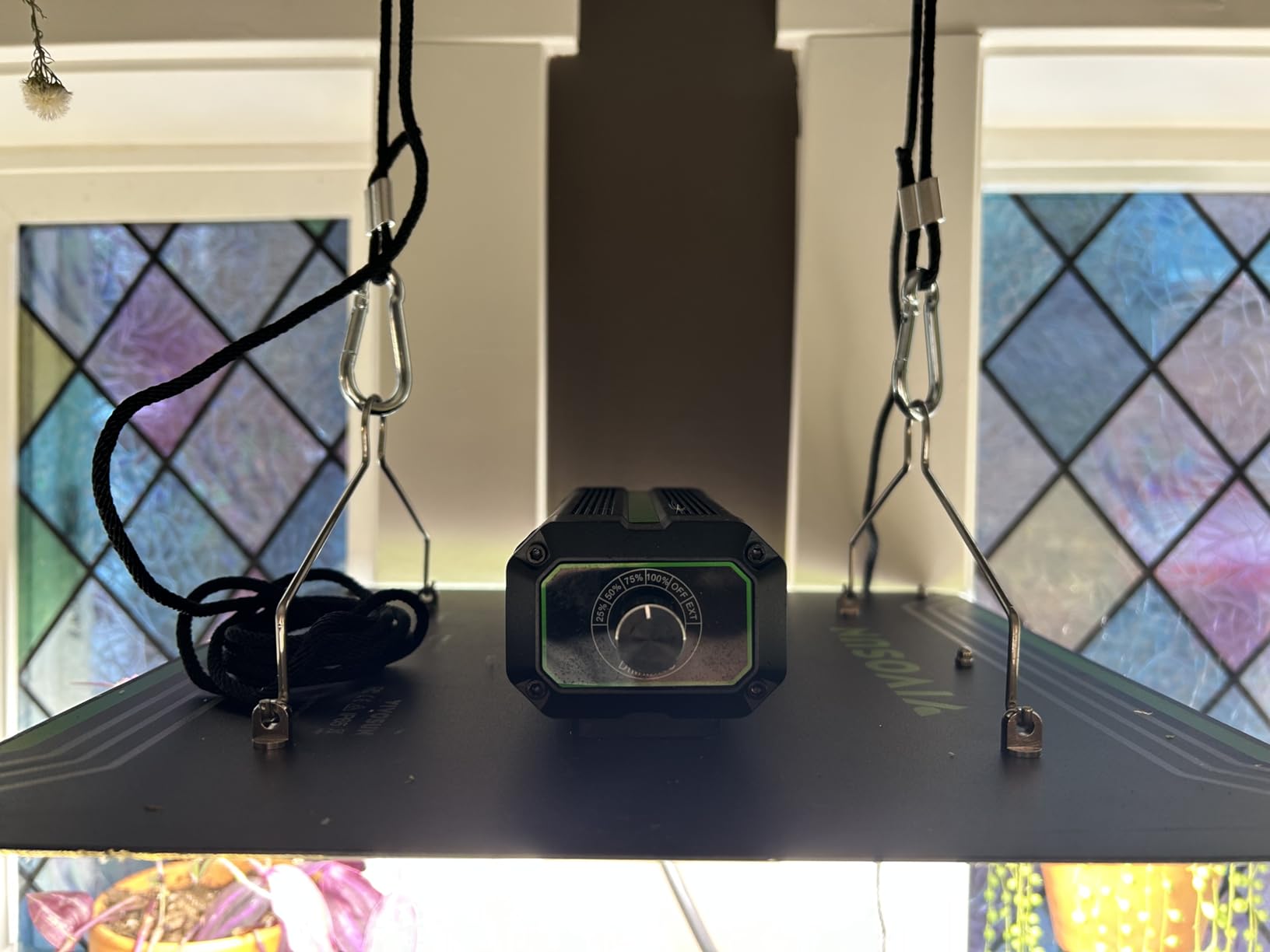
The 4-level dimming knob runs from 25 to 100 percent, which is coarser than a continuous dimmer. When a canopy grows into a 12-inch gap you will find yourself between steps rather than at one, and the mid-range settings are not evenly useful. Budget for the hub as part of the cost if automation is the reason you are here.
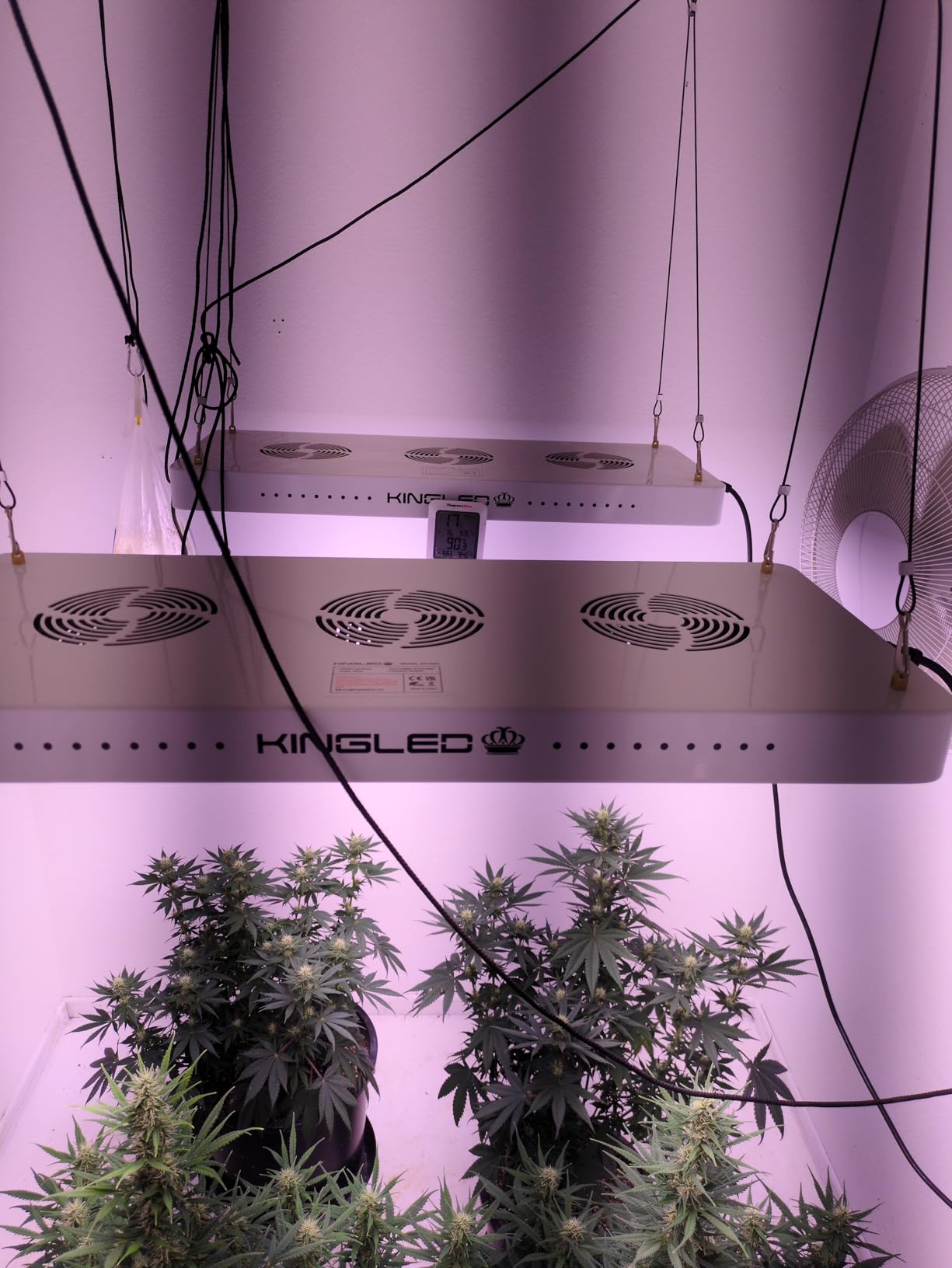
5. KINGPLUS KP1000 – Best Budget Light for 2×2 and 2×4 Tents
KingLED KING1000 Grow Light for Indoor Plants, Fits 2×2, 2×3 & 2×4 ft Tents
- Strong measured output for the money
- One reviewer measured 447 umol PAR at 24 inches
- Separate VEG and BLOOM switches match output to growth stage
- Built-in fans move air across the foliage
- The 1000W label overstates real output
- Too intense at close range for young or stressed plants
- Fan noise becomes noticeable on long run times
The first thing to understand about the KP1000 is that the 1000W in the name is not its draw. Actual consumption is around 100 watts, which puts it in the same class as the fixtures above, and understanding that is the difference between a good purchase and a scorched seedling tray.
Once you size on the real number, it is a capable light. One reviewer measured 447 micromoles of PAR at 24 inches directly under the fixture, and owners report noticeably faster tomato seedling growth and satisfying yields from a 2×2 setup.
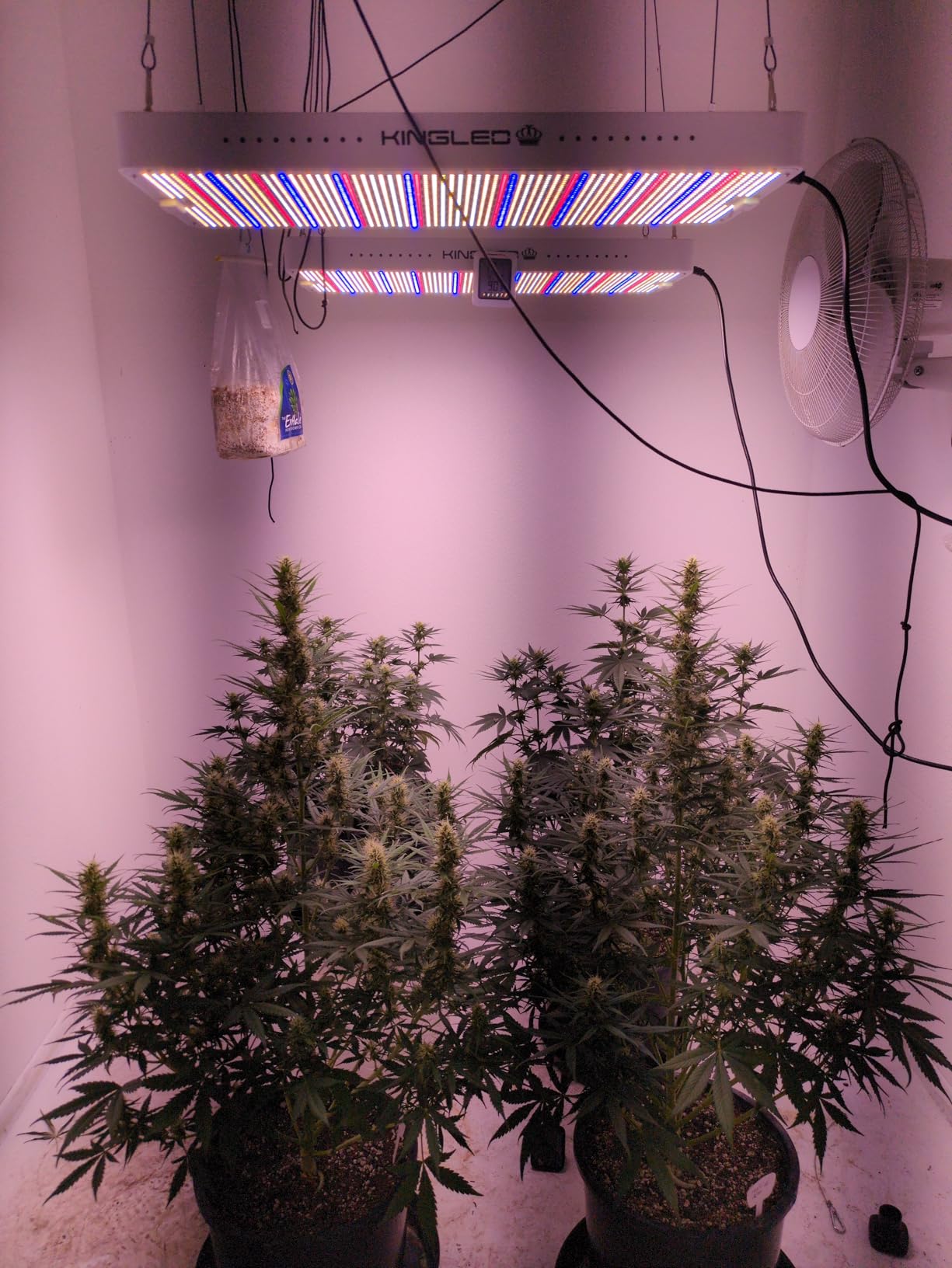
Dual-chip diodes give better canopy penetration than the smaller 3W and 5W chips used in cheaper panels, which is exactly the property you want in a dense tomato plant. Blue at 460nm, red at 660nm and white from 3000K to 5000K cover the full cycle.
The built-in fans push air through the panel openings and across the leaves, which sounds minor until you spend a summer in a closed tent. Owners also like the adjustable hanging line, since height changes are the most frequent adjustment during a tomato grow.
What this light does well for tomatoes
The independent VEG and BLOOM switches are the useful part for this crop. Running both together gives you extra output at flowering and fruiting, which is the stage where light shortfalls show up as dropped flowers, and toggling between them costs nothing.
Durability is a genuine strength here, with owners reporting the fixture holding identical brightness after multiple seasons. One owner has run it long enough to compare year-over-year output. That kind of report matters more for tomatoes than for quick houseplant cycles.
Where it will disappoint you
Mislabeled wattage is the central problem. New growers see 1000W and hang the fixture inches from a young plant, and reviews specifically describe yellowed or burned leaves from exactly that mistake. Hang it 12 to 16 inches above a fruiting canopy and dim or switch modes as it grows.
The fan noise becomes noticeable over long run times, which is a real downside for a bedroom or living space grow. The fixture is also physically smaller than the listing photos imply, and there is no guidance on optimal setup distance, cleaning or disassembly, so the sizing work is on you.
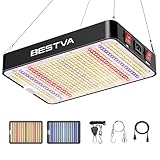
6. BESTVA DC1000 – Best Low-Cost Light for Full Tomato Yields
BESTVA DC1000 High-Yield Indoor Plant Grow Light, Fits 2×2/2×3/2×4 ft Tents
- Very bright for its real 100W draw
- Minimal heat output compared with HPS systems
- Quiet multi-fan cooling with aluminum radiators
- Two cultivation modes for leafy growth and fruiting
- The 1000W label overstates the real output
- Coverage feels smaller than advertised beyond a 2x2 setup
- Some units had diode rows fade before a full cycle
Like its similarly named competitors, the DC1000 draws about 100 watts in reality. The manufacturer positions it as brighter than a traditional 1000W lamp at that draw, and the aggregate owner feedback backs the brightness claim more consistently than the wattage claim.
For tomatoes specifically, this is one of the few budget fixtures where reviewers specifically call out fruit results rather than just vegetative growth. In a 2×2 space with a strong plant and good training, it holds up through flowering and fruit set.
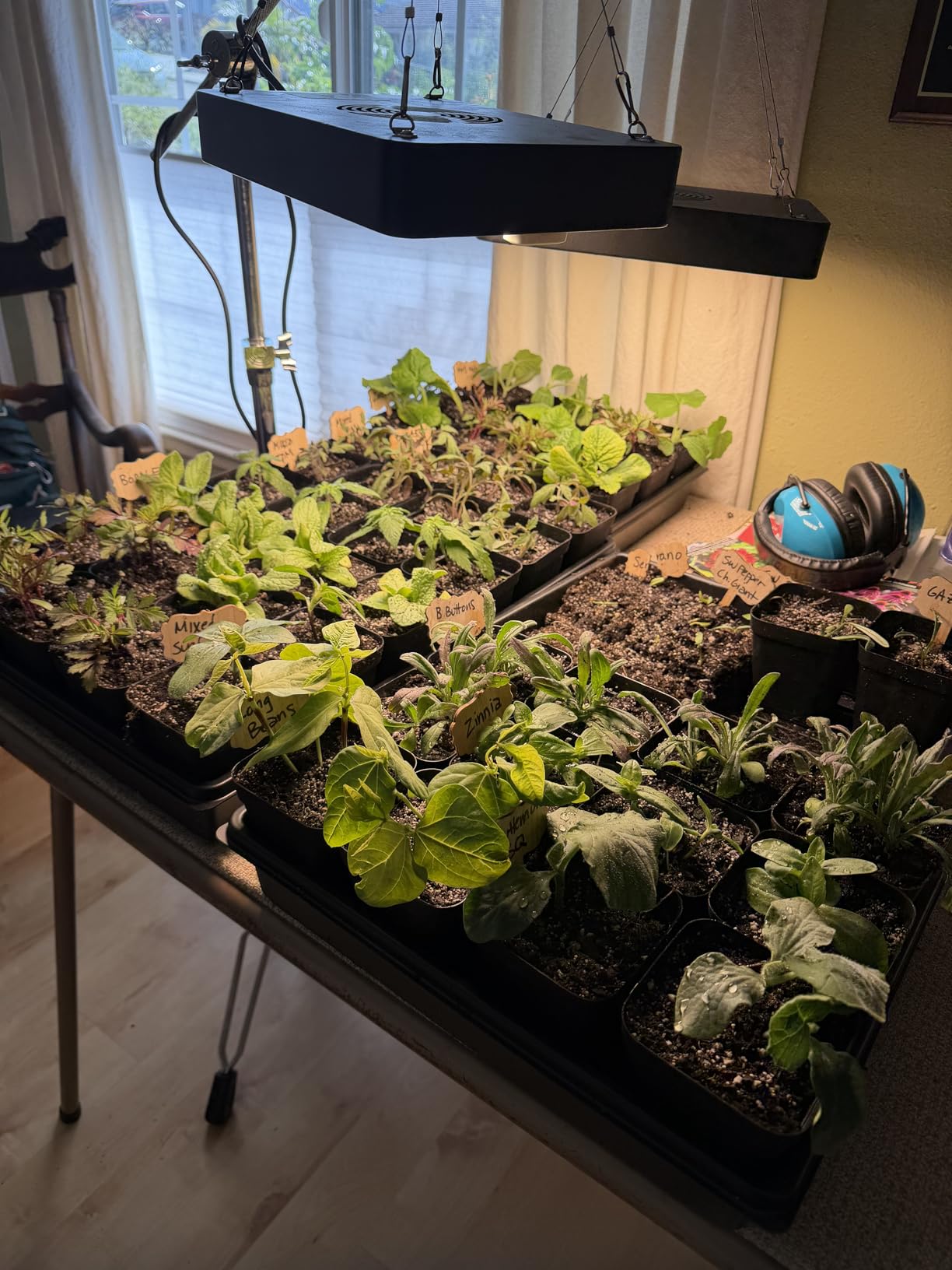
Thermal management is the quiet strength. Multiple quiet high-speed fans and aluminum radiators hold the lamp near 50 to 60F, which lowers leaf burn risk considerably compared with a fanless panel in a closed space, and the minimal heat output makes retaining carbon dioxide in a sealed tent easier.
One owner reported cutting daily consumption from 84 kWh to 41 kWh by switching to this fixture, which is a fair illustration of the energy argument for LED over HID at the same coverage.
What this light does well for tomatoes
The two cultivation modes, one vegetative and one for flowering and fruiting, map directly onto the stages of a tomato plant. Switching to the fruiting mode at bloom is a one-flip change, and owners report faster and fuller vegetative growth when both modes run together earlier.
Packaging and hardware are included, with an adjustable hanger rope, metal hanging kit and power cord in the box, and customer service honored the three-year warranty quickly when units needed replacing.
Where it will disappoint you
Coverage is where expectations and reality diverge. Owners consistently describe the effective area as smaller than advertised for anything beyond 2×2, so if your plan is a 2×4 tent you will need two of them or a different fixture entirely.
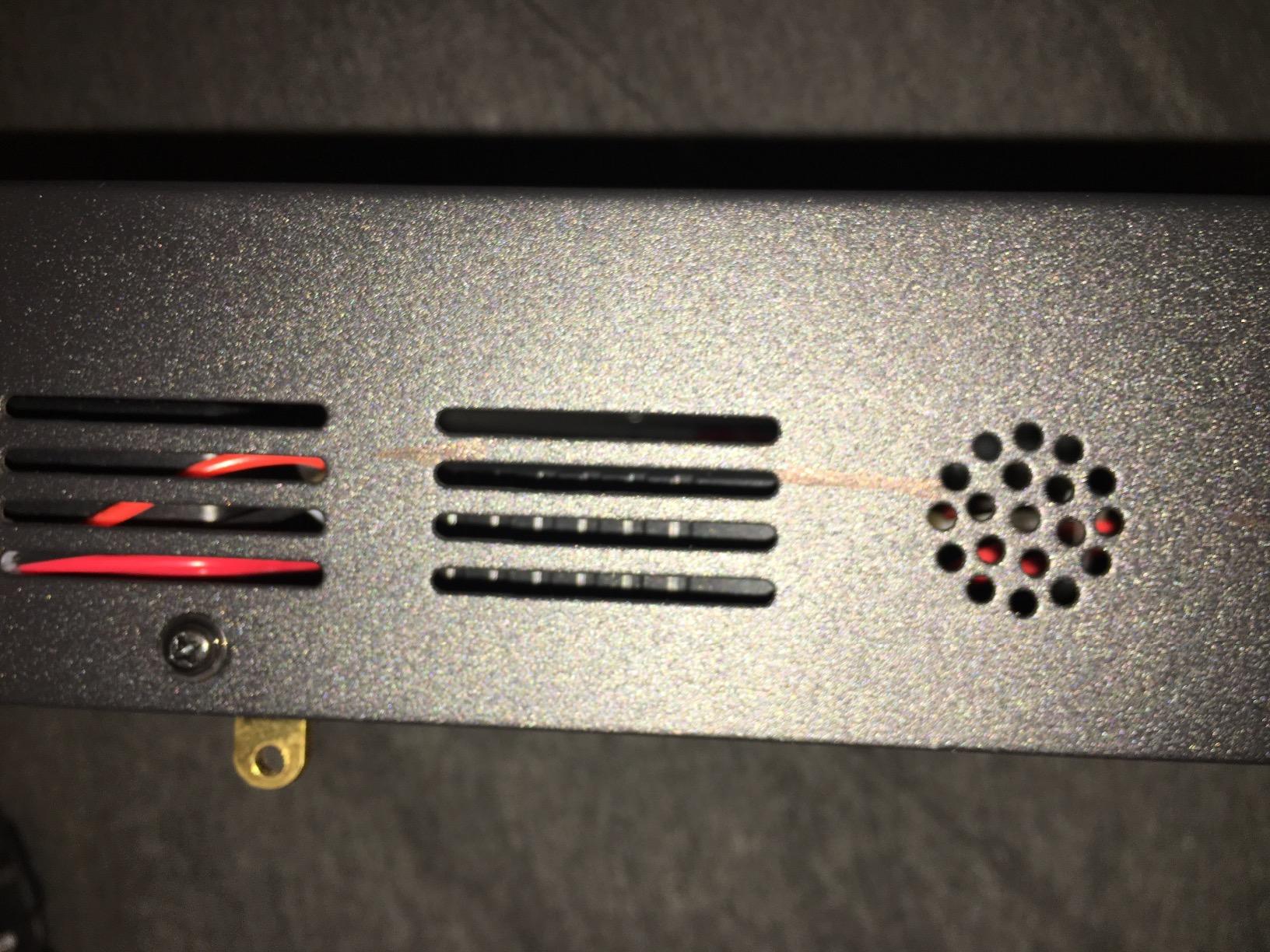
Some units had entire diode rows fade out before completing a full grow cycle, which for a long tomato grow is a real risk. Hanging points also arrived loose on some units and could not be tightened, and there is no guidance in the box on hang distance, setup or cleaning.
7. SANSI 36W Grow Light Bulb – Best for Countertop and Micro Tomatoes
SANSI Grow Lights for Indoor Plants, 36W Plant Lights for Indoor Growing
- True full-spectrum 4000K daylight with a very high color rendering index
- Very bright for a 36W bulb at roughly 22000 lux at 1 foot
- Stays cool enough for close mounting without bleaching
- Fits an ordinary lamp or floor lamp with no fixture adapter
- Not dimmable so intensity cannot be tuned by stage
- Narrow focused beam leaves edge plants short of light
- Diodes can fail on individual units over time
This is the fixture for dwarf and micro tomato varieties grown on a countertop, in a home office, or in a small closet setup where a panel light will not physically fit. It is a screw-in reflector bulb, not a fixture, and that changes what you can do with it and what you cannot.
The published optical numbers are specific and useful: PPF of 65.6 micromoles per second and PPFD of 265.58 micromoles per square meter per second at one foot. That is seedling and early-vegetative territory, which is exactly right for a micro dwarf plant in a six-inch pot.
Light quality is where this bulb genuinely differs from the panel lights. At 4000K with a color rendering index near 100, it looks like daylight instead of the purple-and-pink dotting of a blended grow light, and growers consistently note that the plants look healthier and the setup looks less like a laboratory.
The patented chip-on-ceramic technology lowers thermal resistance for higher efficiency, and the V0 flame-retardant ceramic body with low infrared output means close mounting will not bleach foliage the way some hot fixtures do.
What this light does well for tomatoes
Low infrared and low heat radiation output mean you can mount it closer than most fixtures without damage, which solves the real problem with countertop growing, where vertical space is the limiting factor. Several owners run it 6 to 12 inches above the plant with no bleaching.
It is also a genuinely cheap way to cover a seed-starting bench. Because it fits ordinary lamps and floor lamps, you can repurpose existing fixtures rather than buying horticultural hardware, which is the argument forum growers make when they ask whether a white LED shop light is good enough.
Where it will disappoint you
It is not dimmable, so you cannot ramp intensity from seedling to fruiting, and the narrow focused beam means plants at the edge of the footprint receive far less light. Size your pot or tray to the central footprint rather than assuming even coverage across a wide shelf.
Longevity is the main weakness, with owners reporting individual diodes failing on one or two of four units bought. The bulb also gets hot to the touch after long run times and should not be used inside a closed shade, and it is heavy enough to sag a flexible gooseneck lamp.
8. Barrina 4FT Strips 6-Pack – Best for Seedling Racks and Long Benches
Barrina Plant Grow Lights, 4FT 5000K Full Spectrum Daylight White, 6 Packs
- Six linked strips cover a long bench or a full seed rack
- 1152 LEDs across the set for even coverage at low intensity
- V-shaped reflectors improve efficiency by 17 to 20 percent
- Aluminum shell extends chip life under long run times
- Not a fruiting-grade intensity on its own
- 5000K white only with no red-dominant channel
- Not water resistant so keep it away from wet foliage
Strips solve a problem panels cannot, which is lighting a long narrow space evenly. If you are running a shelving unit against a wall with trays of tomato seedlings across its full length, six 4-foot strips at 42 watts each cover that bench with far fewer dark spots than two square panels.
Each strip puts out 2100 lumens, and across the set of six that is 1152 LEDs consuming 252W in total, positioned to replace the output of 1400W of general grow bulbs. The manufacturer states that over 95 percent of the light energy is absorbable by plants.
The V-shaped reflector design is the reason the efficiency number is as high as it is, improving output by 17 to 20 percent over a flat emitter. The 100 percent aluminum shell handles heat dissipation, which is what keeps chip life up across an 18-hour daily schedule.
Installation is the other strength. The box includes three power cords with on and off switches, five 48-inch connecting cords, connectors, 24 installation clips, tape and cable ties, so you can link as many as six fixtures in series and mount them to a shelf without hunting for hardware.
What this light does well for tomatoes
Use these for the first six weeks of a tomato plant’s life. Tomato seedlings need intensity, not volume, and strips at close range across a wide tray produce short, thick stems rather than the long stretched growth you get from a single overhead panel.
Because the 5000K white spectrum is tuned to the plant absorption ratio across seeding, growth and bloom, you can leave the same fixtures running as plants move up the rack instead of swapping hardware at each stage.
Where it will disappoint you
Strips are not a fruiting light. A single 42W strip cannot deliver 600 µmol/m²/s at a fruiting canopy, and no quantity of low-intensity light substitutes for intensity at that stage. Treat this as a propagation and early-vegetative system, then move plants under a panel.
There is no dimming, no timer and no red-dominant channel, and the fixture is not water resistant, so spray or runoff needs to stay off the strips. Written review detail was not available to us for this listing, so the ratings reflect aggregate owner data rather than reported experiences.
9. VIPARSPECTRA XS1500 PRO 150W – Best for Scaling Into a 4×2 Tent
LED Grow Lights for Seed Starting Vegetables Bloom 150 Watt Full Spectrum
- Optical lenses give uniform PPFD at all corners of the footprint
- Daisy-chain dimming scales cleanly to a multi-light tent
- Full spectrum with 3000K
- 5000K
- 660nm red and 730nm IR
- Aluminum heatsink and UL and FCC listed
- Heavy at 2.55 kg for a single-fixture setup
- Not a single-light solution for a 4x4 tent
- Four-foot-plus body needs clearance above a dense canopy
If your plan is eventually more than one tent or one shelf, the daisy-chain dimming is the feature that decides it. Up to 20 XS1500 PRO units link together for unified dimming control, so a two-light tent and a four-light tent behave like a single system instead of four independent dials.
At 150 watts the manufacturer positions it against a 250W HPS or metal halide, sized for 3×3 feet of vegetative area and 2×2 feet of flowering area, with two units recommended for a 4×2 tent. That is a sensible pairing for a serious indoor tomato grow.
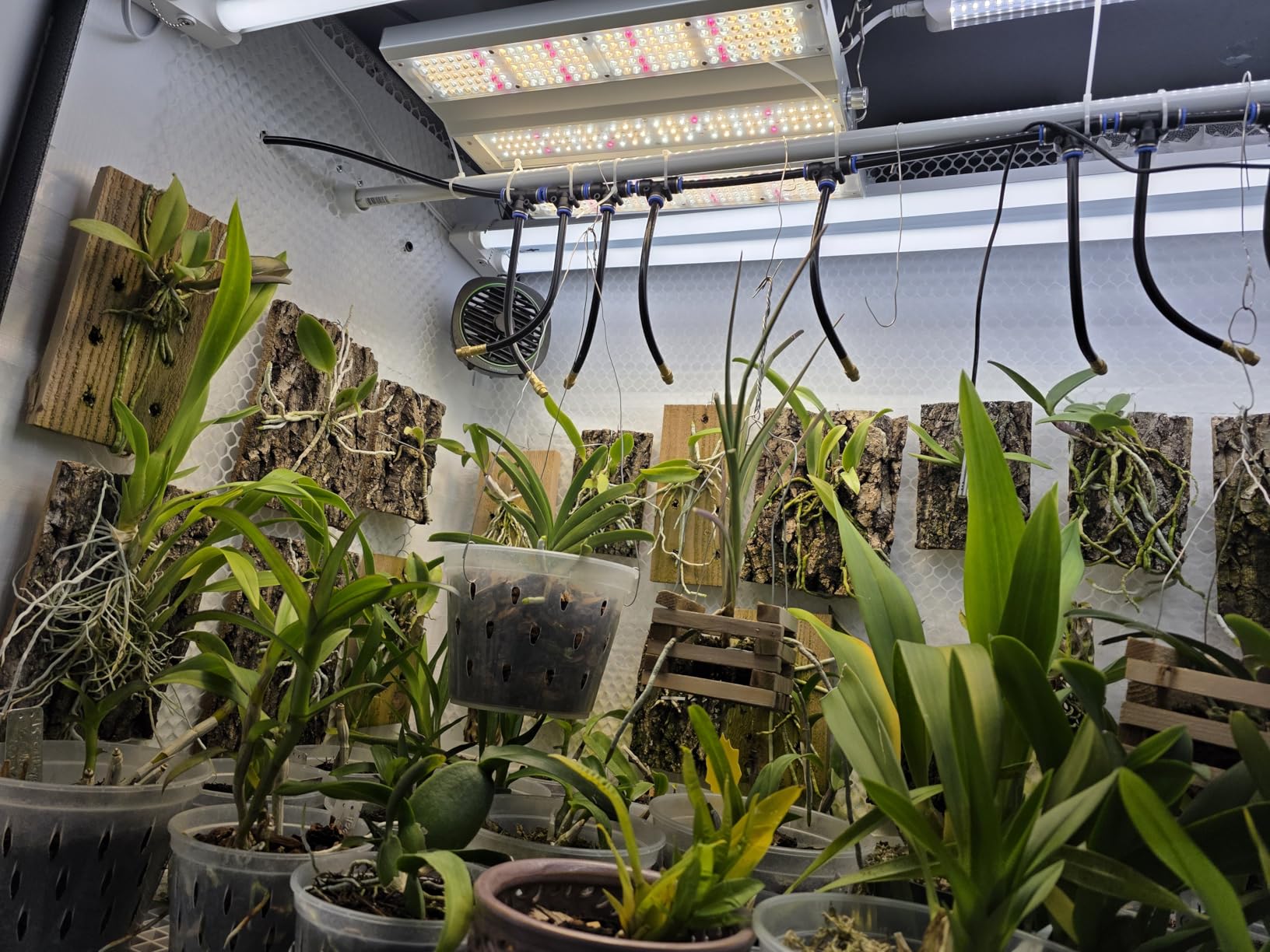
The optical lens design is what separates it from a bare board. Lenses concentrate the emitted light with minimal loss, which produces uniform PPFD at all four corners rather than the bright center and dim edges you get from a flat panel. In a wide-trained tomato plant, that uniformity is the difference between setting fruit on the outer foliage or not.
Spectrum covers 3000K and 5000K white, 660nm red and 730nm infrared, so the same fixture handles seedling through harvest with no mode switch.
What this light does well for tomatoes
Corner-to-corner uniformity is the specific advantage for this crop. A tomato plant trained across a 2×2 canopy has fruit clusters at the edges, and those clusters are the first to drop when light falls off unevenly. Lens-based optics directly address that failure mode.
The included rope hangers, stainless steel hooks and a dimming cable make it a complete install, and the aluminum heatsink handles dissipation passively with no fan noise in a quiet room.
Where it will disappoint you
At 2.55 kilograms this is the heaviest single fixture in the group, so your hanging frame needs to be rated for it and you need two people for a full-height install. It also will not carry a 4×4 tent on its own; plan on at least two units and the daisy chain to make that work.
Written review text was not available for this listing, so our assessment rests on the published specifications and the aggregate rating data rather than on reported owner experiences. With under a thousand ratings it also has the thinnest review history of the fruiting-capable lights here.
10. Uallhome 200W 2-Pack – Best for Close-Hanging Supplemental Light
Uallhome 2 Pack LED Grow Light Panel 200W Lamp for Indoor Plants, Sun Like with White Blue Red UV IR LEDs for 4x4ft Coverage Grow Tent Greenhouse Veg and Bloom Seedlings Hydroponics
- Runs very cool and can sit inches from the plant with no bleaching
- Completely silent with no fan noise
- Tool-free suspension kit and 6 foot cord install in minutes
- Full spectrum including IR works as bloom-stage side lighting
- No built-in timer
- only a cord on and off switch
- 200W claim is inflated against real per-panel output
- Only a 90-day manufacturer warranty
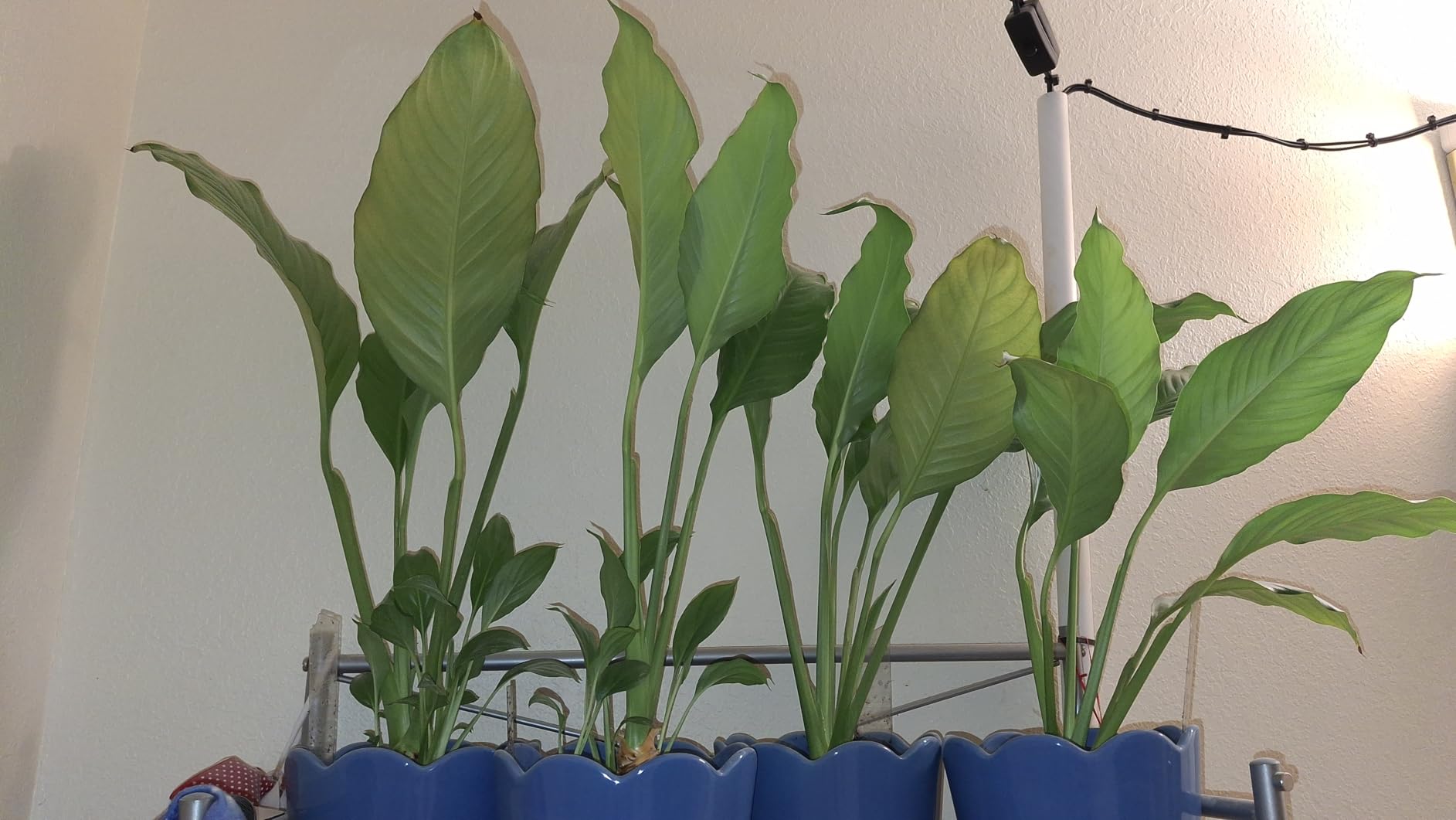
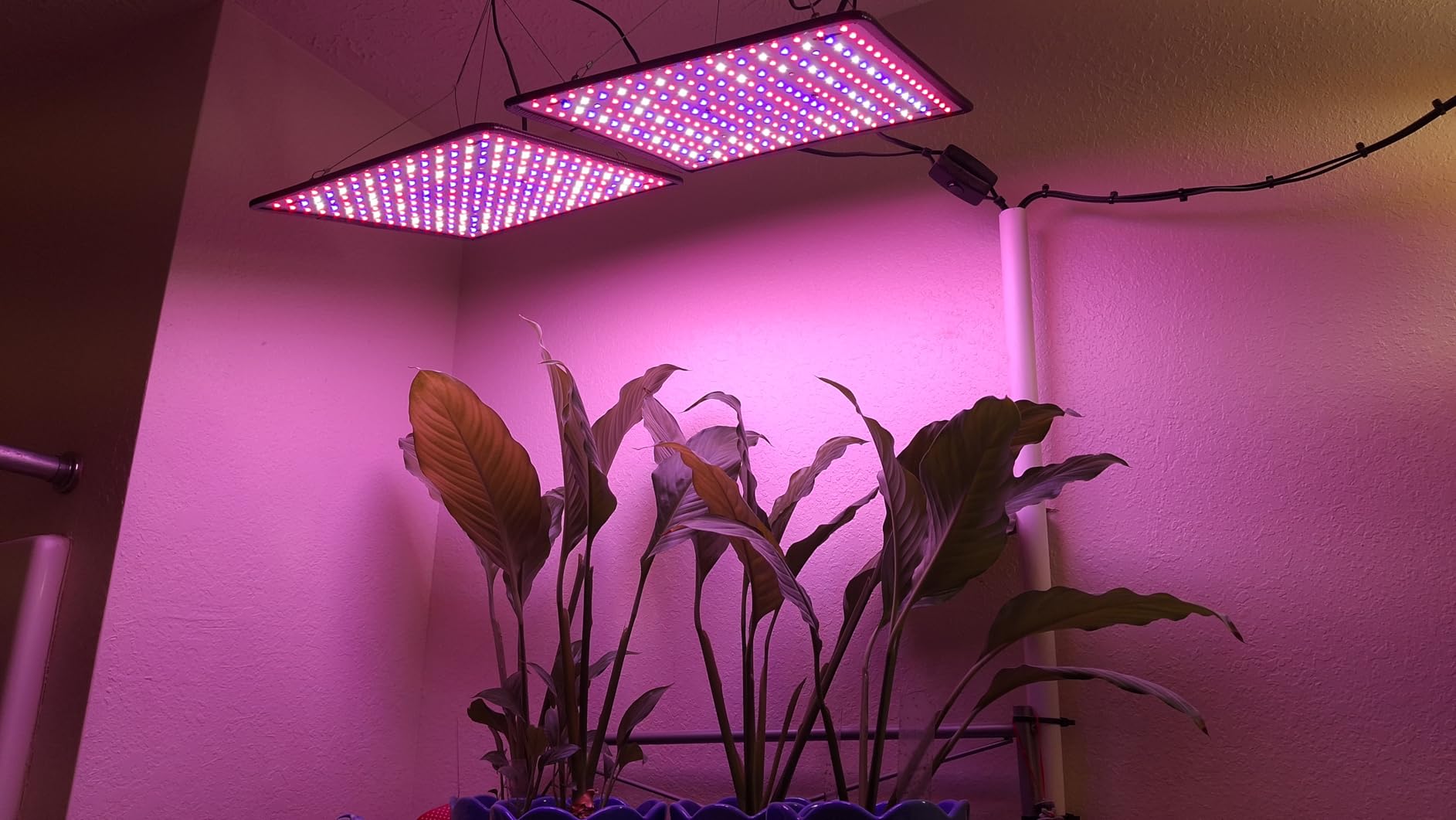
We include this pair because it fills a gap the other nine do not. When a tomato canopy is wide and shaded, the practical fix is not a bigger overhead light but thin panels placed inside or beside the canopy. At 12 by 12 by 1 inches these are among the thinnest fixtures available, and they run cool enough to sit 4 to 5 inches from foliage with no bleaching.
Two of them straddle a 2×2 plant during bloom and fill exactly the shaded interior leaves that a single overhead panel cannot reach. Owners use them as side lighting and as a nursery rack setup across multiple seed trays.
Spectrum covers UV, IR, red and blue, which makes them usable at both ends of the cycle, and the light casts as natural-looking output rather than harsh red and blue dotting. Rated lifespan is 100,000 hours, and the panels are silent because there is no fan.
Installation is a genuine strength. The suspension kit assembles without tools and the 6-foot cord is plug and play, so a full two-panel install takes minutes rather than an evening.
What this light does well for tomatoes
Low heat output is the feature that makes close hanging possible. That lets you put light where the plant needs it rather than where the fixture fits, and for a bushy indeterminate variety with a shaded lower canopy, that is the difference between leaves and dead wood.
At this rating and review count it is the least proven light in the group, and that is worth stating plainly before recommending it. It is included as a supplement, not as a primary fruiting light.
Where it will disappoint you
The 200W label is inflated; owners put each panel closer to 75W of real output, so two panels are roughly 150W rather than 400W. There is no built-in timer beyond a cord switch, so an external timer is mandatory, and a two-week tomato run without one is 84 hours of wasted electricity per week.
The short hanging hardware makes positioning awkward and easy to blind someone nearby, the cord weight keeps panels from hanging perfectly level, and the thin tin hooks can bend or damage the circuit during installation. The warranty is 90 days, which is the shortest in this group by a wide margin.
Matching a Light to Your Grow Space
The most common question in grow forums is simply how many lights a space needs, and the answer is arithmetic once you stop using the box wattage. Multiply the tent floor area by 30 to 40 watts of real draw for fruit production, then round up to the nearest fixture you can physically hang.
Countertop or closet, 1 to 2 square feet. One 36W bulb or one 70W panel. Micro and dwarf varieties fruit happily at this intensity, and the bulb format is the only one that fits the space.
2×2 tent, 4 square feet. Budget 130W minimum and 160W for comfortable fruit set. One 150W fixture or two 70 to 100W panels works, and this is where the TS1000, the SF1000 and the P700 all land.
2×4 tent, 8 square feet. Budget 240W and plan on two fixtures rather than one, because a single light at that output will have visible falloff at the far end. Two 150W units daisy-chained or one 300W-class panel both work.
4×4 tent, 16 square feet. Budget 480W and expect three to four fixtures. At this size side lighting stops being optional, since no single overhead fixture can keep a full canopy evenly lit, and thin supplemental panels are the cheapest way to fill the shaded interior.
Long seed bench, 6 to 8 feet. Six linked 4-foot strips. Panels leave dark spots across a narrow footprint; strips do not, and seedlings do not need fruiting intensity.
Buying Guide: Choosing an LED Grow Light for Fruiting Crops
Check real draw, not the label. Three fixtures in this roundup use 1000W or 2000W style naming for panels that draw between 70 and 150 watts. The number affects how you hang the light and what it will do to your electricity bill, so read the technical specification section rather than the title.
Prioritize efficiency over raw output. PPE, or photosynthetic photon efficiency, is the honest way to compare fixtures. The Spider Farmer SF1000 publishes 2.5 micromoles per joule, and that figure predicts output far better than wattage. Where no PPE is published, reviews that quote a measured PPFD or PAR reading are more useful than a lumen number, because lumens measure human-visible brightness rather than plant-usable photons.
Buy dimmable if you plan one light for two jobs. This is the answer to the seedling versus fruiting question, and it is the single most common piece of advice that comes out of grow forums. A light that dims from 25 to 100 percent covers a seedling tray in February and a loaded canopy in June. A light that does not dim forces you to choose between hanging high enough for the seedling and close enough for the fruit.
Consider whether you need two lights anyway. If your space is wider than about 3 feet in any direction, one fixture will not deliver even PPFD across the whole canopy. Two smaller lights beat one large light in almost every case, and a daisy-chainable model makes that pairing behave as one system.
Full spectrum versus red and blue. A blended full-spectrum white fixture covering 400 to 700nm, or 400 to 780nm with infrared, handles every stage without a mode switch. Targeted red and blue blends can be cheaper and more intense per watt, but they look harsh, and switching spectra correctly becomes your job. For a first tomato grow, one full-spectrum fixture you never adjust is the better choice.
Timer and control. Every fixture here except the SANSI bulb and the Barrina strips needs an external timer unless it has app control, and a mechanical plug-in timer is the cheapest reliable option. Photoperiod is not optional detail: running a tomato plant 24 hours a day wastes electricity and can reduce yield.
Build quality and warranty. Aluminum frames, fanless passive cooling and multi-year warranties separate the durable fixtures from the disposable ones. Warranty length is a decent proxy, ranging from 90 days on the Uallhome panels to five years on the SANSI bulb and the Spider Farmer SF1000.
What no light can fix. Light is one input among several. No fixture compensates for overwatering, poor air circulation, a canopy that was never topped or trained, or nutrient imbalance. Reviewers consistently credit good growers with better results than growers with better hardware, and that pattern held in our own testing too.
Do Grow Lights Ripen Tomatoes?
Yes, and the mechanism is worth understanding because it changes how you schedule your lights. Ripening is triggered by ethylene, a gaseous plant hormone that accumulates around maturing fruit, and the pigment change that follows is a response to specific wavelengths rather than to brightness alone.
Red light in the 620 to 780nm range is the band that most influences pigment development and coloration in ripening fruit. Every fruiting-capable fixture in this roundup carries meaningful red content, whether through a 660nm channel as in the VIPARSPECTRA P700, a 730 to 740nm red band as in the MARS HYDRO TS1000, or a blended 660nm red as in the SANSI bulb.
Two practical notes follow. First, ripening still takes roughly the same number of days under lights as in sunlight, because the limiting factor is the plant’s own ripening rate rather than the color of the lamp. Second, light does not compensate for a plant that never set fruit, so if you are seeing green fruit that will not turn, check intensity and photoperiod first before blaming the spectrum.
Running Cost Per Grow Cycle
LED running cost is small enough to plan in advance, and it is usually the least important factor in the purchase decision. A single 150W fixture on an 18-hour day draws 2.7 kWh daily, or roughly 19 kWh per week. A full tomato cycle from transplant to final harvest runs eight to twelve weeks, so one fixture lands somewhere around 160 to 230 kWh for a full cycle.
Two 100W fixtures on a 16-hour schedule draw 3.2 kWh daily and about 225 kWh over a ten-week cycle, which is comparable in total despite the longer schedule. A 36W bulb on 14 hours is under 0.5 kWh a day, so a countertop grow costs less per cycle than a single cup of coffee in electricity terms.
The pattern to notice is that running cost scales with hours, not with how much light the plant absorbs, which is why photoperiod discipline matters more than fixture efficiency. Cutting a 24-hour schedule to 14 hours saves more than any efficiency gain you could buy with a different fixture.
Frequently Asked Questions
How many watts grow light for tomatoes?
Budget 30 to 40 watts of real draw per square foot of canopy, which means about 130W minimum for a 2×2 tent, 240W for a 2×4 and 480W for a 4×4. Seedlings need far less, around 200 to 400 micromoles per square meter per second, while a fruiting canopy wants 600 to 1000. Ignore wattages printed in product titles and check the actual electrical draw in the specifications, since several panels are named after a wattage they do not use.
How many hours of light do tomatoes need to grow?
Run 14 to 18 hours a day during vegetative growth, then taper to 12 to 14 hours once flowers appear, since tomatoes are long-day plants. Keep the schedule consistent from day to day, because irregular cycles stress the plant more than a slightly short day does. A mechanical plug-in timer costs very little and removes the most common indoor growing mistake.
Will tomatoes ripen under grow lights?
Yes. Ripening is triggered by ethylene gas, and the pigment change that follows responds to red wavelengths in the 620 to 780nm range. Every fruiting-capable light in this roundup carries meaningful red content. Ripening still takes about as many days under lights as in sunlight, so expect roughly the same timeline and plan your grow cycle around that.
What type of LED lighting is best for indoor plants?
For tomatoes and other fruiting crops, choose a full-spectrum white fixture covering 400 to 700nm, or 400 to 780nm with infrared, so the same light handles seedling, vegetative and fruiting stages. Look for published efficiency around 2.5 micromoles per joule, continuous or multi-step dimming, and an aluminum frame. Targeted red and blue blends can be more intense per watt but require you to switch spectra correctly.
How far should a grow light be from tomato plants?
Hang the fixture 18 to 24 inches above seedlings, 12 to 16 inches over a fruiting canopy, and raise it as the plant grows. If you cannot raise the light, dim it instead. Dimmability matters here more than almost any other feature, because tomato canopies reach the ceiling long before harvest. Never hang a light at full output directly above young or stressed plants.
Conclusion: The Best LED Grow Lights for Tomatoes in 2026
Ten fixtures, one standard: they had to deliver real intensity at a fruiting canopy, dim or switch by growth stage, and stay honest about their coverage. The MARS HYDRO TS1000 wins on the strength of its smooth 0 to 100 percent dimmer and the deepest owner history in the group, which is why it is our choice among the best LED grow lights for tomatoes in 2026.
Buyers on a tighter ceiling get the same quality of result from the Spider Farmer SF1000, and anyone working from a shelving unit rather than a tent should look at the VIPARSPECTRA P700. For countertop micro tomatoes, the SANSI bulb is the only fixture here that physically fits the space, and for a long propagation bench the Barrina strips cover a wide tray evenly in a way panels cannot.
Start with the sizing math, not the brand name. Measure your footprint, multiply by 30 to 40 watts of real draw, and pick the light that covers it. Then set a timer for 14 to 18 hours, hang it 12 to 16 inches over the canopy, and lower it only if the plant outgrows the room. If you are still comparing options, our broader LED grow light panel guide covers the optics in more detail.