
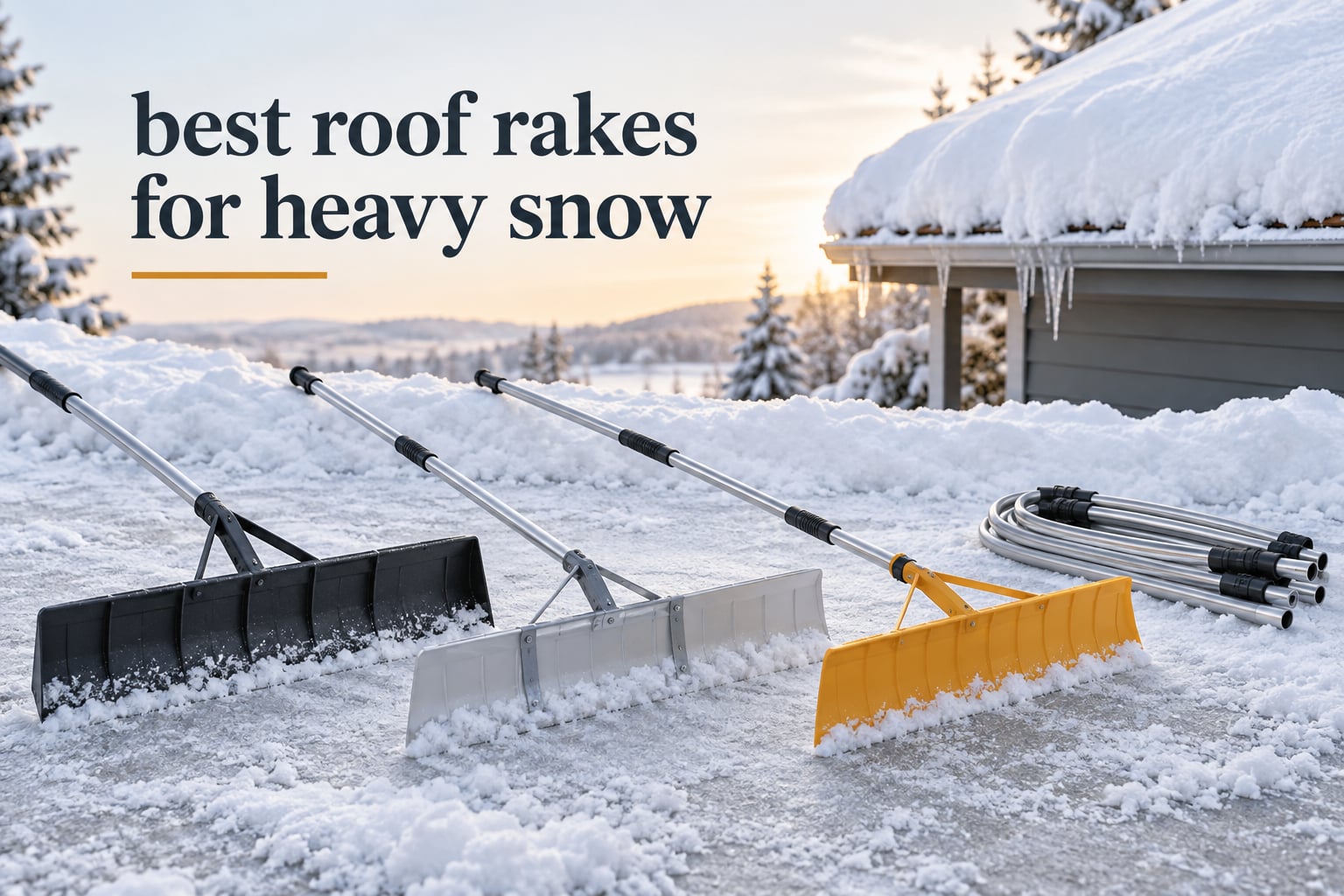
Heavy snow does not fail a roof rake in one dramatic break. It works on the hardware slowly: a plastic blade freezes brittle, an aluminum bracket bows under a crusted drift, a screw in a molded head works loose after twenty hard pulls. If you live where roofs collect more than a foot of snow at a time, the best roof rakes for heavy snow are the ones with a wide head, enough reach to cover a two-story eave, and a blade stiff enough to push through wet snow rather than ride over it.
That is exactly what we ranked. We compared twelve ground-level snow rakes, weighing blade width and material, pole length, actual standing reach, weight, and whether the head touches the roof surface. We also read the complaint patterns in the reviews, because the failure modes show up there long before they show up in a spec sheet.
Are snow roof rakes worth it? For most homeowners in a heavy-snow region, yes. Removing part of the snow load from the roof before it melts and refreezes is the single most effective step you can take against ice dams, and it is the only ice-dam method that keeps both feet on the ground. Our rule of thumb: clear the roof as soon as snow settles rather than waiting, and try to remove roughly a quarter to a third of the accumulated depth during a storm cycle. If you want the ground-level version of the same job, our roof rake roundup for snow removal covers the lighter-snow picks in more detail.
One quick note on category accuracy. Vehicle and car snow rakes are not roof rakes. They are designed to clear a windshield or a truck bed from a lower, closer angle, and they appear in some roof-rake lists online. Nothing in this roundup is one of them.
Table of Contents
Top 3 Roof Rakes for Heavy Snow in 2026


Extreme Max 5600.3207 Shingle-Saver
- 21 ft reach
- 7 x 24 inch aluminum blade
- shingle-saver rollers

SNOWPEELER 30 ft Telescopic Rake
- 30 ft reach
- commercial-grade blade
- 13 lb heavy-duty build
These three cover the realistic choices. The Snow Joe is the one most households end up with, because a light telescoping pole and a 25 inch poly head clear a lot of snow without tiring your shoulders. The Extreme Max is the all-metal alternative with roof-safe rollers and an angled head for low pitch. The SNOWPEELER is the reach answer, extending to 30 feet for tall roofs and hard-packed snow, at the cost of 13 pounds in your hands.
12 Roof Rakes for Heavy Snow Compared Side by Side
| Product | Specifications | Action |
|---|---|---|
| Snow Joe RJ204M Telescoping Roof Rake |
|
Check Latest Price |
| Extreme Max 5600.3207 Shingle-Saver |
|
Check Latest Price |
| SNOWPEELER 30 ft Telescopic Rake |
|
Check Latest Price |
 Avalanche! AVA500 Slide-Style Rake Avalanche! AVA500 Slide-Style Rake |
|
Check Latest Price |
 Suncast SRR2100 Adjustable Rake Suncast SRR2100 Adjustable Rake |
|
Check Latest Price |
 USA-Made 20 ft Shingle Saver Rake USA-Made 20 ft Shingle Saver Rake |
|
Check Latest Price |
 MinnSnowta Dynamo Rotor-Style Rake MinnSnowta Dynamo Rotor-Style Rake |
|
Check Latest Price |
 EZ Smart 16 ft Adjustable-Width Rake EZ Smart 16 ft Adjustable-Width Rake |
|
Check Latest Price |
 Roof Razor 22 ft Brush and Rake Combo Roof Razor 22 ft Brush and Rake Combo |
|
Check Latest Price |
 Leanaco 21 ft Foam SnowBuster Leanaco 21 ft Foam SnowBuster |
|
Check Latest Price |
 VEVOR 21 ft 25 Inch Blade Rake VEVOR 21 ft 25 Inch Blade Rake |
|
Check Latest Price |
 Change Moore 19.88 ft Wheeled Rake Change Moore 19.88 ft Wheeled Rake |
|
Check Latest Price |
Why Heavy Snow Breaks Most Roof Rakes (and When to Call a Roofer)
Heavy snow is a different problem than light snow, and the reason is water content. Dry powder slides off a roof in a single pull because it has almost no weight and no friction. Wet, dense snow sits until it soaks into the shingles, refreezes overnight, and turns into a bonded mat that a plastic blade simply skates over.
That mat is the whole reason ice dams exist. Warm interior heat rises, melts the snow higher up the roof, and the meltwater runs down until it hits the frozen edge above the overhang. It refreezes there and builds a ridge, and every storm adds a little more. Roof rakes work because they interrupt the cycle early, before the melt-and-refreeze has anything to grab onto.
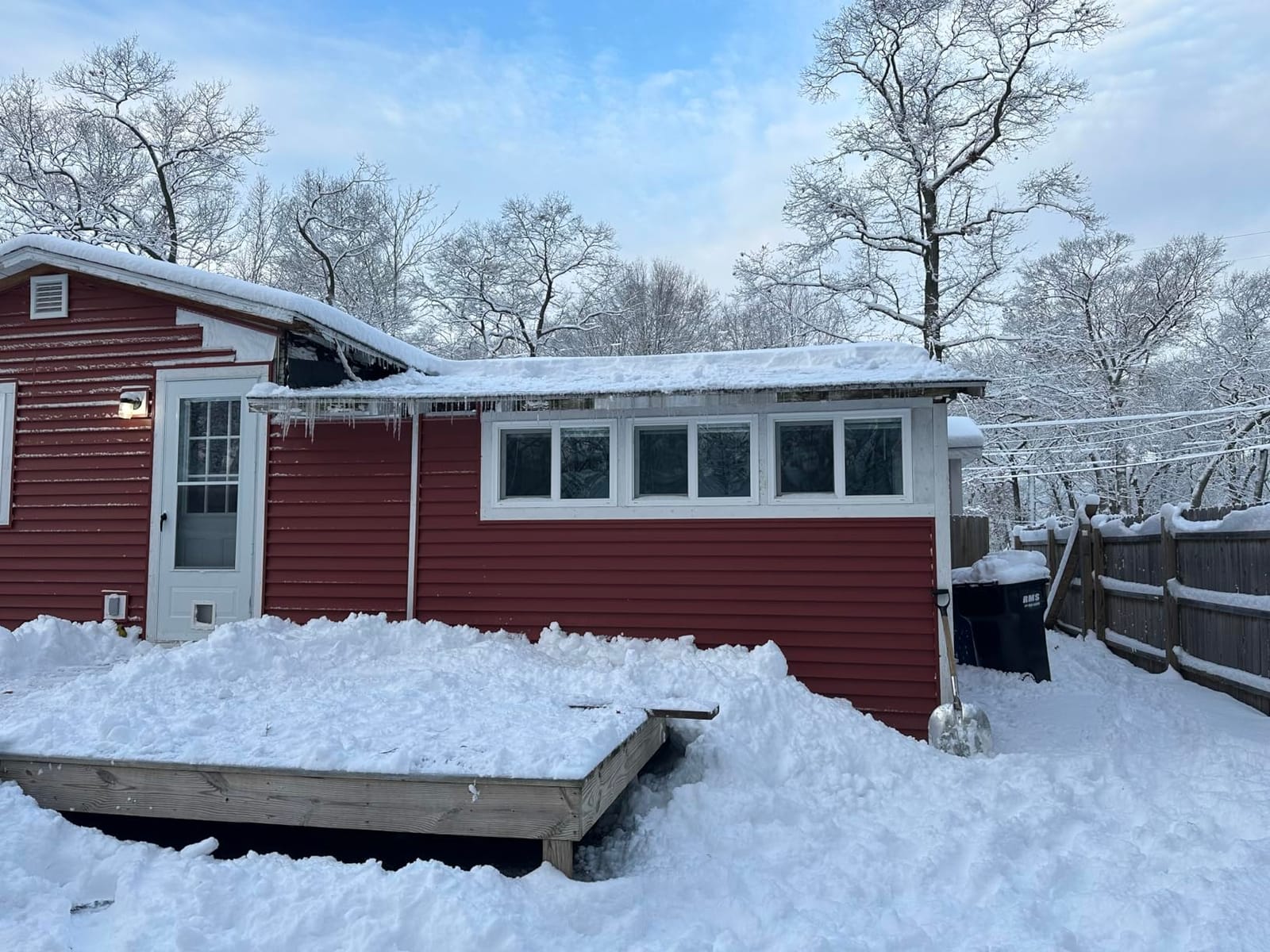
Most owners in northern New England and the upper Midwest, where we see the hardest conditions, describe the same failure pattern: poles flex, blades bend, and grips slip once the snow crusts over. In forum threads, owners in the heaviest snow bands sometimes decide not to rake at all, judging the risk of working near an over-loaded roof not worth it. That is a reasonable call in some winters.
Stop and call a roofer instead when any of these are true:
The snow has crusted, refrozen, or formed slabs that a blade rides over instead of cutting.
You can see a growing ridge of ice at the eave rather than loose snow on the field.
Your roof is old, already flexing or sagging, or has brittle original shingles.
You would need to climb onto the roof, or stand on a ladder in the loaded path, to finish the job.
You have a slate or tile roof and cannot confirm the rake head will not catch an edge or a fastener.
None of the twelve rakes below will remove a solid ice dam. Professionals use steam and water for that, and the manufacturer’s own documentation on several of these tools says so plainly. Rakes are preventive and light-load tools, and the heaviest-duty one in this group still expects you to work loose snow from the ground.
How to Use a Roof Rake Safely in 5 Steps
Technique matters more than people expect. Most damage reports trace back to a fast pull on hardened snow or to the head catching a roof fastener, not to a faulty tool.
Dress for it. Insulated gloves and a grippy outer layer matter more than any feature on the tool. You will be outside in cold weather holding a long lever for a while.
Set the pole before you touch the roof. Extend to the length you need while standing on flat ground, lock every section, and confirm the head clears the shingle line by a couple of inches before you begin.
Pull, do not push. Start at the peak and draw the head down the slope so gravity carries the snow off the eave. Pushing uphill drives the head into the roof surface and loads the support brackets, which is the single most common cause of bent arms.
Work in the direction the roof drains. Clear the lower field first, then the upper field, so snow slides onto ground you have already cleared. Stop before you reach the last few inches above the eave if the snow is crusted.
Finish the eave, then leave. The goal is a clear strip at the edge where meltwater can run off. Once the eave is open, the rake is done. Do not climb up to inspect the result.
For the ground work afterwards, our picks for snow blowers built for heavy snow and machines tested on heavy wet snow handle the piles a rake leaves at the base of the downspouts.
1. Snow Joe RJ204M Telescoping Roof Rake: the Best All-Rounder
Snow Joe Telescoping Roof Rake, Extendable Leaf & Snow Shovel with Poly Blade, 25 Inch Wide, RJ204M
- Sets up in about a minute with no snap-together sections
- Lightest head in the group at 4.8 pounds
- Oversized 25 inch poly blade clears wide swaths per pass
- Doubles as a leaf and debris rake on roofs and cars
- Brass insert and brace screws can pull out under load
- Too light to break crusted or refrozen snow
- Handle bows at full extension
This is the rake we recommend to most households, and it is the tool we reach for first when snow is falling steadily rather than sitting on the roof already crusted. The 6 by 25 inch poly head is genuinely oversized, and at 4.8 pounds it is the easiest one here to hold overhead for a full pass without your arms complaining.
The setup matters more than the numbers suggest. Instead of threading pole sections together, the Twist-n-Lock handle extends in about a minute, which means you are not assembling anything in gloves at 6 in the morning. Owners with solar panels on the roof mention it often, since the light weight makes careful work around glazing more forgiving.
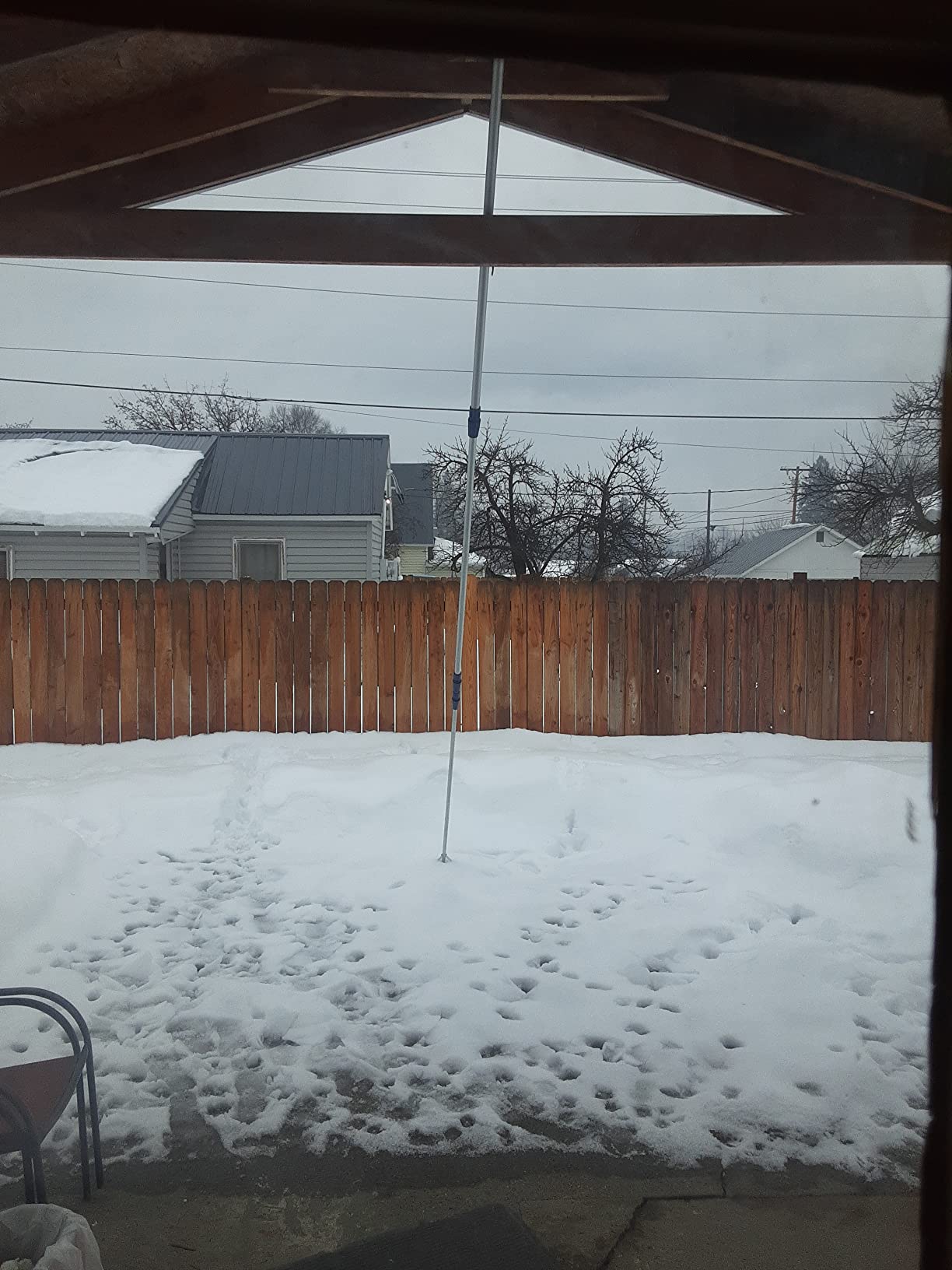
Owners like the reach, which extends to 21 feet with roughly 27 feet of overhead coverage once you account for your own height and the angle. That is enough for the eave of a typical two-story home without a ladder, which is the entire point.
Can it cut heavy wet snow, or only fresh powder?
Only fresh snow. The 4.8 pound weight is a virtue for fatigue and a limitation for crusted drifts, and reviewers report that it rides over hardened or refrozen layers instead of cutting them.
If your region gets repeated wet snowfall that refreezes overnight, treat this as a preventive tool you use during the storm, not a rescue tool you reach for after a week of accumulation.
What breaks first, and how do I prevent it?
The small brass insert threaded into the molded plastic head, and the screws holding the braces to the blade. Reports of both loosening or falling out during use are consistent across reviews.
Check those two points with a screwdriver at the start of each season and before a long storm, and note that lock nuts can freeze in the threads in deep cold and block length adjustment.
2. Extreme Max 5600.3207 Shingle-Saver: the Best All-Metal Value
- All-metal build with no plastic parts to snap off
- Rollers hold the head off shingles
- Light aluminum is easy to control at reach
- Angled head suits low-pitch and ranch roofs
- Aluminum support brackets can bend under hardened snow
- Sharp raw aluminum edges may need deburring
- Bolt joint can walk out of the rod tip
The Extreme Max is the pick for anyone who does not want plastic parts anywhere on a tool that lives in freezing conditions. The head, the pole, and the grip are all metal, and the 7 by 24 inch blade is angled, which makes it unusually good on low-pitch roofs where a straight blade tends to ride.
It also ranks near the top of the category in snow rake sales, and at 21 feet of reach it covers the same two-story envelope as the Snow Joe. Owners with ranch homes and shallow pitches call out the angled profile specifically, since it gets under a shallow snow field more effectively.
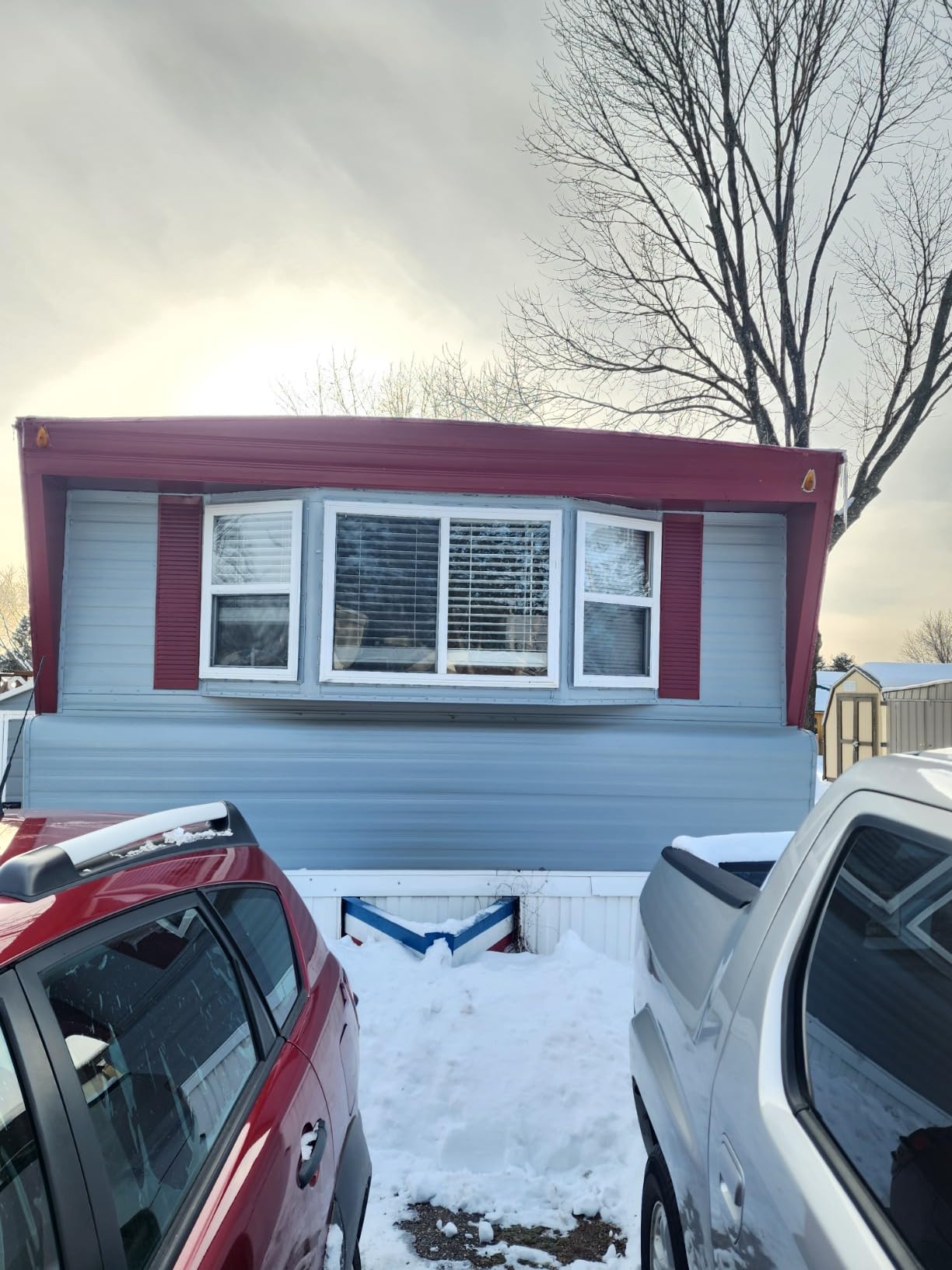
The blade rollers are the detail worth understanding. They hold the head slightly off the shingle surface while still cutting close, so you clear more snow per pass without the metal edge riding directly on granules. That is a meaningful difference on a roof with an asphalt shingle surface you care about.
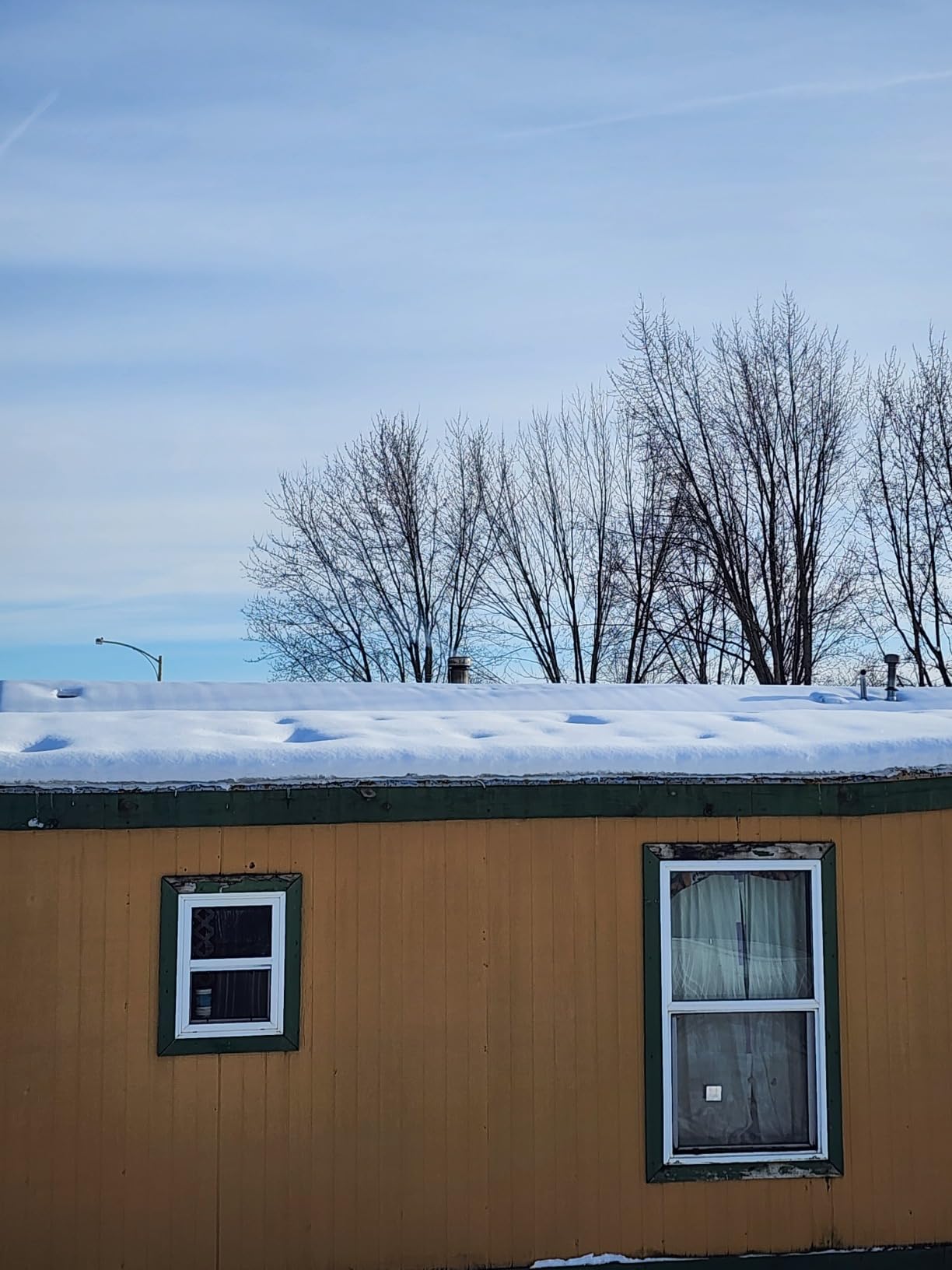
Do the shingle-saver rollers really prevent damage?
They reduce contact substantially, and they are the reason we would put this head close to a shingle surface. They do not make damage impossible, so heavy pulling against a fastener is still the wrong move.
The rollers are small plastic parts, and owners do report occasional breakage. That is the one plastic element in an otherwise all-metal tool, so treat a broken roller as a signal to slow down rather than to push harder.
Why do the brackets bend, and how do I avoid it?
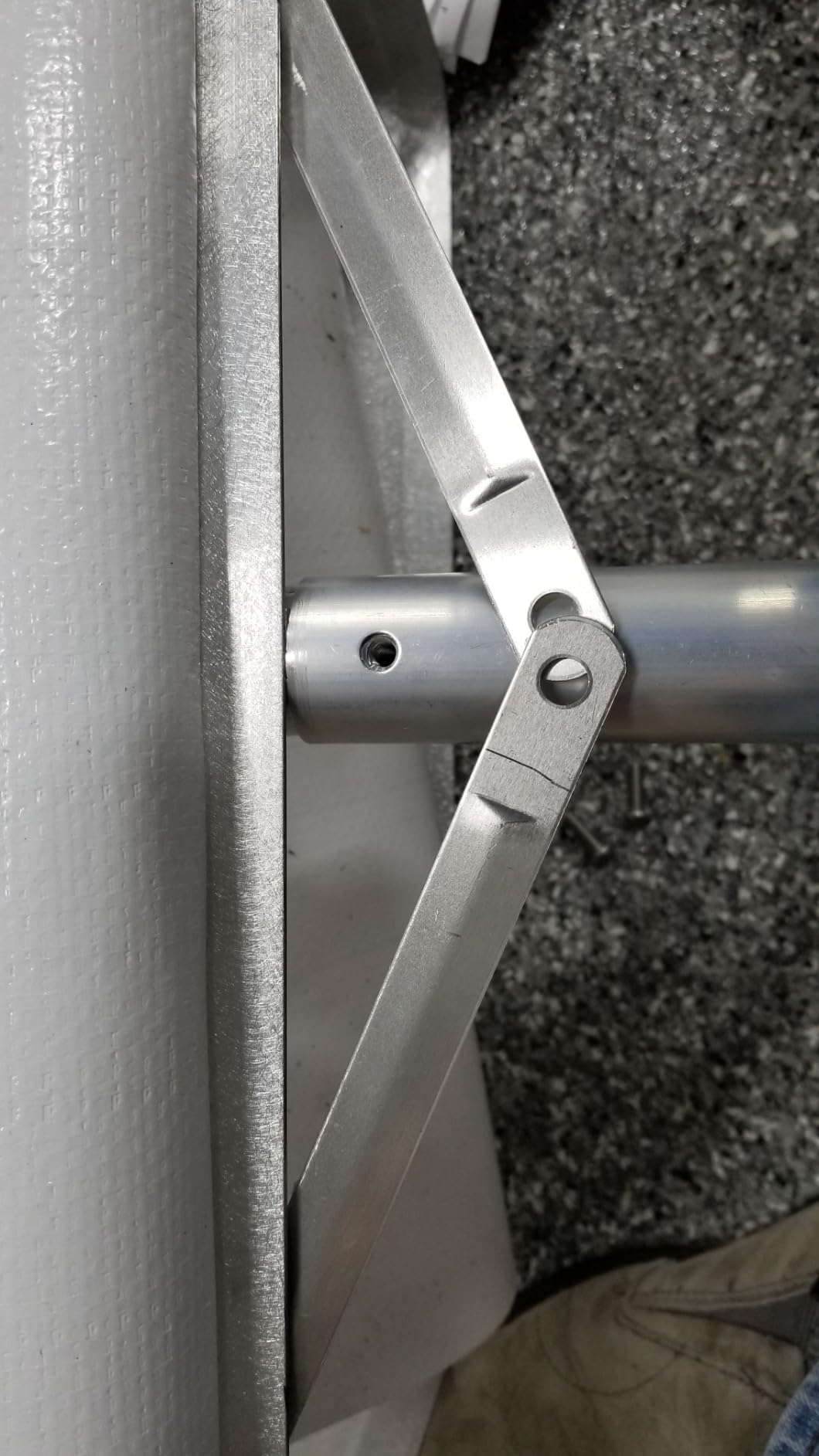
The support brackets and the bolt joint at the rod tip take the full twisting load when you drag hardened snow, and that is where the failures concentrate in reviews.
Pull down the slope rather than pushing, keep the snow loose, and spend a moment deburring any raw aluminum edges after assembly. A bracket that has already taken a hard hit rarely recovers its original alignment.
3. SNOWPEELER 30 ft Telescopic Rake: the Best Reach for Heavy Snow
- Longest reach here at 30 feet
- Commercial-grade blade cuts hard-packed snow
- Glide pads reduce shingle contact
- Sectional handle adds length as needed
- Heaviest unit at 13 pounds
- Slide chute folds over between passes
- Awkward in wind and under tree branches
If your roof is tall, steep, or hard to reach from the lawn, this is the tool built for it. The telescopic handle extends to 30 feet across sections, which is the longest reach in this group and the main reason to buy it. Very few people need that much, but the people who do have no substitute.
The blade is described as commercial grade, and owners in heavy-snow areas credit it with moving large loads that lighter plastic heads simply push around. Glide pads under the head reduce the chance of dragging metal across the roof surface, and the tear-resistant slide chute is intended to carry snow off the edge quickly.
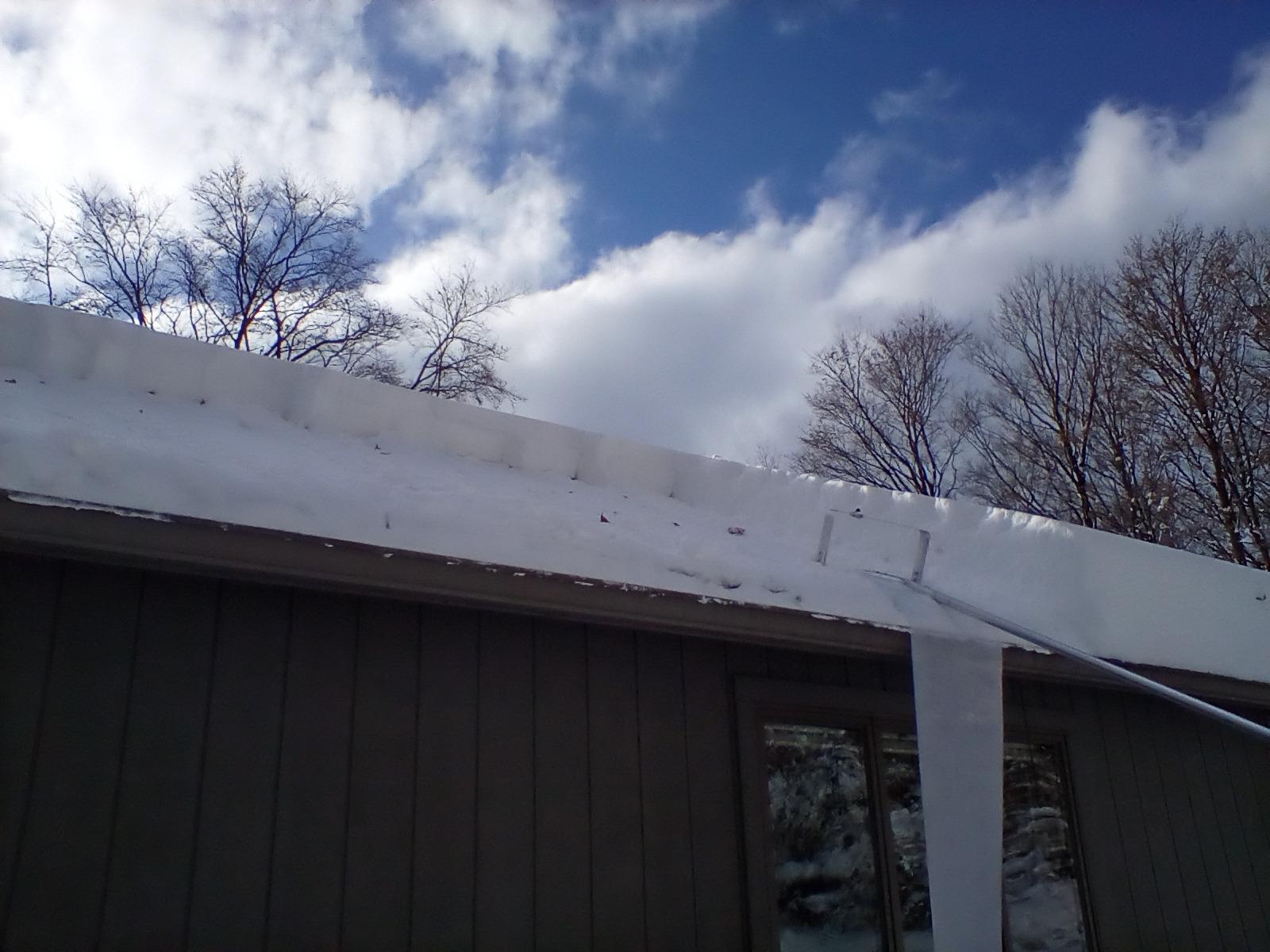
Owners also highlight its usefulness on low-pitch roofs and in valleys, which are the spots most people give up on. Reviewers who have used it across several seasons report it continuing to perform.
Is 30 feet of reach worth the extra weight?
For a tall or steep roof, yes, because reach is the one thing no other tool in this list fixes. For a standard two-story home, the shorter rakes do the same job with less effort on your shoulders.
At 13 pounds with the mass far from your body, the fatigue is real and it arrives early in a long session. Work in shorter bursts, and set the length to the minimum that clears the eave.
What happens to the slide chute over a hard winter?
It is the wear item. Owners report the chute folding over and needing straightening between passes, and it can snag on roof obstructions and tear if it catches.
Check the chute for holes and tears at the start of each season, and take the tool down before you reach an area with vents, gutters, or protrusions you have not seen from the ground.
4. Avalanche! AVA500 Slide-Style Rake: the Best for Speed
Avalanche! Roof Snow Rake, Snow Removal Tool, Assembled in the USA
- Slide design clears far faster than a conventional blade
- Wheels protect shingles and leave a protective layer
- Fiberglass sections store compactly
- Made in the USA with solid parts
- 15.5 ft base pole needs extensions for a two-story peak
- 9.2 pounds sits far from the operator
- Plastic slide is a consumable wear part
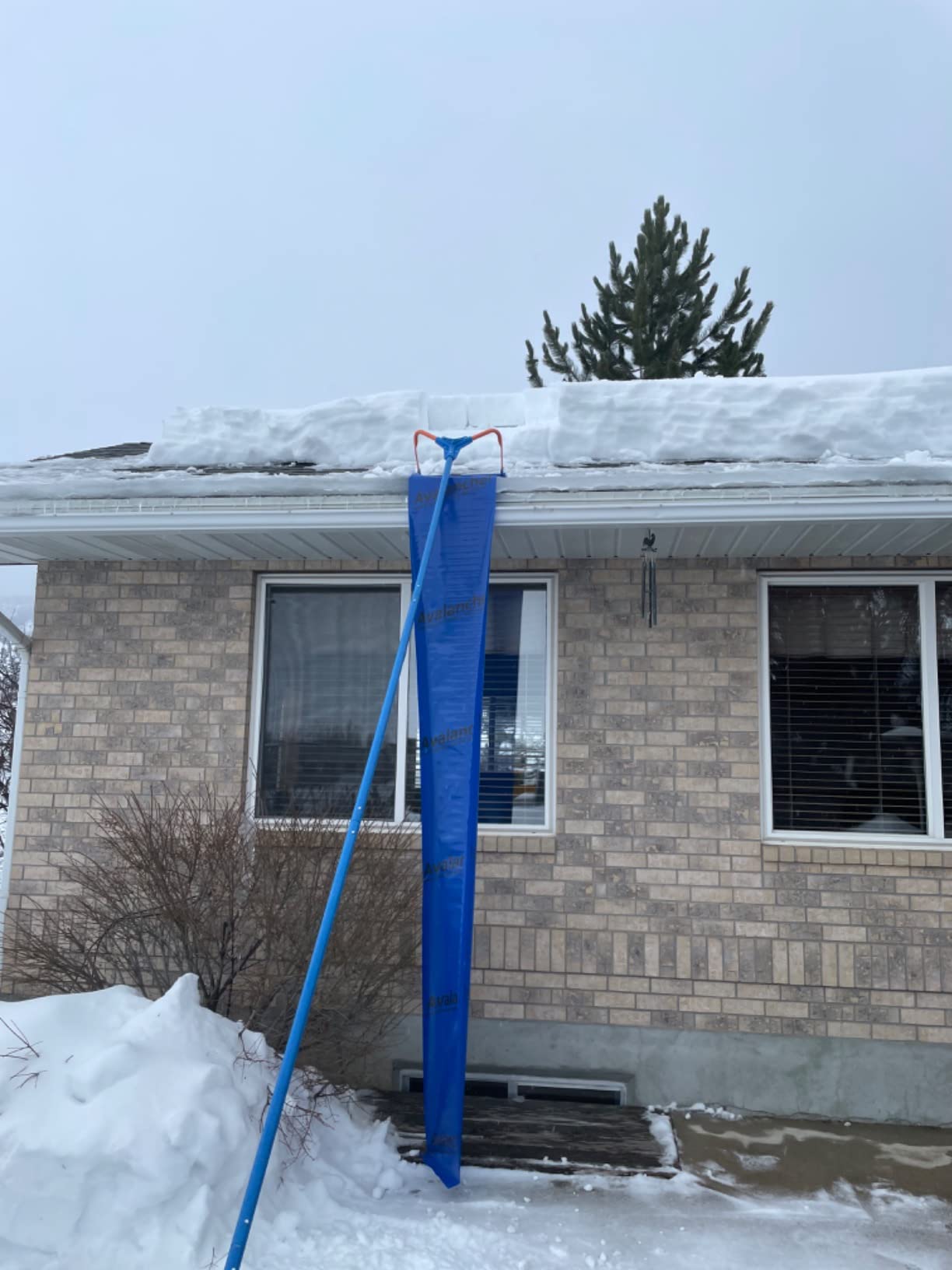
The Avalanche does not rake. It slides, and that is the entire design. A smooth 17 inch wide, 12 foot long plastic chute runs down the roof face and the snow rides along it to the edge, which is why owners describe jobs that would have taken most of a morning finishing in well under an hour.
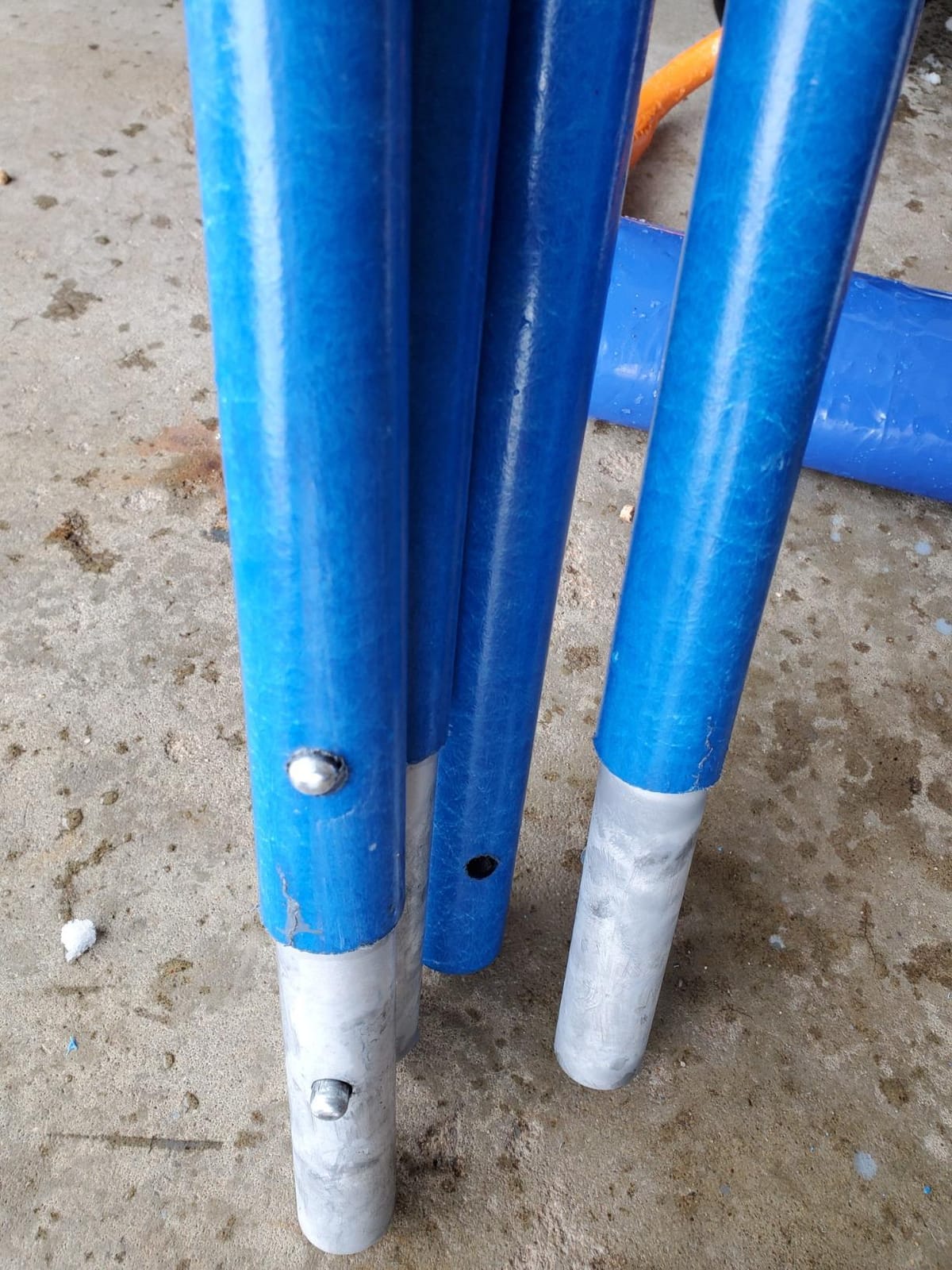
Four fiberglass sections snap together into a 15.5 foot pole, and 1.5 inch wheels hold the chute off the shingle surface. Those wheels are a detail other designs copy: they let the slide work close to the roof while leaving a thin layer of snow behind as a protective cover.
It is assembled in the USA, and several multi-season owners report it still performing. For moderate pitches worked before ice dams form, it is a genuinely different experience from a conventional rake.
Does a slide design really beat a conventional blade?
On volume moved, yes. The chute is a conveyor rather than a scraper, so each pass takes much more snow with less force, and the wheel clearance protects the shingles at the same time.
It loses that advantage on deep, compacted, or refrozen snow, where the chute rides over the crust instead of cutting it. Save it for fresh and moderately settled snow.
Will 15.5 feet reach a two-story peak?
Not on its own. The base pole reaches the lower field of a two-story home, and reaching the peak above the eave line usually means adding extension sections, which owners describe as an extra cost decision.
Also weigh it honestly. At 9.2 pounds with the mass far from your body, the slide is tiring on a long job, and the supplied winding crank is reported to slip on the roller shaft.
5. Suncast SRR2100 Adjustable Rake: the Best Non-Stick Blade
Suncast Adjustable Roof Rake with 21′ Resin-Coated Aluminum Handle, Curved Non-Stick Graphite Blade for Snow and Leaf Removal, Black
- Resin-coated aluminum lower handle resists cold and wet
- Curved graphite blade helps snow release instead of sticking
- Seven-to-21-foot range suits different roof heights
- Breaks down for compact storage
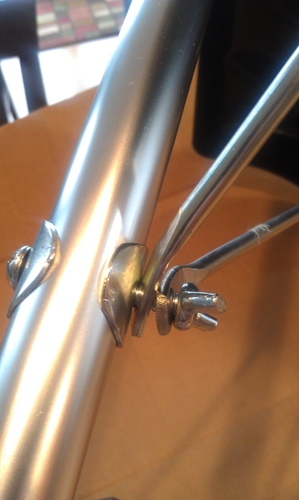
- Sectional pin-jointed design flexes more than a telescoping pole
- Plastic head is less rigid than metal under hard snow
- No wheels or rollers to protect shingles
The Suncast’s distinguishing feature is a curved, non-stick graphite blade, and owners single it out for a specific reason: snow and leaves release rather than gumming onto the head. If you have ever pulled a rake and had half the snow come along with it, that coating is the difference.
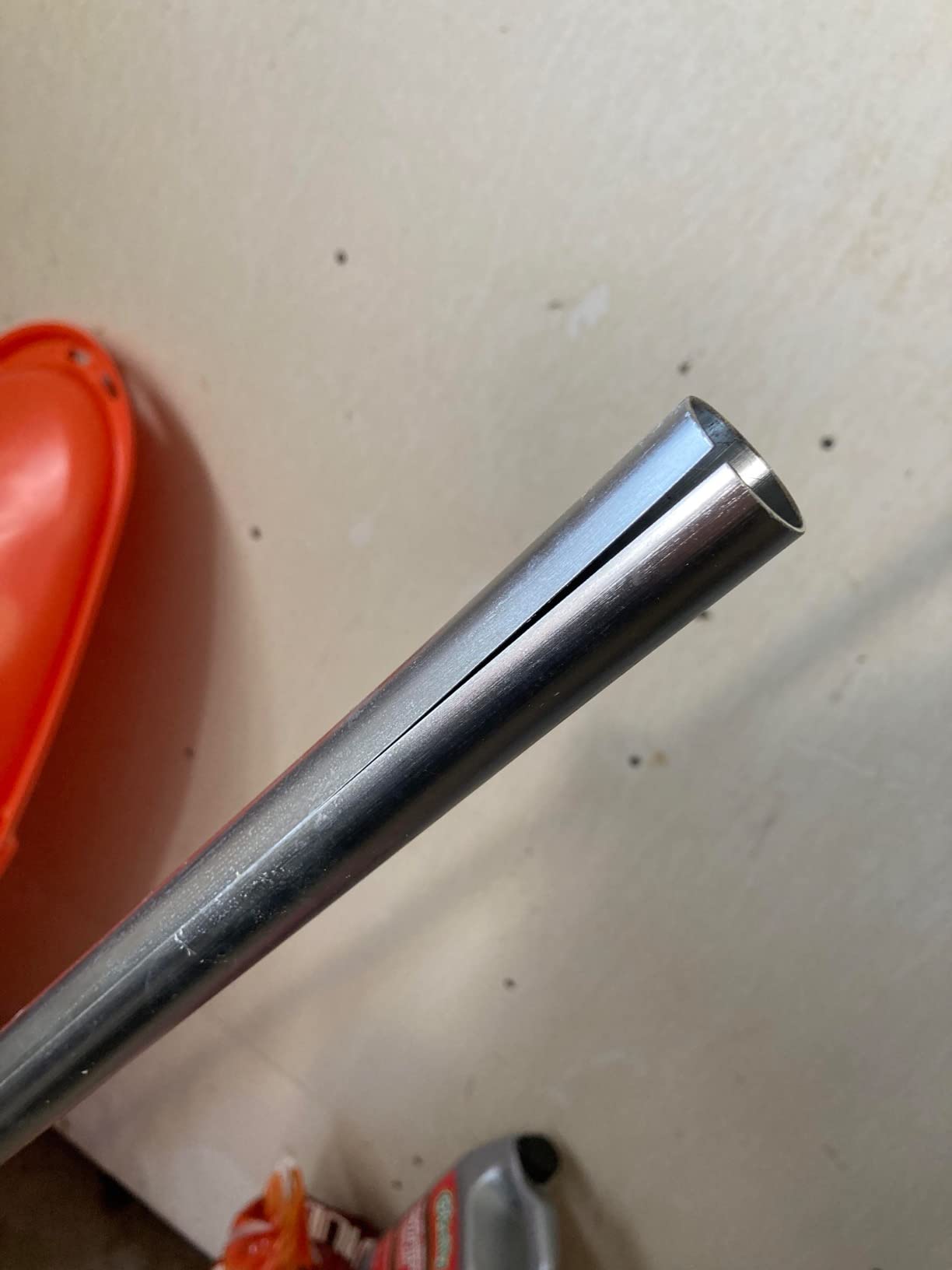
The pole adjusts from 7 to 21 feet with extension pieces, reaching 252 inches, which covers a two-story eave without a ladder. It collapses to 62 inches for storage, so it is less awkward in a garage than most of the telescoping options here.
The lower handle is resin-coated aluminum, which adds sturdiness in cold and wet conditions where bare aluminum feels brittle. The head itself is a plastic bow shape, 21 inches wide.
Does a non-stick graphite blade cut hard-packed snow?
It releases snow well, but release and cutting power are different things. A plastic bow head simply cannot match an all-metal blade when the snow has crusted, so this is a fresh-snow and leaves tool.
The curved shape helps it glide, and the coating reduces sticking, but neither adds the mass needed to break a refrozen crust.
How much flex is there at 21 feet?
Noticeable. A pin-jointed sectional design is inherently less stiff at full extension than a single telescoping tube, and owners note the flex directly in reviews.
There are also no wheels or rollers on the head, so it runs closer to the shingle surface than several rivals. Work carefully near the roof, and pull rather than push.
6. USA-Made 20 ft Shingle Saver Rake: the Best Rated Pick
- Best-rated pick in the group with only 2 percent one-star reviews
- Strong yet lightweight all-aluminum build
- Shingle Saver rollers keep the head off the roof
- Quick five-minute assembly and takedown
- Support struts feel thin for the length
- Bolts at the head joint need periodic retightening
- Fixed 20 ft length leaves tall peaks out of reach
This is a continuation of the classic American roof-rake design, all aluminum, with the Shingle Saver roller system on the head. It carries the highest average rating in our group, and the one-star share is small, which tells you the complaints that do exist are narrow rather than structural.
Owners treat it as an ice dam tool first and a snow tool second. Several describe cutting down or eliminating dams on two-story homes by working the eave on a schedule, and the 20 foot reach makes that a ground-level job. Assembly takes about five minutes and the takedown is just as quick.
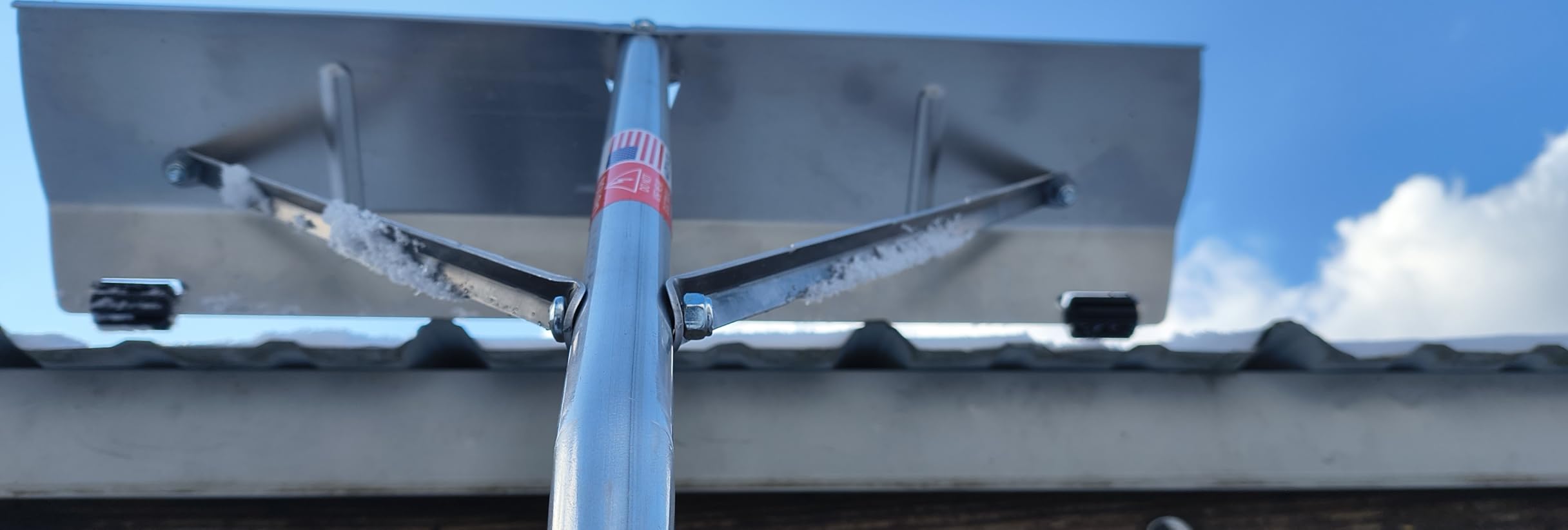
The 24 inch aluminum head is wide enough to move a real load per pass, and the whole unit is light enough to keep overhead for a full sweep even at 20 feet, which is unusual for an all-metal rake.
Is 20 feet enough reach for a two-story house?
For the eave and the lower field, yes, and that is the area that controls ice dam formation. For the peak of a tall or steep roof, owners wish for extra pole sections, and a fixed 20 foot length is the one structural limitation here.
Measure from your standing position to the lowest point you need to clear, with the pole angled, before you commit to any fixed-length tool.
Which bolts need checking between uses?
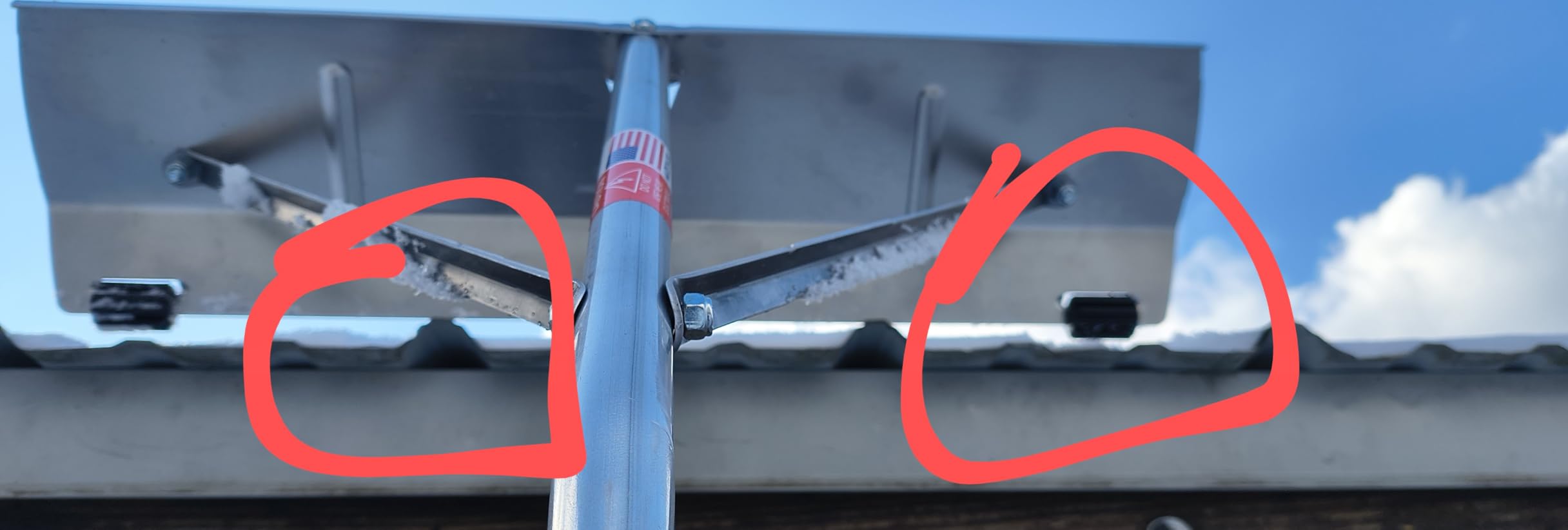
The three bolts at the head joint. They need periodic retightening during use, and owners consistently mention this as the routine maintenance item.
The support struts also feel light relative to the 20 foot length, so pull rather than push and keep the snow loose. The rollers do the shingle protection, so let them work instead of forcing the head down.
7. MinnSnowta Dynamo Rotor-Style Rake: the Best for Low Roof Contact
- Rotor-style design clears snow with less effort than a traditional rake
- Reported to cause less shingle damage than standard heads
- Rigid and durable 24 inch aluminum head
- Most expensive unit in this group by a wide margin
- Low review volume and weak sales rank mean limited field history
- Handle length is not published
- so verify reach before buying
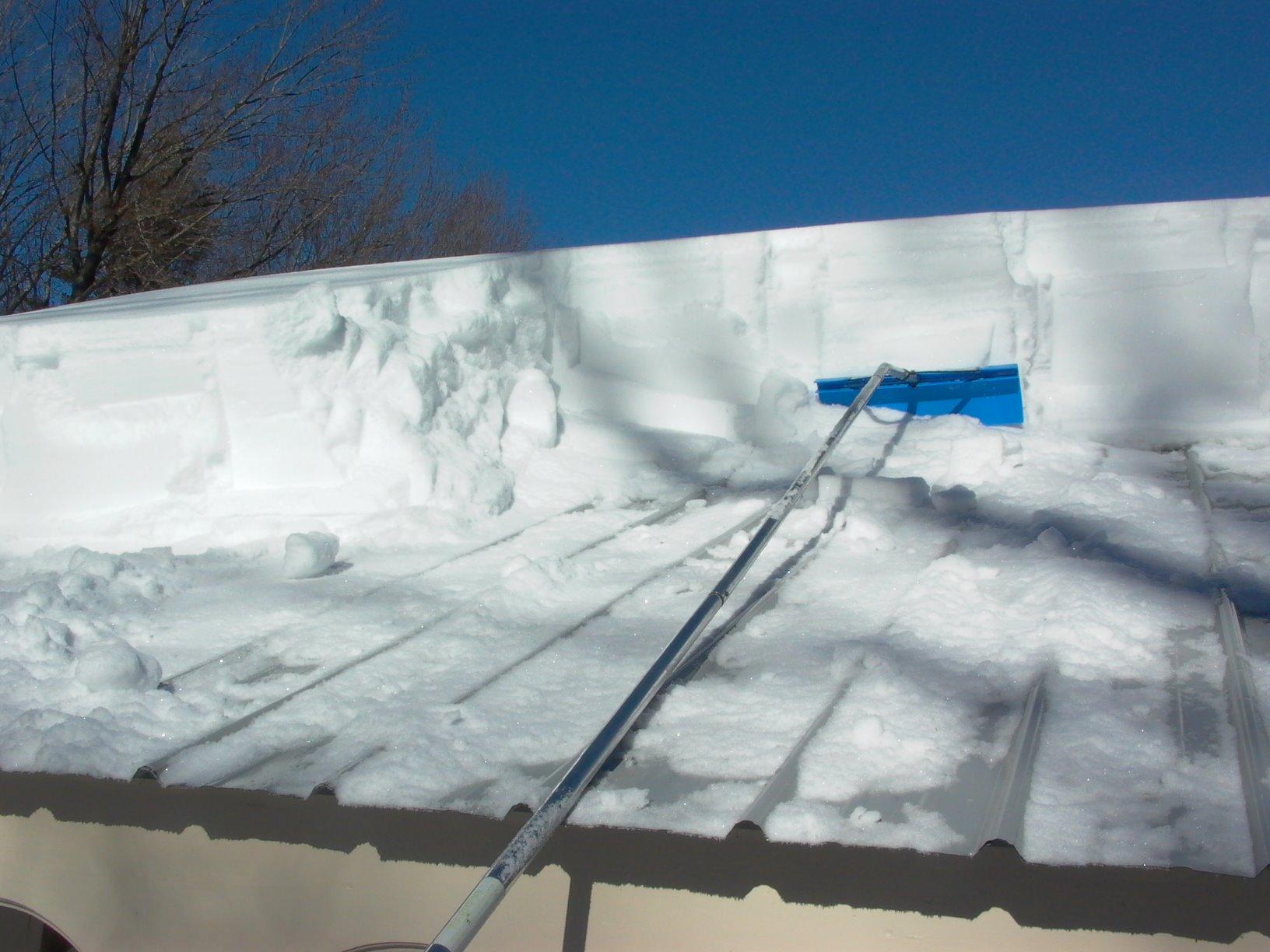
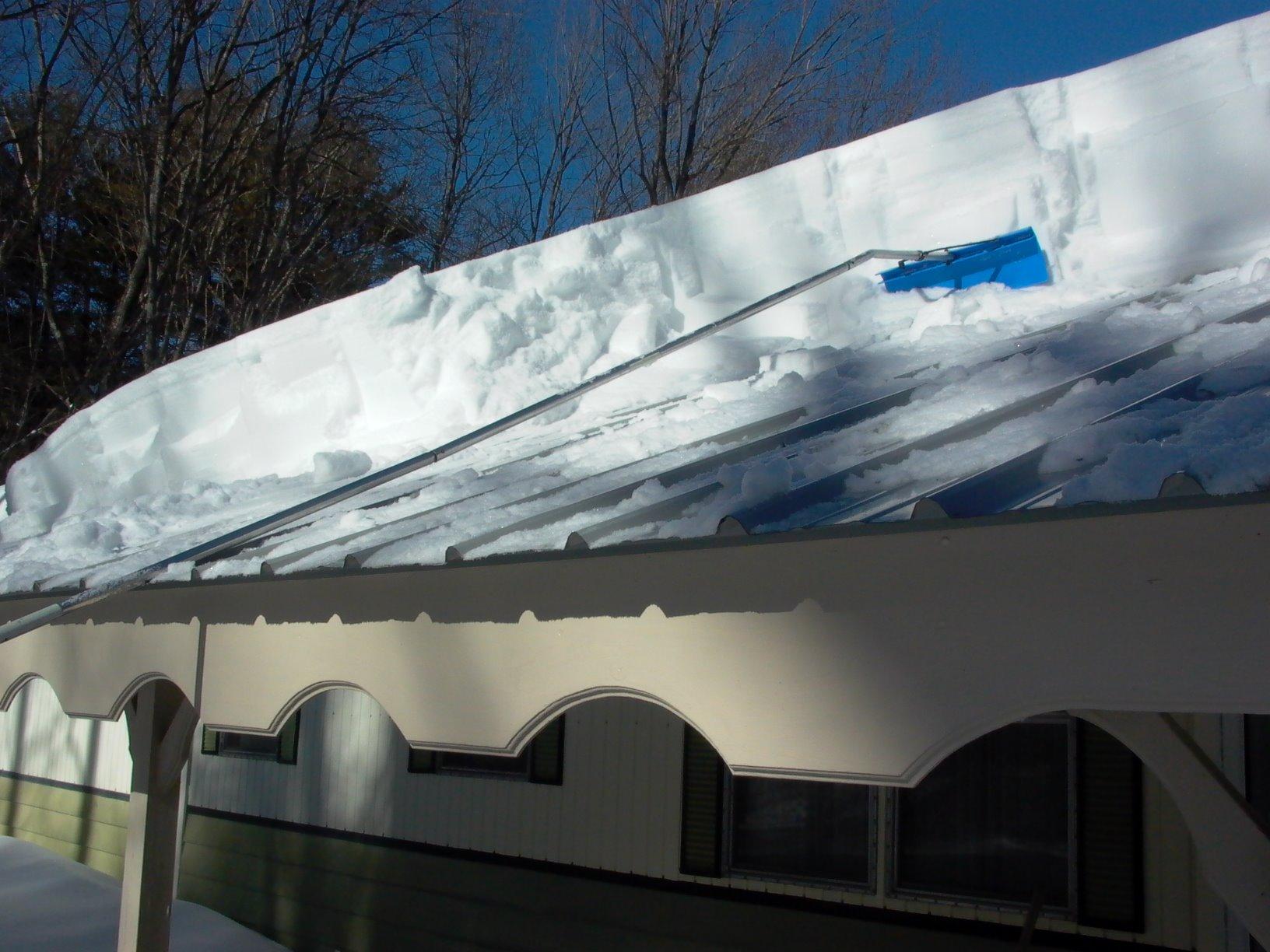
The Dynamo takes a different approach again. Rather than a flat blade or a slide, it uses a rotor-style head intended to reduce shingle contact and cut the effort needed per stroke. Grip, handle, and head are all aluminum, and the head is a full 24 inches wide.
The reviews we read are enthusiastic and consistent about those two claims: less effort than a traditional rake, and less damage to shingles. The problem is not the design, it is the evidence base, and you should weigh that carefully.
One hundred and forty-seven reviews is the thinnest sample of the serious contenders here, and it sits near the bottom of the category in sales rank. The ratings are excellent, but a light review pool tells you less about a tool’s fifth winter than a heavier one does.
What does rotor-style geometry change on a shingle roof?
Intended to lift and roll snow away while reducing the flat face-to-shingle contact a conventional blade creates, which is why owners report less effort and gentler shingle treatment.
The 24 inch aluminum head itself is rigid, so the weakness is not the material. What it does not have published is handle length, and reach is the one specification you cannot guess at.
Is the thin review history a reason to skip it?
Not automatically, but it is a reason to verify before committing. Ask for the assembled pole length, and consider whether a model with thousands of reviews and published dimensions fits your roof better.
This is the one pick in the list where the cost and the limited field history are the real objections, not the tool’s capability.
8. EZ Smart 16 ft Rake: the Best Adjustable Blade Width
EZ Smart Patented Adjustable Snow Roof Rake with 16 ft Pole
- Only tool-free adjustable blade width here
- from 3 to 36 inches
- Narrow setting gives control around valleys and chimneys
- Roof-safe blade resists bending
- Collapses into the included mesh bag
- 16 ft pole is the shortest reach among the telescoping options
- Plastic handle and polyethylene head flex more than aluminum
- Full width is the only setting for maximum per pass
The EZ Smart is the only rake here where the blade width itself changes, using a patented umbrella-style head that opens from 3 inches to 36 inches without tools. That is a real advantage on a roof with chimneys, skylights, valleys, or solar panels, where a fixed 24 inch blade is constantly catching on something.
Owners use the narrow setting for precision work in tight spots and open it fully for the main passes. The roof-safe blade is built to resist bending and breakage, and the whole system collapses into a mesh bag that will actually fit on a shelf.
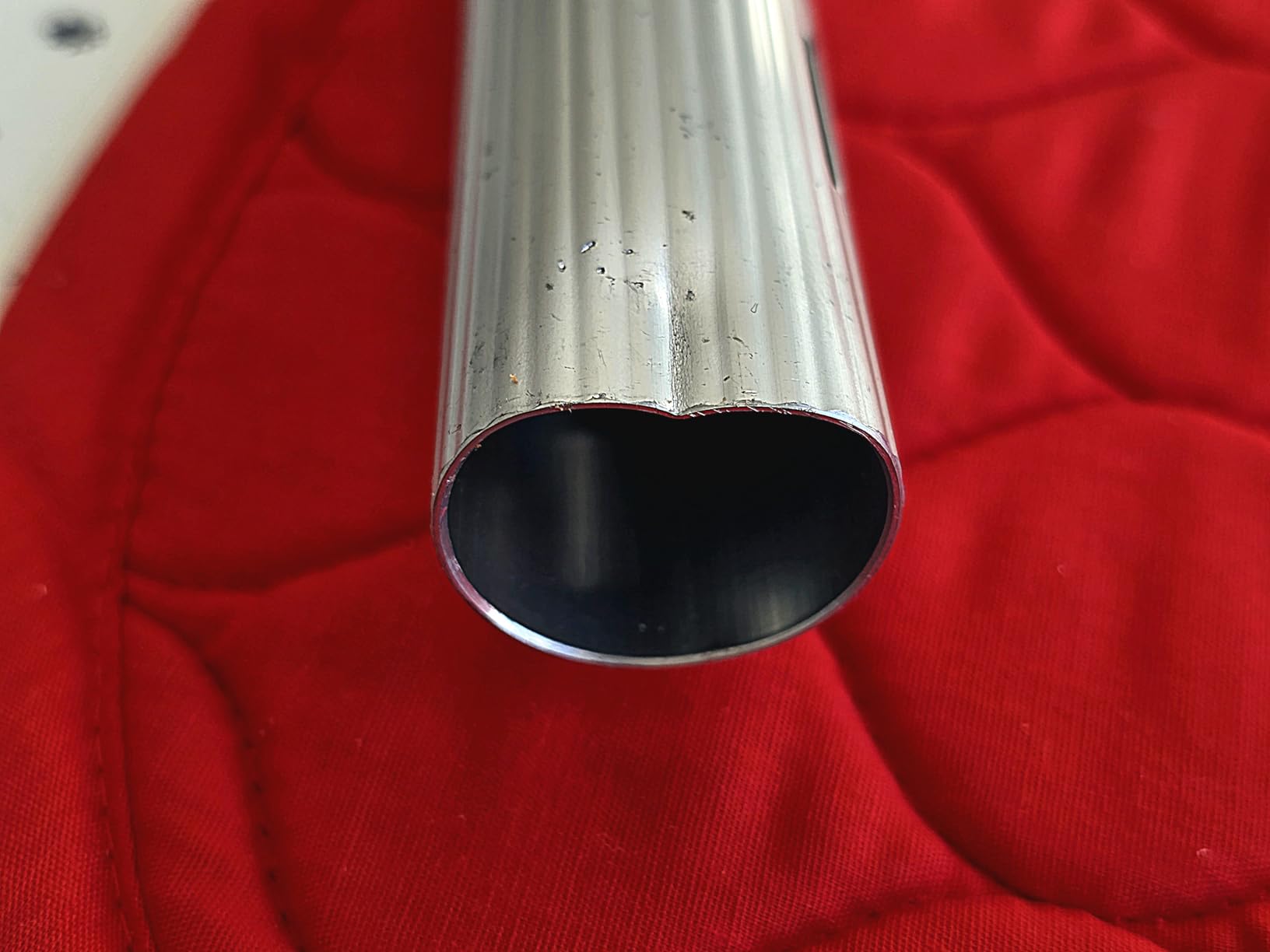
Everything is handled from the ground, and the 16 foot sectional pole is the shortest reach among the telescoping options in this roundup. That single fact defines where this tool belongs.
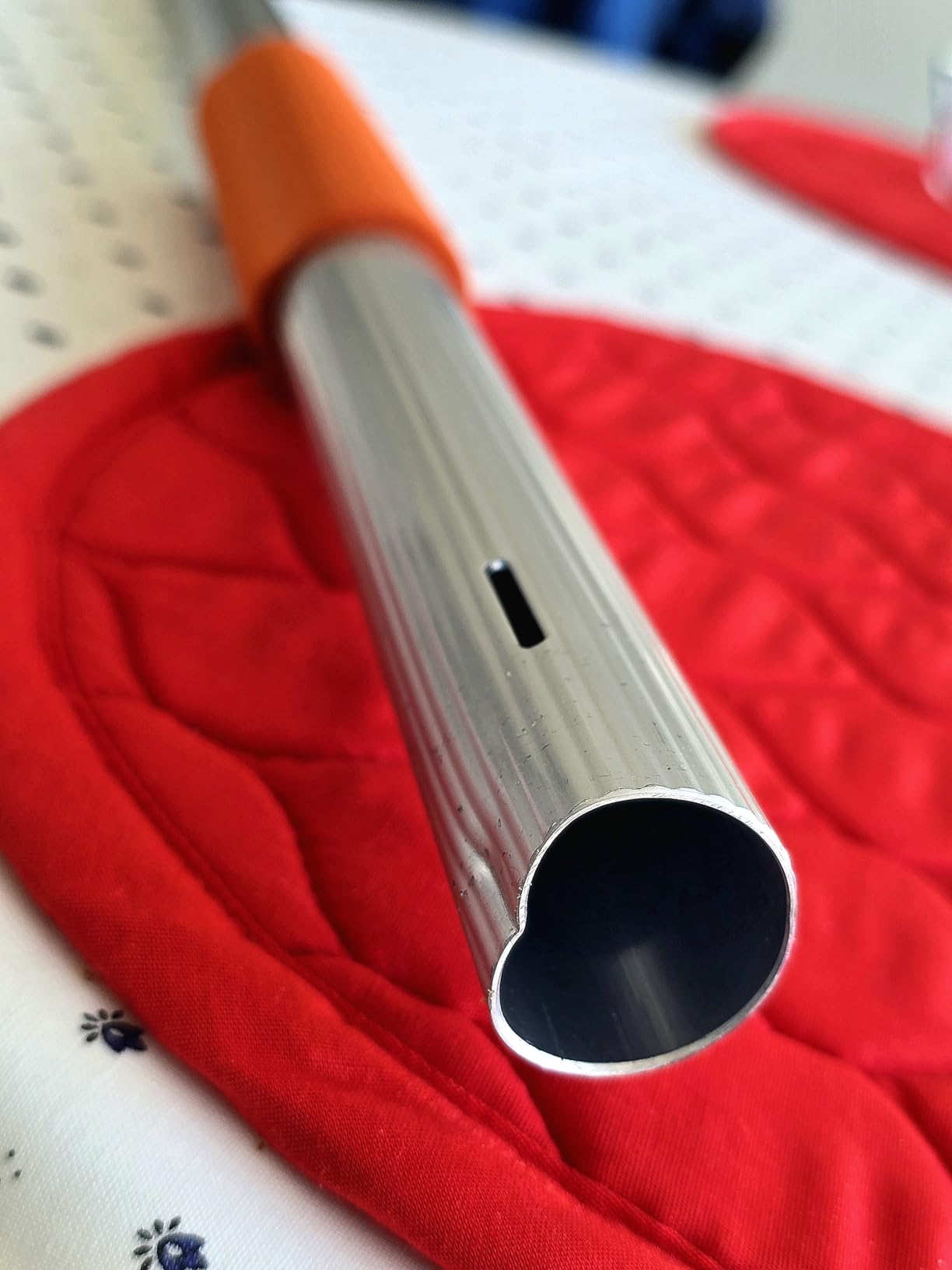
Is a variable-width blade useful around roof obstacles?
Yes, and it is the reason to buy this over a fixed-width design. Narrowing to a few inches lets you work in a valley or along a skylight without jamming a wide head against a protrusion.
It also protects itself. A fixed blade snagging a vent or a bolt is exactly how plastic heads crack, and a head that is three inches wide in a tight spot simply clears the obstacle instead.
Does plastic construction hold up in heavy snow?
Less well than aluminum, and honestly. The plastic handle and polyethylene head are lighter on hard-packed snow than the metal units, so this is a fresh-snow tool with a 16 foot envelope.
If your winters are wet and slow to settle, look at an all-metal 20-to-21-foot rake instead. If your snow is dry and you work around obstacles, the adjustable head earns its place.
9. Roof Razor 22 ft Brush and Rake Combo: the Best All-in-One
- Two tools in one for leaves
- moss
- needles and snow
- 22 ft reach from four quick-connect sections
- Adjustable angle reaches valleys
- solar panels and pool covers
- Highest average rating in the group
- 18 inch brush side is narrower than dedicated snow blades
- Sectional joints develop play over time
- Dual-purpose design compromises snow performance
The Roof Razor does two jobs with one head: a brush on one side, a rake on the other, on four quick-connect aluminum sections that reach 22 feet. For anyone who also wants to clear leaves, pine needles, and moss off a roof in the fall, that halves the number of long tools living in the garage.
It carries the highest average rating in the group, and the one-star share is essentially zero across its reviews. Owners use it across roofs, valleys, soffits, solar panels, RVs, and pool or hot tub covers, all from the ground.
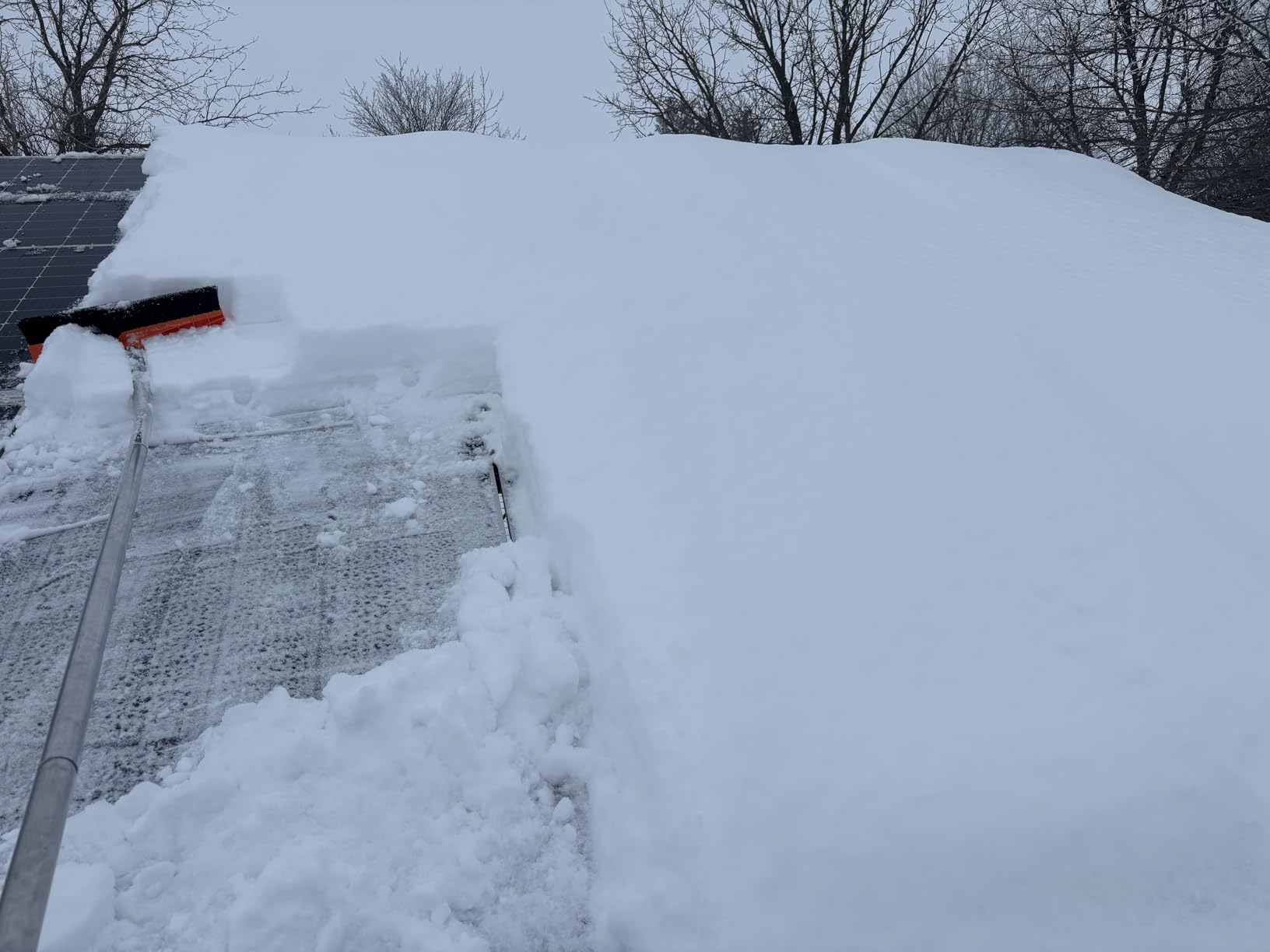
The adjustable angle setting is what makes the brush side genuinely useful rather than a gimmick, since it lets you set the head for a valley or a panel surface instead of fighting the geometry. At 7 pounds it stays manageable at full extension.
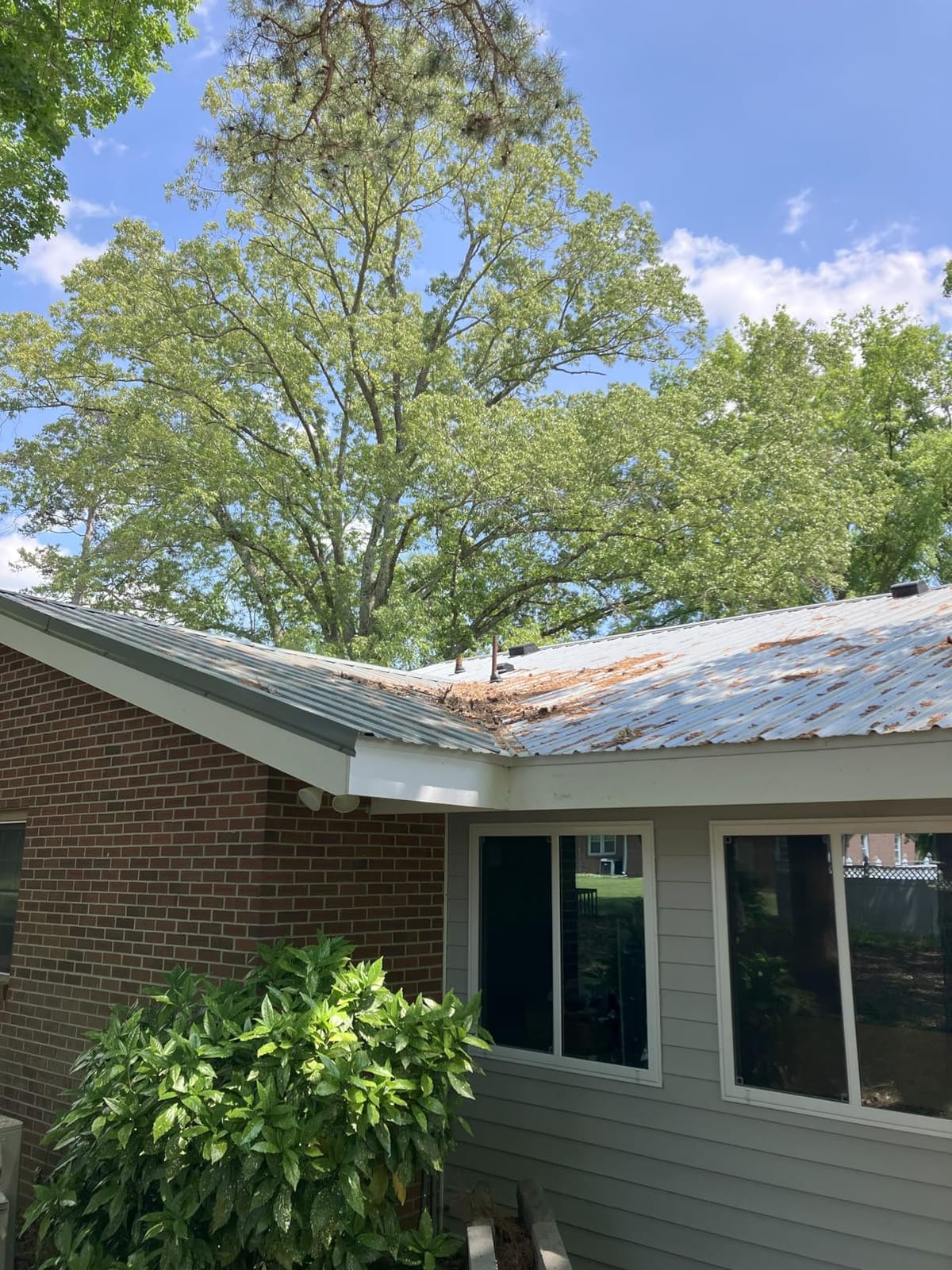
Is a dual-head tool as good as a dedicated snow rake?
For a normal winter, usually. It is lighter than most dedicated rakes and reaches slightly further, and the 22 foot envelope covers most two-story roofs.
For genuinely heavy snow, no. The 18 inch head is narrower than the 24 and 25 inch blades on dedicated models, so deep clearing takes more passes, and the design is a compromise by nature.
Does 22 feet of sectional reach hold up over time?
It holds up, with one caveat. The quick-connect sections are repeated stress points, and owners report play developing at those joints over time as the tool is twisted in cold conditions.
Check the connections before a long storm, and treat the second joint from the top as the first place to look if the head starts feeling vague at full extension.
10. Leanaco 21 ft Foam SnowBuster: the Best for Solar Panels
- Soft foam head will not scratch panels
- glass or delicate finishes
- S-shaped head works pushing and pulling
- Acme thread metal tip can be safely overtightened
- Aluminum alloy pole resists bending under load
- Will not work on ice at all
- as the manufacturer states
- 16 inch foam head is the narrowest here
- Soft foam cannot slice crusted snow
Every other rake in this list can scratch something. This one is built specifically not to. The head is a 16 inch pad of EVA soft foam, which will not mark solar panels, glass, painted metal, or a finished roof surface, and that is a genuine reason to buy it even though it has the lowest rating here.
The head is S-shaped so it works in both the push and pull directions, the pole telescopes to 21 feet for about 27 feet of reach, and the handle has an anti-slip sponge grip. It is also used on windows, pool covers, RVs, and semi-trucks, not just roofs.
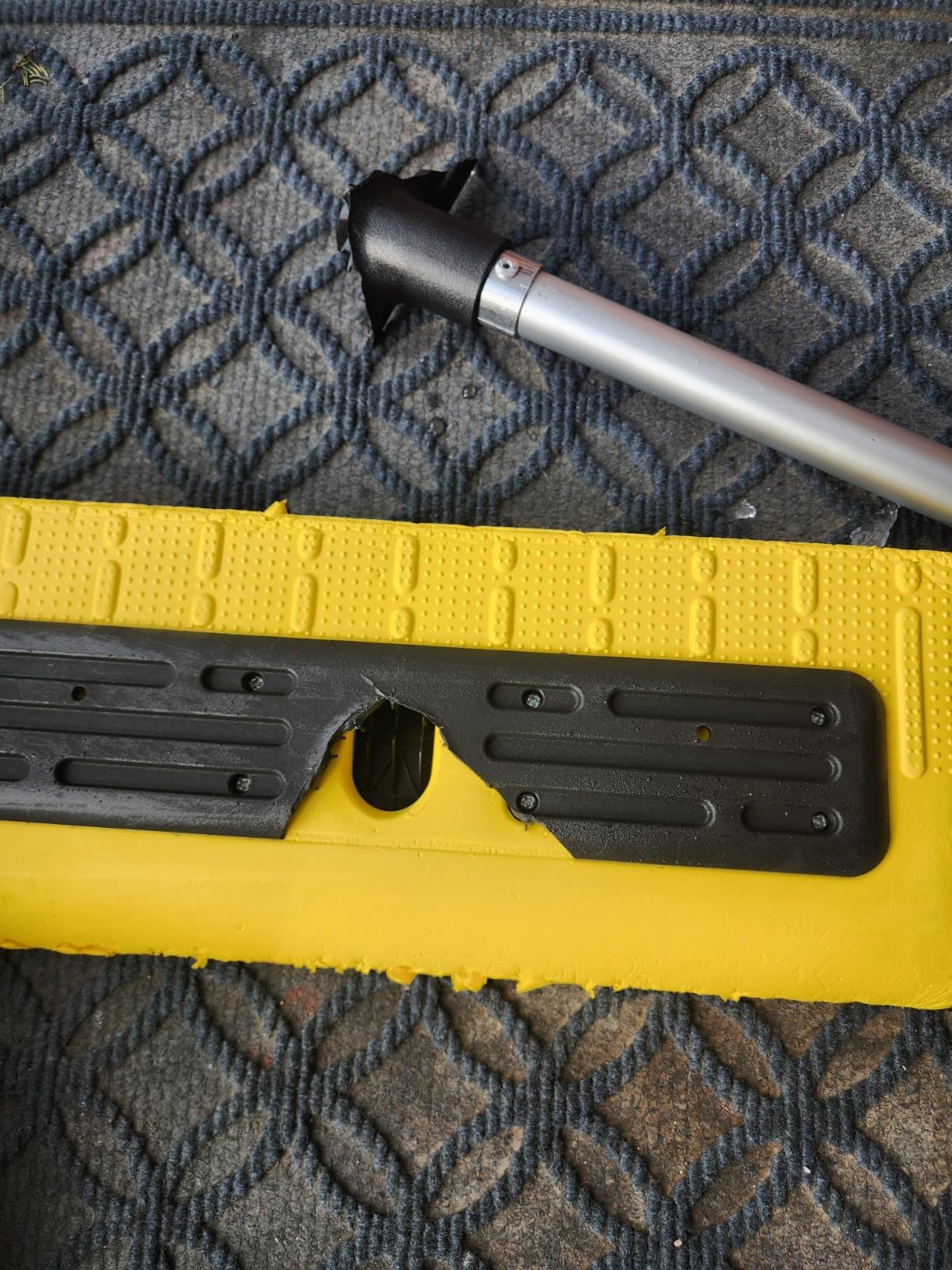
The pole hardware is a plus. A 3/4 inch Acme thread metal tip can be overtightened without stripping, and the integrated handle cover helps keep the head from loosening, which is more than several metal designs in this list manage.
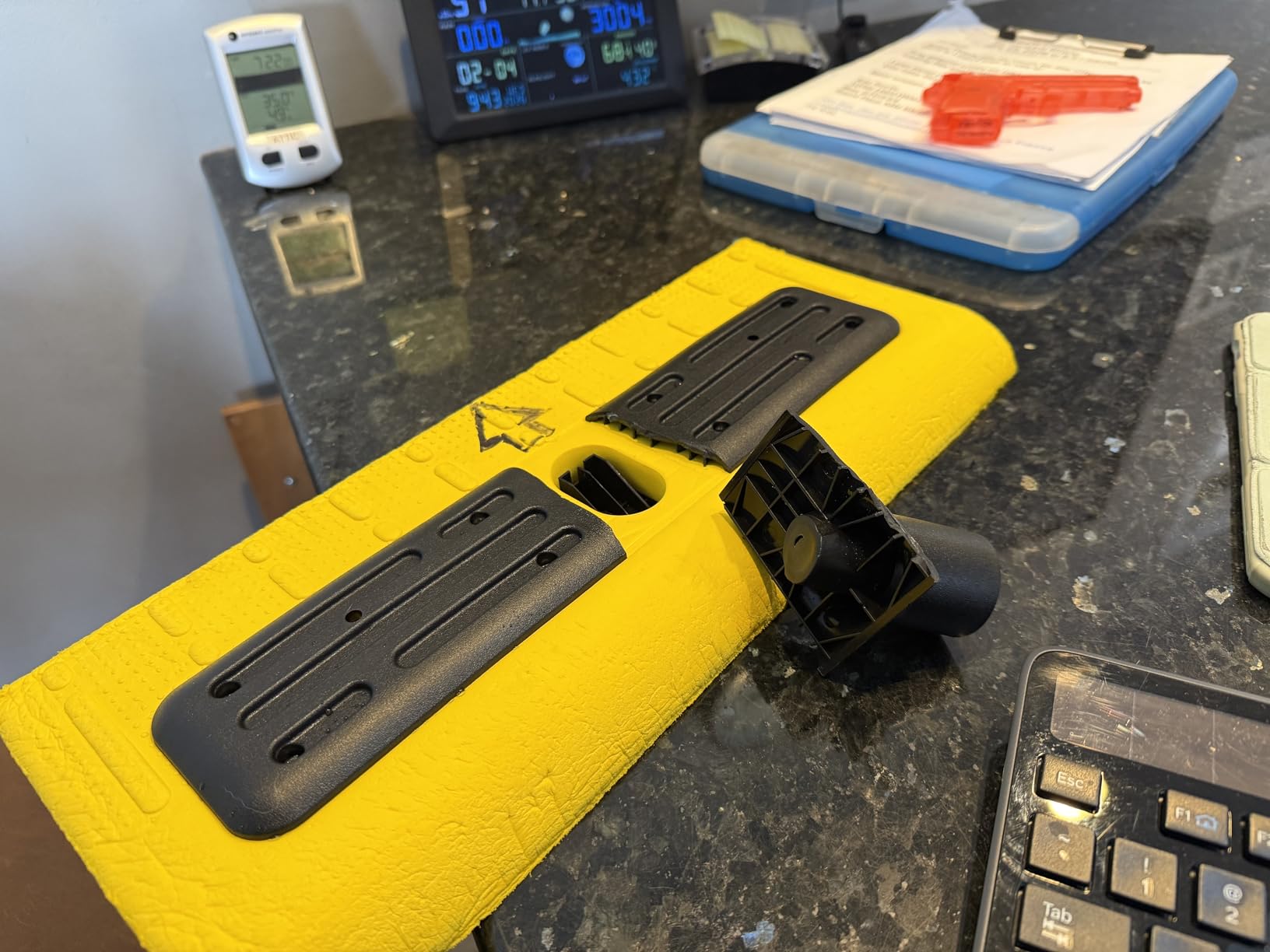
Why is a soft foam head right for solar and glass?
Because it cannot abrade the surface. Snow, grit, and ice dragged across a panel or a window is exactly how glazing gets scratched, and a rigid blade makes that outcome likely over a season of use.
Owners who have solar panels or a finished metal roof describe it as the only tool they are willing to use up there, and that is the trade-off in a single sentence.
Where does a foam head stop working?
Against ice, and the manufacturer says so directly. A soft pad has no cutting edge, so it rides over crusted or refrozen snow rather than breaking it.
It is also the narrowest head here at 16 inches, so the one job it was built for, it does slowly. This belongs on a list of roof rakes as a specialist, not a generalist.
11. VEVOR 21 ft Rake: the Best Wide Plastic Blade
- 25 inch cupped blade moves a lot of snow per pass
- Adjusts from 5 to 21 feet to reach most residential roofs
- Only about seven pounds so it is easy to control at reach
- Five-step assembly and detachable handle for storage
- ABS blade can crack in cold or snag on exposed fasteners
- Screws in the plastic blade inserts are a weak point
- Short support rods can cup the blade side to side
The VEVOR is a strong value pick with real heavy-duty performance in deep snow, according to the reviews. The 25 inch ABS blade is cupped rather than flat, which gives it a scooping action that moves noticeably more per pass than a straight blade of the same width.
The handle adjusts from 5 to 21 feet, so you can set it short for a low section and extend for the eave without re-screwing anything. At 6.8 pounds it is one of the lighter options that still has a wide head, and several owners use it as a fast ground snow-moving tool as well.
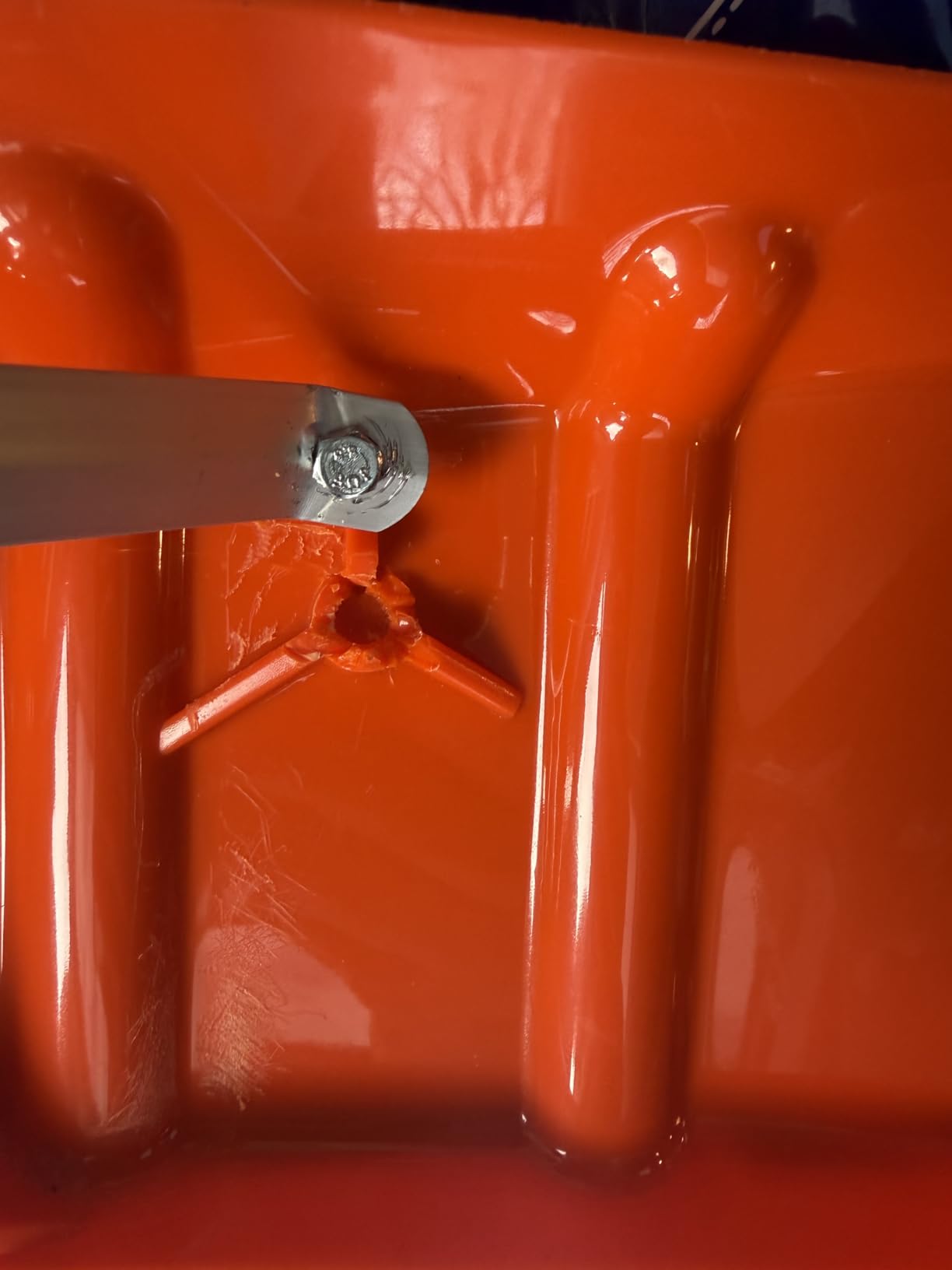
A triangular brace structure with two side pillar blades adds stability, and the five-step assembly needs no professional tools. The detachable handle makes off-season storage straightforward.
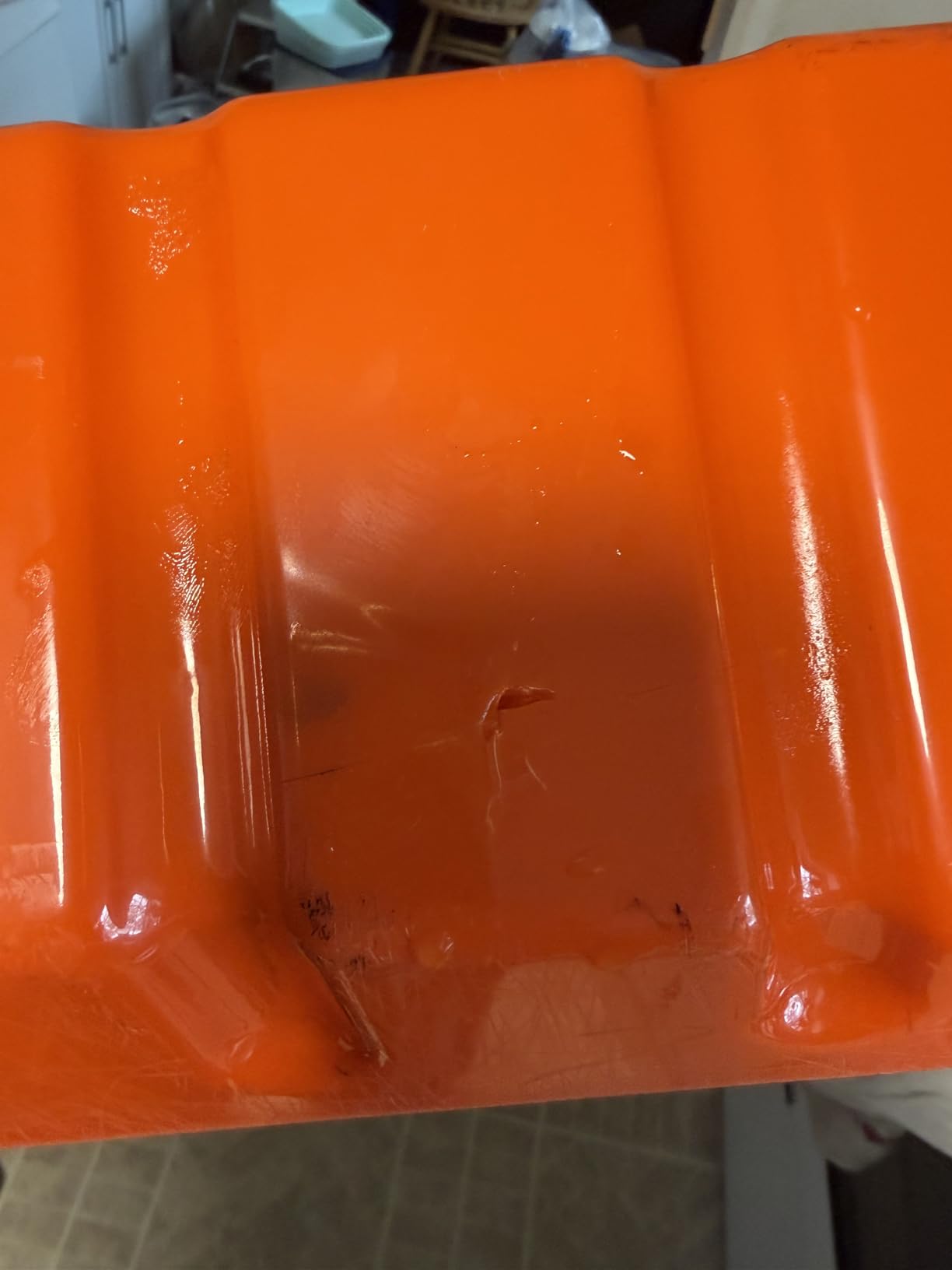
Does a 25 inch plastic blade move enough per pass?
Yes, and the cupped shape is the reason. A wider, deeper head means fewer strokes across the field, which matters most when the snow is deep and the cold is settling in.
The 0.13 inch ABS blade is also described as corrosion resistant, so it will not rust the way a thin steel head would, even if it does have a cold-weather weakness.
What breaks first in extreme cold?
The blade, and specifically the screws threading into the plastic blade inserts. One owner reports the blade snapping off in chunks at 20 to 30 degrees Fahrenheit after snagging a roof bolt, which is the failure to design around.
Keep the pull slow on metal roofs with exposed fasteners, and if the rubber end grip loosens in the cold, replace it before the next storm rather than gripping harder.
12. Change Moore 19.88 ft Wheeled Rake: the Best for Scratch-Free Metal Roofs
Change Moore Scratch Free Snow Roof Rake with Wheels for Snow Removal, 4.78’-19.88’ Extendable Aluminum Snow Rake for House Roof, Time-Saving Lightweight Roof Snow Removal Tool with 25″ Blade
- Wheels hold a gap between blade and roof
- 2.0 mm blade is thicker than most rivals
- All-aluminum build resists flex at full extension
- Also clears leaves
- dirt
- and branches in warmer months
- Wheels add drag and can catch on rough shingles
- Shortest maximum reach here at 19.88 feet
- Snap-button joints repeat under stress
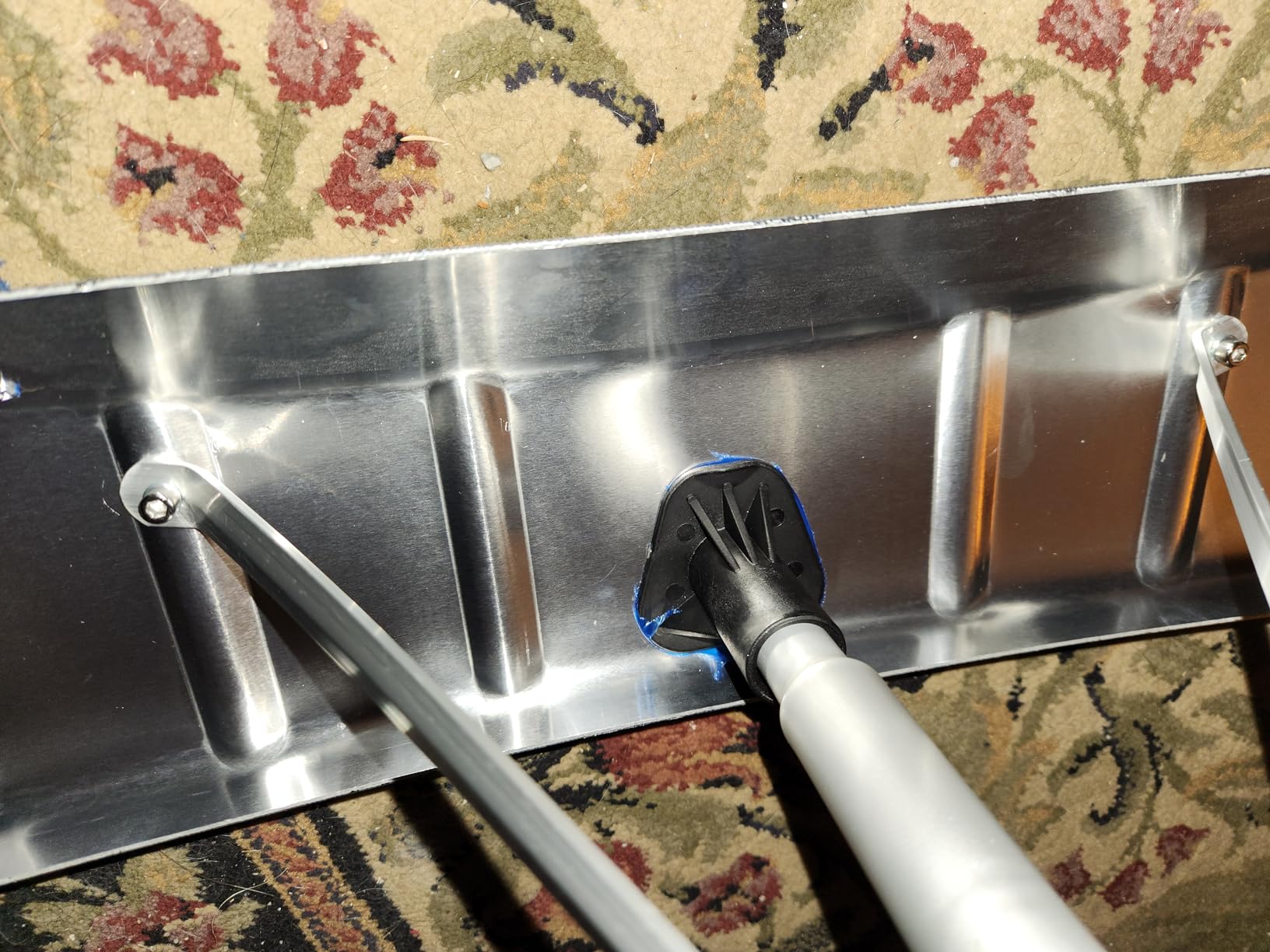
The defining feature here is a pair of rust-resistant wheels mounted under the head, which hold a gap between the blade and the roof so the aluminum never touches the surface. On a metal roof with exposed fasteners, that gap is the whole point, and it is also why the blade can be wider than 25 inches without as much risk.
The blade itself is 2.0 mm aluminum, which is thicker than most competitors, and owners report it holds its shape at full extension. Two struts on either side form a triangular structure, and the first grip section is sponge-wrapped for cold hands.
Length adjusts across five sections from 4.78 to 19.88 feet with snap-button assembly, and the tool is usable year-round for cars, leaves, dirt, and branches.
Are roller wheels better than a foam pad on metal?
On a metal or architectural roof, yes. The wheels give you a rigid metal cutting edge with a consistent standoff from the surface, so you can clear snow without sacrificing either speed or the finish.
A foam pad is gentler but gives up all cutting ability. The right answer depends on whether your roof surface tolerates a wheeled head running close to it.
What do the wheels cost you in control?
Drag and snag risk. Owners report the wheel system catching or derailing on uneven or rough shingles, and a derailing wheel can twist the head mid-pass, which is exactly when a blade meets an edge.
Move deliberately, keep the head in the open field between obstacles, and expect slower strokes than a plain blade. At 19.88 feet it also has the shortest maximum reach in this group.
How to Choose a Heavy-Duty Roof Rake?
Choose by roof height, snow type, and roof surface, in that order. Height sets your required reach, snow type sets your required blade, and surface sets how much contact your head can safely make. Get those three right and the rest is preference.
Reach: how long does the pole need to be?
Standing reach is what matters, not pole length. Stand where you plan to work, hold the rake at the angle you will actually use, and confirm the head clears the eave. A 20-to-21-foot rake covers a typical two-story home, and only very tall or steep roofs need the 30-foot class.
Longer is not automatically better. The 30 foot rake weighs 13 pounds with that mass far from your body, so a 21-foot tool that reaches the same eave will usually finish the job with less fatigue.
Blade: width and material decide what you can move
Width is the easiest lever. An 18-inch head needs noticeably more passes than a 24-to-25-inch head across the same field, and stroke count is where the time goes. If you have open field with few obstacles, take the widest head offered.
Material is the tradeoff. Aluminum blades cut crusted and hard-packed snow and are what you want in a heavy wet-snow region. Poly, polyethylene, and ABS heads will not scratch a shingle or a panel, and they handle fresh snow well, but they are lighter and can crack in deep cold. The 2.0 mm aluminum on the Change Moore is thicker than most, which is worth noticing on any metal head.
Head design: blade, roller, slide, or foam
Four geometries appear across these twelve, and each suits a different job. A conventional blade is the generalist. Rollers, either wheels or Shingle Saver pads, hold the head off the surface and let you work close. A slide chute moves the most snow per pass and is fast but hardens into a consumable wear part. A foam pad protects delicate surfaces and gives up cutting entirely.
Roof surface compatibility
Asphalt shingle suits nearly everything here, and rollers or a slide are the safest way to work close to it. Metal roofs need standoff, which means a wheeled head or a foam pad, plus slow strokes around exposed fasteners. Slate and tile are where we say call a roofer, because a blade or head can catch an edge and the repair cost is not a DIY job. Flat and low-pitch roofs suit angled heads and slide designs, which are built to work at a shallow angle where a straight blade tends to ride.
Price tiers: what each level actually buys
Budget tools give you a telescoping pole and a wide plastic head, which is genuinely enough if you rake during a storm and stay on loose snow. Mid-tier adds all-metal construction, rollers, and an angled head, which is the durability difference over multiple seasons. Premium buys reach and specialized head geometry: 30 feet, a commercial-grade blade, a slide chute, or a rotor-style head.
Professional ice dam removal is the comparison point for a real ice dam, and rakes are the DIY alternative to paying for it. A rake you will actually use twice a season is worth more than an expensive one that sits in the garage.
Frequently Asked Questions
Are snow roof rakes worth it?
Yes, for most homeowners in snowy regions. Clearing part of the snow load from the roof before it melts and refreezes is the most effective step you can take against ice dams, and it is the only ice-dam method that keeps both feet on the ground. Rakes are preventive tools for loose snow, not tools for removing a formed ice dam.
Do roof rakes damage shingles?
Not when used correctly. Pull down the slope rather than pushing, keep the head from riding directly on granules, and choose a design with rollers or wheels if you intend to work close to the roof surface. Most damage reports come from pushing uphill or from a head snagging a fastener on a metal roof.
Is there a 30-foot roof rake that can remove snow?
Yes. The SNOWPEELER in this roundup telescopes to 30 feet across sectional extensions and uses a commercial-grade aluminum blade. The tradeoff is weight, at 13 pounds with the mass far from your body, which tires the arms during a long session. Most two-story roofs do not need that much reach.
What is the best tool for removing snow from roofs?
A telescoping roof rake is the standard answer for most homes because it works from the ground. For fresh snow on delicate surfaces, a foam-headed rake protects solar panels and glass. For removing an existing ice dam, professionals use steam and water, and no rake will do that job.
How often should I rake snow off my roof?
Work during and shortly after a snowfall rather than waiting for the load to build, and clear roughly a quarter to a third of the accumulated depth each cycle. The goal is to keep the eave open so meltwater can run off before it refreezes. Once the eave is clear, the job is done.
How do I choose a roof rake?
Match three things: reach for your roof height, blade material for your snow type, and head design for your roof surface. Aluminum blades cut crusted snow, plastic heads protect shingles and panels, and rollers or wheels let you work close without touching the surface. Measure your standing reach before you buy.
When is it too late to rake snow off a roof?
Stop when the snow has crusted or refrozen into slabs, when you can see a growing ice ridge at the eave, when the roof is old or already sagging, or when finishing the job would require climbing onto the roof. At that point a roofer with steam equipment is the right call.
Which Roof Rake Should You Buy in 2026?
If you want one answer, take the Snow Joe RJ204M. A 21 foot telescoping pole, a 6 by 25 inch poly blade, and 4.8 pounds of total weight cover a two-story eave from the ground, and more than two thousand owners have used it through a storm. It is the best roof rake for heavy snow for most households because it is the one you will actually reach for.
Match it to your conditions instead. If your snow gets wet and refrozen, take the all-metal USA-Made 20 ft Shingle Saver or the Extreme Max with roller head, and accept a smaller blade in exchange for a build that survives crusted snow. If your roof is tall, steep, or awkward, the SNOWPEELER’s 30 feet of reach has no substitute. If the surface is metal, solar, or glass, use a wheeled head or the foam SnowBuster. If you clear leaves as well as snow, the Roof Razor combo handles both from 22 feet.
Whatever you choose, pull rather than push, work loose snow only, clear the eave first, and stop when the snow has crusted. A rake is preventive maintenance, and treating it that way is what keeps it working for a decade.