
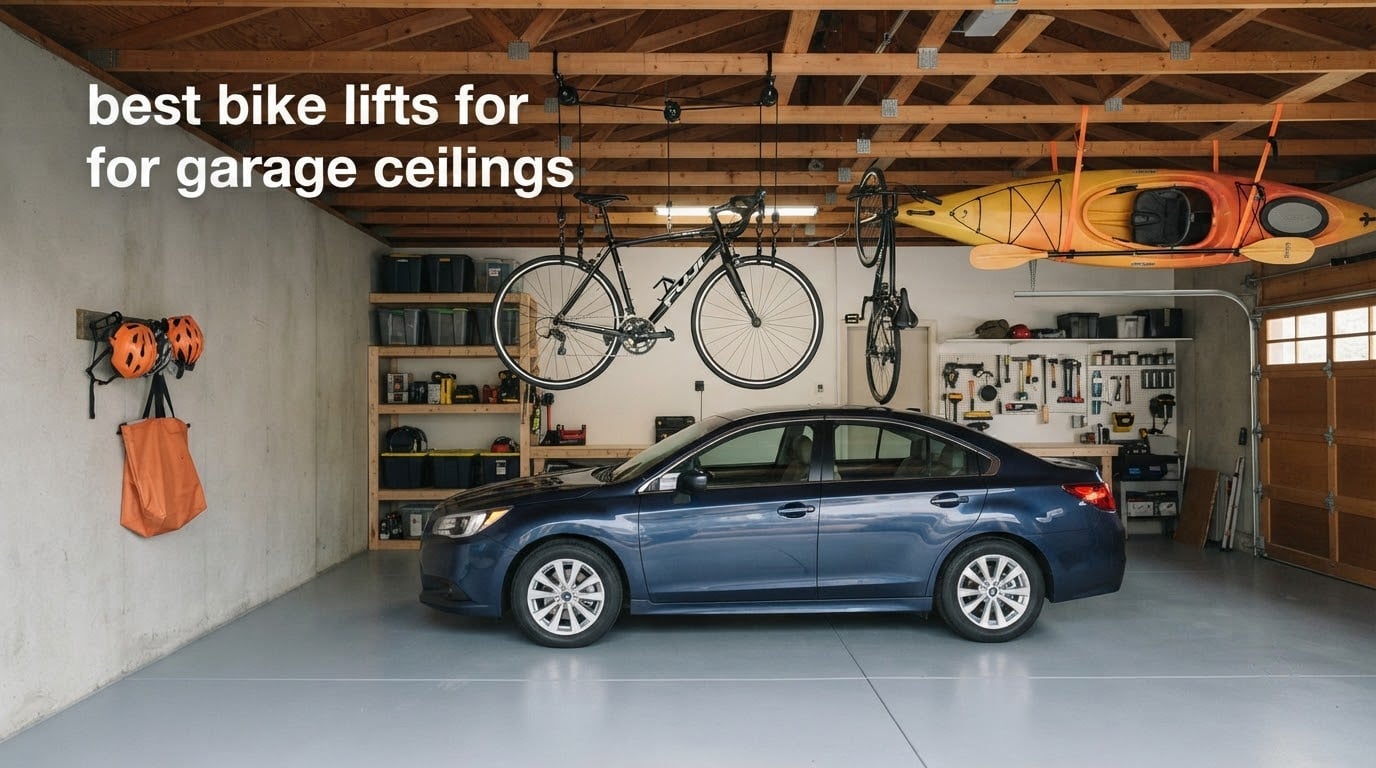
A ceiling bike lift is a pulley-and-rope system bolted into your garage joists that raises a bicycle from the floor to just below the ceiling, where a lock holds it until you pull the rope down again. It is the only storage type that gives back both floor and wall space, and it is the right answer for anyone with three or more bikes, a garage with no usable wall left, or a heavy e-bike that is too awkward to lift overhead. Below is our roundup of the 10 best bike lifts for garage ceilings in 2026, covering pulley hoists, a spring lift, a motorized rack and a sliding rail system.
Most of these systems are cheap hardware doing a simple job: two pulleys, a length of rope, two padded hooks and a lock-off. What separates a good one from a bad one is rarely the mechanism. It is whether the hook actually stays on the bike, whether the included fasteners can hold a 70 lb e-bike to a piece of framing, and whether the rope is long enough for your ceiling. We weighted the picks on capacity, lock design, mounting requirements and the volume of owner feedback behind each design.
If you want the wider storage picture before you commit, our guides to overhead garage bike racks and garage bike storage racks tested and reviewed cover the wall-mounted and floor-stand options that a ceiling system is often compared against.
Table of Contents
Top 3 Bike Lifts for Garage Ceilings in 2026
The Wallmaster takes the top spot because it balances a 4.6 rating across 1800 reviews with a clean steel design, a safety lock and adjustment up to 12 ft. The RAD Sportz 2-Pack wins on value and capacity at 100 lb per hoist, and the TRUSOON pair is the pick if you ride heavy e-bikes in a garage with a high ceiling.
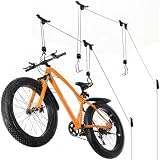
Wallmaster Ceiling Bike Hanger 2-Pack
- 50 lb capacity
- Height adjustable to 12 ft
- Rubber-coated hooks with safety lock
- Alloy steel

RAD Sportz Bicycle Hoist 2-Pack
- 100 lb per hoist
- Self-locking line brake
- Indoor ceilings to 12 ft
- Also lifts ladders

TRUSOON 2-Pack E-Bike Hoist
- 85 lb per hoist
- Woven straps not metal hooks
- 10 to 16 ft ceilings
- Powder-coated steel
All 10 Systems at a Glance in 2026
Every system below mounts to the ceiling rather than the wall or floor, so the comparison is like for like. Capacity is the published load rating per hoist, and ceiling height is the manufacturer-stated limit.
| Product | Specifications | Action |
|---|---|---|
| Wallmaster Ceiling Bike Hanger 2-Pack |
|
Check Latest Price |
| RAD Sportz Bicycle Hoist 2-Pack |
|
Check Latest Price |
| TRUSOON 2-Pack E-Bike Hoist |
|
Check Latest Price |
 GREAT WORKING TOOLS Hoist 2-Pack GREAT WORKING TOOLS Hoist 2-Pack |
|
Check Latest Price |
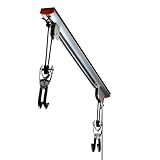 RAD Rail Mount Bike and Ladder Lift RAD Rail Mount Bike and Ladder Lift |
|
Check Latest Price |
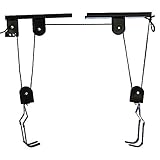 HOSKO 100 lb Ceiling Hoist HOSKO 100 lb Ceiling Hoist |
|
Check Latest Price |
 Ihomepark 3-Pulley Hoist Ihomepark 3-Pulley Hoist |
|
Check Latest Price |
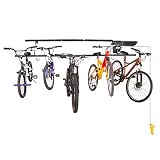 Garage Gator Motorized 8 Bike Lift Garage Gator Motorized 8 Bike Lift |
|
Check Latest Price |
 Kradl Spring-Powered Hoist Kradl Spring-Powered Hoist |
|
Check Latest Price |
 HANDT 3-Rail Sliding Ceiling Rack HANDT 3-Rail Sliding Ceiling Rack |
|
Check Latest Price |
1. Wallmaster Ceiling Bike Hanger 2-Pack – Best All-Round Ceiling Hoist
Wallmaster Ceiling Bike Hanger, Bicycle Lift Hoist Pulley System for Garage
- Builds a 4.6 rating across 1800 reviews
- Steel body with a built-in safety lock
- Height adjustment covers most residential garages
- Two units in one pack
- Quick ceiling-beam installation
- 50 lb rating is modest for heavy e-bikes
- Overhead mounting from a ladder is awkward alone
This is the hoist I would put in the widest range of garages. The hardware is unremarkable in the best way: alloy steel, a rubber-coated hook, a safety lock, and a height adjustment that stretches to 12 ft ceilings. The pack contains two complete hanger units, so one order covers a two-bike setup or a bike and a kayak.
What earns it the top spot is the review volume behind the 4.6 rating. Eighteen hundred ratings is a deep sample, and the pattern in the feedback is consistent: owners like the steel build, like the lock, and report that the lift quietly gives back half a two-car garage. Owners also repeatedly note the two things to plan around, which I will come back to below.
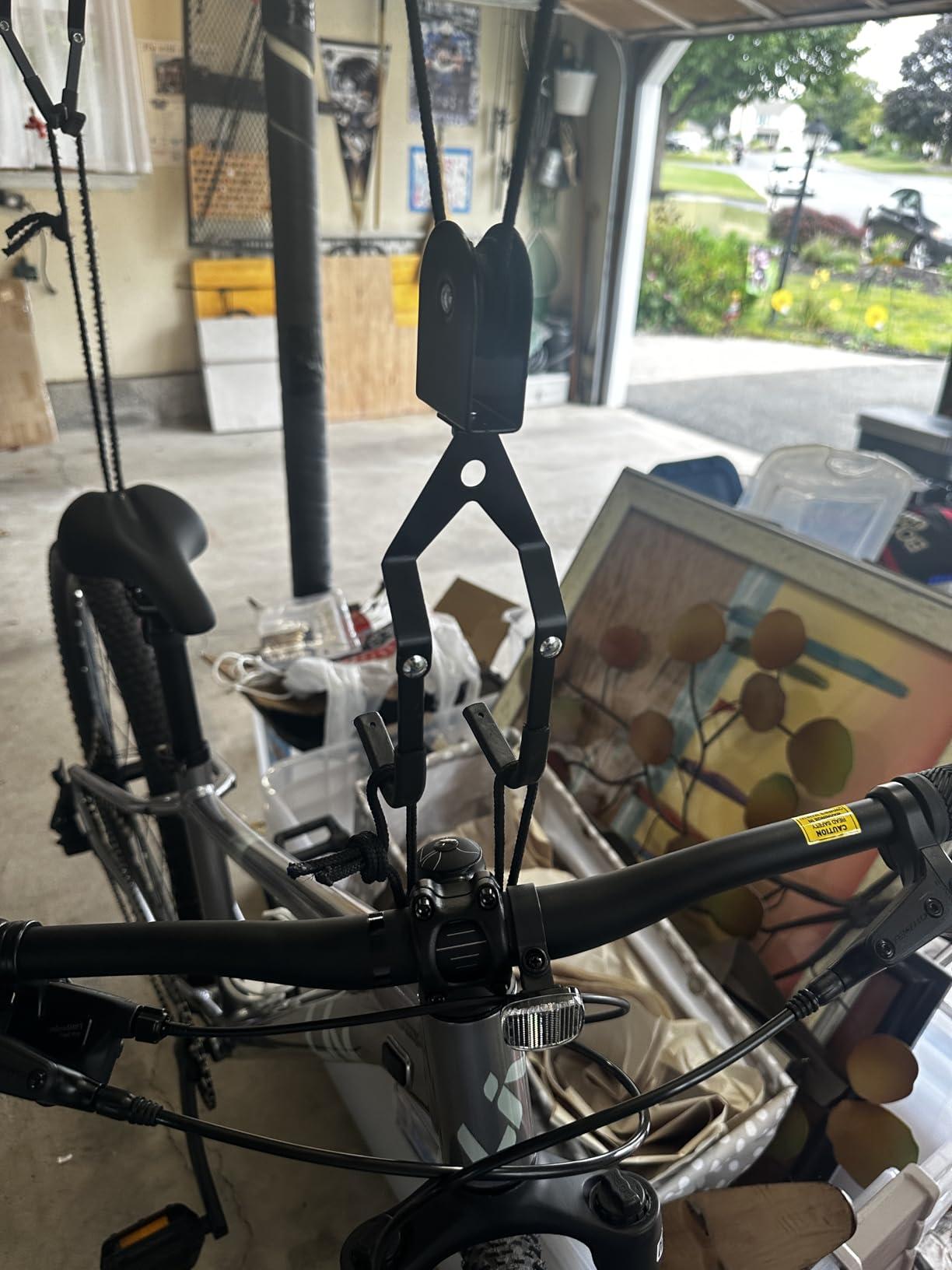
Owner photos from garages show the bikes parked high enough to clear a normal vehicle roofline, which is the whole point. The hook coating keeps the paint off the metal, and the lock means you are not holding the rope tension while you walk away from a loaded bike.
The one real constraint is capacity. Fifty pounds covers road bikes, most mountain bikes and plenty of cruisers, but a 60 to 70 lb e-bike is already into the margin. If your heaviest bike is a fat-tire or a loaded commuter, step up to a 100 lb design rather than pushing this one.
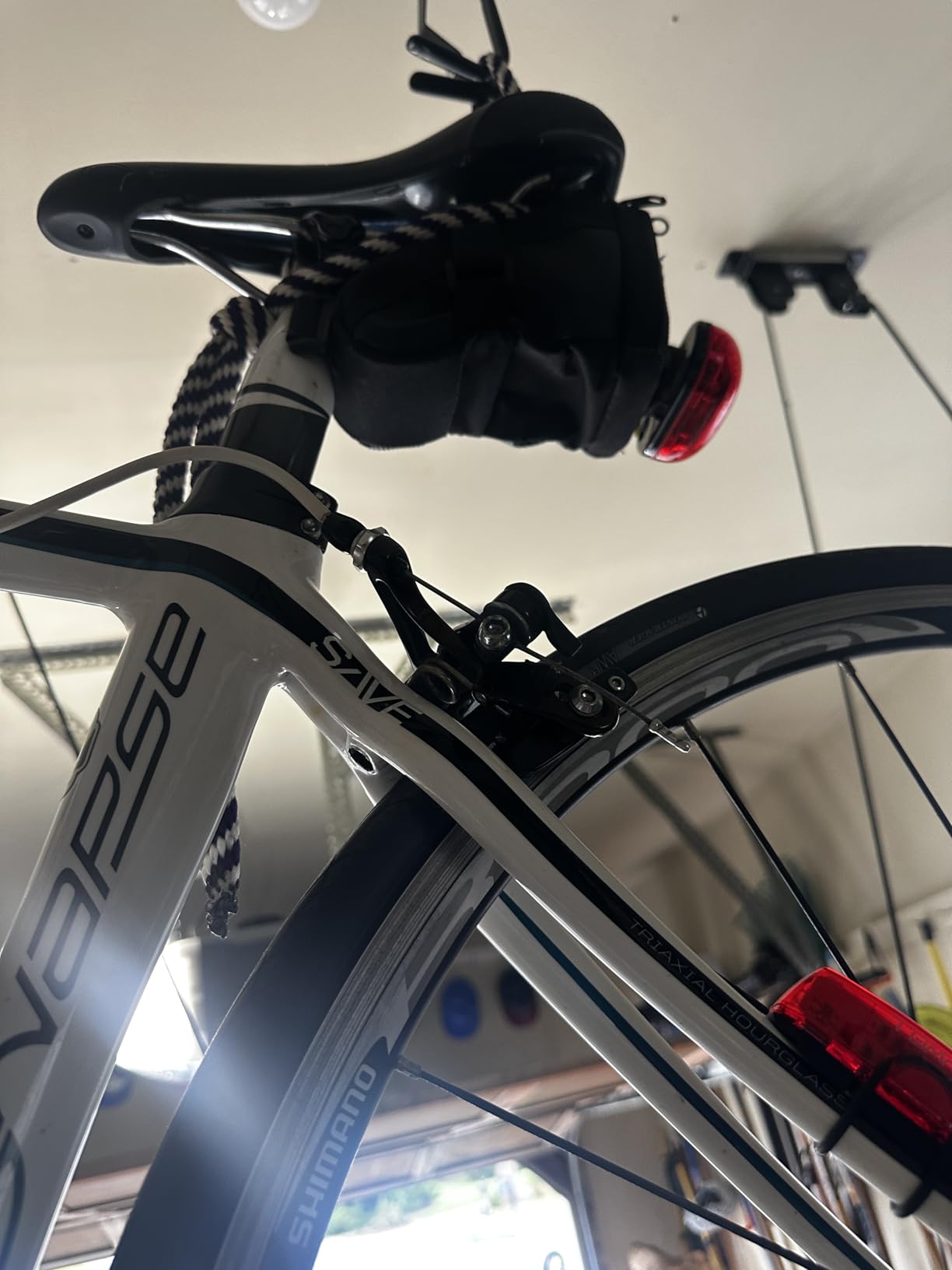
Check your ceiling and joist spacing before you order
The adjustment range covers ceilings up to 12 ft, which is most suburban garages, but the rope has to be trimmed to your actual height before the bike goes up. Measure floor to joist, not floor to drywall, because the unit hangs below the framing.
Installation is a joist-mount job. The pack includes four metal screws, and the feedback notes that driving lag screws into a joist from a step ladder is genuinely awkward working overhead. Our advice is to get a second person or a tall step ladder with a platform.
Where this hoist falls short
The 50 lb rating is the honest limitation. It is fine for the majority of bikes people hoist, but owners of heavier e-bikes consistently describe it as the reason they moved to a higher-capacity system.
Second, mounting overhead alone is unpleasant and slightly risky. If you are not comfortable with a ladder, budget for help at install time. Nothing about the design itself is difficult; it is purely the working position.
2. RAD Sportz Bicycle Hoist 2-Pack – Best Value for 100 lb Loads
- The most-reviewed bike hoist design in circulation
- 100 lb capacity handles e-bikes and ladders
- Self-locking line brake
- Rubber-coated hooks
- Most owners install it in about an hour
- Included screws strip easily
- Shallow hook curve lets flat bars slip
- Thin rope
- Some bikes hang unevenly
This is the design the rest of the category is built around, and at 14,043 ratings it has more owner history than anything else in this roundup by a wide margin. Capacity is 100 lb per hoist, which is the number that decides most purchases: it is enough for a heavy e-bike, a fat bike, a kayak or a set of extension ladders.
The mechanism is a line brake rather than a ratchet. You pull, it rises, it holds, and you let the rope down slowly to lower the bike. Owners consistently describe the threading as smooth and the locking behaviour as predictable, which is the thing you want when a loaded bike is hanging over a car.
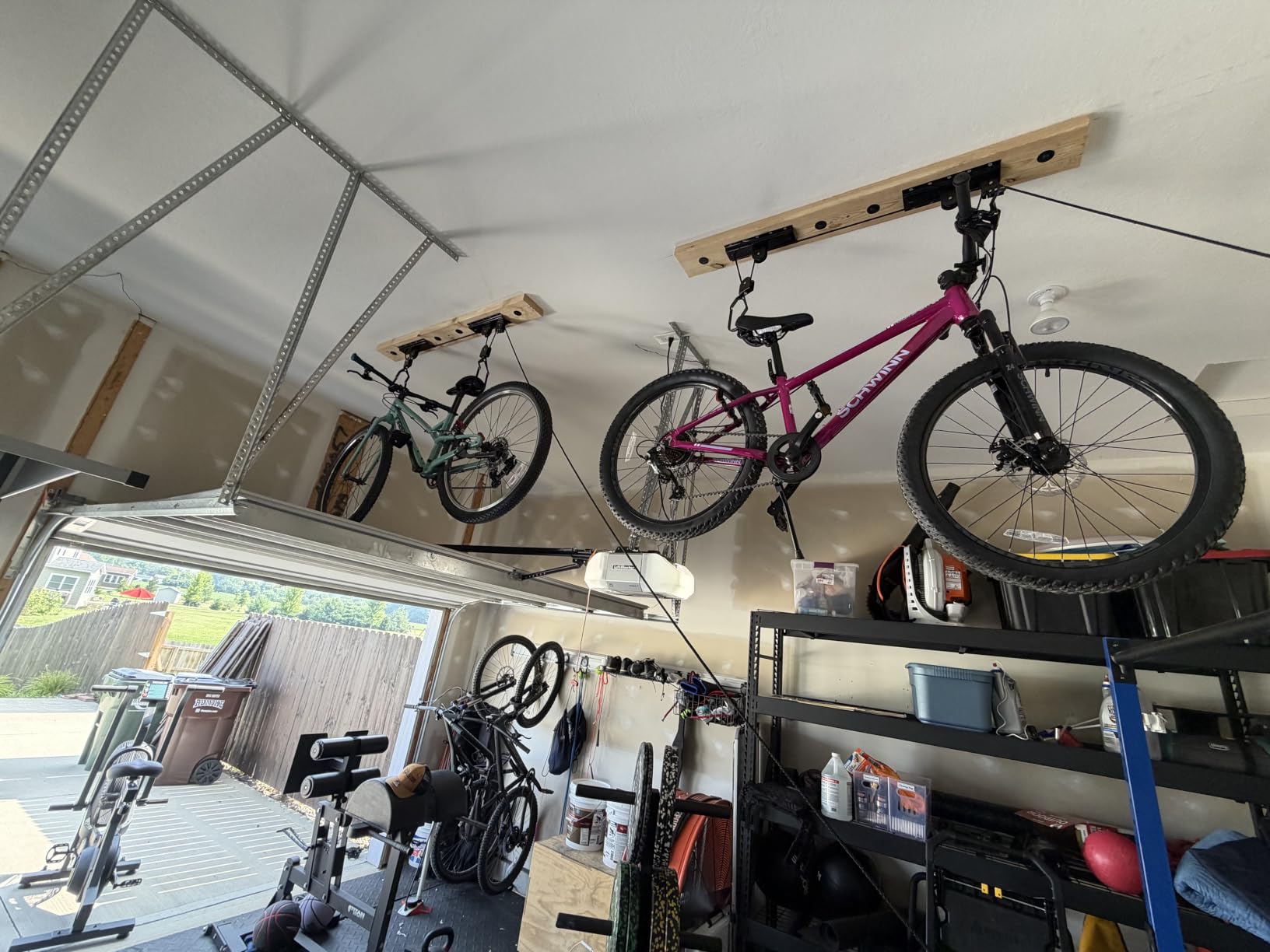
At 4.3, this rating sits a notch below the Wallmaster, and the reasons are consistent enough to plan for. The included screws are the most common complaint: they are soft and strip, so a large share of owners buy their own lag bolts or add a 2×4 backing board. The second repeated gripe is the shallow hook curve, which can let a flat handlebar or seat slide out during the lift.
If you are nervous about the hook, the fix that owners use is simple: a soft strap or bungee around the frame once it is seated. That is cheap insurance on a 70 lb bike hanging above a vehicle.
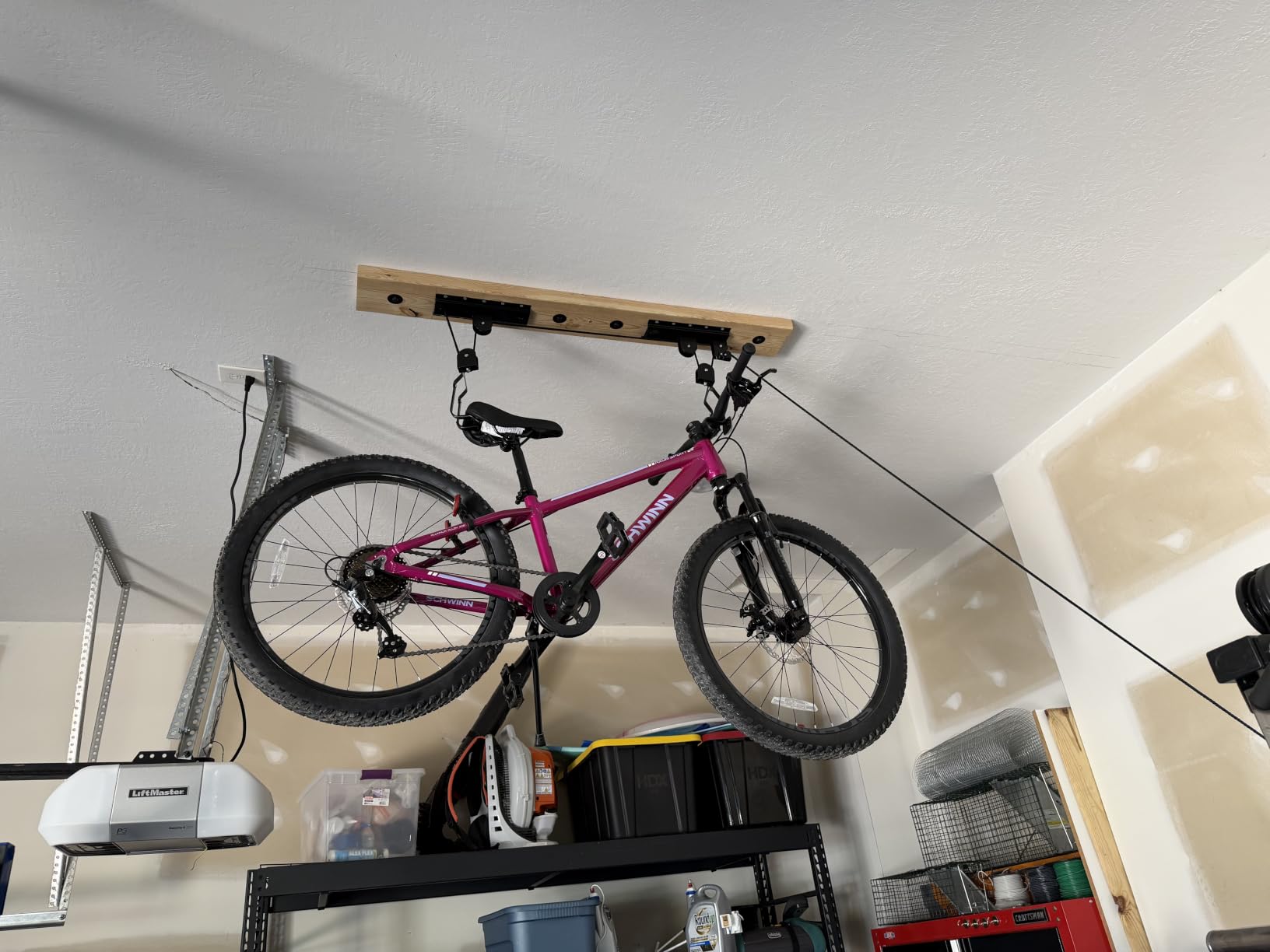
Swap the included fasteners before you mount it
This is the single highest-value minute you can spend on this product. Because the supplied screws strip easily, use 3 to 4 inch lag screws into a joist, or screw a 2×4 into the joist first and mount the hoist to the board. The extra step is the reason some owners describe install as about an hour rather than fifteen minutes.
Also check that your joists are spaced to suit two hoists side by side. Standard residential joists are commonly 16 inches on centre, which gives you room for two bikes over one parking bay, but measure before you plan the layout.
What to know about rope length and uneven hangs
The unit is specified for indoor ceilings up to 12 ft. In a taller garage the rope runs out before the joist does, and owners of high-ceiling spaces are the ones who end up searching for longer-rope systems.
Because the hooks are narrow relative to a bike’s wheelbase, the bike can hang slightly uneven, and some riders end up pulling the high end down an extra time after locking it off. It is a minor annoyance rather than a defect, but it is real enough to mention.
3. TRUSOON 2-Pack E-Bike Hoist – Best for E-Bikes and High Ceilings
TRUSOON 2-Pack Bike Hoist, Heavy Duty Ebike Pulley System for Garage, 85lb
- Only system here rated for 16 ft ceilings
- Straps avoid paint scratches
- 85 lb per hoist suits heavy e-bikes
- Metal grommets slow rope fraying
- Teens can operate it solo
- Smaller review base at 98 ratings
- Needs solid wood joists
- Straps take a second to click on and off
Two things set this apart from every other pulley hoist here. The first is the attachment point: instead of a metal hook that touches your frame, it uses a woven quick-release strap that wraps any frame shape and clicks off just as fast. The second is the stated ceiling range of 10 to 16 ft, which is the answer to the single most common complaint about this whole category.
On height, that range matters more than it looks. Across forum threads about tall garages, the recurring line is that almost every consumer system tops out at 12 ft. This is one of the few in the roundup explicitly specced to reach 16 ft, which makes it the pick for anyone with a tall ceiling who has run out of rope on other systems.
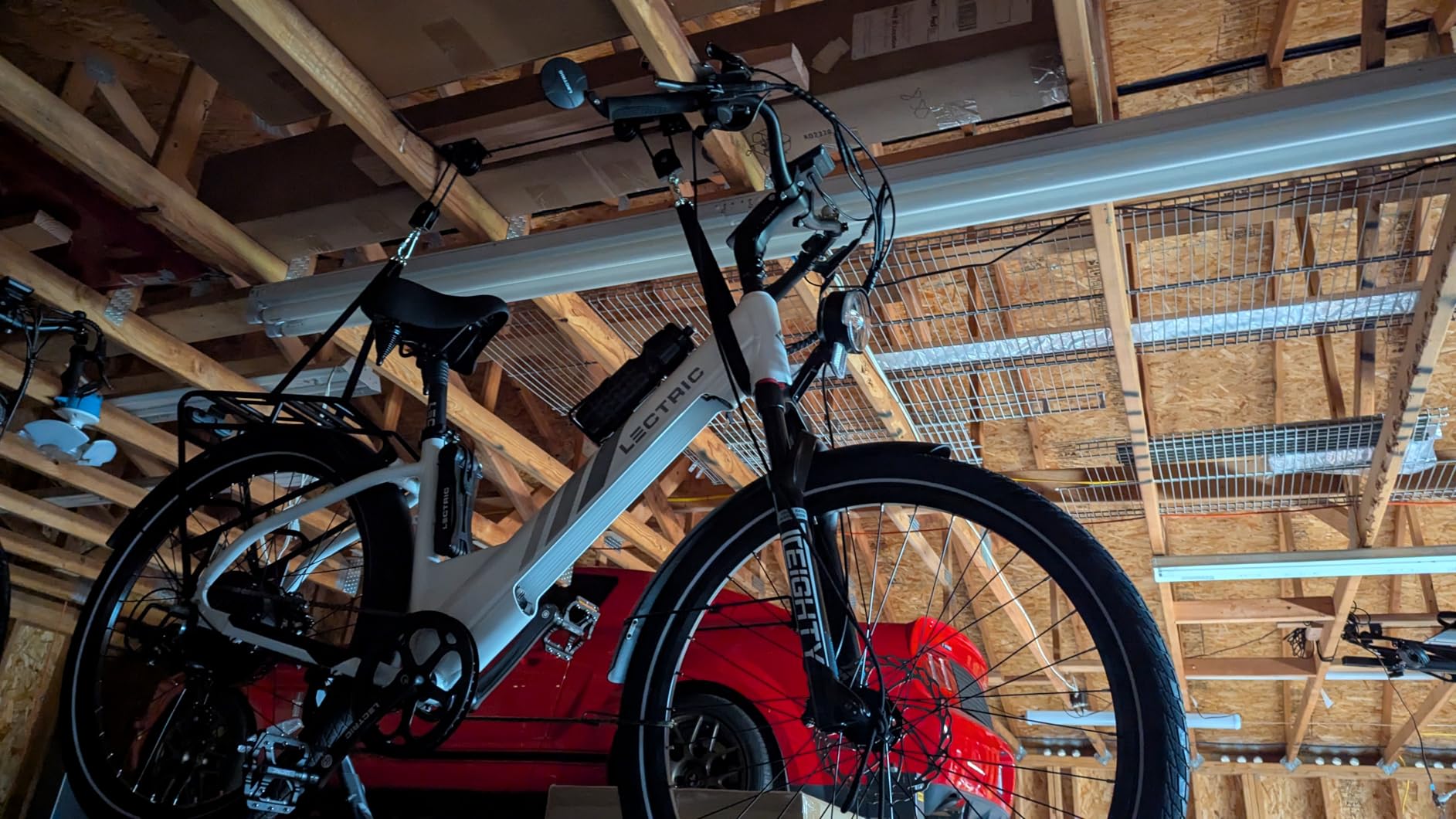
At 85 lb per hoist, the pair handles two e-bikes or two fat-tire rigs, and the marketing pitch of a his-and-hers electric bike setup is the realistic use case. Owners like that the strap avoids the release-during-lift risk that metal hooks carry, and that powder-coated steel frames and metal grommets address corrosion and rope fraying, the two things cheap nylon rope kits fail on.
The honest caveat is the review base. Ninety-eight ratings with a 4.6 average and 73 percent five-star is strong sentiment, but it is a fraction of the evidence behind the RAD design. The included hardware is specified for solid wood joist anchoring, so a steel-joist garage needs a different plan.
Weigh your e-bikes before assuming two hoists are enough
Rated capacity is a static number. A loaded commuter, a fat bike with a big battery, or a bike with panniers can approach 70 lb before anything is hung on it. Weigh the bikes, add accessories, and keep headroom under the rating.
Because the straps wrap rather than hook, a step-through frame or a carbon frame is handled cleanly. That matters for owners who would not want a steel hook touching an expensive finish.
Where the smaller review base should worry you
Roughly a hundred ratings means fewer failure reports have surfaced, and cheap fasteners are the most common failure in this category generally. Plan to supply your own lag screws regardless of what is in the box.
The straps also take a second to click on and off, a small irritation if you are pulling a bike down several times a day. If you ride daily and want instant access, read the alternative section below before committing.
4. GREAT WORKING TOOLS Ceiling Mount Hoist 2-Pack – Most Versatile for Two Bikes
Great Working Tools Ceiling Mount Bike Hoist Set of 2 Bike Hangers Pulley System
- Two complete hoists in one order
- 55 lb covers most mountain bikes and cruisers
- Hook and strap system resists accidental release
- Anti-scratch rubber coating
- Works on folding and extension ladders
- Supplied rope is thin
- Short rope in high-ceiling garages
- Mounting lag bolts usually bought separately
The value argument here is arithmetic: two complete hoist systems in one order, rated to 55 lb, for a household that wants two bikes up and out of the way without buying twice. Feedback is overwhelmingly positive on that point, and the 4.6 rating across 1158 reviews supports the value claim rather than merely tolerating it.
It is also the most approachable design here for older riders. Owners report that the pulley action is smooth enough for a younger or less strong user to raise and lower a bike independently, which is not true of every system in this roundup. The hook and strap combination is a genuine safety plus: the strap keeps the bike seated on the hook while the pulley lock holds the load.
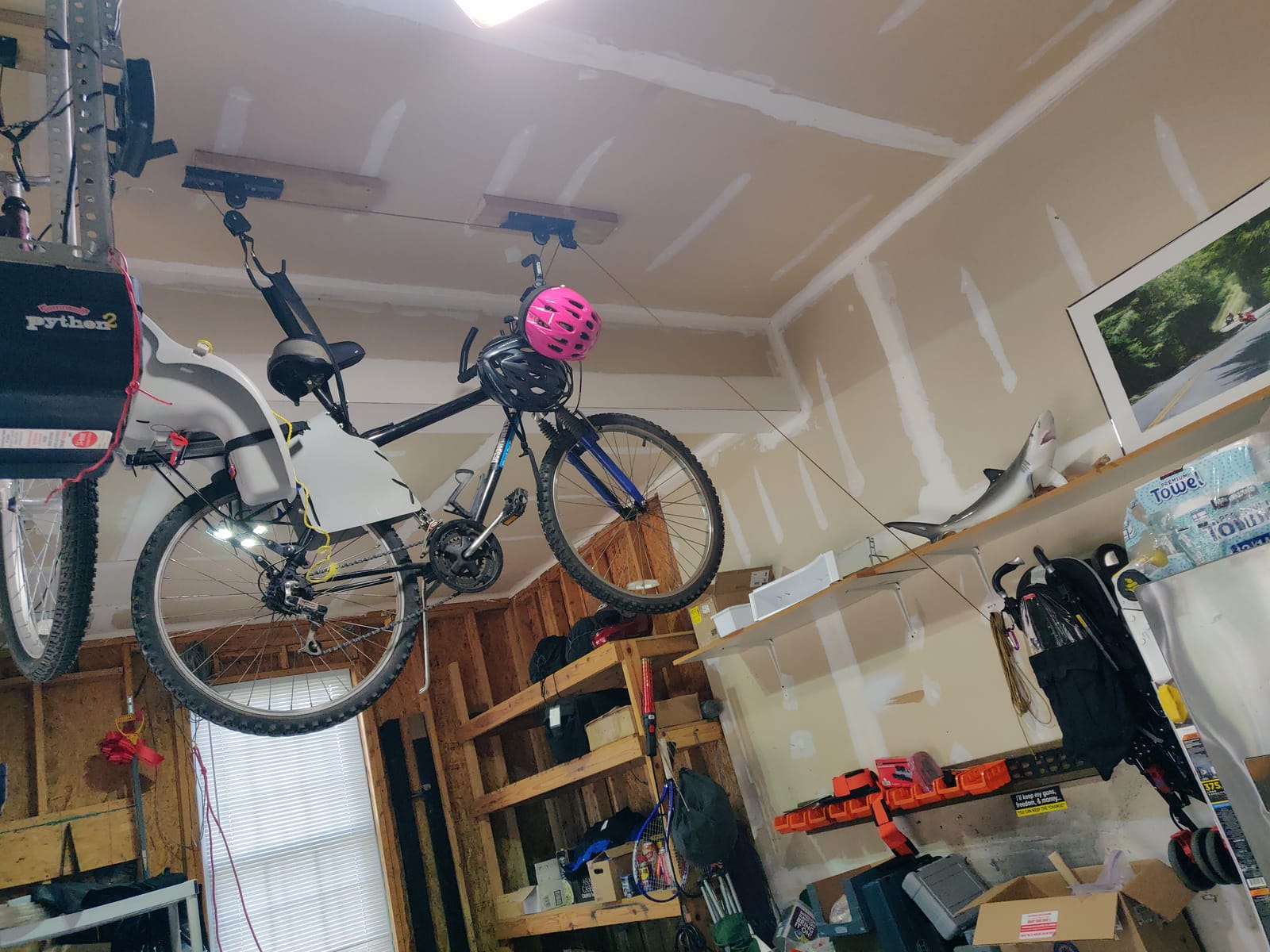
The thin rope is the near-universal complaint, and a fair number of owners replace it with heavier paracord as a first modification. That is a reasonable, cheap upgrade. The second issue is length: in garages taller than 12 ft the rope runs short, and the bike ends up hanging lower than you intended, which on some ceilings means it sits close to head height for a person walking underneath.
Mounting hardware is not included in the form most people need, so add your own lag bolts or a 2×4 backing board to the order. It is a small extra step, and it is the step that separates a setup that holds for years from one that works loose.
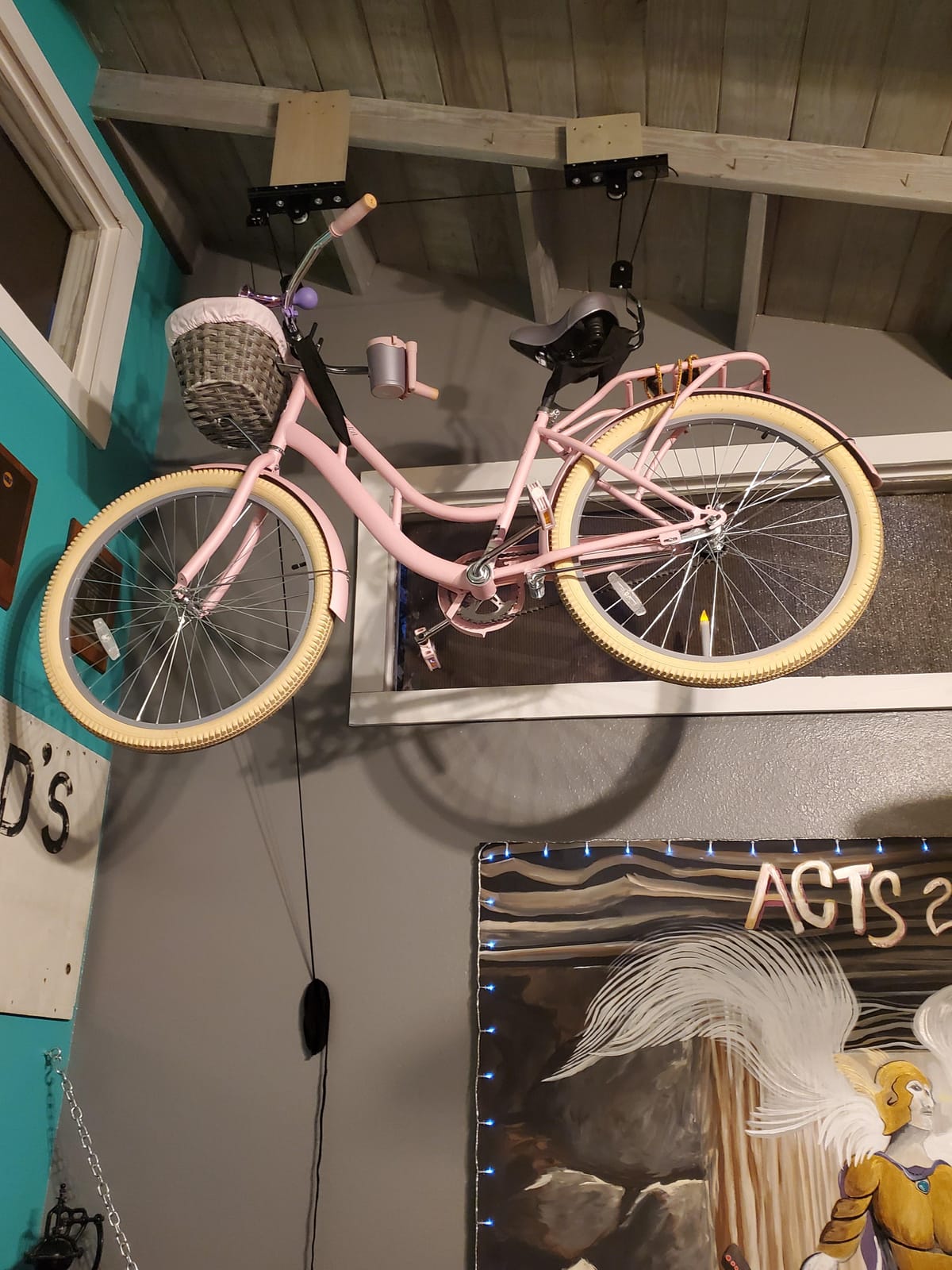
Check that the bike clears head height in low-ceiling garages
In garages under about 11 ft, a hoisted bike can hang at a height that is awkward for a person walking beneath it. Measure the raised position before you fix the mounting point, and if the clearance is tight, consider a system with a longer drop or a rail rack positioned over a work bay rather than a walkway.
Also confirm the ceiling is at or under 12 ft before buying. The rope is specified for ceilings up to 12 ft, and owners in taller garages report the shortfall clearly.
Who should skip this one
If your heaviest bike is over 55 lb, this is the wrong rating. There is a version of this category at 100 lb for a modest step up, and for a heavy e-bike the difference matters.
The other skip case is anyone in a garage with no accessible wood joists. The included hardware assumes a joist or a 2×4 you screw to a joist, and the fix for a finished or steel-framed ceiling is a bigger job than this product supports.
5. RAD Rail Mount Bike and Ladder Lift – Best for Ladders, Kayaks and Awkward Joists
RAD Cycle Products Rail Mount Bike and Ladder Lift for Your Garage or Workshop Holds up to 75 Pounds No Mounting Board Needed
- No 2x4 mounting board required
- 75 lb covers most bikes and ladders
- Cam lock holds every pull
- Adjustable rail works around joist spacing
- Only 16 oz
- 75 lb rating is below the 100 lb pulley hoists
- Long rail is awkward in tight bays
- Aluminum is lighter duty than a steel bracket
This is the same RAD engineering as the flagship hoist, reconfigured around a long rail instead of a fixed pulley bracket. The practical difference shows up at install time: the rail mounts directly to a ceiling joist, so you skip the 2×4 backing board that most competing kits effectively require. Owners pick that out as the main reason to buy it.
The adjustable rail is the second reason. When your joists are awkwardly spaced or you want the pulleys positioned to one side of a bay rather than centred, being able to slide the pulley position along the rail is genuinely useful. The cam lock is rated favourably by owners as well, holding on every pull rather than only when tension is applied.
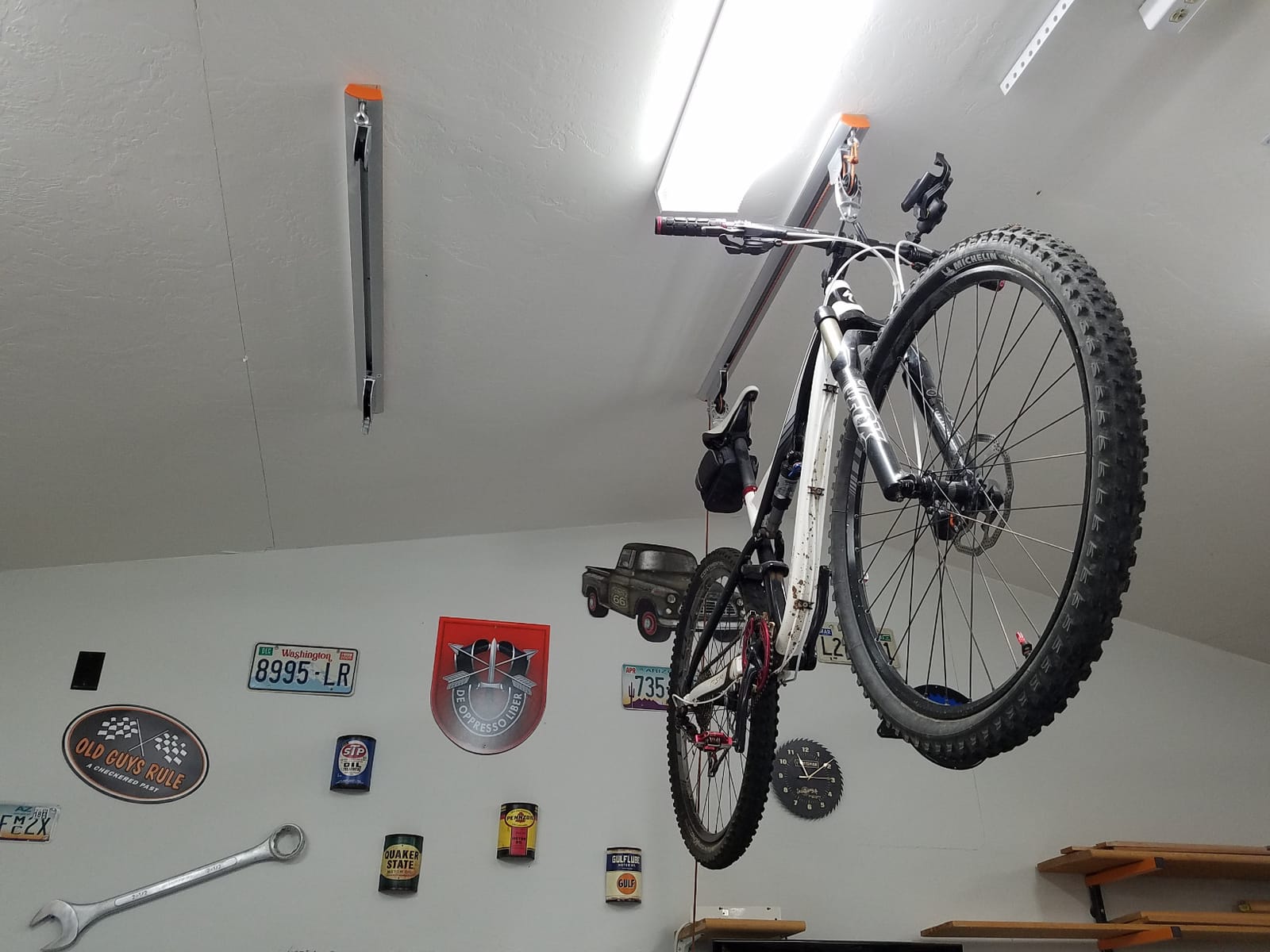
At 4.3 across 3260 ratings, satisfaction sits slightly below the RAD two-pack, and the reasons are structural rather than quality. Seventy-five pounds is below the 100 lb ceiling models, so a heavy e-bike is out of range. The long rail can be fiddly to fit between closely spaced joists in a narrow bay, and the anodized aluminum is lighter duty than a solid steel pulley bracket.
None of that matters much if your lift targets are ladders, kayaks, a ladder and a bike pair, or light equipment where the rail’s flexibility is the point. The weight of the whole unit at 16 oz also means you can reposition it without a second opinion.
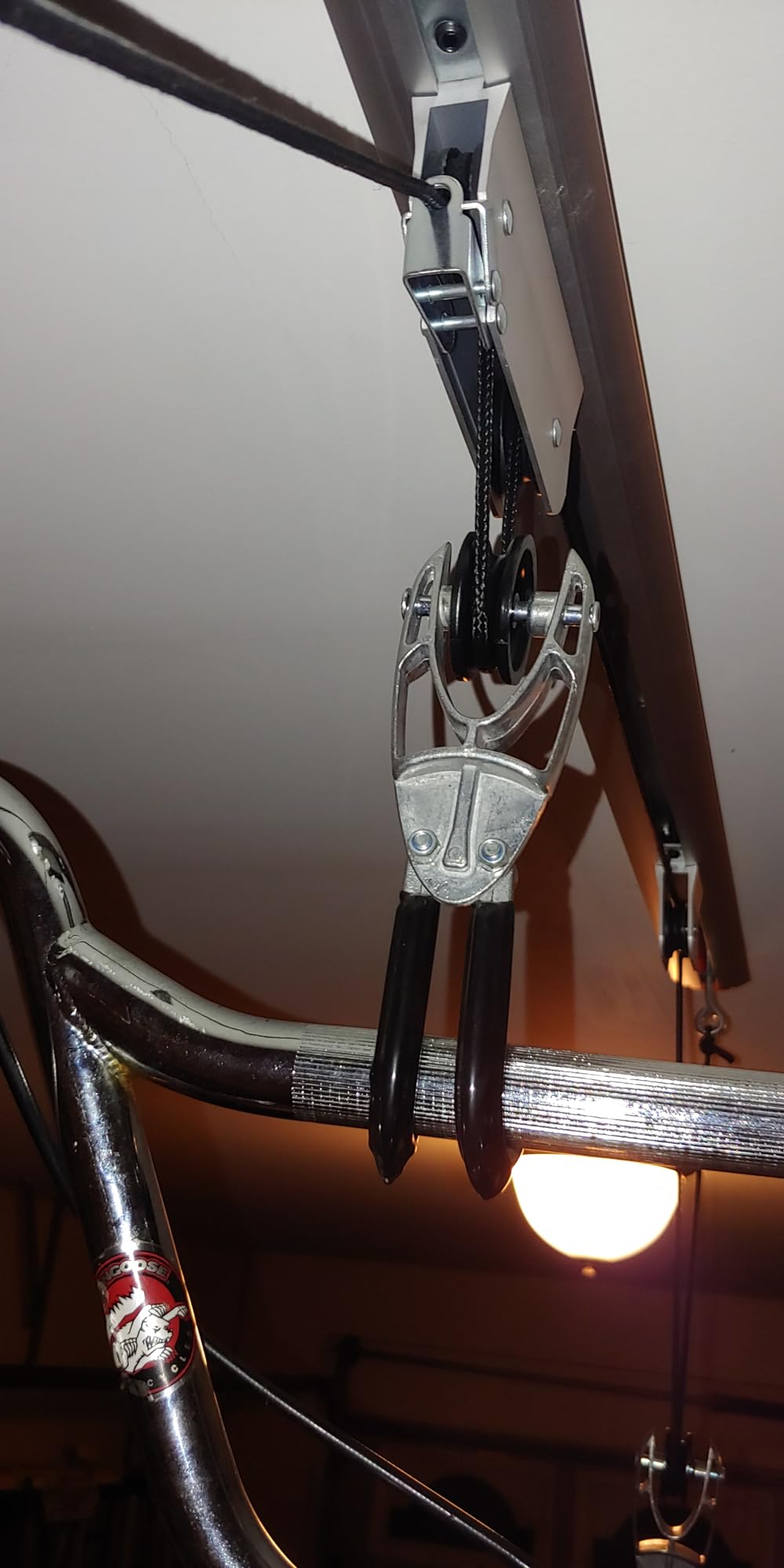
Use it when the lift target is not a bike
This is the pick for a garage that stores more than bikes. A 75 lb rating and a rail mount handle an extension ladder, a kayak, a stand-up paddleboard or a set of roof boxes, and the no-board mounting keeps the install to two fasteners into framing.
For kayaks in particular, the rail gives you a wide span to hang across, and a pulley rail is the pattern that long-term users in paddling forums describe running for years without adjustment.
Where the rail format gets awkward
Measure the bay before ordering. The assembly is 8 by 8 by 30 inches, so it needs a joist run long enough and a bay wide enough to accept it, and in a tight bay between two closely spaced obstructions the install is fiddly.
If your bike is heavier than 75 lb, or you want the sheer confidence of a 100 lb rating over a car you care about, the fixed-bracket pulley hoists in this roundup are the better buy even though they need an extra mounting board.
6. HOSKO 100 lb Ceiling Hoist – Best Simple Setup for Lightweight E-Bikes
Bike Lift Hoist for Garage Ceiling, Heavy Duty Ceiling Mountain Bicycle Hanger Pulley Rack 100 lb Capacity
- Lifts 45 lb e-bikes without strain
- Self-locking action works like a blind
- Vestibule plastic coating protects frames
- Doubles for kayaks and ladders
- Lowest 1-star share among budget hoists
- Included screws and anchors are too weak for a ceiling
- Thin rope
- Diagram-only instructions
The feedback on this one is unusually specific, and it comes from people with a real problem: owners of 45 lb e-bikes report that this hoist lifts them without straining. That is the test that matters, because a 100 lb rating on paper means very little if the pulley has no mechanical advantage and the bike is at the end of its rope.
The self-locking behaviour is described as working like Venetian blinds, which is a good analogy: the rope holds wherever you leave it without a separate ratchet to release. Once installed, owners call it set and forget, and the plastic-coated hooks keep steel off the frame.
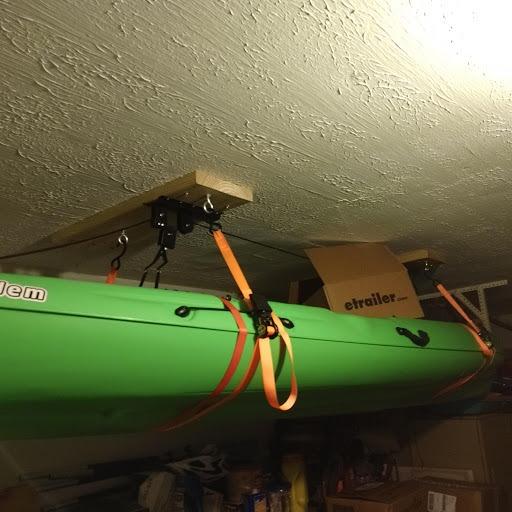
The consistent complaint, and it is close to unanimous in the reviews, is the included hardware. The supplied screws and wall anchors are not strong enough for a ceiling, and almost every owner ends up mounting to a 2×4 or a steel strut with their own 3 to 4 inch construction screws. Plan on that from the start rather than treating it as a surprise.
Secondary gripes are the rope gauge, which some owners expect to replace over time, and thin diagram-only instructions. At about 10 ft of lift height it is also the shorter system in the roundup, so it suits a standard garage better than a tall one.
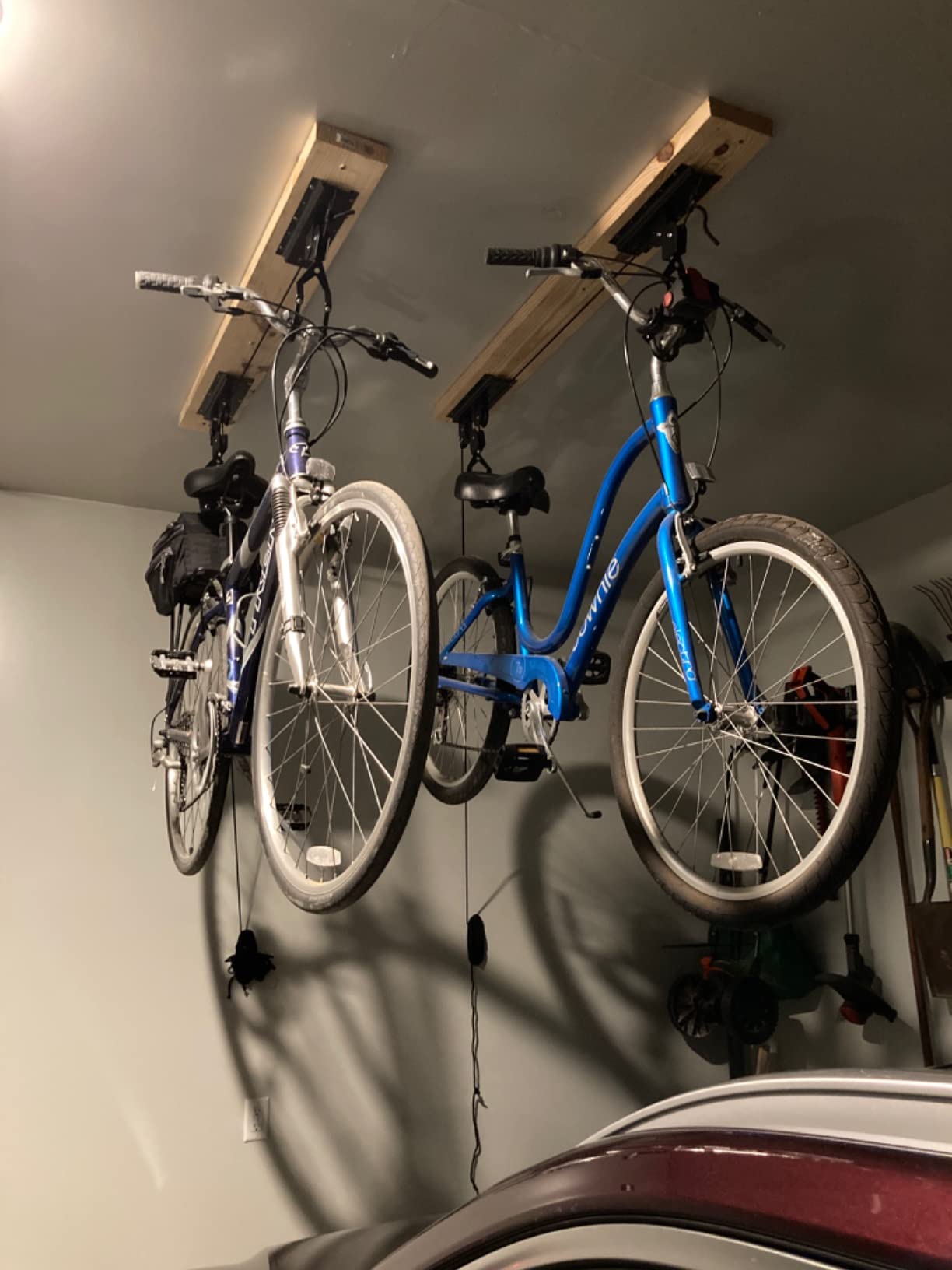
Count on replacing the fasteners, not the hoist
Budget for a 2×4 and your own construction screws. The difference between the supplied anchors and proper lag screws into a joist is the difference between a lift that stays put and one that works loose over a few years, and the reviews make clear that owners are making that upgrade without complaint.
Once the mounting is right, the pulley action itself draws almost no criticism, which is unusual for a hoist in this price bracket.
Where this is the wrong pick
A ceiling much above 10 ft is a poor match, because the lift height and rope both top out lower than the 12 ft systems here. If you have a tall garage, look at the longer-rope or extended-height options instead.
It is also a single-unit design with two hooks, so a two-bike garage means two orders. That is fine, but if you want both bikes up in one purchase, the two-packs in this roundup do it for less.
7. Ihomepark 3-Pulley Hoist with 45 ft Rope – Best for Extreme Ceiling Heights
Bike Hoist, Ceiling Bicycle Lift, 3 Pulley, 45ft Rope, 100LB Capacity
- Longest rope in the roundout at 45 ft
- Three pulleys give real mechanical advantage
- Handles kayaks
- ladders and gear as well as bikes
- Welded coated hooks
- Supplied fasteners described as weak
- Listed item weight of 10 g is not representative
- Less review depth than the established brands
This is the answer to the tall-garage problem stated in hardware form. Forty-five feet of rope with three pulleys gives you enough travel to raise a bike to a genuinely high ceiling and a mechanical advantage that makes the lift manageable rather than a workout. Owners in high-ceiling spaces describe the three-pulley layout as the reason one person can do it solo.
It is also the most multi-use of the budget hoists here. The stated uses cover kayaks, extension ladders and general gear, and with 100 lb of capacity and that much rope it is genuinely capable of a heavy touring kayak, not just a bike.
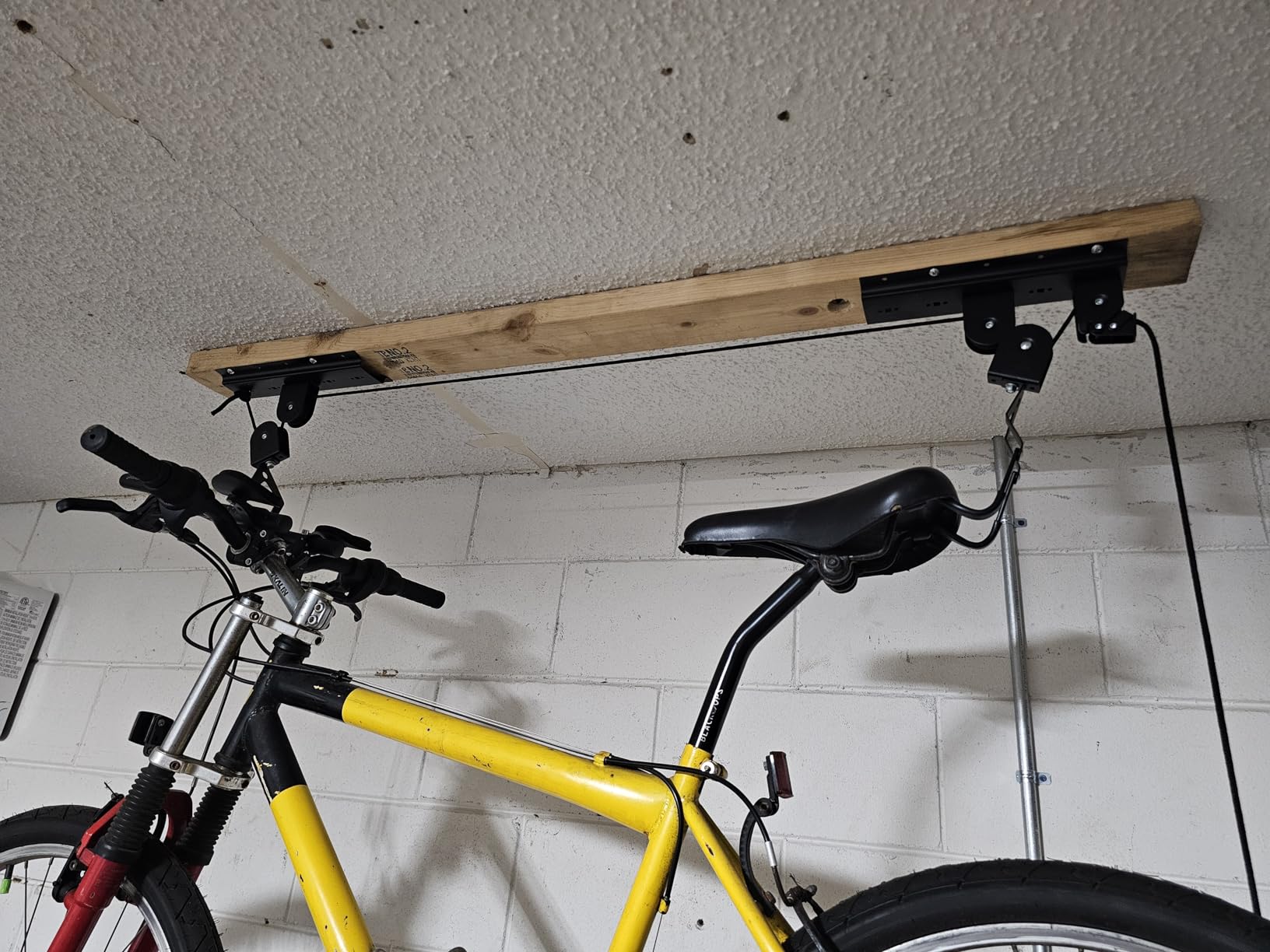
At 4.3 across 620 ratings, it sits mid-pack, and the reason is the same one that runs through this whole category: the fasteners. The included screws and anchors are described as weak, and most installers substitute lag screws or add a backing board. Treat that as a required step rather than an upgrade.
One listing detail is worth knowing: the stated item weight of 10 g does not represent the assembled unit, so do not use it for any load or handling assumptions. Judge the system on the 100 lb rating and the 45 ft rope, which are the numbers that matter.
How much drop you actually need
Work backwards from your ceiling. The bike should stop roughly a foot below the joist so the hooks and rope do not bind against the framing, and it still needs to clear the roof of whatever you park underneath. Forty-five feet of rope covers almost any residential ceiling height with room to spare, which is why this is the pick for the tall-garage complaint.
If your ceiling is under 10 ft, that extra rope is simply trimmed. Nothing about the system needs the full length to work.
Where the trade-offs sit
Three pulleys mean more hardware at the mount and a longer install than a single-bracket hoist. It is still a straightforward joist job, but plan a little more time than a basic one-bracket kit.
The review base is thinner than the RAD, Wallmaster and HOSKO designs, so if you value long-proven reliability over rope length and there is no height problem in your garage, one of those is the steadier purchase.
8. Garage Gator Motorized 8 Bike Lift – Best Motorized Lift for Eight Bikes
- Motor lift means any household member can raise bikes
- 220 lb total capacity
- Key lock restricts access to the rack
- Motor is fast and the upper stop is reliable
- Replaces a full bay of floor
- Seat-only hooks hang bikes nose-down and block parking
- Needs about 12 ft ceilings to be practical
- Supplied hooks have thin rubber
- Bar bows and bikes can swing
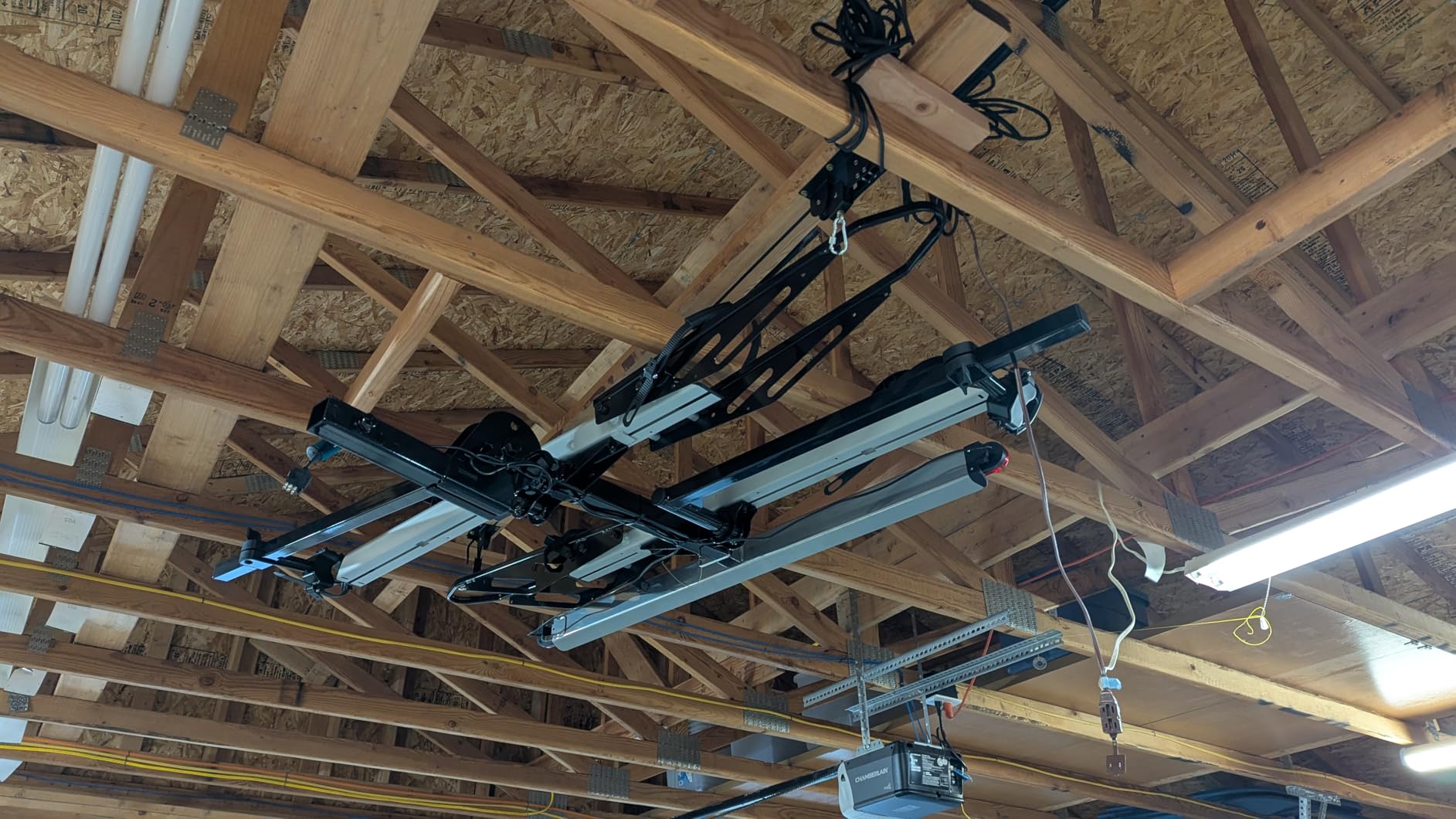
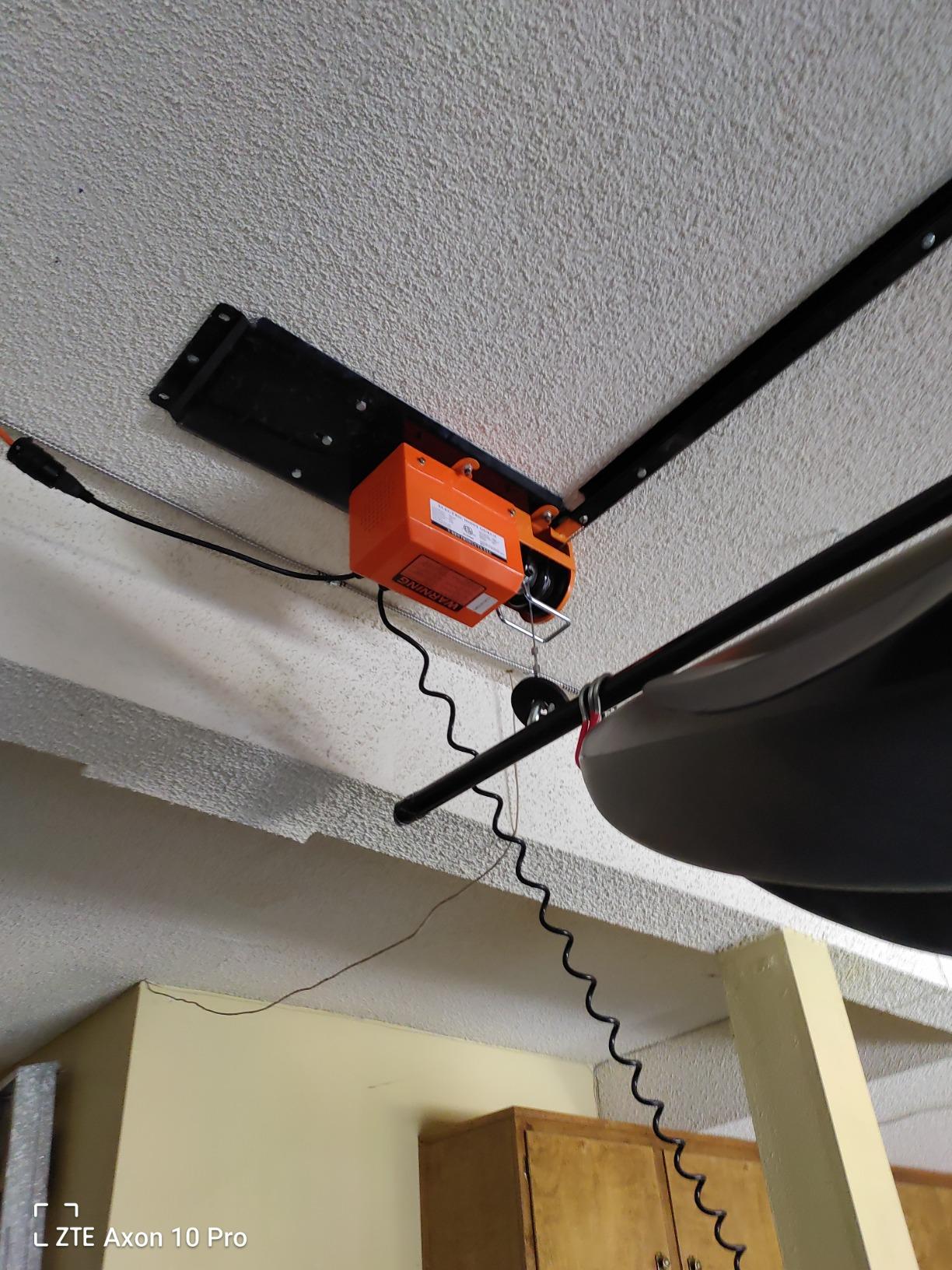
This is the motorized category that most competing roundups skip entirely, and it solves a problem pure hoists cannot: a household where nobody wants to pull a rope. A push-button controller on a 15 ft wired lead runs a motor hoist that raises the whole rack to the ceiling. The key lock is a real security feature rather than a gimmick, and owners with tall ceilings describe the floor space it gives back as an entire parking bay.
Capacity is 220 lb across eight storage hooks, and owners running several e-bikes plus other gear report it handling that load comfortably. The motor is described as fast, and the upper stop as reliable, which matters because the failure mode people fear most is a rack partway up.
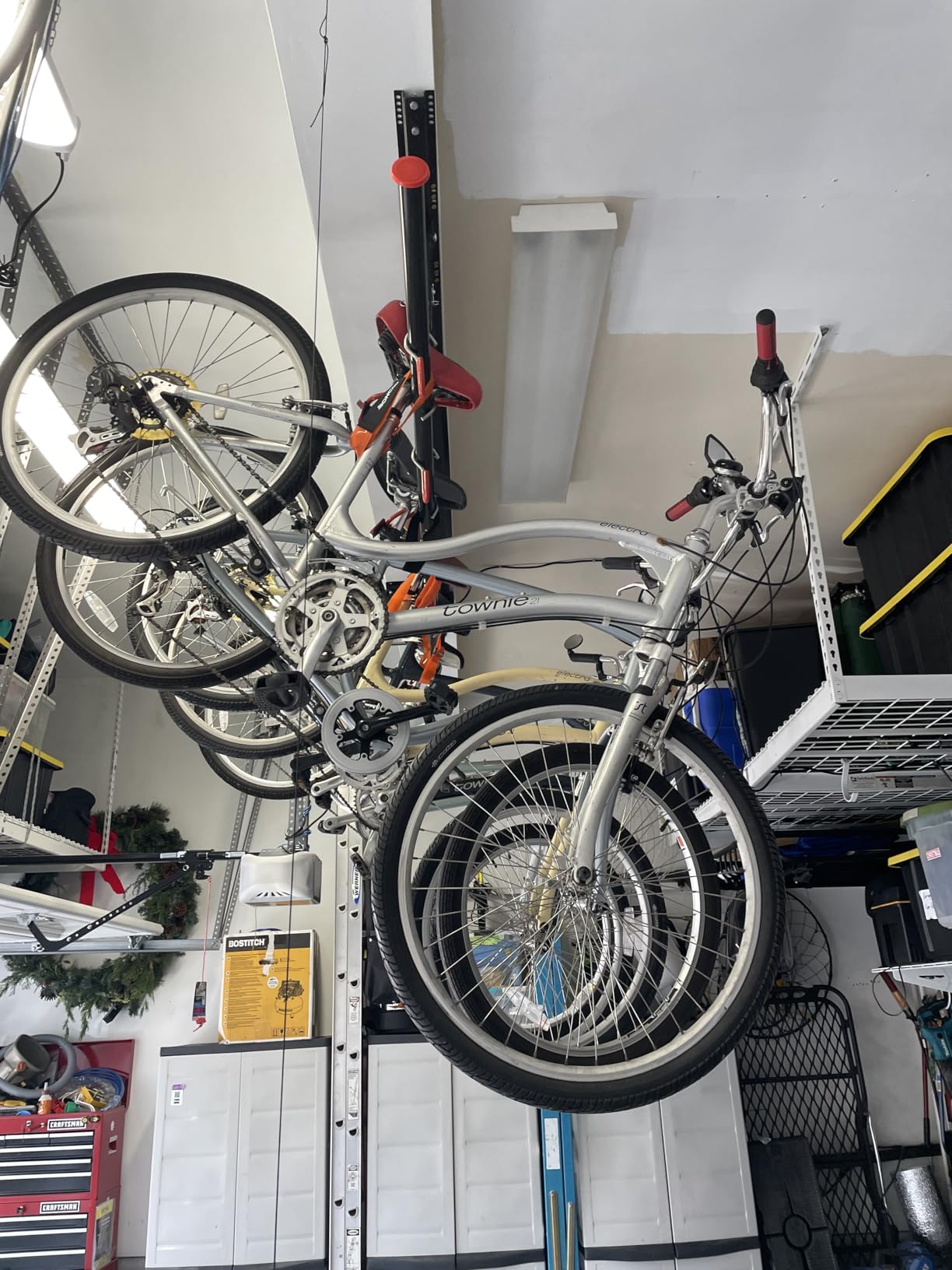
The decisive weakness is geometry, not mechanics. The supplied hooks catch the seat, so bikes hang nose-down with the front wheel dropping low, and several owners report that this blocks parking entirely in a 10 ft garage. Bikes also finish roughly a foot below the ceiling at full height, which is why the feedback repeatedly says this needs 12 ft ceilings to work properly.
A few owners went further and built a custom wood rack to replace the supplied hanger bar, which fixes the swing and the bar-bowing some report. The supplied hooks also have thin rubber that can split, and the motor is noticeably noisy, so it is not a silent neighbour-friendly system.
Measure your ceiling before you fall in love with it
Twelve feet is the practical floor for this design, not the spec floor. Below that, the bikes sit low enough that the nose-down hang interferes with a parked vehicle. If your garage is a standard 9 ft or 10 ft, the per-bike pulley hoists earlier in this roundup fit the space better.
Plan the install as a two-hour job with a helper. It weighs 50 lb assembled and the ceiling mount uses a channel plate with mounting plates, so it is a proper two-person fit rather than a single-hook-and-done job.
Where a motorized lift earns its keep
The reason to pay for motorisation is access. If children, older riders or anyone with back or shoulder problems use the bikes, a button press is the difference between a system that works for the household and one that works for one member of it.
It is also the pick for a shared household garage with six to eight bikes, where one lift and one key lock replaces multiple hoists and a wall of hooks. The 220 lb rating leaves room for mixed gear as well as bikes.
9. Kradl Spring-Powered Ceiling Hoist – Best for Zero Lifting Effort
Kradl – Spring-Powered Ceiling Bike Hoist and Rack, Lifts up to 40lb
- No electricity
- batteries
- rope or pulleys
- One smooth hand pull to raise and lower
- Installs with two included screws
- Stops anywhere between floor and ceiling
- Two-year warranty
- 40 lb rating is well under the pulley hoists
- Weigh your bike before ordering
- Step-through frames need the crossbar adapter
- 10 percent 1-star share
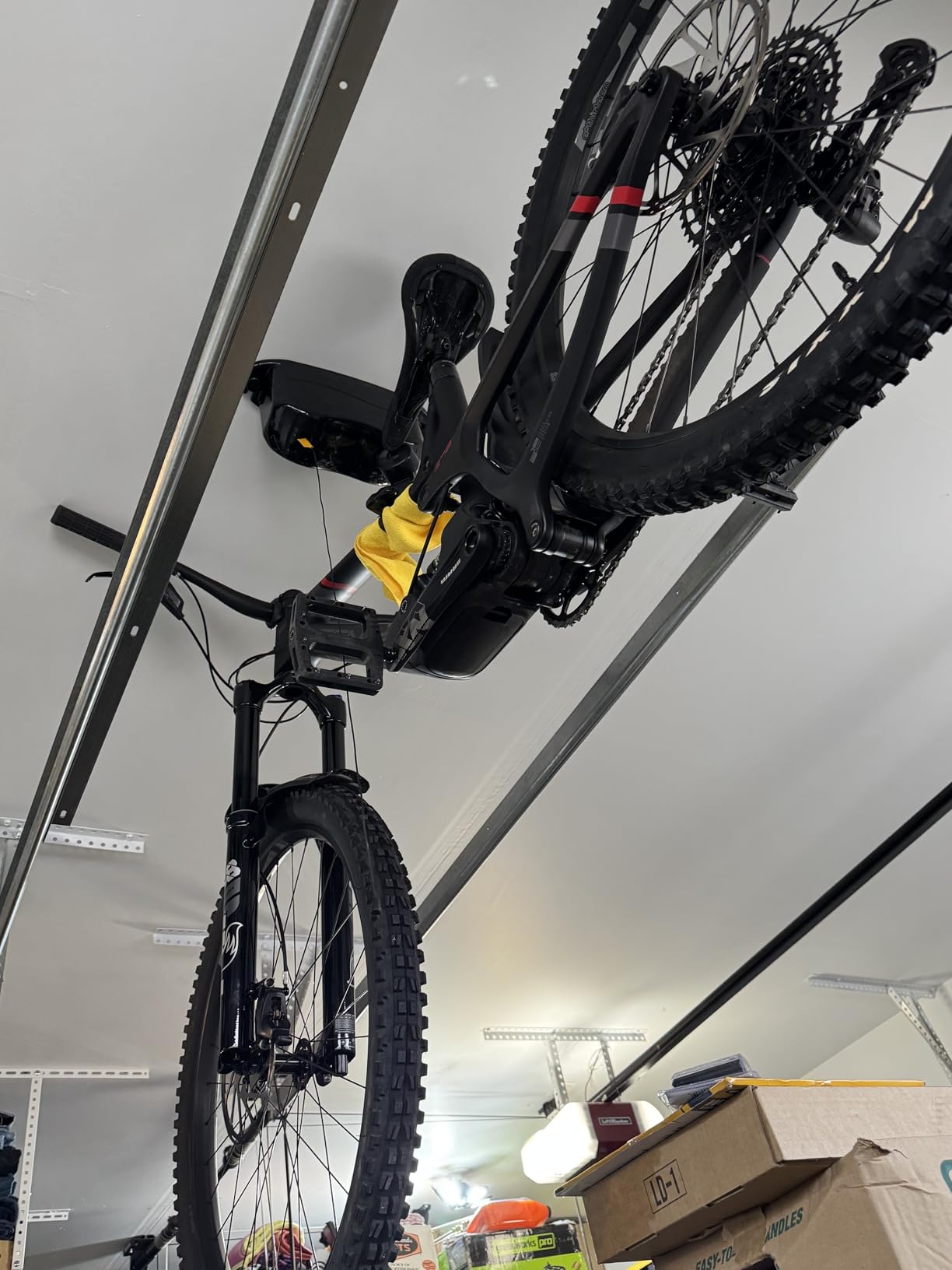
Kradl removes the parts of a hoist that cause friction: no rope, no pulleys, no batteries, no electricity. An internal spring in a 13 inch wide body does the work, and you raise and lower the bike with one smooth pull. There is no rope to scald your hands and nothing to fray, which is a real advantage in a category where rope condition is the top maintenance worry.
Installation is genuinely a two-screw job, and the 2 Year manufacturer warranty is the longest in this roundup. Owners who match the unit to their bike are enthusiastic about the smooth raise-and-lower action and the ability to stop the bike anywhere between the floor and the ceiling rather than only at the top.
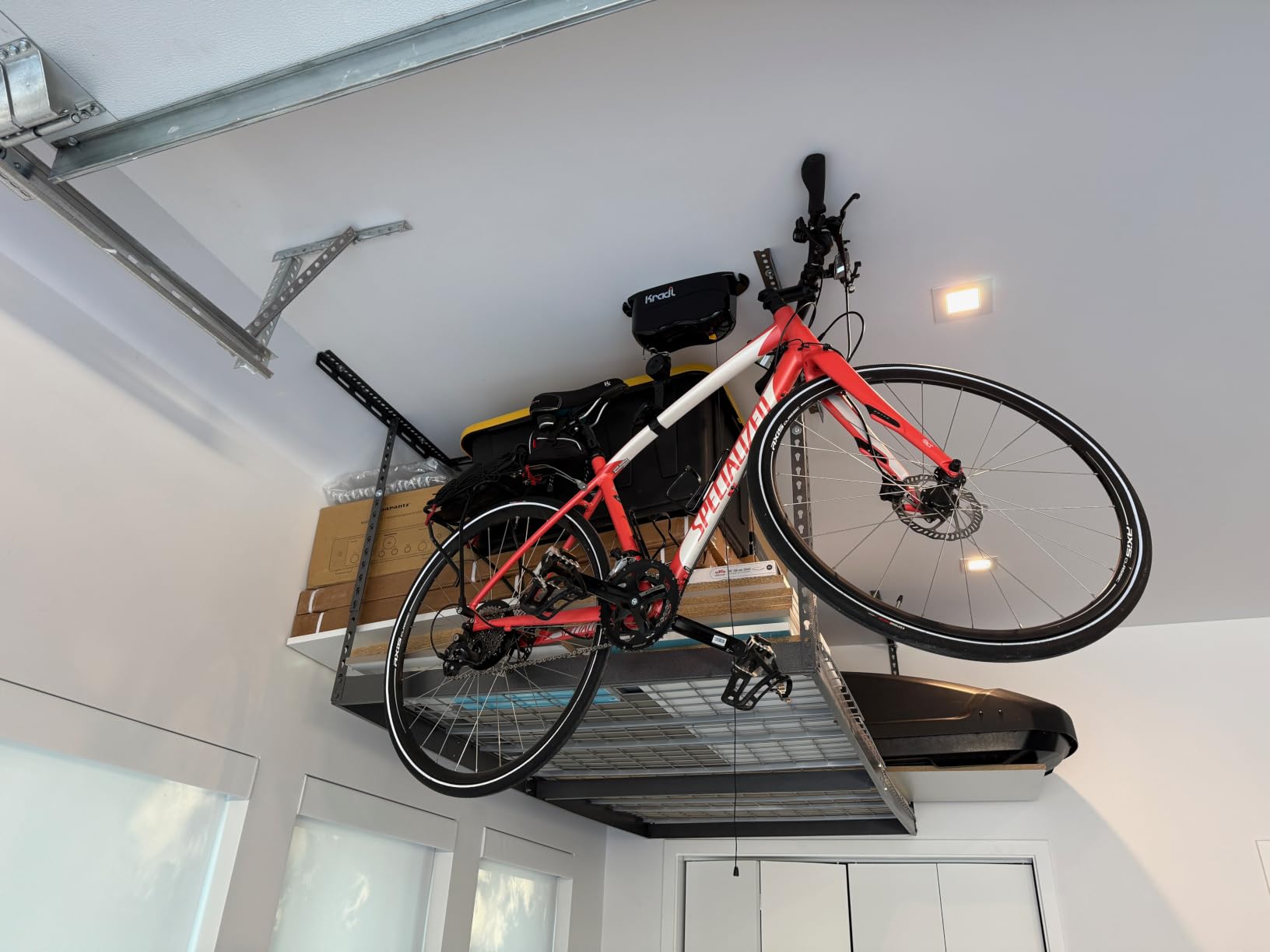
The critical buying step, repeated throughout the reviews, is to weigh your bike first. This 40 lb version is intended for bikes from 26 to 40 lb, and a bike under 25 lb will not balance the spring correctly, so lighter road bikes and kids bikes need the 25 lb model instead. Get that wrong and you join the 10 percent one-star group, which is the highest in this roundup.
Capacity is also the hard limit. A single unit tops out at 40 lb, and for an e-bike up to 80 lb the guidance is a pair of units plus a separate e-bike kit. Step-through frames need the optional crossbar adapter. Ceiling height is capped at 12 ft for this 40 lb version, with extensions available for taller ceilings.
Weigh the bike before you order, not after
This is the one product here where fit is decided by a number you can get in five minutes. Park the bike on a scale, read the weight, and match it to the capacity band. Under 25 lb means the smaller model; 26 to 40 lb means this one.
The spring itself does the rest. There is no rope tension to manage and no lock-off to release, so the daily-use experience is the simplest of any lift in this roundup.
Where it loses to a pulley hoist
At 40 lb, the ceiling rating is half that of the 100 lb pulley hoists here. That is fine for a mountain bike, a beach cruiser or a steel frame, and it is not fine for most e-bikes, which usually need two units plus a kit.
So the choice is really about the bike and the user. If the bike is under 40 lb and the person lifting it is young, old or recovering from something, the spring lift is the better experience. If the bike is heavy, use a pulley hoist and buy better fasteners.
10. HANDT 3-Rail Sliding Ceiling Rack – Best Multi-Bike Storage for Six Bikes
- Highest-rated system here at 4.8 with zero 1-star ratings
- Sliding rails let you reach a middle bike without lifting others
- Stores 6 bikes vertically or 12 horizontally with a second set
- Rubber-padded hooks
- Mounts parallel or perpendicular to joists
- Static rack
- not a pulley lift
- Needs enough vertical clearance to lift a bike onto the hook
- 51 inch rail is a fixed length
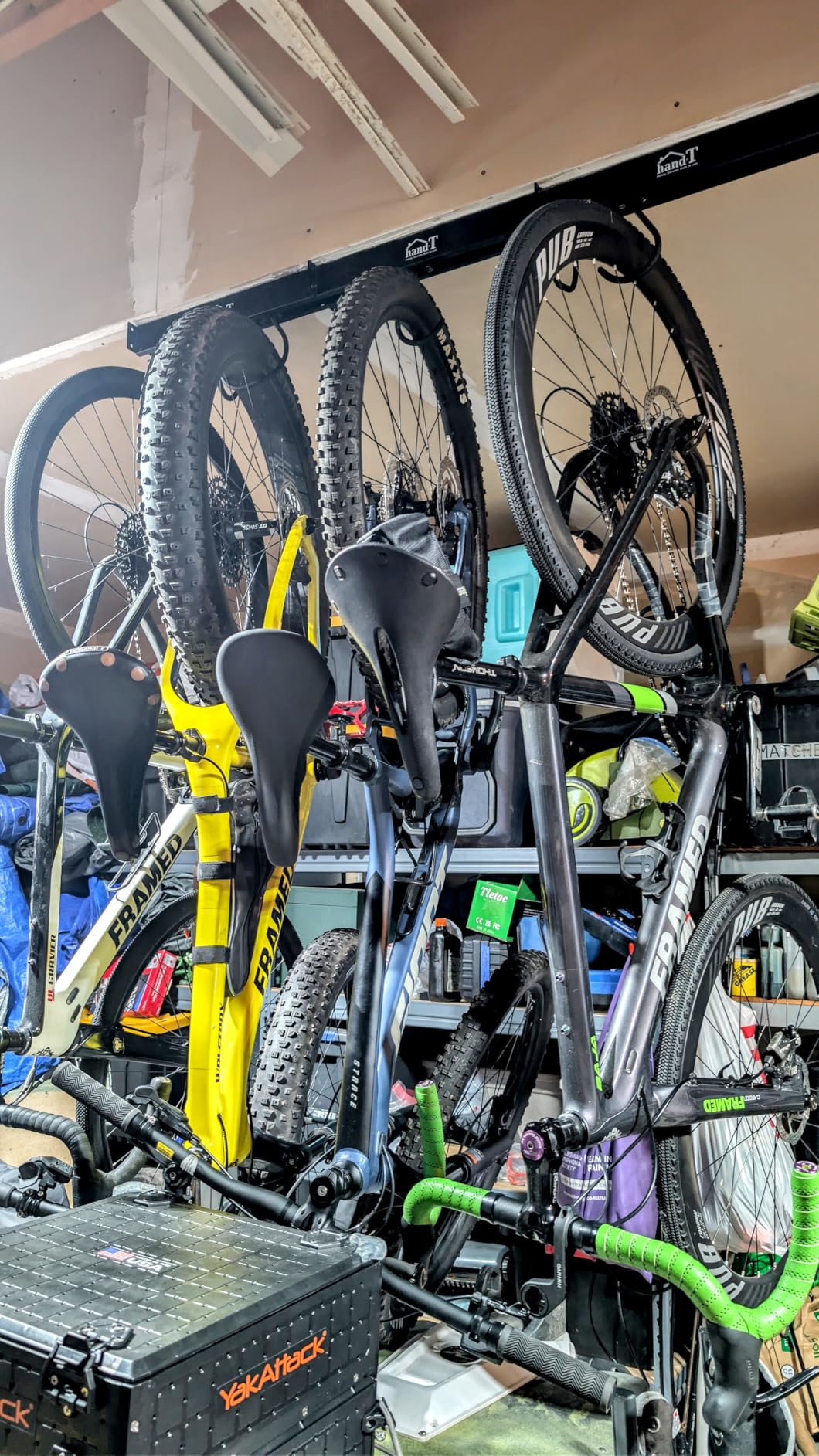
This is a rail-and-hook rack rather than a lift, and the difference is fundamental: bikes stay parked overhead and you lift them on and off by hand, rather than winching them up and down. In exchange you get a system that holds six bikes in a fixed footprint, keeps every bike neatly aligned, and never leaves a rope hanging down your garage wall.
The rating is the standout here. At 4.8 across 101 reviews with 90 percent five-star and no 1-star ratings, it is the highest-rated product in this roundup, and the sentiment is consistent rather than scattered. Owners single out the sliding design: because the hooks slide along the rail, you can shuffle bikes sideways to reach one in the middle instead of unloading the whole rack.
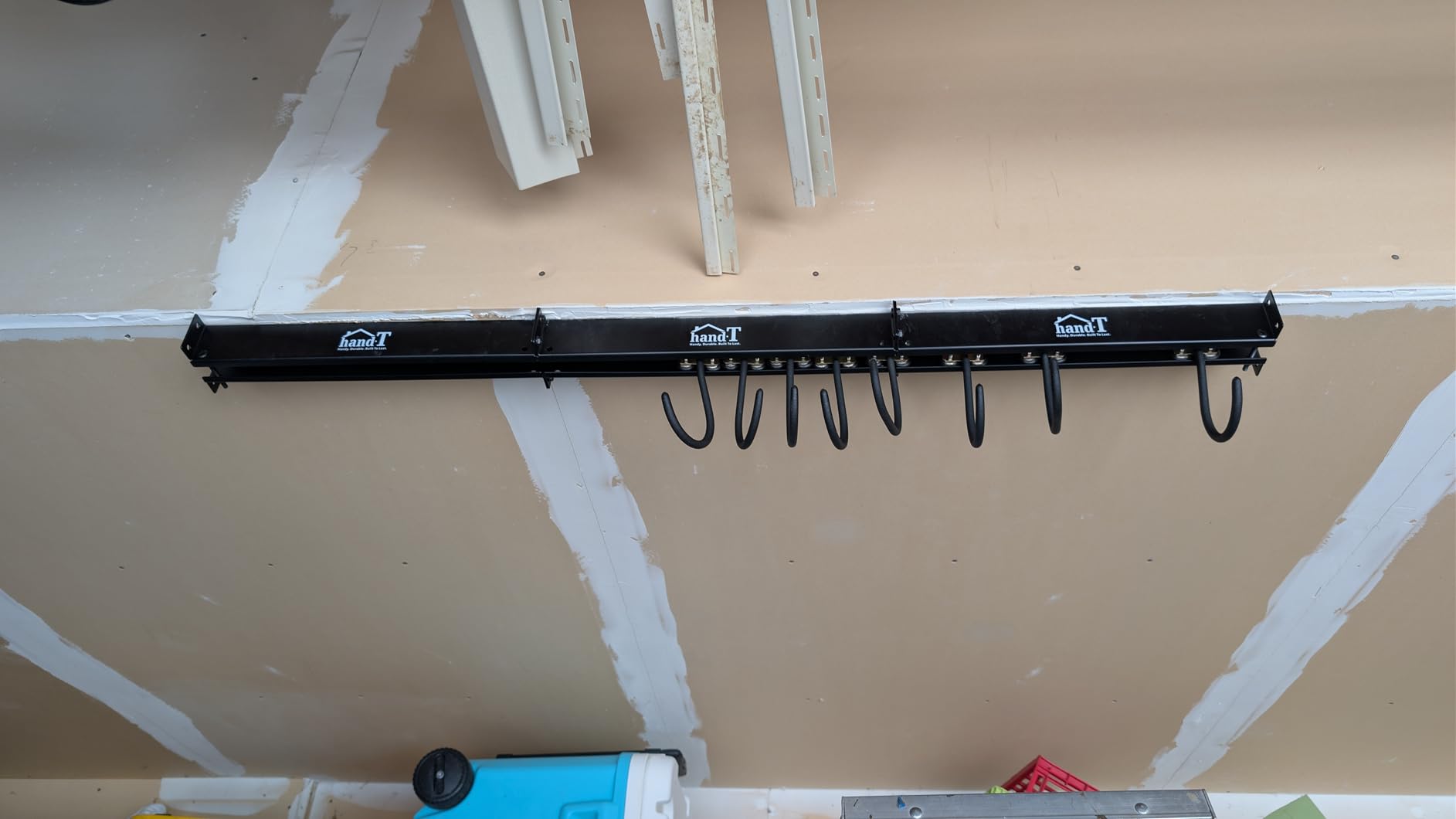
Configuration is the other selling point. Each set holds 6 bikes vertically, and a second set takes the total to 12 bikes horizontally. The rails are 51 by 3 by 3 inches, powder-coated metal, and the rubber coating over the hooks is what keeps frames unmarked.
One install detail genuinely helps: the rails can be mounted parallel or perpendicular to the ceiling joists, which removes one of the most common reasons a ceiling rack fails to go in. A joist that does not line up with where you want the bike is a solvable problem when you can rotate the rail.
Check that you can still get a bike up to the rail
Because this rack does not lift anything for you, you need enough vertical clearance to raise a bike onto the hook. Measure from the floor to the rail with your tallest bike in hand, and remember that a lifted bike needs more room than a stored one.
Rail position also has to clear the garage door tracks, the opener rail and any light fixtures, the same clearance checks that apply to a pulley hoist. Over a parked car rather than a work bay is usually the easier placement.
Who should pick a rack instead of a lift
A rail rack suits a household with several bikes that are not ridden daily and a garage where tidy alignment matters. Six bikes stacked neatly in one footprint, with no ropes and no pulleys to maintain, is a different and often better answer to a family garage.
Skip it if you ride most days and want one motion to bring a bike down, or if your bikes are too heavy to lift overhead comfortably. In both cases a per-bike lift or a motorized rack serves you better, and a heavy e-bike on a static hook is still a lift you are doing by hand.
How to Choose a Ceiling Bike Lift in 2026?
Three variables decide almost every purchase: your ceiling height, the weight of your heaviest bike, and how many bikes need to live up there. Get those three straight and the rest is preference. Get one of them wrong and you will be unhooking a system from a ceiling joist you drilled on day one.
Start with height, because it is the constraint people discover late. Most consumer pulley hoists in this roundup are specified to 12 ft, and forum threads about tall garages keep returning to the same frustration: the rope runs out before the ceiling does.
Match the system to your ceiling height
Under 9 ft, you are working with a short drop. Almost any pulley hoist fits, but check the raised height of the bike against head height for anyone walking underneath. Between 9 ft and 12 ft, every system in this roundup works and the choice is about capacity and hook design. Above 12 ft, you need an extended-rope design or a hoist explicitly rated for the height, and that requirement eliminates most of this category at a stroke.
Measure floor to joist rather than floor to drywall, and measure the deepest point in the bay including any light fixture or opener rail. A hoist mounted to a joist hangs below the framing, so the effective drop is always a little shorter than the ceiling number suggests.
Match the load rating to the bikes you actually own
Add up your bikes and the accessories on them, then take the heaviest single bike and find its weight. A 100 lb rating covers a 70 lb e-bike with headroom, a 50 lb rating does not, and a 40 lb spring lift covers neither. Most riders who get into trouble here are carrying a 65 lb fat bike on a 50 lb hoist because the spec sheet looked generous.
Two cautions. Rated capacity assumes a static load, not a swinging drop, so leave margin. And for spring lifts, the weight decides the model, not the other way round.
Choose between a pulley hoist, a lift and a rail rack
A pulley hoist is the workhorse: cheap, one bike per unit, and you pull a rope. A spring lift removes the rope and reduces effort to a single pull, but the capacity bands are narrower. A motorized lift puts a button between you and the load and scales to eight bikes, at a real step up in cost and installation. A rail rack does not lift at all and stores several bikes in a fixed footprint with no moving parts.
If the household includes anyone who cannot comfortably pull a rope loaded with a bike, the spring or motorized options are the honest answer. If the bikes are stored over winter and come out in a batch, the rail rack wins on tidiness and maintenance.
Decide how many bikes need to live up there
Count now, not later. Two-pack designs cover a household of two in one order, and the multi-bike rail and motorized systems exist for four to eight bikes. Our related coverage of overhead garage bike racks goes into the fixed-rack options in more depth if your garage has to hold a whole family fleet.
Also plan the layout. Standard joist spacing is commonly 16 inches on centre, which is what makes two hoists over one parking bay possible. Measure before ordering multiple units so they land where you want them.
Installing a Ceiling Hoist Without Regretting It
Every system in this roundup attaches to framing, not to drywall. That single rule prevents most failures, and it is worth understanding why before you drill anything.
A ceiling joist is the load-bearing beam above the drywall, spaced regularly across the garage, commonly 16 inches on centre. A hoist transfers the full weight of the bike through a few bolts into that beam, then into the structure. A drywall anchor cannot do that, which is why the reviews across this category repeatedly show owners abandoning the supplied anchors in favour of lag screws into wood or a steel strut.
The practical sequence is short. Find the joists by rapping the ceiling with a stud finder or knocking along the line until the sound changes, locate the centre of the joist, predrill to avoid splitting, drive lag screws or construction screws into solid wood, then pull the empty hook down and load-test it before a bike ever touches it. If the board is exposed framing, this is a 20 minute job per hoist. If it is finished drywall, the joists are still there but the access is the problem.
What to do about drywall, steel joists and tall ceilings
Finished drywall is workable. Cut a small inspection opening around the joist, mount the hoist or a backing board to the timber, patch, and paint. It is more effort than a raw-framed garage but entirely within a competent home project. The one thing not to do is mount into the drywall between joists or into a furring strip, because that is exactly the failure mode people regret.
Steel and light-gauge joist framing is the harder case. Homeowners describe drilling upside down into steel joists as a chore, and the standard answer in those threads is a beam clamp, which grips the flange without drilling. If you have steel framing, verify what you are clamping to and its load rating before trusting it with a loaded e-bike.
For taller ceilings, the hardware question and the height question are separate. Systems rated to 12 ft will not reach a 16 ft joist even with the same pulley, so check the rope length and the stated ceiling range together. Our notes on fixtures for high ceilings cover the same measurement discipline, since a ceiling accessory that is only rated for 9 ft fails the same way a hoist does.
The pre-install clearance checklist
Before you fix anything, walk the bay and check what is overhead. Garage door tracks and the opener rail are the usual conflicts, followed by light fixtures, sprinkler heads and any ducting. The failure people report is not usually a collapse; it is a bike hung in the path of the door, or a rope caught in the opener rail.
Then check the height of what you park underneath. A hoist that clears a sedan may not clear a truck, and the height the bike reaches should be measured at the front wheel, which is the lowest point when a bike hangs nose-up.
Load-test the empty hook first
Pull the hook down with nothing on it, attach it securely, and pull the rope up to full height before you ever involve a bike. Confirm the lock holds under rope tension with no weight on it, which is the condition under which a jam or release is most likely to hide. Then load the bike slowly and watch the mount for any movement in the first few pulls.
It is also worth checking the bike cannot roll out of the hook. A strap, a second carabiner or a soft loop around the frame is cheap, and it is the difference between a system you trust over a car and one you flinch at.
Ceiling Lifts vs. Wall Racks and Floor Stands
Ceiling systems are not always the right answer, and the honest comparison matters more than the recommendation. Floor stands cost the least and give the fastest access, but they occupy floor area permanently and put your bikes in the path of a parked car. Wall racks are efficient use of vertical space, cost little and need no drilling into a ceiling, but they consume about 24 inches of wall width plus 5 to 6 feet of projection for a horizontal mount, and they are useless in a garage already full of vehicles.
Ceiling systems are the only option that returns both floor and wall area, and they are the most secure, because a bike 9 to 12 feet off the ground cannot be taken without releasing the hoist. They also cost you the ability to grab a bike without effort, and installation runs from a two-screw job to a two-person channel-plate fit.
Our thinking is that a ceiling lift is the answer when floor space is already committed, the bikes are not ridden daily, and nobody in the house will struggle with a loaded rope. If your bikes are daily drivers in a small garage where wall space remains, a wall-mounted rack is the better system, and our garage bike storage rack guide covers those in detail.
Frequently Asked Questions
What is a good bike hoist for storing bikes on the ceiling in a garage?
A pulley-and-rope system bolted into your garage ceiling joists is the standard answer. It raises a bike from the floor to just below the ceiling and holds it there with a lock, returning the floor and wall area underneath. Look for a load rating above your heaviest bike, a rubber-coated hook, and a stated ceiling height that exceeds your actual measurement.
What is the best way to hang bikes from the garage ceiling?
Mount the hoist to a ceiling joist, not to drywall, using lag screws or construction screws into solid wood. Pull the empty hook down and load-test it before hanging a bike. Keep the raised bike clear of garage door tracks, the opener rail and light fixtures, and add a strap or second carabiner so the bike cannot roll out of the hook.
What ceiling height do I need for a bike hoist?
Most consumer pulley hoists are rated for ceilings up to 12 ft and work at 8 ft and above, though the bike hangs lower in a short-ceilinged garage. Above 12 ft you need an extended-rope design or a hoist explicitly rated for 10 to 16 ft ceilings. Measure floor to joist rather than floor to drywall, since the unit hangs below the framing.
What is the best bike hoist for an e-bike?
E-bikes commonly weigh 40 to 70 lb with battery, so pick a hoist rated 85 to 100 lb rather than a 50 lb model. Heaviest bikes are easiest on a spring lift or motorized system because the lifting effort is removed. Weigh the bike with its battery and accessories first, and leave headroom under the rated capacity.
What are the best bike hangers for a garage ceiling with more than 12 ft height?
For high ceilings, choose a long-rope pulley system or one rated well above 12 ft. A 45 ft three-pulley hoist and a two-pack system specced for 10 to 16 ft ceilings both solve the problem that most consumer hoists top out at 12 ft. Check the rope length against your joist height before ordering, and confirm the pulley gives enough mechanical advantage for one person.
What is the best bike hoist for storing in a garage?
The Wallmaster Ceiling Bike Hanger 2-Pack suits most garages, combining a 4.6 rating across 1800 reviews with a safety lock, rubber-coated hooks and adjustment to 12 ft. Pick a 100 lb model such as the RAD Sportz 2-Pack for heavy e-bikes or ladders, a spring lift such as the Kradl if you want zero rope effort, and a motorized or rail rack for four or more bikes.
The Bottom Line on the Best Bike Lifts for Garage Ceilings in 2026
For most garages, the Wallmaster Ceiling Bike Hanger 2-Pack is the pick we would install: a 4.6 rating across 1800 reviews, a safety lock, rubber-coated hooks and adjustment up to 12 ft ceilings, with the one caveat that 50 lb is a road-bike-and-mountain-bike rating rather than an e-bike rating. Heavier bikes go to the RAD Sportz 2-Pack at 100 lb per hoist, and tall ceilings go to the long-rope or 10 to 16 ft designs. For a household that will not pull a loaded rope, the Kradl spring lift or the Garage Gator motorized rack removes the effort entirely, and for six bikes stored in tidy alignment the HANDT sliding rail does it without a moving part. Replace the included fasteners on any budget hoist, mount to a joist rather than drywall, and check the garage door clearance before you drill.