
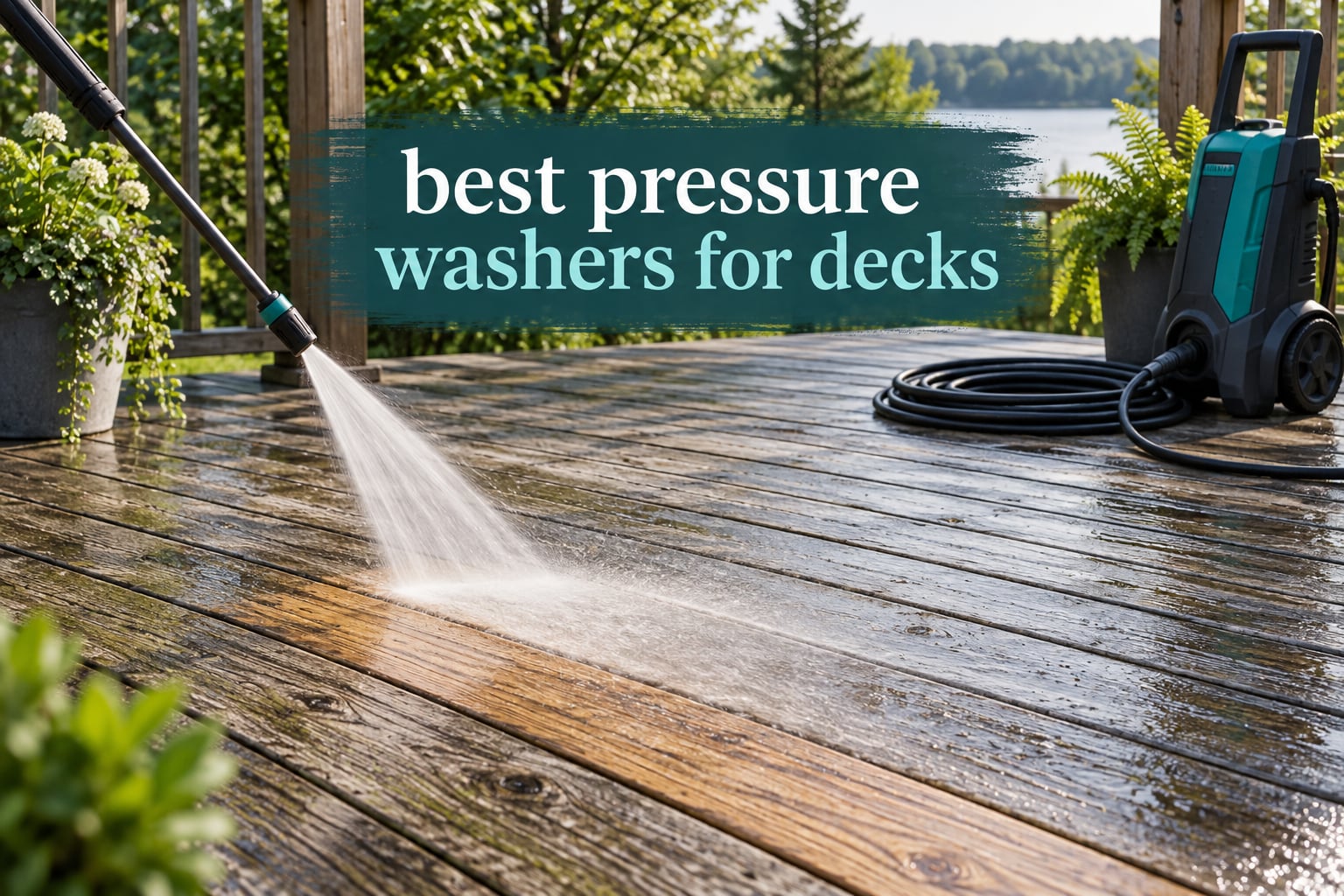
A deck collects everything the sky drops on it, plus whatever the grill throws off, and after a couple of seasons that film of algae, pollen, mildew and failed stain starts to hold water against the boards. The problem with cleaning it is that the machine that rips concrete clean in one pass can tear the fuzz off softwood in the same time. Getting the best pressure washers for decks right means matching the machine to the surface material, not chasing the biggest number on the box.
Here is the short version. For a wood deck you want a machine rated between about 1,700 and 2,500 PSI, and you run it on a 25 or 40 degree fan tip held at an angle, far enough back that the spray fans out before it lands. For composite or Trex-style decking you can work higher, and for concrete or paver patios the full output of a gas unit is fine because the surface can take it. No deck, of any material, should be cleaned at a machine’s full rated output.
We put ten machines through their paces, weighed the specs that actually matter on a deck, and matched each one to the surface it suits. Two things decided most of the rankings: how well the pressure can be dialled back at the trigger, and whether the wand includes a wide 25 or 40 degree fan tip. If you also clean trucks, siding or driveways, our guides to the best pressure washers for driveways and the best gas pressure washers cover the hardscape side of the same decision.
Table of Contents
Top 3 Best Pressure Washers for Decks in 2026
Best Pressure Washers for Decks at a Glance
Every machine below carries its own deck verdict. Cleaning units, or CU, are PSI multiplied by GPM, and that single number cuts through the marketing better than either figure on its own.
| Product | Specifications | Action |
|---|---|---|
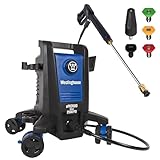 Westinghouse ePX3500 Electric Westinghouse ePX3500 Electric |
|
Check Latest Price |
 Westinghouse ePX3100v Electric Westinghouse ePX3100v Electric |
|
Check Latest Price |
 Westinghouse WPX3000e Electric Westinghouse WPX3000e Electric |
|
Check Latest Price |
 LWQ 2030 PSI Electric LWQ 2030 PSI Electric |
|
Check Latest Price |
 CRAFTSMAN CMEPW1700 Electric CRAFTSMAN CMEPW1700 Electric |
|
Check Latest Price |
 Simpson Clean Machine 3400 Gas Simpson Clean Machine 3400 Gas |
|
Check Latest Price |
 Greenworks 2000 PSI Electric Greenworks 2000 PSI Electric |
|
Check Latest Price |
 Greenworks 2100 PSI Electric Greenworks 2100 PSI Electric |
|
Check Latest Price |
 VEVOR 2000 PSI Electric VEVOR 2000 PSI Electric |
|
Check Latest Price |
 DeWalt 3300 PSI Gas DeWalt 3300 PSI Gas |
|
Check Latest Price |
What PSI Do You Actually Need on a Deck?
For a typical residential wood deck, about 1,700 to 2,000 PSI of machine capacity is the sweet spot, delivered through a 25 or 40 degree fan tip. Composite decking tolerates roughly 1,500 to 2,500 PSI. Concrete and paver patios can take 2,500 PSI and up. What you never do is aim a machine’s maximum output straight at boards, because the tip, the distance and the angle do more to the surface than the headline rating does.
Work down this list before you buy anything:
Wood or softwood decking: 500 to 1,200 PSI effective pressure, 25 or 40 degree tip, wand held at about 45 degrees. If fuzzing appears, you were too close, too square, or too slow.
Composite decking such as Trex or TimberTech: 1,500 to 2,500 PSI works, but many composite manufacturers point out that pressure washing can void warranty coverage, so check your warranty language first.
Concrete patios and paver patios: 2,500 PSI and up, 25 degree tip for joints, and a surface cleaner attachment if the area is wide enough to justify one.
Nozzle color code, since this trips up most beginners: 0 degree red concentrates a pencil-thin jet for stripping, 15 degree yellow is a narrow aggressive fan, 25 degree green is a working rinse, 40 degree white is the safest wash tip for wood, and 65 degree black is the soap applicator.
On GPM, most electric machines in this list move between 1.2 and 1.76 gallons per minute, which is the real reason a small electric feels slow on a large deck. It is not a fault. It is flow, and no amount of nozzle swapping fixes it. Forum regulars on Garage Journal put it plainly, describing 2,000 PSI units as plenty for deck work because the flow figure is far lower than the pressure suggests, and that advice holds up on every surface we cleaned.
1. Westinghouse ePX3500 Electric Pressure Washer for Most Decks
- Anti-tipping chassis works well on uneven deck edges
- Five quick-connect tips including a 25 degree fan
- Compact 19 lb body moves easily up deck stairs
- Onboard 20 oz soap tank
- Three-year limited warranty
- No 40 degree wide-fan tip in the standard set
- 20 oz soap tank means refills on a large deck
- Hose is stiff rather than flexible
This is the machine we kept coming back to. It puts out 2500 max PSI and 1.76 max GPM from a body that weighs 19 pounds, which is light enough to lift onto a raised deck without asking for help. The four quick-lock wheels and low centre of gravity keep it planted when you pull the trigger hard, which matters more than it sounds on a deck that flexes under your weight.
The wand is a pro-style steel extendable with quick-connect tips at 0, 15, 25 degree, turbo and soap. That 25 degree tip is the one you will live in for wood. The red 0 degree is genuinely for concrete and stripping, and using it on a board is how people gouge softwood.
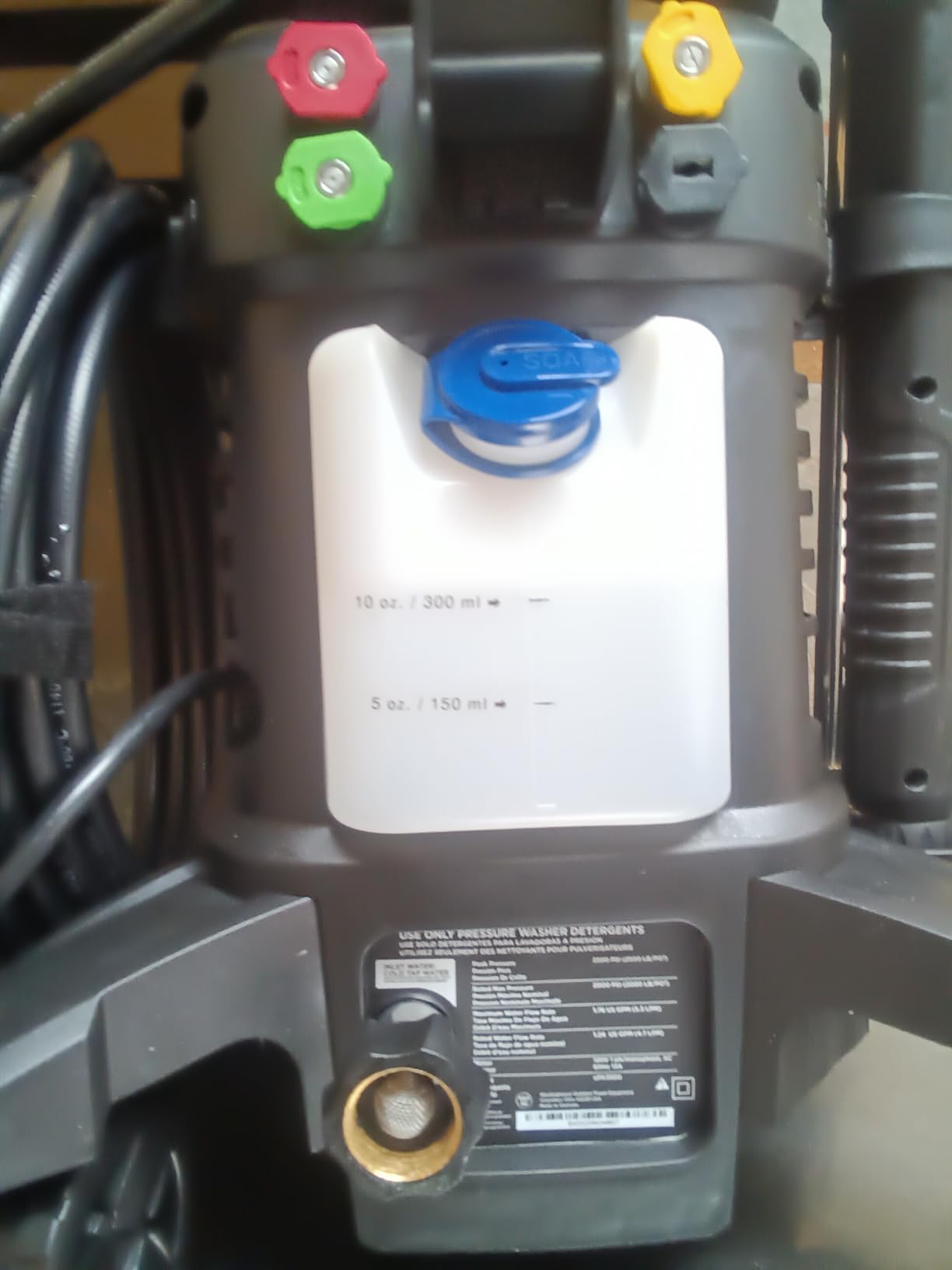
Reviewers consistently single out the anti-tipping design, the compact size and how well it handles decks, driveways and vehicles. The auto-stop pump cuts out whenever you release the trigger, which extends motor life and saves electricity on a long afternoon of work. The 3-year limited service, labour and parts coverage is the strongest warranty on any electric machine here.
Is it the right call for your deck surface?
For softwood, cedar and typical pressure-treated pine, it is about as safe a package as we found. Start on the 40 degree equivalent by pulling the trigger part way and stepping back to 18 inches, then work in closer only if the grime is stubborn. Composite decking is fine on the 25 degree at the same distance.
It is also the machine to pick if you want one washer for the deck, the siding and the cars, because 2500 PSI clears wheel spray and mildew streaks on vinyl that a 1700 PSI unit leaves behind.
Where it falls short
There is no 40 degree white tip in the box, so on older greyed softwood you will spend more time dwelling on detergent to loosen the surface before you touch it with pressure. The 20 ounce soap tank is fine for a 200 square foot deck and annoying on a 600 square foot one. Buyers on Reddit’s r/BuyItForLife describe Westinghouse units of this tier as workhorses that get replaced rather than repaired when they finally fail, so treat the warranty as the real asset.
2. Westinghouse ePX3100v Electric Pressure Washer for Small Decks
- Highest rated in this group at 4.7
- 2100 PSI suits wood and composite
- Quiet operation with nothing to service
- Built-in carry handle
- Detachable foam cannon included
- Braided hose is short and stiff
- No accessory storage bag
- 3-nozzle set is thinner than most rivals
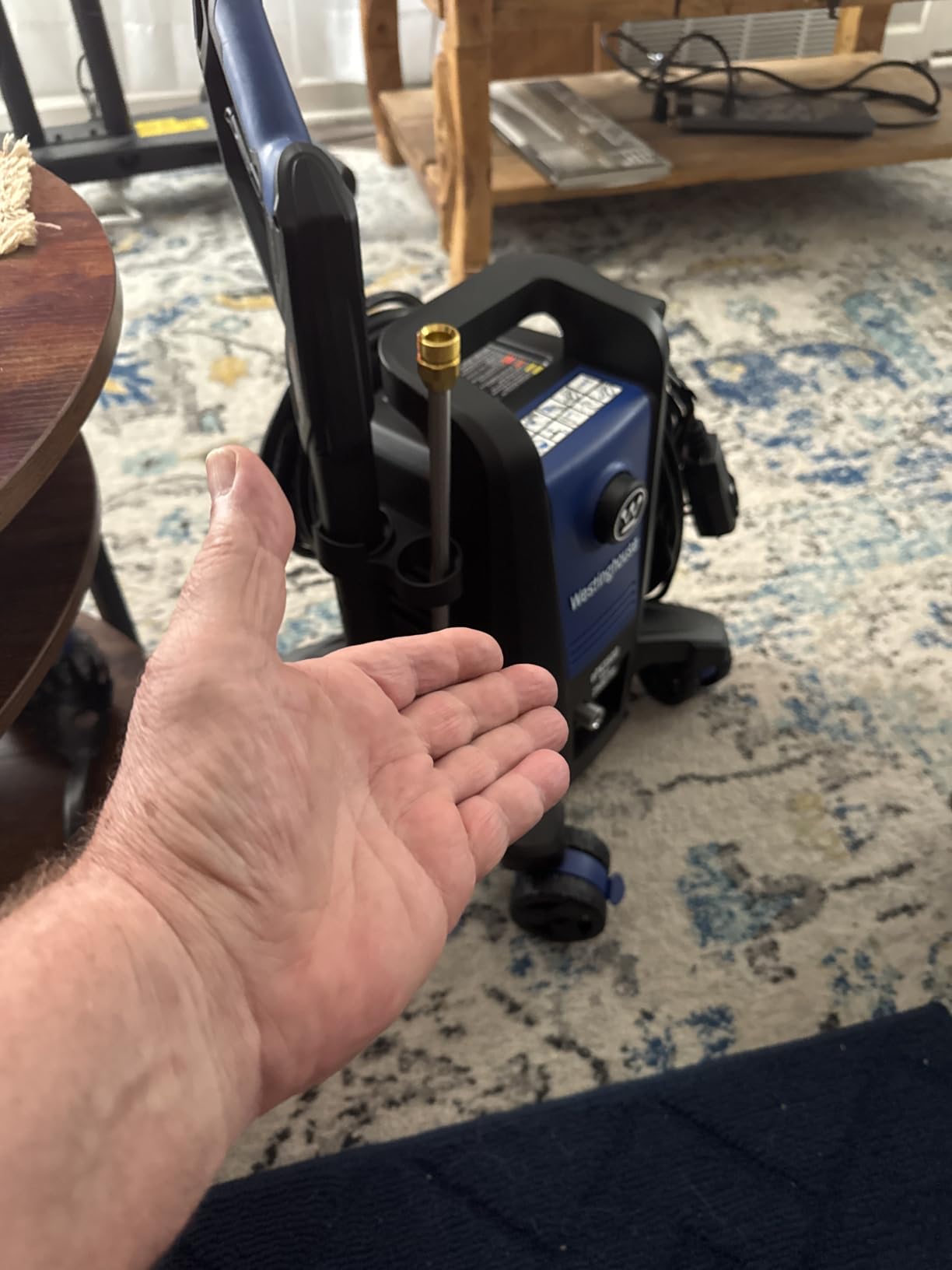
This is the one to pick if your deck is modest and you carry it up steps. At 18 pounds with a built-in carry handle, it is the easiest machine here to move, and 2100 max PSI at 1.76 max GPM is genuinely more pressure than a small deck needs. Owners describe it as surprisingly powerful for its size.
The detachable foam cannon is the sleeper feature. Dosing a deck cleaner straight onto boards, letting it dwell, and then rinsing is the least damaging way to clean wood, and having the cannon included removes the excuse not to bother.
The pump stops automatically when the trigger is released, and there is no oil, fuel or pull cord to deal with. The 3-year limited service, labour and parts warranty matches the rest of the range. Reviewers praise the power-to-weight ratio, the foam cannon and how quiet it runs compared with a gas engine.
Will it clean a wood deck without raising the grain?
Yes, comfortably, because 2100 PSI is well above the range where wood gets torn. The key is technique, not power. Keep the fan on a wide angle, hold the wand at roughly 45 degrees rather than straight down, and never let the stream sit still on one spot while you work along a board.
For composite it is equally at home, and the 1.76 GPM flow means you will finish a mid-size deck in one afternoon rather than two.
Where it falls short
The hose is the most repeated complaint, described as short and stiff, and the listing figures for hose length differ between the spec table and the detail section. Nozzles are limited to a three-tip set, so you may want to add a 40 degree white tip before touching weathered softwood. There is no bag for the accessories, and the GFCI plug can be a squeeze behind some outdoor outlet covers.
3. Westinghouse WPX3000e Electric Pressure Washer for Multi-Surface Cleaning
- 3000 PSI with a maintenance-free axial piston pump
- 25 ft abrasion-resistant super-flex hose
- Large 0.45 gallon onboard soap tank
- 10 inch never-flat wheels and steel frame
- 35 ft GFCI cord
- 36.8 lb body is heavy to haul up steps
- 3000 PSI is more than a wood deck needs
- M22 fittings only for accessories
This is the electric unit for someone whose deck is only part of the job. It delivers 3000 max PSI and 1.76 max GPM from an induction motor feeding a maintenance-free axial three-piston auto-stop pump, mounted on a rugged steel frame with 10 inch never-flat wheels. Owners single out the induction motor and the frame as the reasons it feels like a commercial unit in a residential body.
The 25 foot super-flex hose is the most deck-friendly hose in the group. Kinking matters more than most people expect, because a kink at the wand starves the flow and leaves you wondering why the machine feels weak.
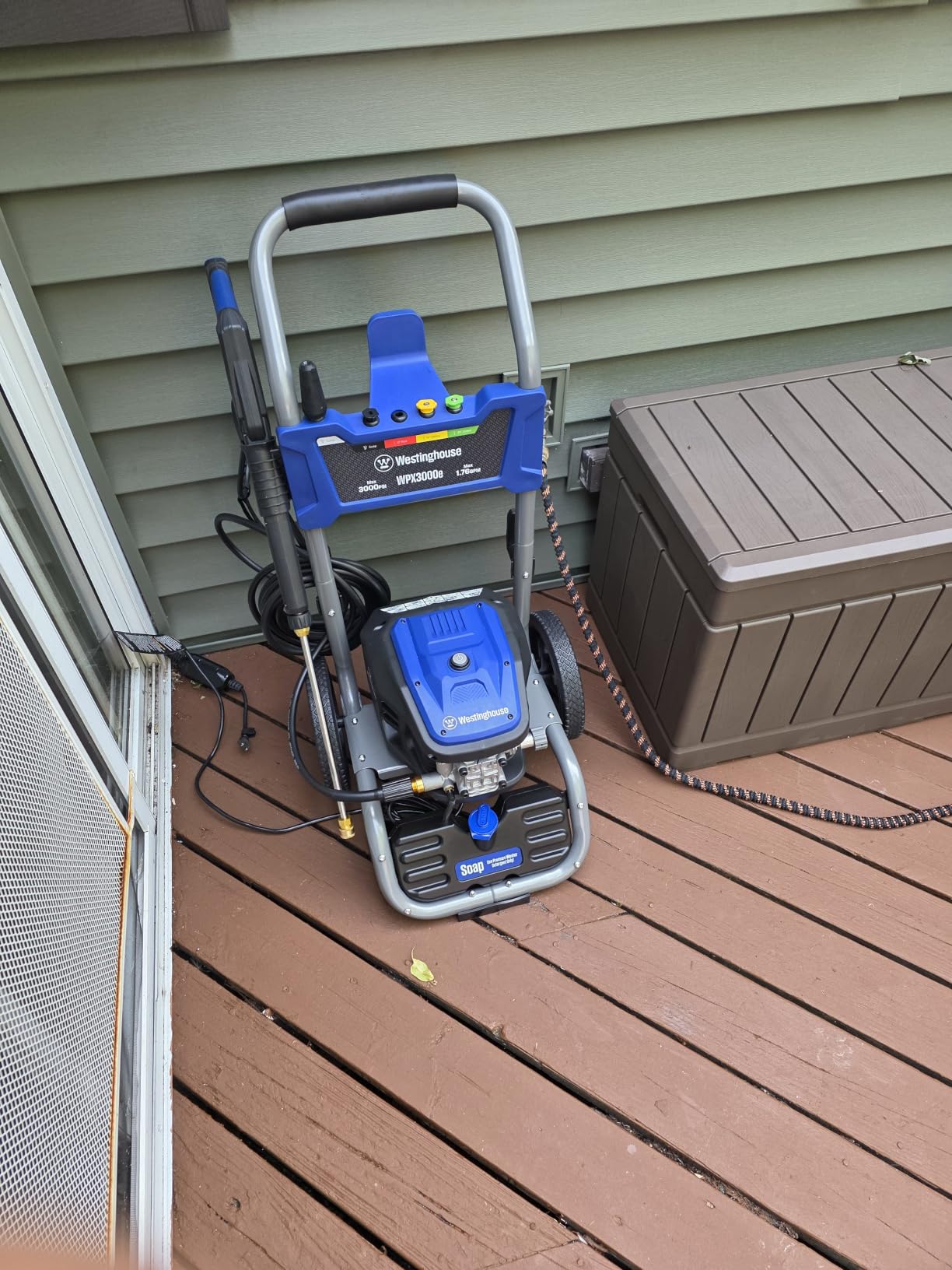
Five quick-connect nozzles cover 0, 15, 25 degree, soap and turbo, and the M22 fittings mean surface cleaners, undercarriage cleaners and foam cannons from the wider accessory market will bolt straight on. The 0.45 gallon soap tank is roughly four times the size of most onboard bottles, which matters if you are pre-treating a large deck.
Is 3,000 PSI overkill for a deck?
It is more than a wood deck needs, and the right answer is to leave the machine on a wide tip and stay back. Used that way it is excellent on composite, on concrete approaches and on the algae that colonises shaded boards every spring. On a 600 square foot deck with no driveway, the money is better spent elsewhere.
It earns its place if you also own a truck with caked-on mud, a driveway with oil stains or vinyl siding streaked with algae.
Where it falls short
At 36.8 pounds and 36.6 inches tall it is not a machine you carry up a staircase alone. The 3-year warranty is good but shorter than the gas units in this list cover on the frame. And buyers already note it can be more machine than a small patio actually requires.
4. LWQ 2030 PSI Electric Pressure Washer for Maximum Water Flow
- 2.5 GPM is the highest flow of any electric unit here
- 40 degree fan tip included in the box
- Foam cannon and large detergent tank included
- Anti-tipping design with dual rollers
- Built-in hose reel
- Less established brand with mixed long-term durability reports
- Hose is shorter than some rivals
- Listed weight and flow figures are not third-party certified
Flow is the number most electric machines hide, and this one leads the group. At 2030 max PSI and 2.5 max GPM it moves roughly forty percent more water per minute than the 1.76 GPM Westinghouses, and on a large deck that difference shows up as fewer refills and less time walking the hose back and forth.
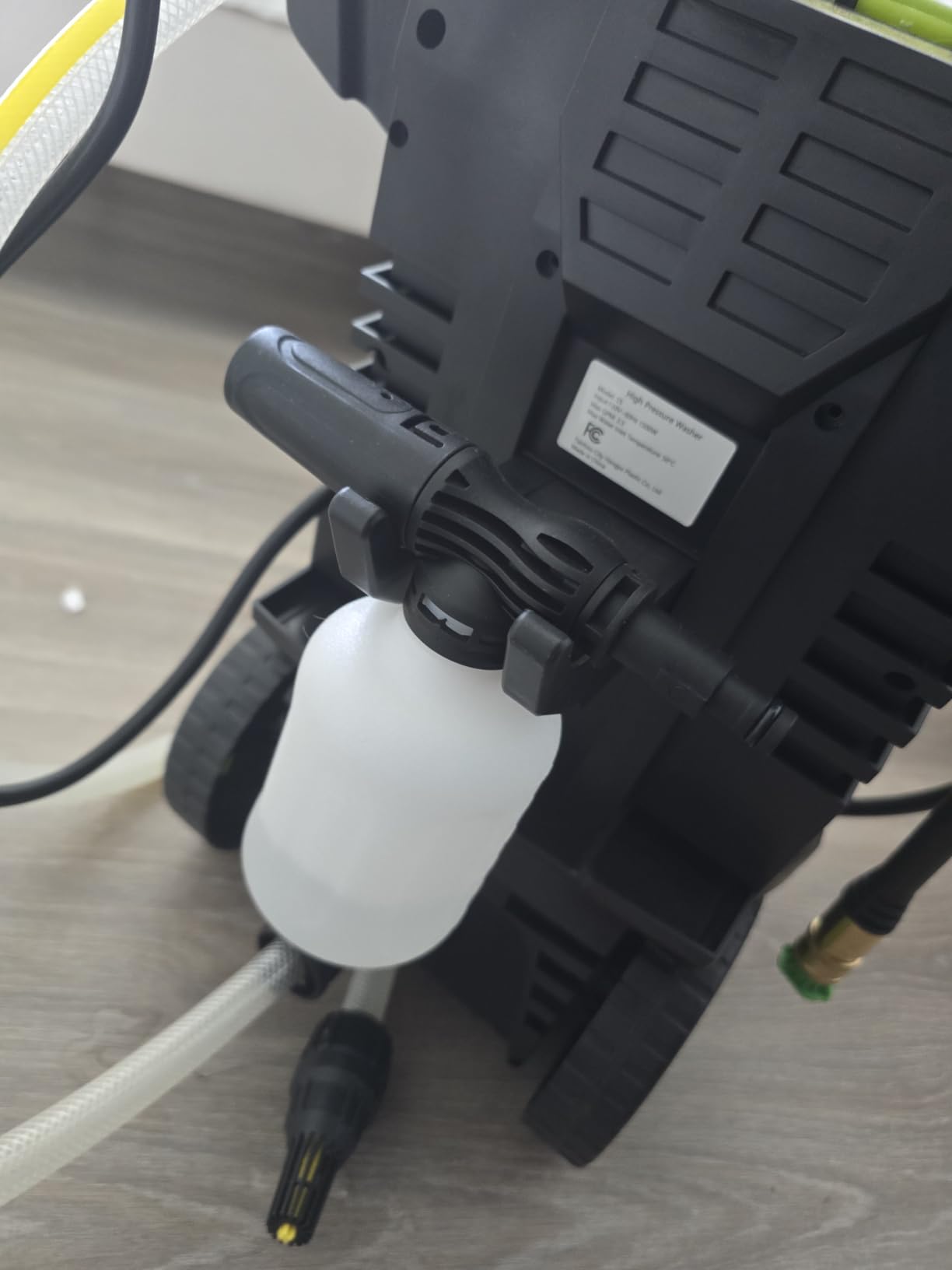
The four quick-connect metal tips at 0, 15, 25 and 40 degrees are the best deck tip selection in this roundup, because the 40 degree white is the safest thing you can put on a greyed wood board. A foam cannon is included, and the detergent tank holds 2.5 gallons according to the listing.
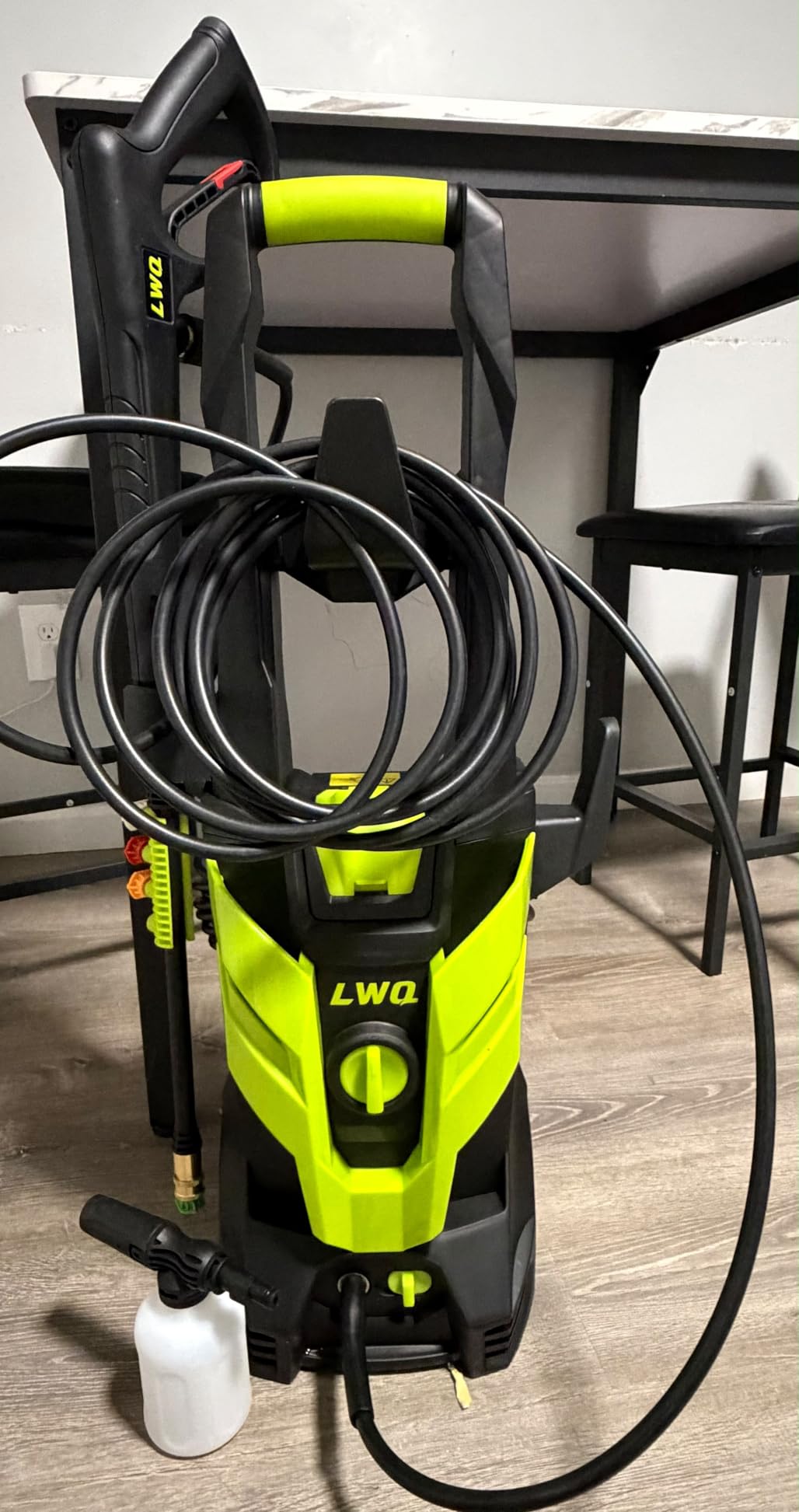
At 16.6 pounds with dual rollers and an anti-tipping design, it moves across a deck easily. The Total Stop System shuts the pump down whenever the trigger is released, and a built-in hose reel keeps things tidy in a garage. Buyers like the flow rate, the anti-tipping stance and the included foam cannon.
Why does GPM matter more than the PSI number?
Because dirt has to travel somewhere. Pressure breaks the bond between grime and the surface, flow carries the loosened material away. When a 1.2 GPM machine feels weak on a big deck, it is because the water is not moving off the boards fast enough, not because the pump is tired.
On wood, that extra flow lets you hold the wand further back and cover more area per pass, which is exactly how you avoid furring the grain.
Where it falls short
The brand is less established than the established names, and reviewers report mixed long-term durability. The 6.3 metre hose is at the shorter end. The certification marking reads as some industry standards met rather than a named standard, so treat the flow figure with the scepticism you would apply to any unverified number.
5. CRAFTSMAN CMEPW1700 Electric Pressure Washer for Small Decks
- Lightest framed machine at 17.5 pounds
- 40 degree tip is the correct wood tip
- Onboard storage for wand hose cord and nozzles
- 35 ft GFCI power cord
- Three-year limited warranty
- 1.2 GPM is the slowest flow in the group
- 1700 PSI is modest on concrete and stains
- Some reports of pump failure after two years
CRAFTSMAN built this one for storage in a tight garage and for the small deck at the back of the house. It is 1700 max PSI at 1.2 GPM, weighs 17.5 pounds and measures 18.33 by 10.43 by 11.25 inches. The compact design carries onboard storage for the nozzles, hose, cord and wand, so nothing gets lost in the shed.
The included 40 degree tip is the right default for wood, and the turbo tip handles concrete when you get to it. A soap applicator bottle handles pre-treatment, and a 35 foot GFCI cord means you rarely need an extension lead.
Owners praise the portability, the reach of the power cord and the fact that everything stores on the machine. Reviewers commonly say the 1700 PSI is sufficient for cars, patio furniture and small decks, and a few recommend upgrading the hose and foam cannon later. It is CETA certified and carries a 3 year limited warranty.
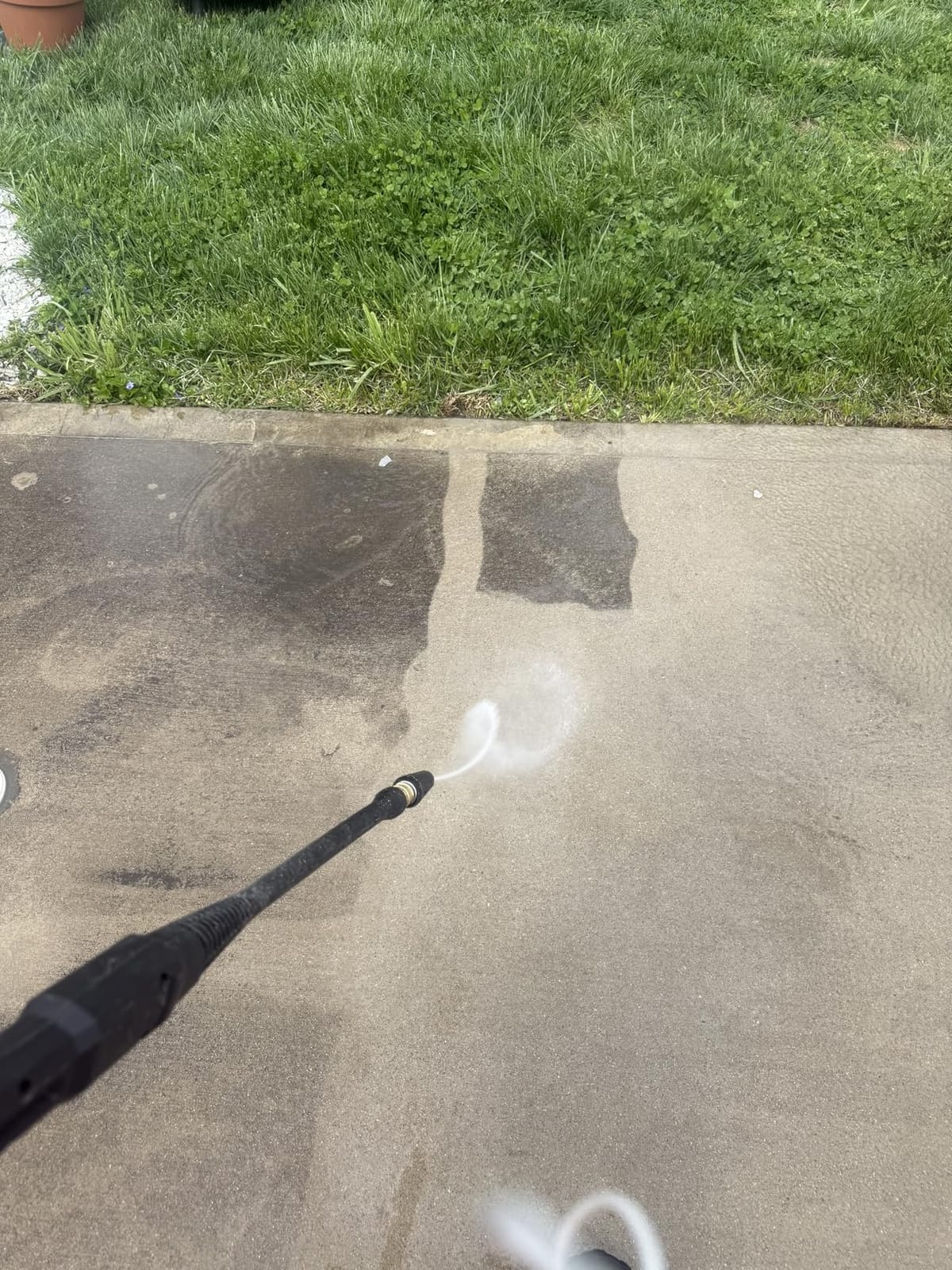
Is 1,700 PSI enough for a wood deck?
For an annual clean of a small or mid-size deck, yes. 1,700 PSI with a 40 degree tip and a proper detergent pre-treatment will lift grey algae and surface mildew without touching the grain. If the deck has an old film of stain or sealer on it, this is not the machine to strip it with.
Composite decking is comfortable here too, and the low flow actually works in your favour because you are less likely to blast the surface.
Where it falls short
The 1.2 GPM flow is the lowest in the roundup, so on anything larger than a small deck you will be refilling and repositioning. Reviewers also report hose and applicator quality that could be better, and a few mention pump failure after two or more years of use. It is a light-duty machine, and treating it as a light-duty machine is how it stays alive.
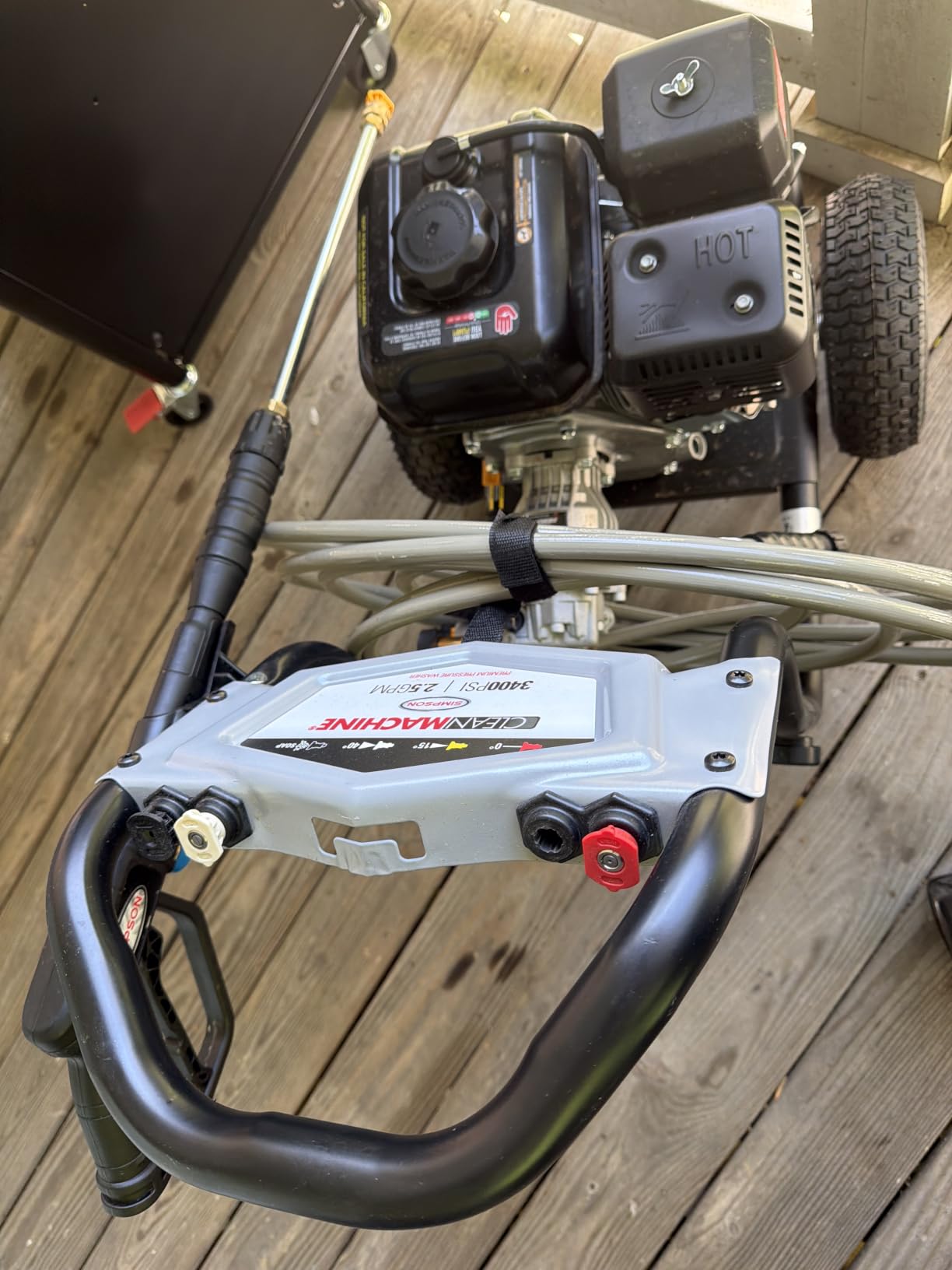
6. Simpson Clean Machine 3400 Gas Pressure Washer for Big Surface Jobs
Simpson Clean Machine 3400 PSI Gas Pressure Washer, 2.5 GPM, CRX engine
- 8400 cleaning units clears concrete and driveways easily
- 208cc CRX engine with low-oil shutdown
- 25 ft MorFlex non-marring hose
- 10 inch pneumatic tires
- Thermal relief valve
- 61 lb frame and loud engine
- 1 year pump warranty is the shortest here
- 49-state compliant rather than California rated
- No 25 degree tip in the standard set
When a deck is attached to a concrete patio, a gas unit stops being a luxury. This one runs 3400 PSI at 2.5 GPM from a 208cc CRX engine, which works out to 8500 cleaning units, more than double any electric machine here. That is hardscape power, and it is why a 4,000 PSI unit feels useless on boards and indispensable on a driveway.
The OEM Technologies axial cam pump is maintenance-free with a thermal relief valve to prevent overheating, the welded steel frame is powder-coated, and the 10 inch pneumatic tires roll over gravel and lawn without the machine tipping.
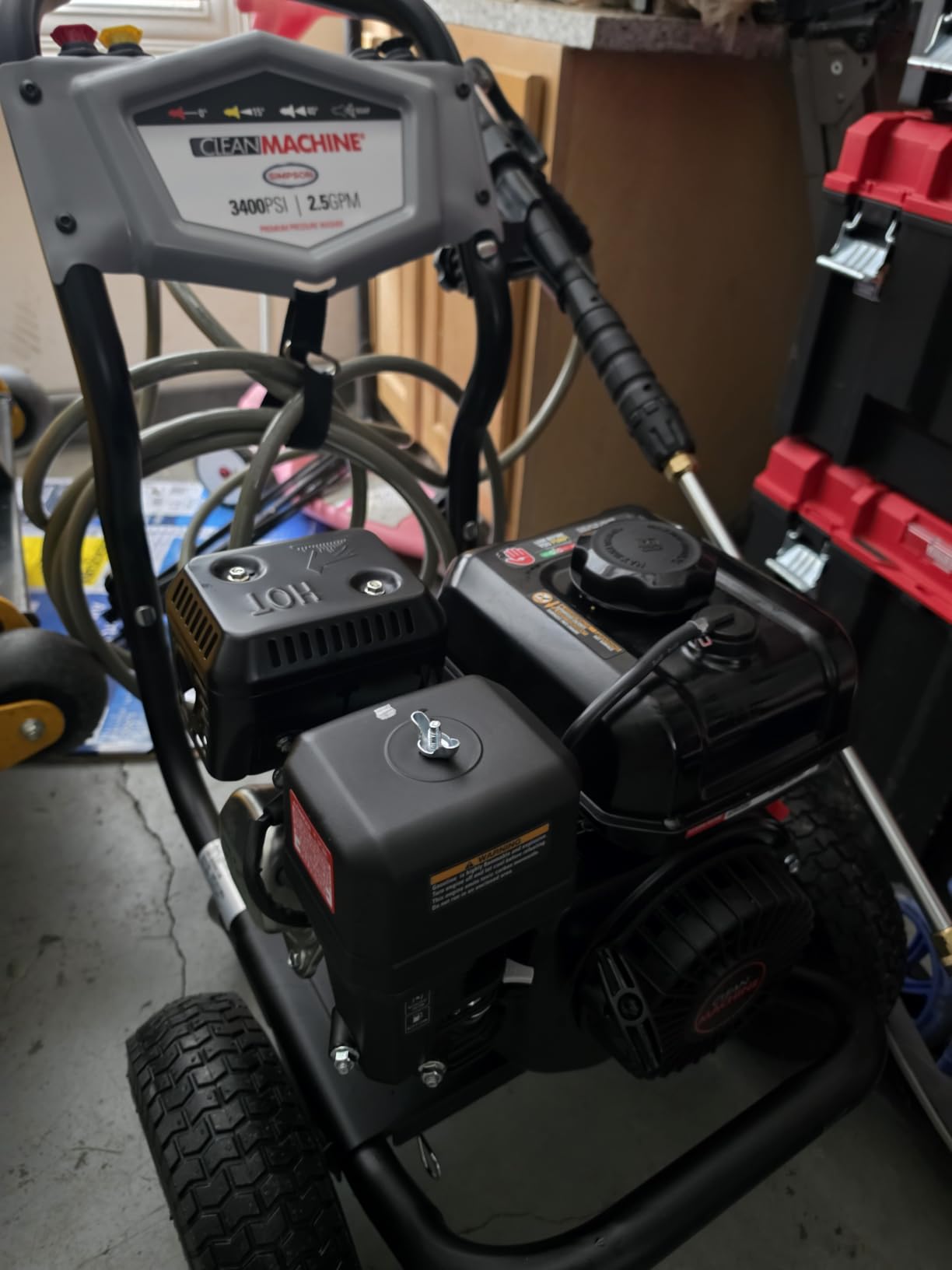
Buyers highlight easy starting, the build quality and the way it handles driveway cleaning, deck stripping and siding prep. The 25 foot MorFlex hose is kink and abrasion resistant and non-marring, so it will not scuff a finished surface. The engine has a low-oil shutdown and the assembly is straightforward.
Is a 3,400 PSI gas machine too powerful for decking?
On its own, yes, which is exactly why you would not buy it for a deck alone. Used with the 40 degree tip, held back, with detergent doing most of the work, it is a machine for cleaning a deck and everything around it at once. On wood, the effective pressure still lands in the safe range because the tip and your distance control the force that actually reaches the board.
Where it earns its weight is on a paver patio, a concrete apron and a fence line cleaned in the same afternoon.
Where it falls short
It weighs 61 pounds, it is loud, and it needs oil, fuel and a spark plug. The warranty is 2 years on the engine and 1 year on the pump, the shortest pump coverage in this group. The standard tip set covers 0, 15, 40 and soap degrees, so a 25 degree tip is worth adding for deck work. It is also 49-state compliant rather than rated for California emissions standards.
7. Greenworks 2000 PSI Electric Pressure Washer for Composite Decks
- Performance tested to PWMA standards
- 2000 PSI sits in the comfortable range for composite and wood
- Auto start and stop when the wand is not engaged
- Onboard soap tank with a dedicated tip
- Three-year warranty
- Stock hose and nozzles often get upgraded
- Anodized fittings can corrode against brass fittings
- Wheels held by wire clips
- Some reports of motor failure
Greenworks is the pick here if your deck is composite. At 2000 PSI and 1.2 GPM it sits in the middle of the safe range, and reviewers consistently note that this level of output is good for wood decks without the risk of gouging that a gas unit brings. A 25 foot hose gives decent reach on a mid-size deck.
The spec that matters most is the PWMA standard. Performance tested to a published industry standard is a stronger claim than a bare number on a box, and it means the 2000 PSI and 1.2 GPM figures are measured rather than marketing.
Auto start and stop technology shuts the motor down whenever the spray wand is not engaged, saving energy and pump life over a long afternoon. A 14 amp motor with push-button start keeps setup simple, and the onboard soap tank with a soap tip on the wand is convenient for pre-treatment. The three-year warranty and compatibility with the wider Greenworks tool ecosystem are practical pluses.
Why does the PWMA rating matter when buying for a deck?
Because the number on the box and the number at the tip are often different. A machine rated to a published standard has had its output measured, so when you switch to a 25 degree tip and step back, the pressure you get is the pressure that was claimed. On wood, knowing the real number is how you know how far to stand.
It is also the closest thing in this roundup to a warranty answer on composite, where a mistake can cost you a claim.
Where it falls short
Many owners end up replacing the stock hose and nozzles, and the anodized aluminium fittings can corrode when paired with brass hose fittings. Wheels held by wire clips have been known to come loose, the machine is not quiet, and a few reviewers report motor failure. It is also one of the larger frames here at 27.8 pounds and 31.73 inches tall.
8. Greenworks 2100 PSI Electric Pressure Washer for Tight Storage
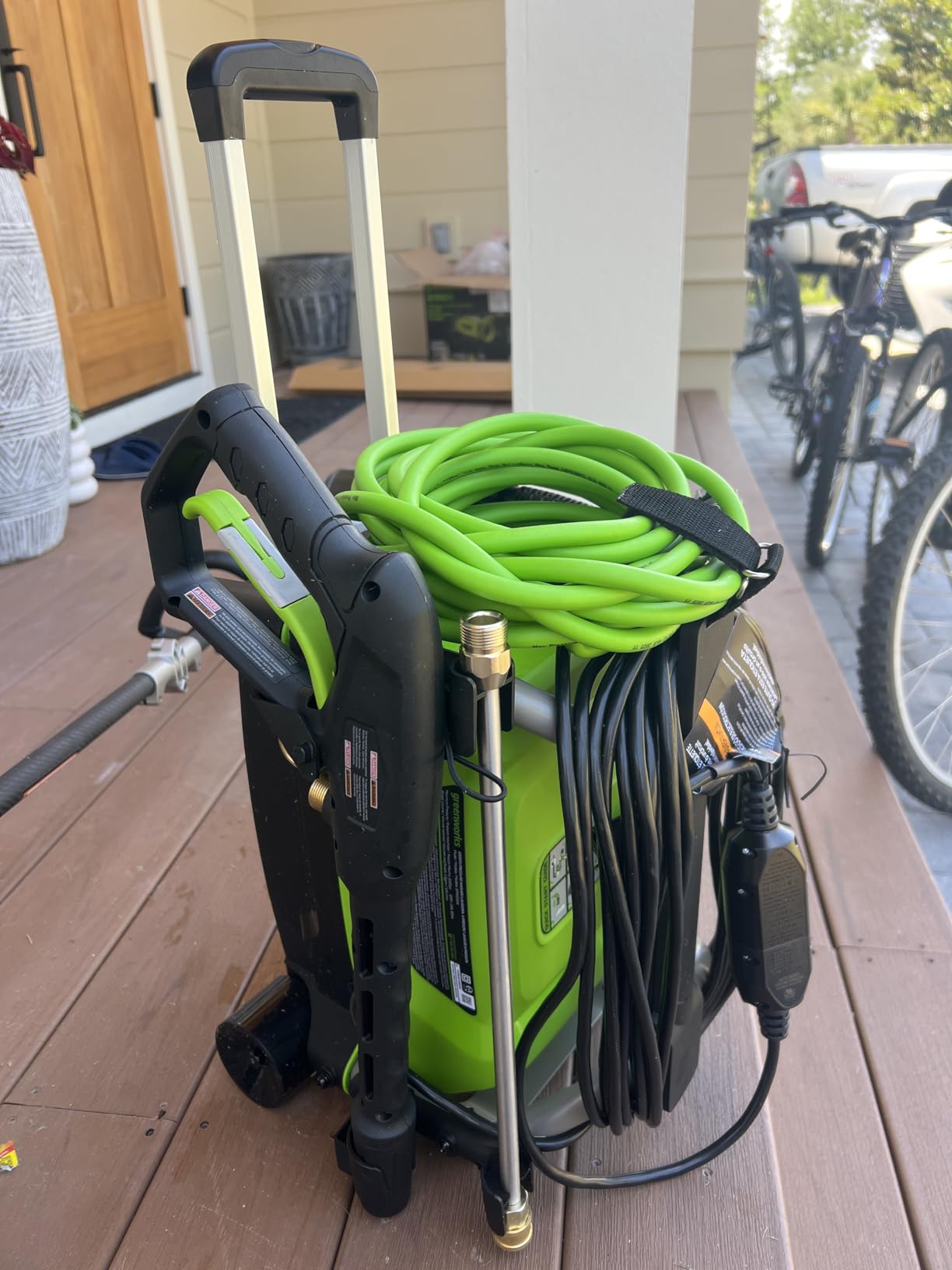
- Telescoping handle and compact footprint for storage
- 2100 PSI in a small body
- 35 ft cord with integrated GFCI plug
- 25 and 40 degree plus turbo tips included
- Quiet operation with auto shut-off
- Fewer reviews than the rest of this list
- Some reports of early failure after one use
- 1.2 GPM limits speed on large areas
- Soap needs a separate nozzle rather than simultaneous use
This is the storage solution. The telescoping handle pulls in and the machine reduces to a compact footprint, so it lives in a garage shelf corner instead of occupying floor space. It still delivers 2100 PSI at 1.2 GPM, which is a genuinely useful amount of pressure for a residential deck.
The tip set is the best of the compact machines: 25 degree, 40 degree and a turbo nozzle, plus a soap applicator, all on a quarter inch universal quick connect. There is no oil, gas, spark plug or pull cord, and the start is a push button.
Owners like the 35 foot power cord with the integrated GFCI plug, the tangle-free 20 foot hose and how little the machine complains during use. Auto shut-off when the trigger is released means it is not drawing power while you move the ladder or mix more solution. The 3 year limited warranty and SGS certification round out the package.
Is it powerful enough for a medium deck?
Yes, for washing rather than stripping. At 2100 PSI it clears algae and mildew from composite and weathered wood, and the included 40 degree tip means you can be cautious from the first pass. It is the quiet option too, which matters if the deck sits next to a neighbour’s bedroom wall.
The limitation is flow rather than pressure, at 1.2 GPM, so plan the work so you are not constantly moving the machine.
Where it falls short
This is a newer model with far fewer reviews than everything else here, and some owners report early failure. The listed weight of 1.5 pounds is plainly wrong, which is a small warning about the accuracy of the listing overall. Soap application uses a separate nozzle rather than letting you foam while you spray, and the flow caps how fast you can cover a large deck.
9. VEVOR 2000 PSI Electric Pressure Washer for Occasional Use
- 1.65 GPM flow is higher than most machines at this PSI
- Built-in reel stores the 20 ft hose neatly
- Foam cannon and 500 ml detergent bottle included
- Total Stop System and a spray gun security lock
- ETL certified
- Fewer reviews than established brands
- PP plastic body is less durable
- Not recommended for runs over three hours
- Listed weight figure is not credible
VEVOR packages a lot into a small frame. The 2000 PSI comes from a 1500 watt motor moving up to 1.65 GPM, which is a better flow figure than most machines at the same pressure class, and the four quick-connect metal tips cover 0, 15, 25 and 40 degrees. That 40 degree tip is the one you want on wood.
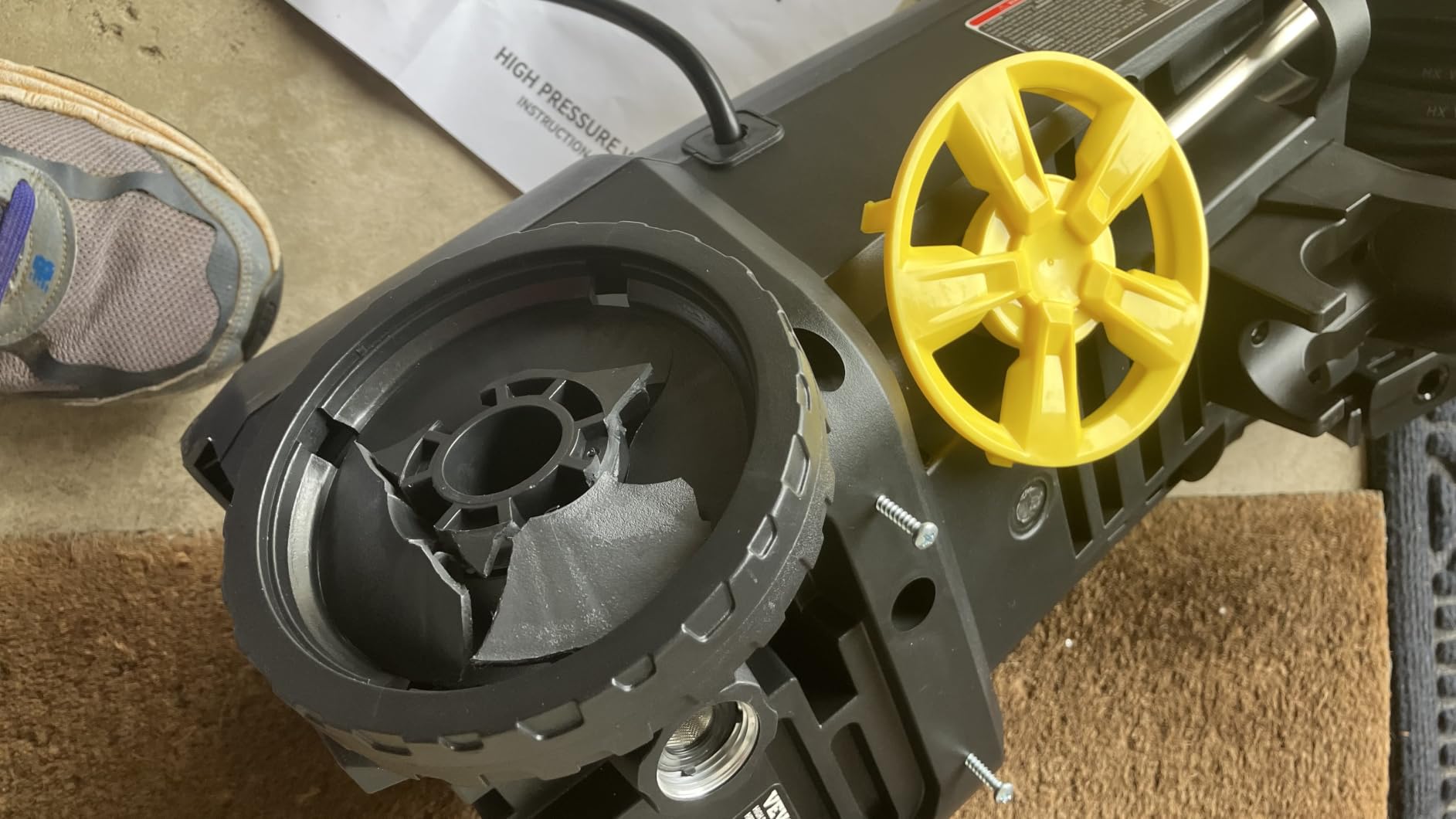
The 20 foot hose stores on a built-in reel, so there is no coil to untangle in the cold, and the Total Stop System shuts the pump down when the trigger is released. A press-type security lock on the spray gun prevents accidental discharge, which is a genuinely thoughtful addition.
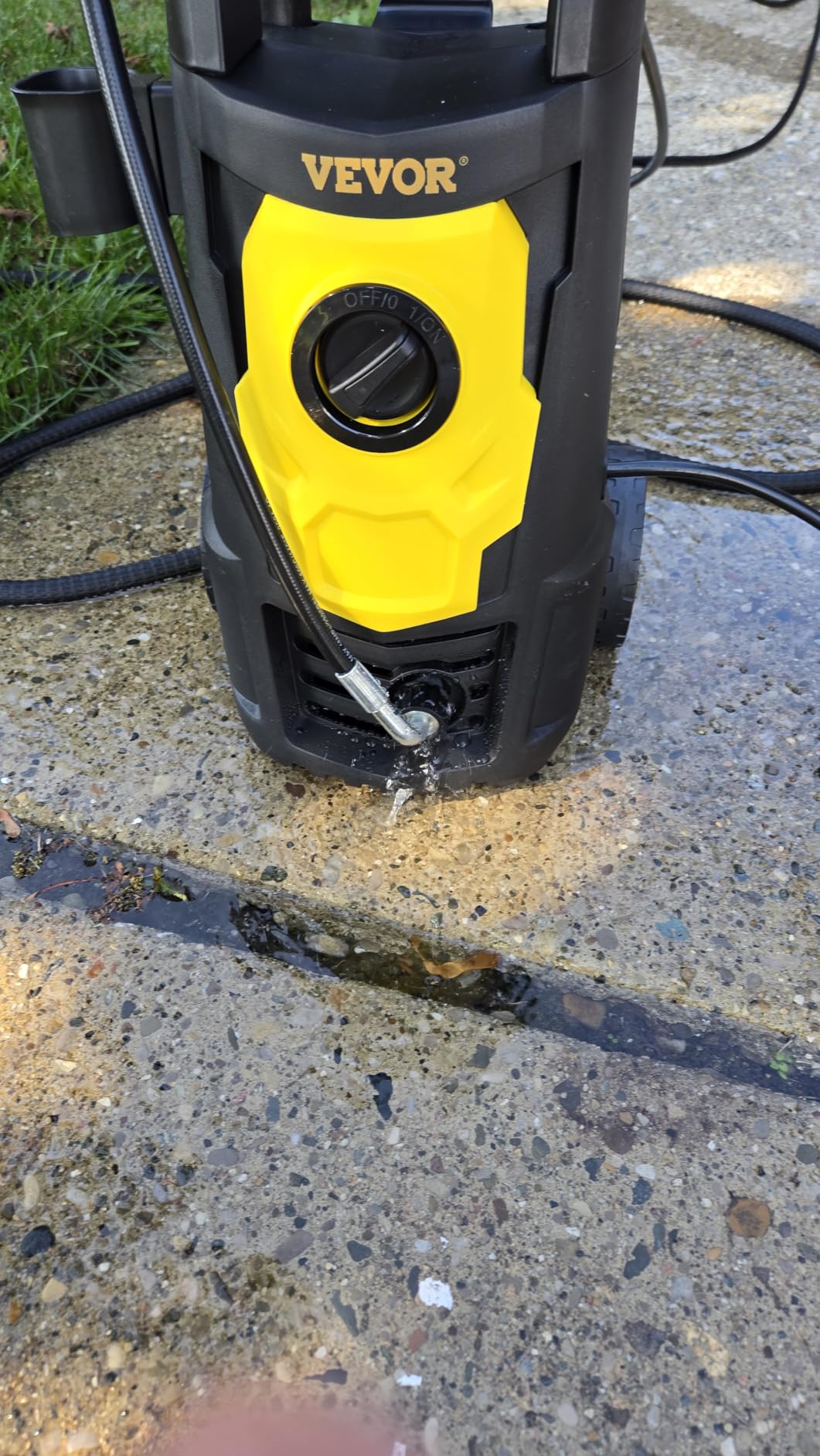
Owners highlight the flow rate, the hose reel and the number of accessories included for the money. The metal water inlet and outlet fittings are designed to resist leaking at the joints, where cheaper machines tend to weep, and an inlet filter protects the nozzle from blockage. It is ETL certified and the manufacturer advises against runs longer than three hours.
Is it a reasonable deck washer for a once-a-year clean?
For a once or twice yearly clean of a modest deck, yes. 2000 PSI with a 40 degree tip, plus the included foam cannon for detergent and dwell time, covers the job. The three-hour ceiling on continuous run time is not a problem for deck work, it is a problem for washing an entire property in one go.
It is the model to consider if you wash once a year, store it between jobs and want the accessories to come in the box.
Where it falls short
The compact PP plastic body is the main durability concern, and there are far fewer reviews behind it than the established brands. The listed weight of 98 grams is not credible, so judge the heft in store if that matters to you. A 500 ml detergent bottle is small, so you will be refilling it mid-deck.
10. DeWalt 3300 PSI Gas Pressure Washer for Whole-Property Cleaning
DeWalt 3300 PSI Gas Pressure Washer, 2.4 GPM, Residential Model DXPW3300-S
- Longest warranty in the group at 5 year frame and 3 year pump
- 3300 PSI at 2.4 GPM
- 208cc DeWalt engine starts easily
- Welded powder-coated steel frame
- 25 ft abrasion-resistant hose with five nozzles
- Heaviest unit here at 64 pounds
- Gas upkeep for oil fuel and spark plugs
- 49-state compliant rather than California rated
- Overkill for a small deck
Warranty length is the signal experienced owners watch, and this one leads the group. The frame is covered for 5 years, the pump for 3 and the engine for 2. The 208cc DeWalt engine is easy to start, the welded powder-coated steel frame is built to be moved, and the 10 inch pneumatic tires handle uneven ground.
Output is 3300 PSI at 2.4 GPM, which is 7920 cleaning units. That is serious power, and it is the right number for a driveway, a paver patio, siding and paint preparation, not for boards on their own.
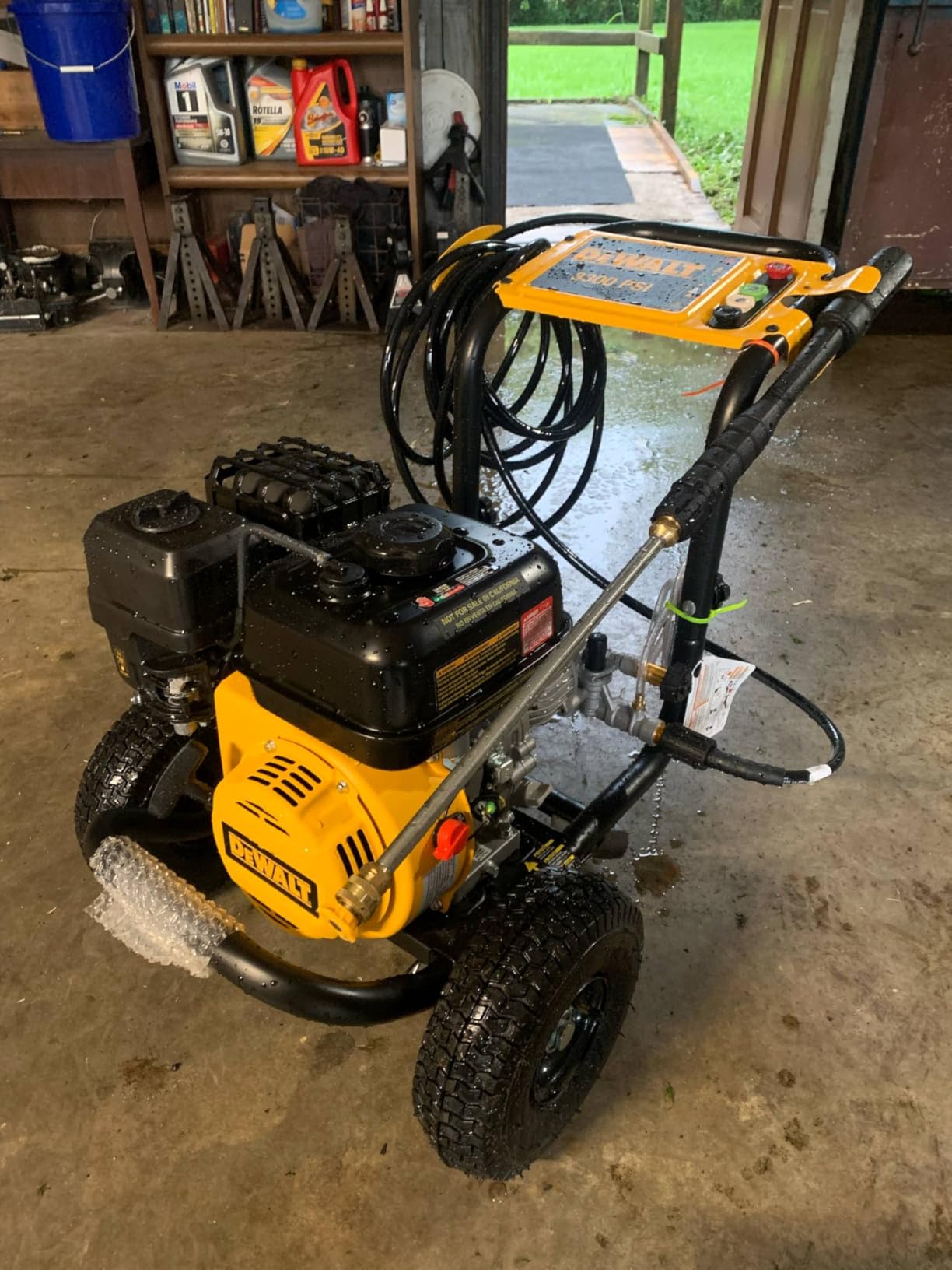
Five quick-connect nozzles cover 0, 15, 25, 40 and soap degrees, so the deck-appropriate tips are in the box, and the ergonomic spray gun comes with a 16 inch steel wand. The 25 foot abrasion-resistant hose resists the dragging that wrecks ordinary hoses. Buyers put the warranty first in their reviews, which is exactly what they should do.
Who is this machine actually for?
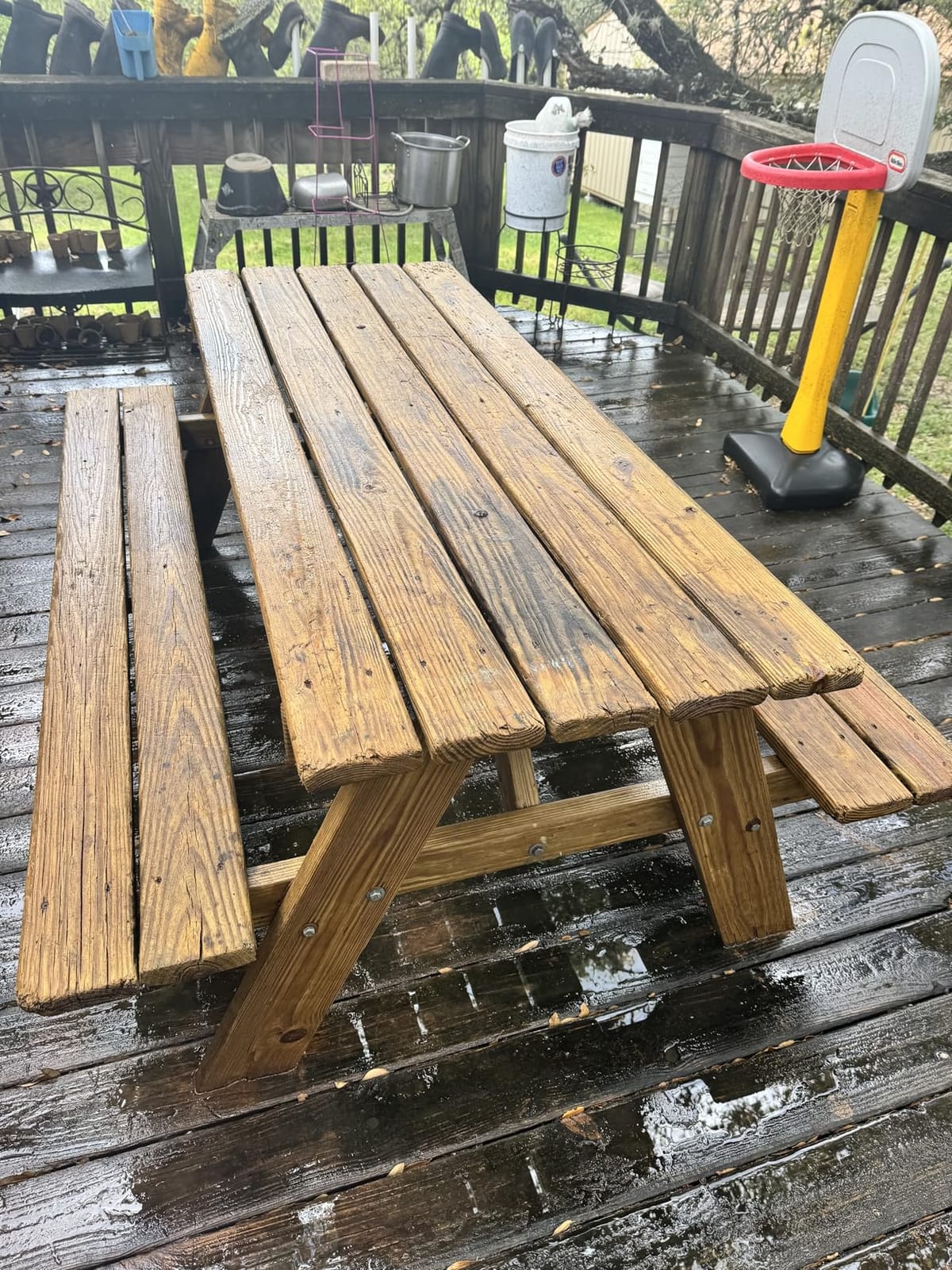
Someone who cleans a whole property, not just a deck. A house with a paver patio, a concrete driveway, a long fence line and a deck all in the same maintenance rotation. On decking, run the 25 or 40 degree tip and stay back; the extra pressure is there for everything around the boards.
If your washing is a weekend every spring, the coverage is real peace of mind for a machine you will own for years.
Where it falls short
At 64 pounds it is the heaviest machine here, and gas means oil changes, fuel and a spark plug. It is 49-state compliant rather than rated to California emissions standards, and some owners note a residual fuel odour from factory testing. For a small deck, it is plainly more than the job requires. Our guides to the best commercial pressure washers and best pressure washers for cars cover the lighter end of that range.
Electric or Gas for a Deck?
Electric wins for most decks. The machines are quieter, lighter, cheaper to run and capped in a pressure range where a mistake is recoverable, and none of the top three picks here needs a fuel can. Gas earns its place only when the deck is attached to concrete or pavers, or when the same machine also cleans trucks, driveways and siding.
For a small or mid-size wood deck cleaned once or twice a year, an electric unit in the 1,700 to 2,500 PSI range with a 25 or 40 degree tip is the correct answer. For a large property where the deck is one item on a list, a gas unit in the 3,300 to 3,400 PSI class with about 2.5 GPM will save hours, and the deck is the easy part of the day.
The mistake owners describe most often is buying 3,000 to 4,000 PSI for a small deck and then being afraid to use it. Match the machine to the surface, not to the ambition.
How to Pressure Wash a Deck Without Gouging It
The machine is half the job. The other half is technique, and technique is where decks get ruined.
1. Sweep and clear the deck. Pull leaves, needles and grit out of the board gaps, because debris under a high-pressure stream scratches the surface.
2. Test an inconspicuous spot with a 40 degree tip from 18 inches, angled at 45 degrees. Check it when dry, not wet, because fuzzing only shows once the board dries.
3. Apply a deck cleaner or an oxygenated bleach solution with the foam cannon. Let it dwell for 5 to 10 minutes. Do not let it dry on the boards.
4. Rinse with the widest tip you have, starting at the highest point of the deck and working down so dirty water runs off rather than back over clean boards.
5. Keep the wand moving at a steady pace along the grain. Never park the stream on one spot.
6. Hold the wand at 45 degrees rather than straight down. A 90 degree angle concentrates force into the grain and is the main cause of gouging.
7. Control the runoff. Block deck drains, protect a pool skimmer and keep the discharge off adjacent planting.
8. Let the deck dry fully before deciding it is not clean. Wet wood hides fuzzing and looks dirtier than it is.
What to Do After the Wash
Wood raised grain, or furring, is normal after any wash. Once the deck is dry, knock it back with a light pass of 80 to 120 grit sandpaper along the grain, which is faster than picking out every fibre by hand. Do not seal a deck while it is still damp. Most guidance is to allow 24 to 36 hours of dry time, longer in humid weather, before applying a sealer or stain.
On composite, check your warranty before sealing. Many composite manufacturers do not recommend sealing or pressure washing at all, and applying a film-forming sealer can trap moisture or change the appearance of the boards.
Buying Guide: What Actually Matters on a Deck
PSI sets the ceiling, GPM sets the pace, and cleaning units combine the two. Most machines here land between 2040 and 5280 CU for electric, with the gas units above 7900 CU. The machine that feels slow on a large deck is usually low on flow, not pressure.
Adjustable pressure at the trigger is the single most important deck-safety feature, and almost no competitor roundup lists it as a criterion. A trigger that throttles down lets you feather the spray instead of switching tips constantly.
Wide fan tips matter more than the tip count. A 25 and a 40 degree tip do nearly all the deck work; the red 0 degree is for concrete and stripping, and the 65 degree black is for soap only.
Detergent and dwell time beat pressure on wood. A deck cleaner given 5 to 10 minutes to work does more for grey wood than twice the PSI, and it does it without raising the grain. A foam cannon and an onboard soap tank make that step easy.
Total Stop System or auto start and stop extends pump and motor life, and every machine in this roundup has it in some form. Pump type separates the tiers: axial cam and triplex plunger pumps are the durable options, and axial three-piston units appear on several of the electric machines here.
Finally, consider renting. If you need the washer for one weekend every two years, a rental deck machine covers it without a storage space or a service schedule. Our guide to the best commercial pressure washers covers the higher-output tier for anyone cleaning decks as part of paid work.
Frequently Asked Questions
What PSI pressure washer do you need for a deck?
For a typical residential wood deck, about 1,700 to 2,000 PSI of machine capacity used with a 25 or 40 degree fan tip is the sweet spot. Composite decking handles roughly 1,500 to 2,500 PSI, while concrete and paver patios can take 2,500 PSI and above. What matters more than the machine rating is the tip, your distance from the boards and a 45 degree wand angle.
Is 3000 PSI too much for a deck?
On its maximum setting, yes, a 3,000 PSI machine is more than wood needs. Used correctly with a wide 25 or 40 degree tip, held back and angled, the effective pressure at the boards drops into a safe range. High-output machines are worth having when you also clean concrete, driveways and siding, but they are not required for boards alone.
How much PSI do you need to strip a deck?
Stripping old sealer or stain is the one job that genuinely needs the top end of the range, closer to 2,500 to 3,000 PSI with a narrow 15 degree tip worked slowly. Even then, several short passes beat one heavy pass. A deck brightener or stripper applied first will do much of the work for you at a fraction of the risk to the grain.
What is the best electric pressure washer for cleaning a deck?
Among the machines reviewed, the Westinghouse ePX3500 stands out for deck work: 2500 max PSI, 1.76 max GPM, a 19 pound body, a 25 degree fan tip in the box and a three-year warranty. The Westinghouse ePX3100v is the lighter, quieter pick for small decks, and the LWQ 2030 PSI unit leads on flow at 2.5 GPM if your deck is large.
Can you pressure wash a composite deck?
Yes, composite decking such as Trex or TimberTech can be pressure washed, typically at 1,500 to 2,500 PSI with a 25 or 40 degree tip. Many composite manufacturers warn against pressure washing or sealing and some tie it to warranty coverage, so read your warranty language before you start. Never sit the stream on one board and always work along the length of the boards.
Do you need a surface cleaner attachment for a deck?
Not for most decks. A surface cleaner is designed to keep even pressure across a flat surface, which helps on large concrete and paver patios, but on decking its fixed height makes it harder to follow uneven boards and gaps. Use a wide fan tip on a wand instead, and reserve a surface cleaner for the hardscape around the deck.
Final Verdict
The Westinghouse ePX3500 is our pick for the best pressure washers for decks. It has enough pressure to handle composite and grime, a wide-enough tip range to stay gentle on wood, a chassis that will not tip on an uneven deck, and the longest warranty in the electric group. If your deck is small, take the ePX3100v instead, and if it is large, the LWQ 2030 PSI unit buys you the flow that makes the job finish in one session.
Whatever you choose in 2026, buy for control rather than power. Detergent with dwell time, a 40 or 25 degree fan tip, a 45 degree wand angle and patience will keep the boards looking new far longer than raw PSI ever will.